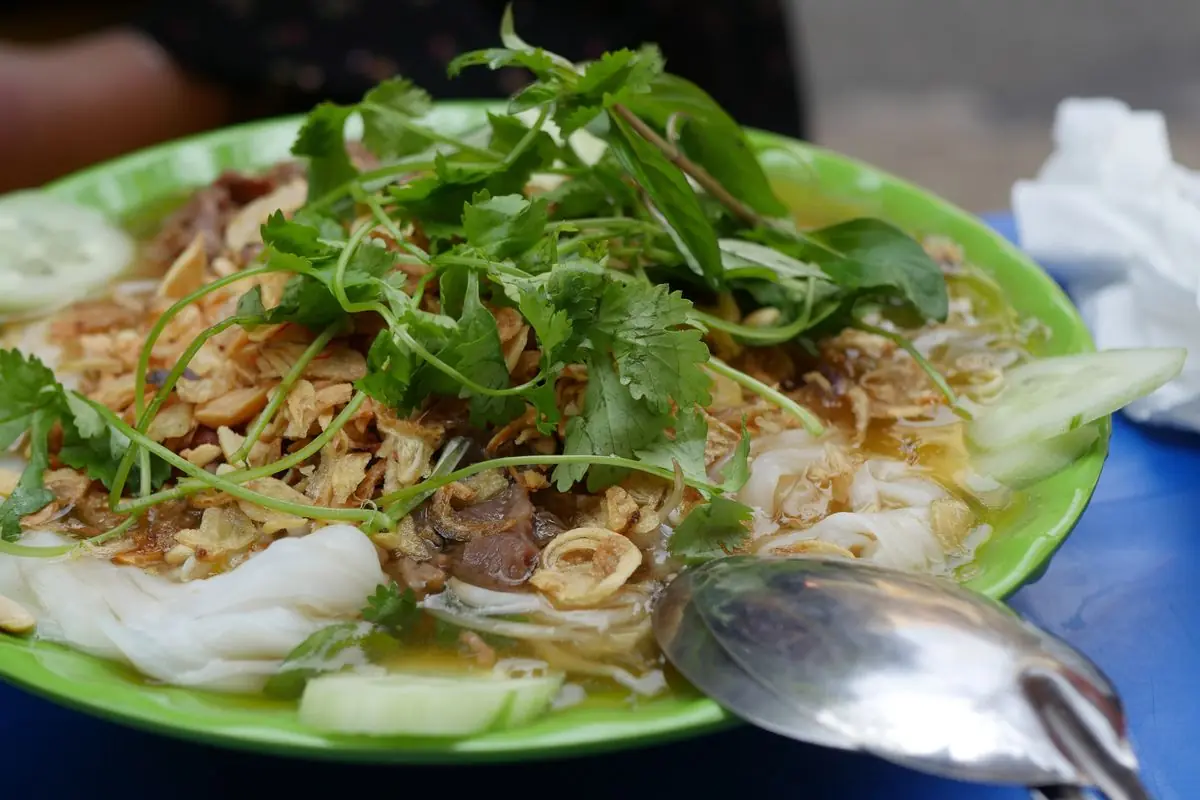
Hai Phong crab spring rolls: order one square roll or a bun cha set?
A whole crab spring roll, fried to order, gives you the full seafood filling and a crisp, golden wrapper. For a lighter breakfast or a day of exploring Hai Phong's food scene, a bowl of bun cha with a smaller portion of crab spring roll may be a better fit.
 17 min read

Golden nem cua be cut into pieces on a bamboo tray with vermicelli, greens, lime, cucumber and a bowl of dipping sauce.
A Hai Phong crab spring roll is usually cut into four pieces before it reaches your table, but the price is for the entire roll. It’s an easy detail to miss, especially when each large, square roll can weigh nearly 200 grams before frying. A first try needs only one roll, some rice vermicelli, and a handful of fresh herbs.
What are Hai Phong crab spring rolls?
Known locally as nem cua bể, nem vuông, or nem vuông cua bể, these square crab spring rolls are one of Hai Phong’s best-loved specialties. They have a crisp, golden wrapper made from Vietnamese rice paper, filled with a savory mixture of sea crab, shrimp, pork, glass noodles, mushrooms, and vegetables.
Their shape is the first thing that catches your eye. Unlike the long, cylindrical fried spring rolls commonly found across Vietnam, Hai Phong’s version is folded into a thick square, roughly the size of an adult’s palm. From the outside, it almost resembles a small savory pastry, but cutting through the crust reveals a generous seafood filling.
Crab meat gives the dish its distinctive flavor. Traditional makers often use fresh sea crabs, steaming or boiling them just until cooked before carefully removing the meat by hand. Crabs may come from coastal areas around Hai Phong, including Do Son, Cat Ba, Trang Cat, and neighboring fishing grounds.
Some cooks particularly favor female crabs with roe, which add extra richness to the filling. Even so, the type of crab and amount of crab meat vary between establishments.
You’ll also find restaurants using fresh swimming crab, known locally as ghẹ, instead of other types of sea crab. That’s one reason two dishes both called nem cua bể can taste surprisingly different.
What’s inside a Hai Phong crab spring roll?
The filling: crab, shrimp, pork, and vegetables
A traditional Hai Phong crab spring roll usually contains:
- Fresh sea crab meat, steamed or boiled and carefully picked from the shell.
- Peeled shrimp, chopped or left in small pieces.
- Ground lean pork, adding richness and helping bind the filling.
- Glass noodles, cut into short lengths.
- Shiitake mushrooms and wood ear mushrooms.
- Bean sprouts, eggs, and black pepper.
- Kohlrabi, carrots, or other vegetables, depending on the recipe.
When you cut one open, you’ll notice strands of glass noodles mixed with white crab meat, shrimp, and dark pieces of wood ear mushroom. The filling isn’t blended into a smooth paste. Instead, you can still distinguish the softness of the seafood, the slightly chewy noodles, and the pleasantly crunchy mushrooms.
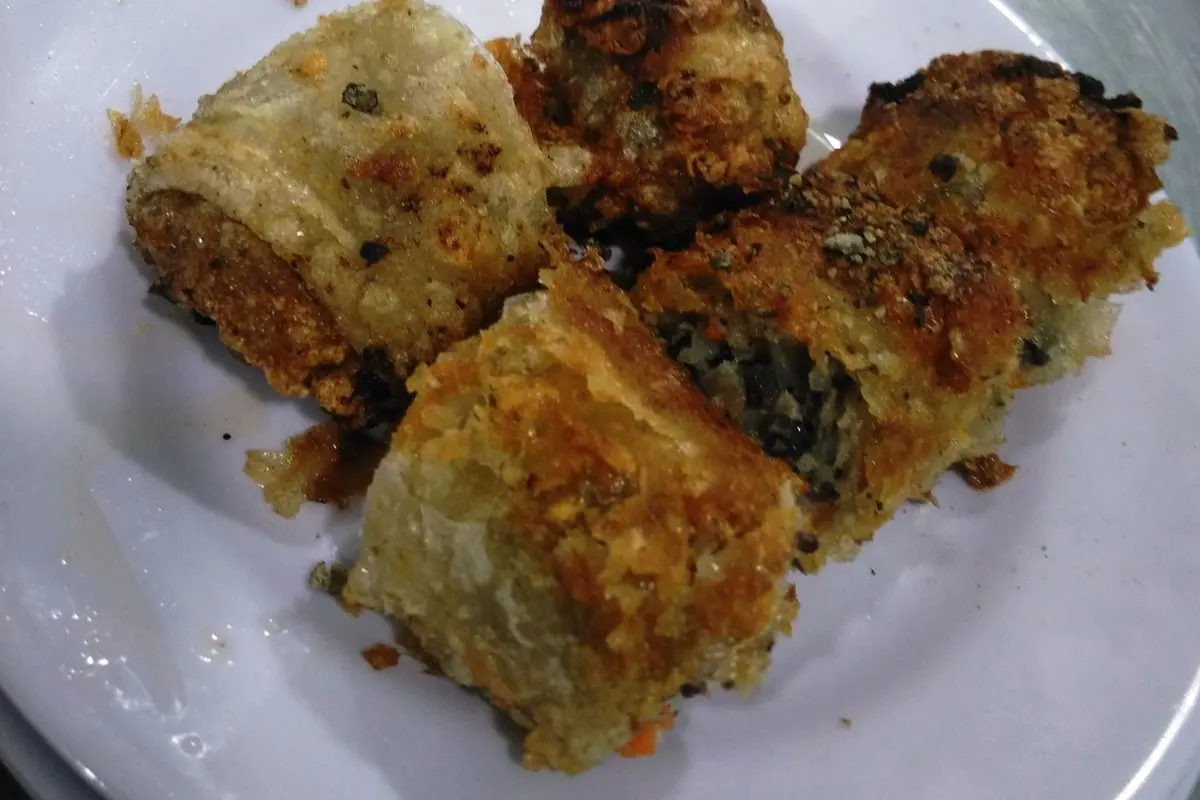
In rolls with visible pieces of crab, a slower bite brings out the crab’s own sweetness over the seasoned ground meat.
At some long-established eateries, the ingredients are prepared separately and arranged in layers before wrapping. This helps limit excess moisture, protects the delicate wrapper, and allows the roll to hold its square shape during frying.
Why are Hai Phong crab spring rolls square?
The wrapper is generally made from thin Vietnamese spring roll sheets, sometimes using freshly handmade rice paper.
These sheets are flexible enough to surround a fairly generous portion of filling without tearing. Once fried, they develop a crisp surface with multiple folded layers.
Some restaurants use two layers of rice paper for each roll. Thuan Yen, for example, has traditionally used handmade wrappers from Hang Kenh, an area of Hai Phong known for its rice paper production.
The square folds create four corners and several especially crispy edges. Combined with careful filling preparation and frying, this shape helps the roll maintain its texture despite being considerably thicker than an ordinary spring roll.
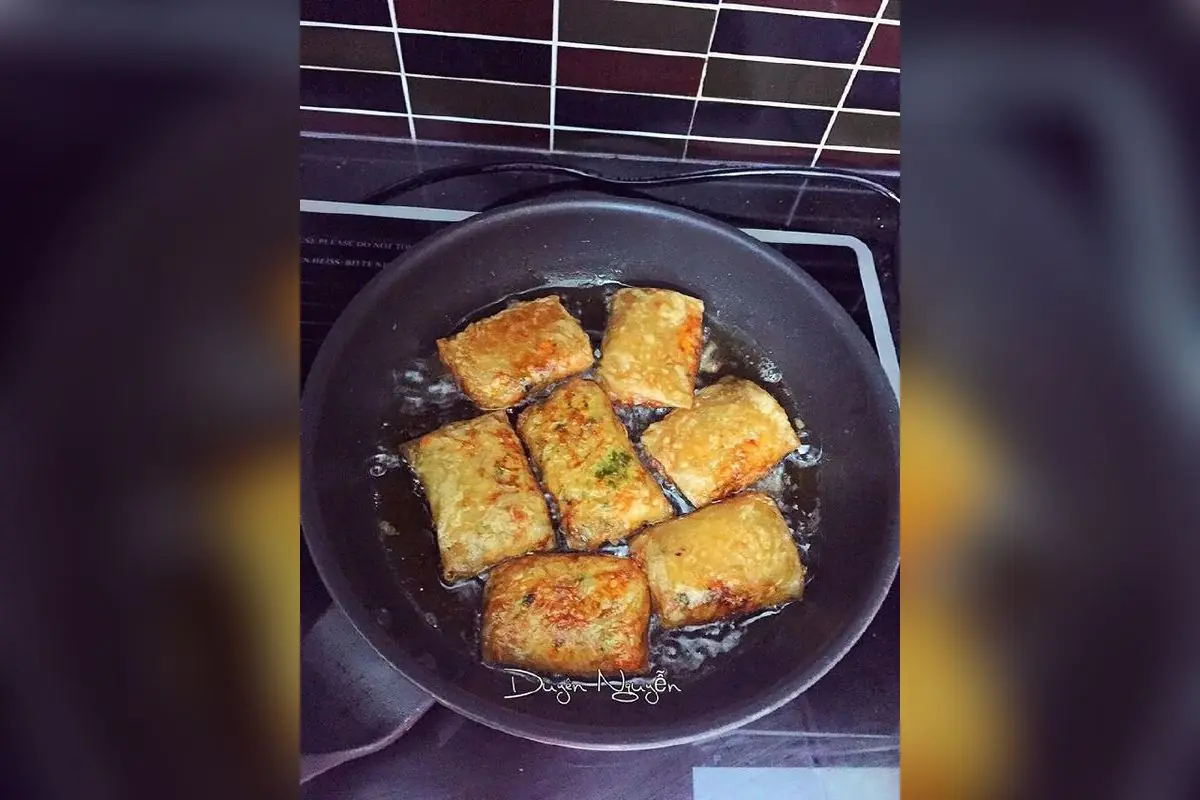
Crab spring rolls can also be wrapped into long cylinders, but the square version is by far the most recognizable in Hai Phong.
How are Hai Phong crab spring rolls different from Hanoi spring rolls?
Hai Phong’s large square version and the Vietnamese fried spring rolls, or nem rán, that many visitors already know are both fried spring rolls. Their fillings, sizes, and serving styles differ.
| Feature | Hai Phong Crab Spring Rolls | Hanoi Fried Spring Rolls |
|---|---|---|
| Shape | Usually thick and square | Usually long and cylindrical |
| Size | Large, roughly palm-sized | Generally smaller and slimmer |
| Main filling | Sea crab or swimming crab, shrimp, and pork | Usually pork, glass noodles, mushrooms, and vegetables; sometimes shrimp |
| Wrapper | Some restaurants use two layers | Usually one layer of spring roll wrapper |
| Serving style | Commonly cut into four pieces | Served whole or cut into shorter pieces |
| Accompaniments | Rice vermicelli, fresh herbs, dipping sauce | Rice vermicelli, herbs, or rice |
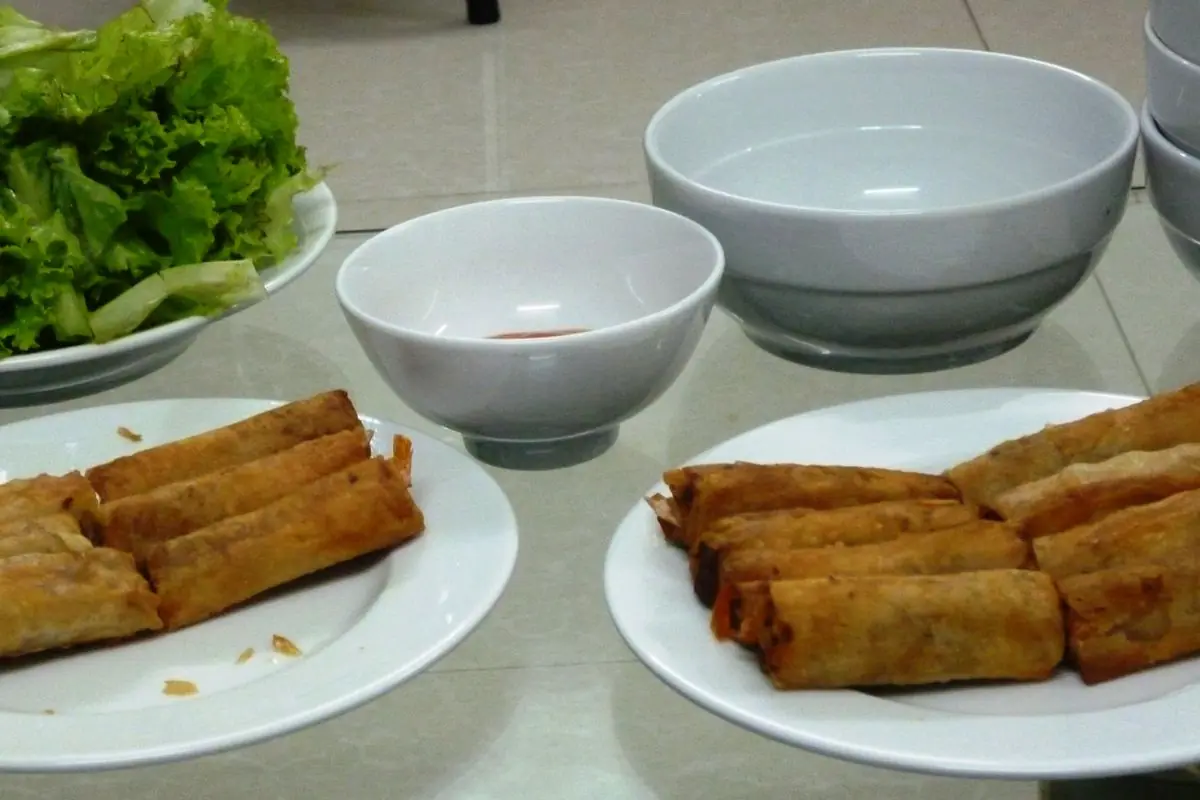
The crab is where they part ways: it’s optional in Hanoi-style fried spring rolls, while sea crab or swimming crab is the defining ingredient in Hai Phong’s nem cua bể.
The larger square rolls need more careful frying so the filling cooks through without burning the outside.
What do you eat with Hai Phong crab spring rolls?
A typical serving includes freshly fried crab spring rolls, rice vermicelli, fresh herbs, and a bowl of sweet-and-sour fish sauce.
The cook usually cuts each square roll into four large pieces with scissors, revealing the crab, shrimp, mushrooms, and noodles inside. The pieces may be served on their own plate or alongside the vermicelli, depending on the restaurant.
The herb plate usually holds lettuce, Vietnamese perilla, coriander, Vietnamese balm or other local herbs, and sometimes sliced cucumber.
The dipping sauce deserves just as much attention as the roll itself.
It’s usually a mixture of fish sauce, sugar, vinegar or lime juice, garlic, and chili, creating a balance of salty, sweet, and sour flavors. Thinly sliced green papaya, carrots, or cucumber may be added for extra crunch.
To eat it the local way, pick up a little vermicelli and some herbs, add a piece of crab spring roll, and dip it into the sauce.
The noodles and vegetables balance the richness of the seafood filling.
Take the first bite of spring roll on its own, without sauce, and the crisp wrapper stands apart from the sweet, savory filling.
Every restaurant has its own dipping sauce recipe, and some versions are sweeter or spicier than others. For a milder meal, simply ask:
"Cho mình để ớt riêng nhé." - Please put the chili on the side.
Bun cha with crab spring rolls: a local Hai Phong breakfast
Crab spring rolls are also served at bún chả restaurants, many of which open early in the morning.
Here diners eat them with grilled pork, rice vermicelli, fresh herbs, and dipping sauce.
A typical meal includes soft rice noodles, smoky grilled pork, crisp crab spring rolls, a plate of greens, and a bowl of sweet-and-sour fish sauce.
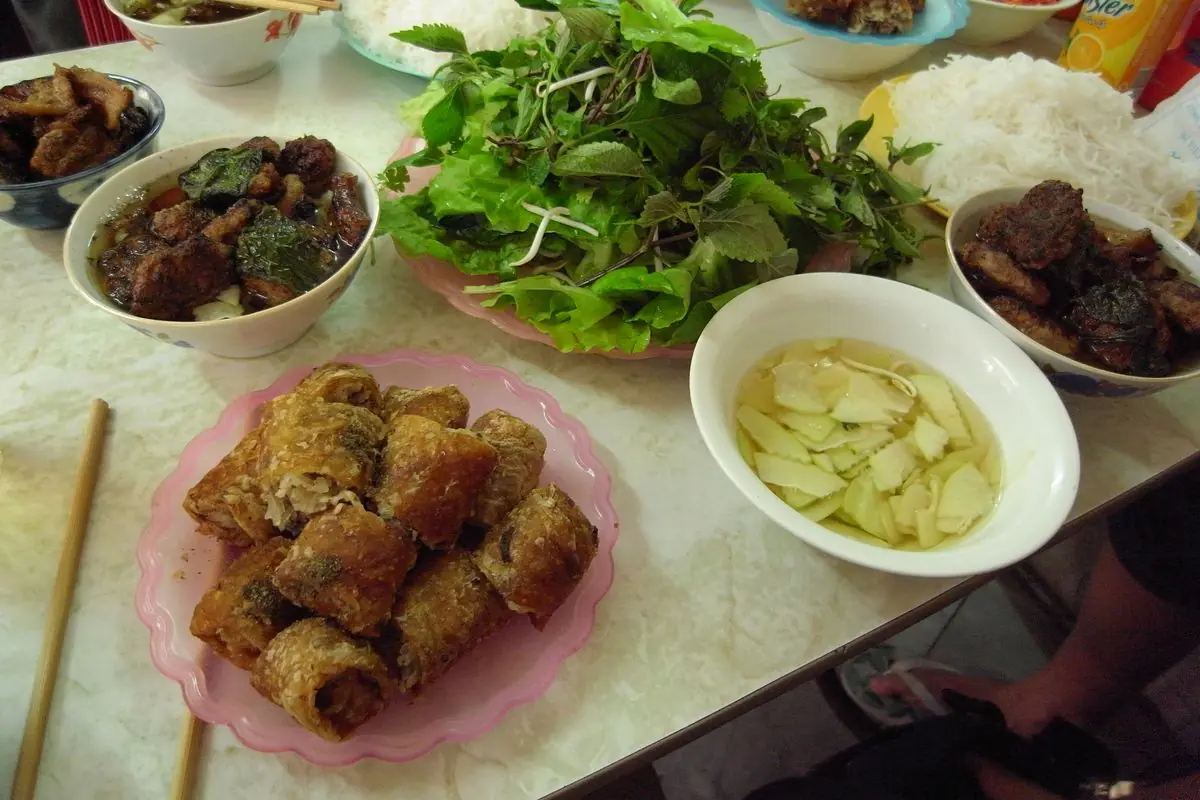
The lightly charred pork adds a different kind of richness, while the fried crab roll brings crunch and a seafood flavor.
Check before ordering: each restaurant serves bun cha with crab spring rolls its own way.
This combination suits a late breakfast or lunch. Doors open around 6-7 a.m. at some restaurants, though the busiest period is often between 11 a.m. and 2 p.m.
How much do Hai Phong crab spring rolls cost in 2026?
The price depends on the size, seafood content, and whether the restaurant charges by individual roll or complete meal.
Large square rolls made with fresh crab are generally more expensive than smaller spring rolls served alongside bun cha.
Approximate prices for 2026:
| Dish | Approximate Price |
|---|---|
| One large square crab spring roll | VND 70,000-80,000 |
| A regular serving of bun cha | VND 35,000-60,000 |
| Bun cha with one whole large crab spring roll | Often VND 100,000 or more, depending on the restaurant |
| Smaller rolls or extra spring roll portions | Prices vary by restaurant |
At Thuan Yen, a large roll went for around VND 70,000-80,000 in 2026.
Smaller eateries and market stalls sometimes sell different-sized rolls at lower prices.
Treat these as ballpark figures; each restaurant’s menu may differ a little.
How many crab spring rolls should one person order?
For a first-time visitor, one large square roll cut into four pieces, with vermicelli and herbs, is usually enough for a satisfying meal.
People with bigger appetites may order more. Regular customers sometimes eat two or even three rolls, although the generous pork and seafood filling makes them quite substantial.
Two people exploring Hai Phong’s street food should order one roll to share first. That leaves room for other local favorites later.
A group of four could start with two large rolls, cut into eight pieces, before deciding whether to order more.
Where to eat the best crab spring rolls in Hai Phong
Thuan Yen Crab Spring Rolls
88 Tran Nhat Duat Street
Thuan Yen is one of Hai Phong’s best-known long-established crab spring roll restaurants.
- Address: 88 Tran Nhat Duat Street, Co Dao Market area, Hai Phong.
- Opening hours: Approximately 6 a.m.-7 p.m.
- Estimated price: VND 70,000-80,000 per large roll.
- Best for: Traditional square crab spring rolls freshly fried to order.
The restaurant was founded by Mrs. Yen around the early 1980s. By 2023, it had been operating for almost 40 years, with her daughter, Nguyen Thi Hai My, continuing the family business.
Thuan Yen is located in the Co Dao Market area, approximately 800 meters from Hai Phong Railway Station and around 500 meters from the city’s Opera House.
The restaurant has an air-conditioned dining area that has previously been described as seating around 50 guests.
Its crab spring rolls are known for using fresh local crab, handmade spring roll wrappers from Hang Kenh, and dipping sauce prepared with traditional Cat Hai fish sauce.
The filling is made by hand, with carefully picked crab meat combined with shrimp, pork, glass noodles, mushrooms, and bean sprouts.
The rolls are usually fried only after customers order. A batch can take around 10-15 minutes, so expect a longer wait during busy lunchtime periods.
Closing time isn’t fixed and falls somewhere between 6 p.m. and 8 p.m., so confirm before an evening visit.
Nga Quan
92 Tran Nhat Duat Street
Just a few doors away from Thuan Yen, Nga Quan is another familiar name in the Co Dao Market area.
- Address: 92 Tran Nhat Duat Street, Hai Phong.
- Opening hours: Approximately 7 a.m.-8 p.m., sometimes later.
- Best for: Crab spring rolls with rice vermicelli, fresh vegetables, and grilled pork.
Nga Quan offers a casual, local dining experience, focusing on crab spring rolls and traditional accompaniments.
Its rolls are often described as having a generous filling and crispy exterior, especially enjoyable with the restaurant’s sweet-and-sour dipping sauce.
The dining space is relatively compact, and the surrounding market area can get lively during peak hours.
It’s an easy stop for visitors exploring central Hai Phong on foot, particularly around the railway station and nearby streets.
Phuong Mai Bun Cha
87 Cat Cut Street
Phuong Mai is a good choice for anyone who wants to try both grilled pork vermicelli and crab spring rolls in the same meal.
- Address: 87 Cat Cut Street, Hai Phong.
- Opening hours: Approximately 7 a.m.-10 p.m.
- Price: Ask for the current menu, as bun cha, crab rolls, and extras may be charged separately.
- Best for: Groups, families, and visitors interested in bun cha with crab spring rolls.
The restaurant has more than four decades of history and is associated with traditional family recipes for bun cha and crab spring rolls.
Its large square rolls are particularly known for fillings that may include fresh swimming crab.
Many diners order the rolls with grilled pork and vermicelli as a full meal.
It also has a more spacious dining area than many small market stalls, which can be convenient for groups.
Because the final bill depends on how many rolls, portions of grilled pork, and extra dishes you order, ask for the total before confirming.
Other streets and markets for crab spring rolls
Beyond these three restaurants, several parts of Hai Phong are worth exploring:
- 323 To Hieu Street: A well-known address for bun cha with crab spring rolls, but ask ahead whether it’s still serving.
- Cau Dat Street: An area with long-established local eateries, some serving traditional Hai Phong dishes.
- Cat Bi Market: A popular food market with a variety of affordable local specialties.
- Cat Cut Street, To Hieu Street, and Co Dao Market: Convenient areas to look for both individual crab spring rolls and bun cha combinations.
Market stalls often offer lower prices than full-service restaurants, but their spring rolls may differ in size and crab content.
Compare the actual rolls, not just the menu prices.
How to order Hai Phong crab spring rolls without confusing portions
In Hai Phong, crab spring rolls may be sold individually or as part of a meal.
Say how many rolls you want and ask whether vermicelli and vegetables are included.
| What You Want | What to Say |
|---|---|
| One large crab spring roll | "Cho mình một cái nem cua bể." |
| Two crab spring rolls | "Cho mình hai cái nem cua bể." |
| Bun cha with crab spring rolls | "Cho mình một suất bún chả nem." |
| Vermicelli and crab rolls without grilled pork | "Cho mình một suất bún nem, không lấy chả." |
| Ask how the price is calculated | "Nem này tính theo cái hay theo suất ạ?" |
| Have the roll cut into four | "Cắt nem thành bốn miếng giúp mình nhé." |
| Order takeaway | "Cho mình hai cái nem mang về, để nước chấm riêng." |
To international visitors, the dish can be described as Hai Phong-style square crab spring rolls.
Pointing to a picture or menu item while saying "One large crab spring roll, please" is often enough to make your order clear.
Ordering a set meal? Confirm whether the price includes an entire crab spring roll or just a smaller portion, and whether rice vermicelli and grilled pork are included.
Buying Hai Phong crab spring rolls to take home
Fried crab spring rolls: best eaten the same day
Many established restaurants sell freshly fried crab spring rolls for takeaway.
The rolls are usually drained of excess oil, placed on absorbent paper, and packed in a takeaway container. Dipping sauce and vegetables are best kept in separate packages.
As fried rolls sit in a closed container, steam and moisture from the filling gradually soften the crispy rice paper. Even a carefully prepared roll won’t have quite the same crunch after several hours.
Fried crab spring rolls are best bought for eating shortly afterward, not for a long journey.
Cooked spring rolls should not sit at room temperature for more than two hours, or more than one hour when the surrounding temperature exceeds approximately 32°C (90°F).
On longer journeys, cool the food promptly and keep it refrigerated.
Frozen uncooked rolls: better for cooking at home
Some Hai Phong producers also sell uncooked crab spring rolls that have been individually wrapped, packaged, and frozen.
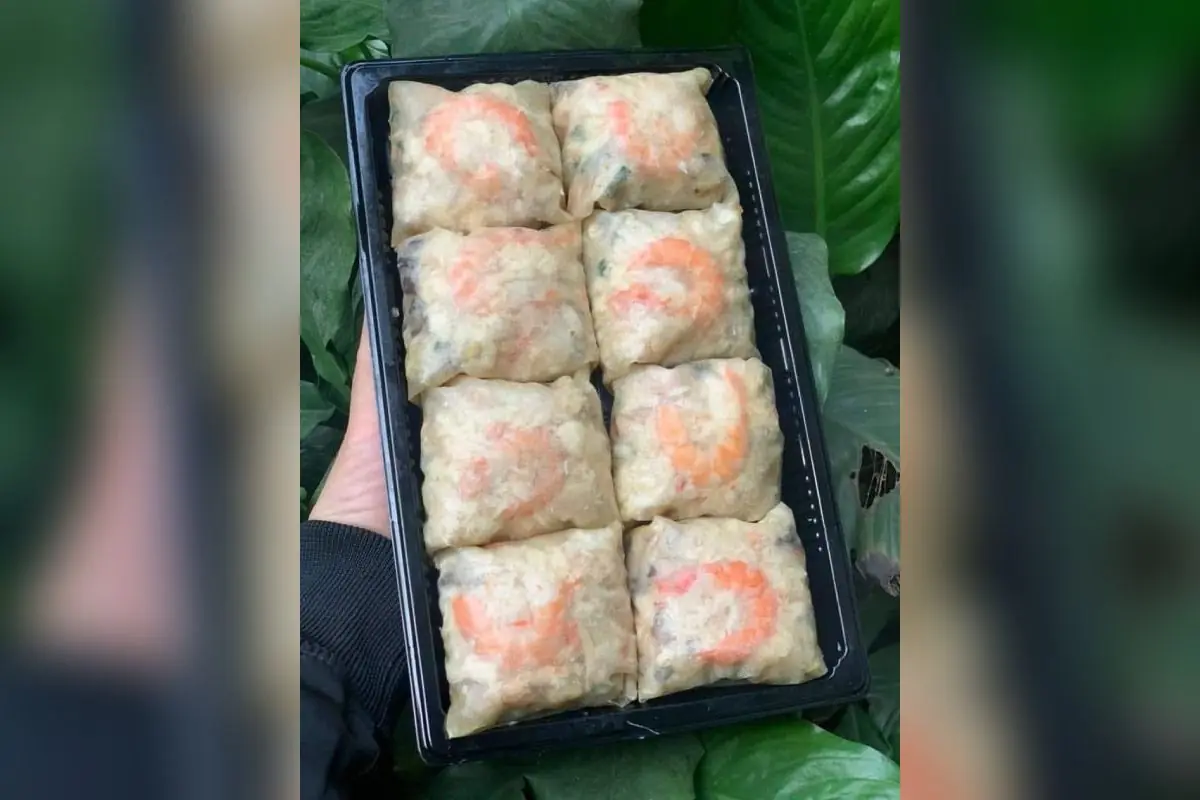
These are useful for visitors buying several boxes or hoping to enjoy the dish after returning home.
When prepared correctly, freshly frying uncooked frozen rolls generally produces a better crust than reheating rolls that were already fried.
Before purchasing, ask the seller:
- Are the rolls fully frozen or simply chilled?
- How many rolls are in each box, and how much does each one weigh?
- What storage temperature and expiry date are printed on the label?
- Should the rolls be thawed before frying or cooked directly from frozen?
- Can the producer provide suitable insulated packaging for a longer journey?
Shelf life on frozen roll labels runs from approximately two months at some producers to up to six months from the production date at others.
Go by the date and instructions on the package you buy.
Frozen rolls should generally remain at around -18°C (0°F), unless the packaging specifies otherwise. Once thawed, handle them according to the producer’s instructions and never leave them sitting at room temperature for hours.
How to fry frozen crab spring rolls
Use enough oil to cover the rolls or cook all sides evenly, over moderate heat.
Turn the rolls carefully as they cook.
Some producers suggest frying for around 10 minutes, but the actual cooking time depends on the size of the rolls, whether they are frozen, and the oil temperature.
The filling must be thoroughly cooked all the way to the center, particularly because it contains pork. The wrapper can turn golden before the center is done.
Contacting the restaurant at least a day in advance for larger takeaway orders gives them time to prepare and pack the rolls.
Can you bring Hai Phong crab spring rolls on a plane?
Crab spring rolls may be carried on some domestic flights within Vietnam, provided they meet the airline’s baggage, food safety, and packaging requirements.
International flights are more complicated because the destination country’s food import and quarantine regulations also apply.
Domestic flights: packaging matters
Vietnam Airlines generally permits ordinary food items within the applicable baggage weight, size, and piece limits, although strong-smelling products are subject to additional restrictions.
To pack crab spring rolls for a flight:
- Place the rolls in sturdy, food-safe containers to prevent crushing.
- Wrap the containers in leak-resistant bags and protective packaging.
- For frozen rolls, use an insulated container and an airline-approved cooling method that maintains a safe storage temperature.
- Pack dipping sauce separately in tightly sealed containers.
- Confirm the airline’s rules for perishable food and cooling materials before departure.
Vietnam Airlines has specific restrictions on fish sauce and other strong-smelling liquids, including a maximum allowance of 3 liters or 3 kilograms per passenger under its applicable policy.
Plastic bottles must be tightly sealed, taped, and packed in a secure foam container as required by the airline.
The carrier recommends placing strong-smelling items in checked baggage and does not accept such items on ATR72-operated flights.
Vietjet’s conditions of carriage also address the transportation of fresh or frozen meat and seafood, subject to appropriate leakproof packaging, inspection, and airline acceptance.
The airline may refuse packages that do not meet its requirements.
Crab spring rolls contain several perishable ingredients, so the rules for dry snacks don’t cover them; check with your operating airline.
International flights: can you bring crab spring rolls overseas?
An airline accepting food on board says nothing about whether another country will let it in.
Crab spring rolls commonly contain pork, crab, shrimp, and eggs. These ingredients may be regulated as animal products even when fully cooked or frozen.
Rules at some popular destinations:
| Destination | Important Restrictions |
|---|---|
| United States | Many pork products from regions affected by animal diseases are prohibited or restricted, including processed and frozen foods. Animal products must be declared. |
| European Union | Travelers arriving from outside the EU generally cannot bring meat or meat products in personal baggage. |
| United Kingdom | Meat and meat products from Vietnam are generally prohibited in ordinary personal food imports. |
| Australia | Food subject to biosecurity controls must be declared, and meat products face strict import restrictions. |
| South Korea | Meat, eggs, and other animal products must be declared and may require valid quarantine documentation. Violations can result in penalties. |
| China and Thailand | Check the destination’s current animal-product import requirements before traveling. |
For travelers returning to the United States, Europe, or Australia, fried or frozen crab spring rolls are unlikely to make it past the border: the pork alone may place the product in a restricted or prohibited category.
Dipping sauce is also subject to international aviation security rules. Carry-on liquids are commonly limited to containers of no more than 100 ml, packed within the applicable one-liter liquid allowance.
Before purchasing food to take overseas, check the destination country’s customs and animal quarantine regulations.
Where declarations are required, declare the food honestly, even when carrying only a small amount.
How long do Hai Phong crab spring rolls last?
Storage time depends on whether the rolls are cooked or uncooked and how consistently they have been kept at a safe temperature.
| Type of Spring Roll | Storage Guidance |
|---|---|
| Freshly fried | Eat immediately for the best crispness |
| Cooked but not eaten | Refrigerate within two hours of cooking |
| Cooked and refrigerated | Keep below 5°C and preferably consume within about 48 hours, or freeze promptly |
| Frozen uncooked | Follow the storage temperature and expiry date on the package |
| Thawed uncooked | Keep refrigerated, cook according to instructions, and avoid extended time at room temperature |
Reheat cooked rolls from the refrigerator until the filling is hot all the way through.
An oven or air fryer can help restore some crispness to the wrapper, but the heating time must be long enough to warm the center properly.
Discard rolls that develop an unusual sour smell, a slimy texture, visible mold, or that have been left outside refrigeration for too long.
Unsafe food can smell and look normal, so go by storage time and temperature, not smell.
Who should be careful about the ingredients?
Hai Phong crab spring rolls contain several animal-derived ingredients, so travelers with food allergies or specific dietary requirements should check the recipe before ordering.
Common allergens and restricted ingredients include:
- Crab and shrimp: Both are crustacean shellfish.
- Eggs: Often used to bind the filling.
- Pork: A common ingredient in the filling.
- Fish sauce: Usually contains fish.
- Wheat: Some spring roll wrappers may contain wheat flour alongside rice flour or tapioca starch.
Traditional crab spring rolls are not suitable for vegetarians or people avoiding pork.
Travelers following a halal diet should not assume the dish is suitable simply because seafood is a prominent ingredient.
People with celiac disease or who must avoid gluten should ask specifically about the wrapper ingredients and the possibility of cross-contact during preparation.
Useful English questions include "Does this contain pork?" and "I’m allergic to shellfish."
Mention any serious allergy before you order.
When eating crab spring rolls at a restaurant, try dipping the exposed filling into the sauce first, rather than soaking the entire piece. The wrapper stays crisp, and the crab meat picks up a little of the sweet-and-sour sauce.
Frequently asked questions
What's the difference between Hai Phong crab spring rolls and Hanoi fried spring rolls?
Hai Phong crab spring rolls contain sea crab or swimming crab and are usually folded into large, thick squares. Hanoi fried spring rolls typically contain ground pork, glass noodles, mushrooms, and vegetables, and are generally smaller and cylindrical. Both are fried until crisp and served with rice vermicelli, herbs, and sweet-and-sour fish sauce.
Where can I find good crab spring rolls in Hai Phong?
Three well-known addresses are Thuan Yen at 88 Tran Nhat Duat Street, Nga Quan at 92 Tran Nhat Duat Street, and Phuong Mai at 87 Cat Cut Street. Thuan Yen is a popular choice for traditional square crab spring rolls, while Phuong Mai is suitable for combining crab rolls with grilled pork vermicelli. Check current opening hours before visiting.
How much does one Hai Phong crab spring roll cost in 2026?
A large square crab spring roll at a specialist restaurant costs approximately VND 70,000-80,000. Smaller rolls or portions served with bun cha may cost less. Ask whether the price refers to one whole roll or a complete meal.
Can I take Hai Phong crab spring rolls on a plane?
Some domestic flights within Vietnam allow properly packaged crab spring rolls, subject to airline rules and safe food handling. For international travel, destination-country import regulations are equally important. Because the rolls contain pork and seafood, they may be restricted or prohibited in many countries, even when frozen.
How long can crab spring rolls be stored?
Cooked rolls should be refrigerated within two hours and are preferably eaten within 48 hours when properly stored below 5°C. Frozen uncooked rolls must be kept according to the manufacturer's instructions, as shelf life varies by product.