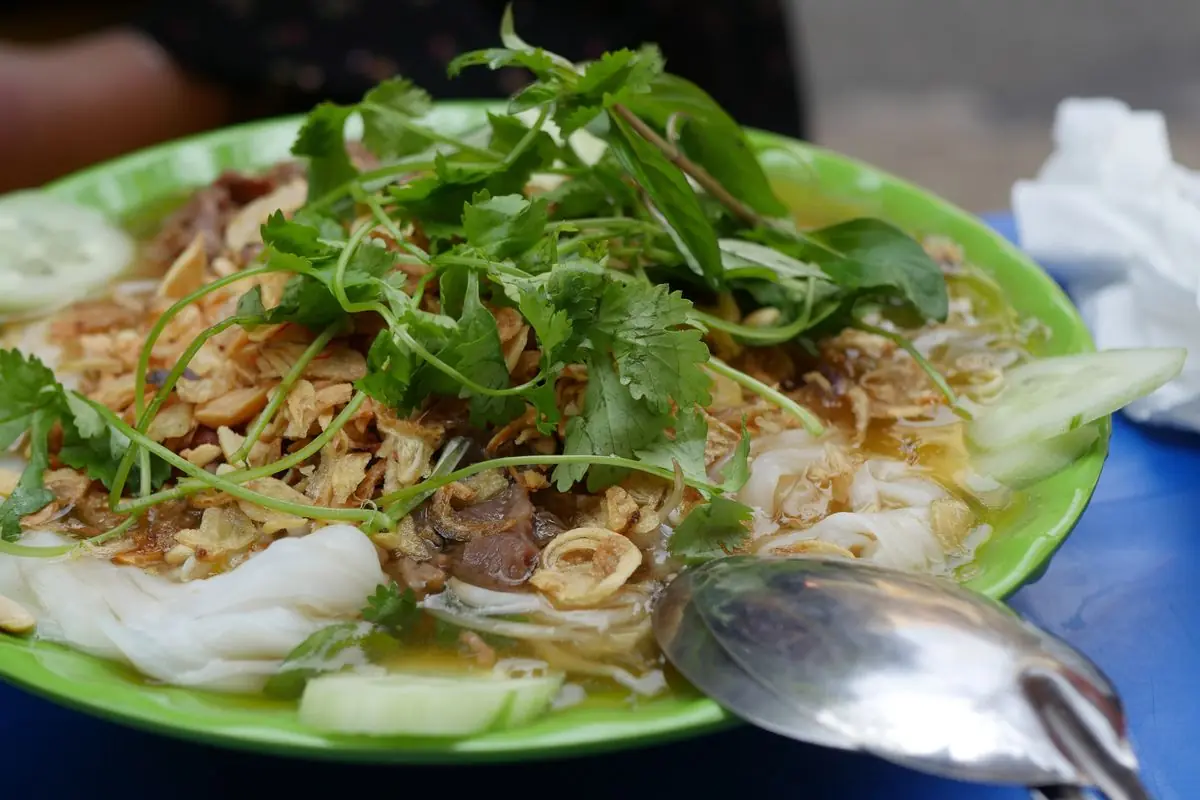
Banh da cua in Hai Phong: what makes it special and how much does it cost?
For around 30,000-50,000 VND, you can enjoy a steaming bowl of banh da cua, Hai Phong's signature crab noodle soup. If it's your first time, start with a regular bowl to appreciate the delicate crab broth before trying seafood-packed versions.
 15 min read
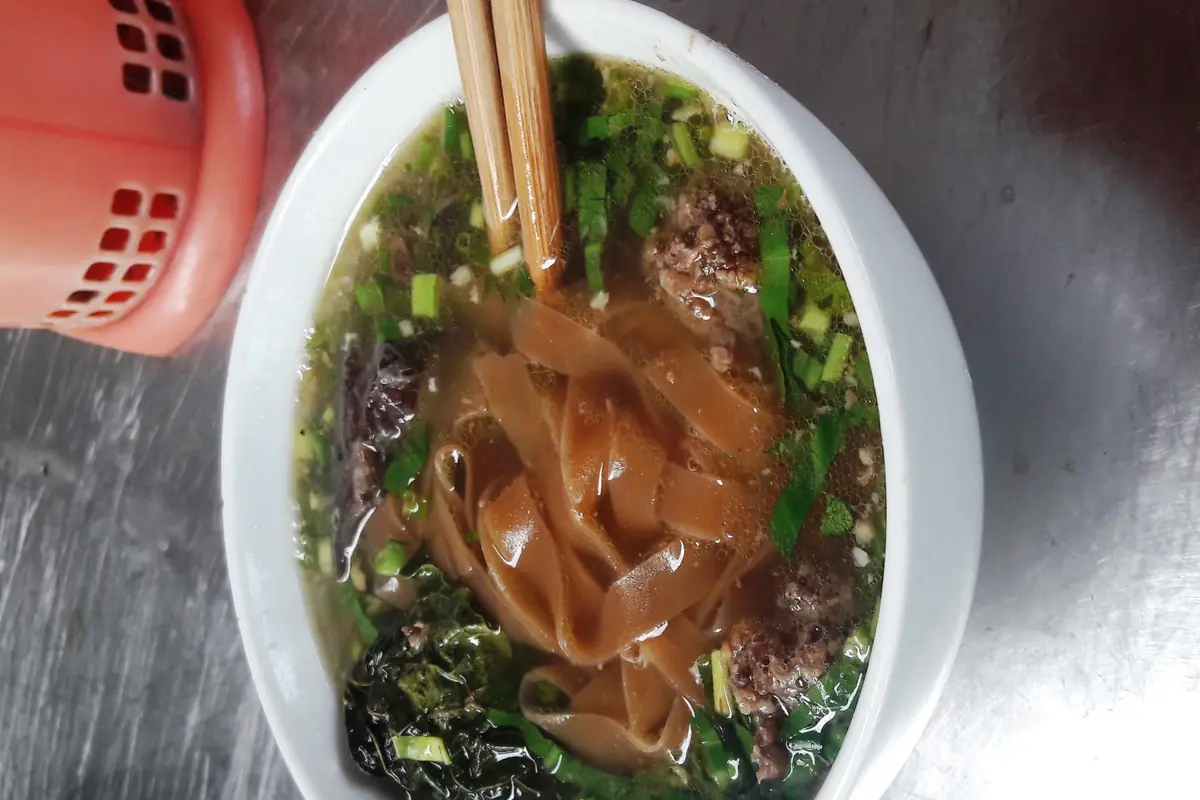
This bowl holds flat noodles, crab, greens and spring onion; extras vary from stall to stall, so check the menu before ordering.
It’s a busy morning in Hai Phong, and steam is rising from a large pot of broth at a small street-side noodle shop. The cook quickly dips a handful of reddish-brown noodles into boiling water, adds crab roe, greens, and fish cakes, then places a fragrant bowl on the table beside a plate of crispy fried dough sticks. Banh da cua is one of the dishes worth making time for on a first visit to Hai Phong, especially if you want to discover what makes the city’s everyday food so memorable.
What is banh da cua, and what’s inside a bowl?
At first glance, banh da cua might remind you of other Vietnamese noodle soups. But the first bite reveals something quite different: broad, flat, reddish-brown rice noodles with a pleasantly chewy texture.
Banh da cua is a traditional crab noodle soup from Hai Phong, a port city in northern Vietnam. Its three essential elements are red rice noodles, a savory crab-based broth, and a selection of toppings.
A typical bowl may include freshwater crab roe, shrimp, fish cakes, pork wrapped in wild betel leaves, fried tofu, or crispy pork fat, depending on the restaurant.
Green vegetables are just as important. Blanched water spinach is particularly common, adding freshness and a little crunch. Some shops also use water mimosa, spring onions, fresh herbs, or fried shallots.
Despite the variety of ingredients, the distinctive taste of freshwater crab is what gives traditional banh da cua its character.
A good broth is gently sweet, aromatic, and rich without being overwhelmingly heavy. It should complement the noodles rather than overpower them.
Had pho or bun noodles before? Think of banh da cua as another comforting Vietnamese noodle soup, but one with wider, chewier rice noodles and a stronger crab flavor.
Making the crab broth
The broth is arguably the most interesting part of banh da cua.
Traditionally, freshwater crabs are cleaned, crushed or ground, and mixed with water. The mixture is filtered to extract the crab liquid, which is then heated carefully.
As the liquid cooks, crab proteins form soft clusters that rise to the surface. These delicate pieces are known as rieu cua, or freshwater crab curds.
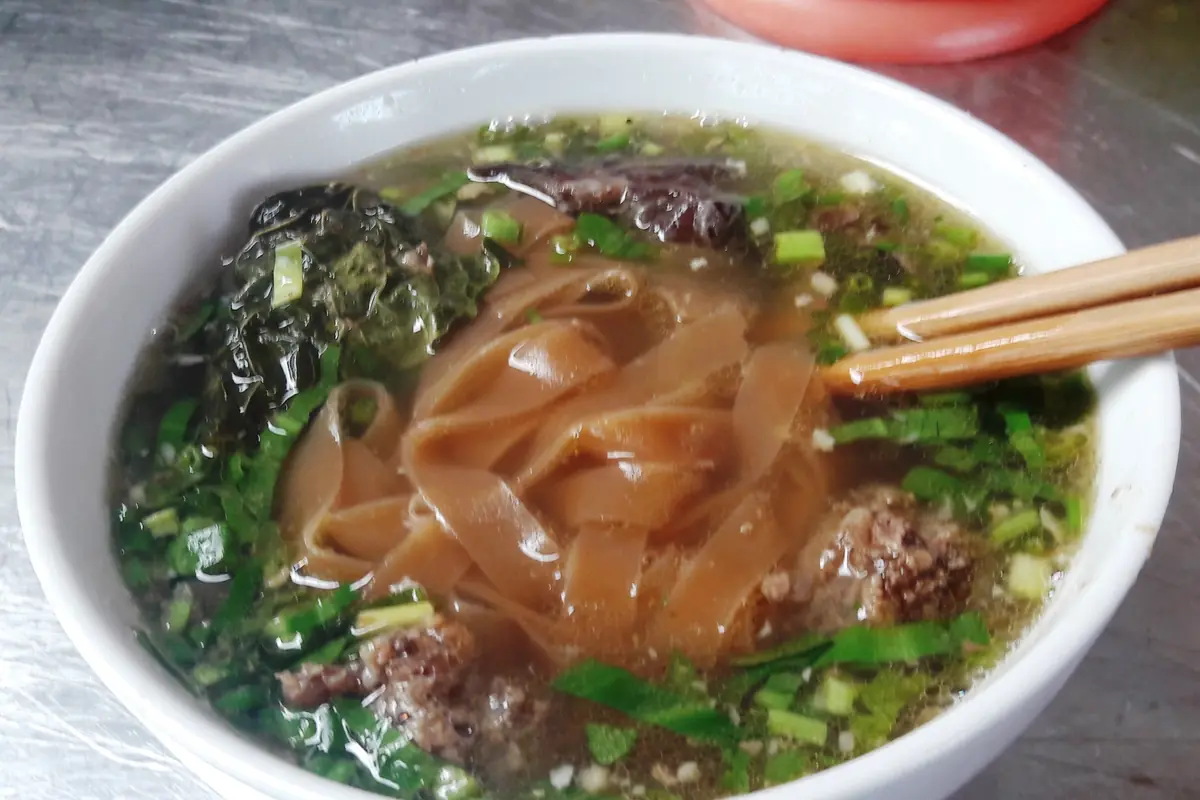
The crab roe or fatty crab mixture is often cooked separately with shallots and oil or fat, creating a fragrant, golden-orange topping.
Each restaurant has its own way of preparing the broth. Some keep it relatively light, allowing the natural crab flavor to stand out. Others add pork bone stock for greater depth and sweetness.
This explains why two bowls of banh da cua from different streets can taste surprisingly different.
Some people prefer a clear, gently seasoned broth for breakfast. Others enjoy a richer bowl with extra crab roe, fried shallots, and crispy pork fat.
Crab noodle broth can contain pork. Some restaurants add pork bones or other pork-based ingredients, so ask before ordering if you avoid pork.
What are Hai Phong’s red rice noodles made from?
One of the first things visitors notice about banh da cua is the unusual color of its noodles.
Unlike the white noodles commonly used in pho or bun dishes, banh da do (red rice noodles) have a reddish-brown appearance.
Their main ingredient is still rice, not a special red grain.
In traditional production, rice is soaked, ground into a smooth batter, and mixed with a small amount of coloring made from cane sugar or golden sugar. Some producers use different natural ingredients, so the exact recipe can vary.
The batter is spread into thin sheets and steamed until cooked. These sheets are then transferred onto bamboo drying racks and left to dry under carefully controlled conditions.
Once the sheets have reached the right texture, they are flattened and cut into noodles.
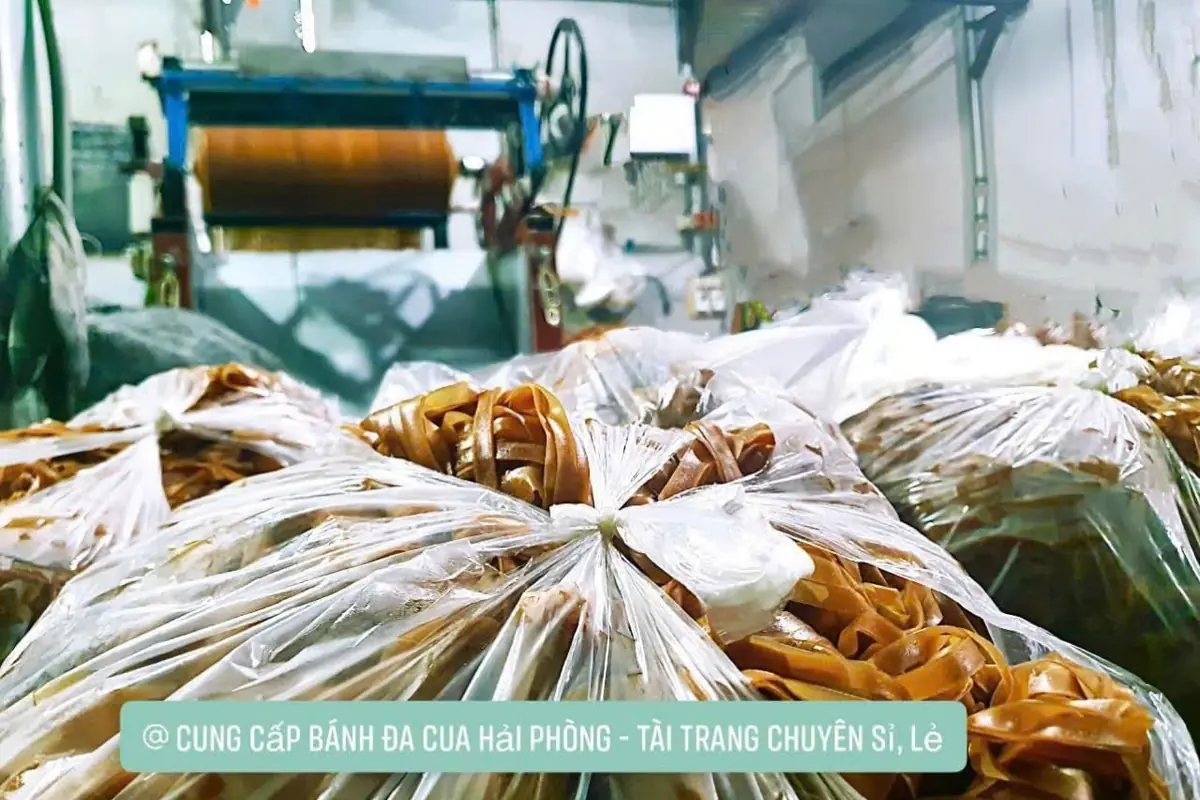
Fresh or partly sun-dried noodles are usually supplied to local restaurants for use within a short period. Fully dried noodles can be stored longer and transported to other parts of Vietnam or overseas.
The traditional noodle-making craft has long been associated with the former Du Hang Kenh area, now part of Le Chan Ward. Nong Xa, in An Phong Ward, is another well-known noodle-making village near Hai Phong.
In Nong Xa, rice noodles are still made by producers who carefully control the batter’s thickness, steaming temperature, and drying process.
The result is a noodle that becomes soft when cooked but retains enough elasticity to hold its shape in hot broth.
That texture is one of the reasons banh da cua feels quite different from other Vietnamese noodle soups.
Start with a regular bowl of banh da cua
Standing in front of a noodle shop in Hai Phong can be a little confusing if you’re not familiar with the menu.
Behind the counter, you’ll often see trays of shrimp, fish cakes, crab roe, greens, and other ingredients, all ready to be added to your bowl.
For a first taste, a regular bowl is usually the easiest choice.
A standard serving typically includes red rice noodles, crab broth, crab curds, greens, and a few basic toppings selected by the shop.
It’s a good way to appreciate the dish without too many competing flavors.
Hungry diners and seafood lovers can order banh da cua thap cam, the mixed version.
Every shop makes its mixed bowl differently
There isn’t a fixed recipe for banh da cua thap cam.
Depending on the restaurant, it may include shrimp, mantis shrimp, fried fish, fish cakes, pork wrapped in wild betel leaves, crab curds, and water spinach.
Some restaurants also add tofu, pork, meatballs, or crispy pork fat.
In October 2025, an American traveler tried a generous mixed bowl at a small shop in an alley off Tran Phu Street.
His bowl included shrimp, pork wrapped in wild betel leaves, fried fish, fish cakes, mantis shrimp, crab roe, wide rice noodles, and water spinach.
The price was just 35,000 VND.
That was one shop’s price, not the standard for every mixed bowl in Hai Phong.
Around Cau Dat Street, bowls with sea crab usually start from about 40,000 VND, mantis shrimp or mixed toppings from about 50,000 VND, and a larger special serving can reach about 70,000 VND.
You’ll also find variations such as banh da cua be (sea crab noodles), banh da be be (mantis shrimp noodles), and mixed seafood banh da.
Some seafood-focused versions use stock made from sea crab or other seafood rather than the usual freshwater crab preparation.
Travelers with dietary restrictions, or anyone set on the traditional freshwater crab flavor, should ask what kind of broth the restaurant uses.
How much does banh da cua cost in Hai Phong?
Banh da cua is generally an affordable meal.
A regular bowl at a modest local shop commonly costs around 30,000-50,000 VND.
Bowls with additional seafood or larger portions may cost approximately 60,000-70,000 VND or more.
Bowls at familiar shops around Lach Tray and Cau Dat commonly cost about 50,000 VND.
Smaller neighborhood eateries may offer simpler servings for around 30,000-35,000 VND, while restaurants using more shrimp, mantis shrimp, or sea crab can charge noticeably more.
A plate of quay, the crispy fried dough sticks often eaten with noodle soup, may be charged separately. At one restaurant, a plate costs 10,000 VND.
Drinks, additional fish cakes, shrimp, or larger portions can also increase the bill.
No prices on display? Ask before ordering, especially when you want extra toppings.
Where to eat good banh da cua in Hai Phong
Good bowls of banh da cua are easy to find in central Hai Phong, and Lach Tray, Cau Dat, and Tran Phu are convenient streets to start.
Each offers a slightly different atmosphere, from busy local eateries to small stalls tucked away in alleys.
Lach Tray Street
A Convenient Introduction to Local Food
Lach Tray is one of the go-to streets for Hai Phong’s crab noodle soup.
The area has a mix of simple local eateries and more established restaurants, making it a convenient place to explore if you’re staying near the center.
Banh da cua shops along Lach Tray are known for hearty bowls filled with red rice noodles, crab broth, greens, and toppings such as fish cakes or shrimp.
One address to try is the restaurant at 48 Lach Tray.
Not every restaurant here opens for breakfast. Some noodle shops operate in the afternoon or evening, while others have their own schedules.
Check the latest opening information before heading out.
Cau Dat Street
Good for Seafood Lovers
Cau Dat is another familiar name on Hai Phong’s food map.
It’s the street for seafood versions of banh da cua.
Banh Da Cua Ba Cu, at 179 Cau Dat, is a long-established name. Other noodle eateries around the street serve versions with mantis shrimp, sea crab, and mixed toppings.
A restaurant around the entrance to a small alley on Cau Dat is known for its seafood-rich bowls.
Before ordering, ask whether the shop serves the traditional freshwater crab version, a sea crab version, or a mantis shrimp noodle soup.
The broth, toppings, and price can vary substantially between them.
Tran Phu Street
Small Shops and Neighborhood Atmosphere
If you enjoy discovering local food down quiet side streets, Tran Phu is another area worth exploring.
This is where an American travel vlogger tried a surprisingly generous 35,000 VND mixed bowl in October 2025.
The scene is familiar to anyone who enjoys Vietnamese street food: small plastic stools, a modest kitchen counter, ingredients displayed in trays, and bowls assembled fresh to order.
It suits travelers who prefer casual meals over polished restaurants.
A restaurant featured in an older article may have changed its hours, prices, or even location.
Rather than following an outdated address without checking, search Google Maps for "banh da cua Tran Phu Hai Phong" and look at recent photos and reviews.
Banh da cua isn’t only a breakfast dish
Banh da cua is a favorite breakfast.
A hot bowl provides noodles, broth, vegetables, and plenty of toppings, making it a filling way to start the morning.
It’s also a natural choice for lunch, particularly after walking around the city center.
But banh da cua isn’t exclusively a breakfast dish.
Some restaurants serve it in the afternoon or evening, while others operate throughout several parts of the day.
So if you arrive in Hai Phong late in the afternoon, you may not have missed your chance yet.
Opening hours vary considerably.
Some smaller shops close when they sell out. Others take a break during the day or change their schedules depending on demand.
If you’re planning a meal around a train, flight, or bus departure, confirm the restaurant’s hours on the day you visit.
How to order and eat banh da cua like a local
Ordering banh da cua is quite straightforward once you know a few useful Vietnamese phrases.
Most shops will ask how many bowls you’d like and whether you want a regular or mixed serving.
You can also request specific ingredients or ask for chili to be served separately.
Phrases for ordering:
- "Mot bat banh da cua thuong." - One regular bowl of crab noodles.
- "Mot bat banh da cua thap cam." - One mixed bowl with assorted toppings.
- "Khong hanh." - No spring onions or shallots.
- "De ot rieng." - Please serve the chili separately.
- "Bat nay co be be khong?" - Does this bowl contain mantis shrimp?
- "Them cha ca bao nhieu tien?" - How much is extra fish cake?
These are simplified versions written without Vietnamese tone marks to make them easier to copy or recognize. For better understanding, you can also show the restaurant staff the Vietnamese text on your phone.
If you have allergies or strict dietary restrictions, use a clearly written, translated message explaining exactly what you cannot eat.
Once your bowl arrives, resist the temptation to add every condiment immediately.
Start with a spoonful of the broth as it is.
You’ll get a better sense of the crab’s natural sweetness, the richness of the crab roe, and the cook’s seasoning.
After that, add a little lime or calamansi if you’d like a brighter flavor.
Like spicy food? Try some chili oil or chi chuong, Hai Phong’s distinctive local chili sauce.
Chi chuong can be quite hot, so begin with a small amount rather than adding a large spoonful straight away.
Crispy fried dough sticks, known as quay, are another popular accompaniment.
Some people dip them into the broth until they’re soft and flavorful. Others prefer to eat them while they’re still crunchy.
Fresh herbs or vegetables may also be served on the side. If you prefer cooked vegetables, ask whether the shop can blanch them.
Can you eat banh da cua if you’re allergic to shellfish or avoid pork?
Although banh da cua is often described simply as crab noodle soup, a single bowl can contain several different animal ingredients.
Explain your restrictions before the cook assembles your bowl and pours in the broth.
Paying at a banh da cua shop
Paying for a bowl of banh da cua is usually simple.
At many neighborhood restaurants, you eat first and pay afterward. Some smaller stalls may ask for payment when serving the food.
At shops without displayed prices, ask about the total before ordering extras.
Cash remains particularly useful at small street-side eateries.
Carrying Vietnamese banknotes in smaller denominations, such as 10,000, 20,000, 50,000, and 100,000 VND, will make paying easier.
Digital payment is becoming more common, too.
In July 2026, Hai Phong’s Department of Culture, Sports and Tourism announced a project with Foody - ShopeeFood to develop a digital food map for the city and encourage cashless payments at participating restaurants.
Supported payment methods include QR codes, electronic wallets, and bank transfers.
Some foreign visitors can also use their own payment apps at compatible merchants.
From April 2026, BIDV expanded cross-border QR payment support for eligible visitors from South Korea and China. Vietnam also has QR payment connections with Thailand.
In August 2026, an expanded service involving NAPAS, BIDV, and Weixin Pay enabled Chinese travelers to pay through Weixin Pay at participating VietQRGlobal acceptance points.
However, not every street-food stall accepts international QR payments.
Whether a payment works depends on the merchant, the supported QR system, and the visitor’s bank or wallet.
Ask before eating if you intend to pay digitally, and keep some cash as a backup.
Should you buy dried red rice noodles to take home?
If you’ve fallen in love with the texture of banh da cua, buying a packet of dried red rice noodles can be a nice way to bring a little of Hai Phong’s food culture home.
Dried banh da do is generally easier to store and transport than fresh noodles.
The noodles can be softened according to the manufacturer’s instructions and then blanched or cooked before being served with broth.
The noodles alone won’t recreate the bowl you ate in Hai Phong.
The soup’s distinctive flavor also depends on the crab broth, crab roe, greens, and toppings.
Dried red rice noodles work in other soups too; they just won’t taste like traditional banh da cua.
When shopping, look for packaged noodles with clearly identified ingredients, producer information, production or expiry dates, and preparation instructions.
Don’t assume every brand needs the same soaking or boiling time. The noodles can differ in thickness and moisture content.
International travelers should also check their destination country’s food import rules.
This is particularly important if you’re flying home to Australia.
Australia has strict biosecurity requirements. Travelers must declare food items covered by its declaration rules, including relevant packaged food products. When unsure, declare the food and let biosecurity officers assess it.
Undeclared restricted items can bring penalties, and a declared product can still be refused entry.
You can check the official Australian Border Force guidance here: abf.gov.au
For travelers returning to other countries, check the relevant customs and agricultural import rules before purchasing food souvenirs.
Our separate guide to Hai Phong specialties to bring home covers more edible gifts from the city.
Banh da cua was popular long before food tours
Banh da cua was popular long before travel videos and food tours.
For generations, it has been part of everyday life in Hai Phong, a city with a long connection to both the surrounding countryside and the sea.
In 2012, Hai Phong’s banh da cua was among twelve Vietnamese dishes recognized for their Asian culinary value at an event in Faridabad, India.
In 2023, the international food platform TasteAtlas introduced the dish under the English name "Red noodle soup."
The dish also appeared in TasteAtlas’s 2025 list of the world’s top 100 soup dishes.
A humble bowl of noodles still appeals to people from very different places, even those who have never tasted freshwater crab or reddish-brown rice noodles before.
There’s nothing particularly elaborate about sitting at a small noodle shop, watching the cook prepare your food, and enjoying a bowl while the city wakes up around you.
The ingredients are familiar to local people: rice, crab, vegetables, herbs, and a few flavorful toppings.
On a first visit, a simple neighborhood shop, freshly prepared noodles, and a little time to sit and eat are enough.
Taste the broth before adding chili, pick up a few strands of red rice noodles with some water spinach, and adjust the seasoning to your liking.
Next time, try the eateries around Cau Dat Street that serve versions with mantis shrimp, sea crab, and mixed toppings.
Frequently asked questions
What's the difference between banh da cua and bun rieu cua?
The main differences are the noodles and the broth. Banh da cua from Hai Phong typically uses broad, reddish-brown rice noodles with a chewy texture and a savory freshwater crab broth. Hanoi-style bun rieu generally uses thin white rice vermicelli and often has a slightly sour broth made with tomatoes or fermented rice vinegar. Toppings and recipes vary between restaurants.
Are Hai Phong's red rice noodles made from brown rice?
Usually not. Traditional red rice noodles are primarily made from rice, with their reddish-brown color often coming from a small amount of caramelized cane sugar or golden sugar mixed into the batter. Some producers use different coloring ingredients. If you're buying packaged noodles, check the ingredient label rather than assuming they're made from brown rice.
Is banh da cua eaten for breakfast or dinner?
Banh da cua is particularly popular for breakfast and lunch in Hai Phong, but some restaurants also serve it in the afternoon or evening. Opening hours vary between shops, and some close when they run out of ingredients. If you're planning an early meal before a train or bus journey, check the restaurant's hours on the day.
What comes in a mixed bowl of banh da cua, and how much does it cost?
A mixed bowl, called *banh da cua thap cam*, may contain crab curds, shrimp, mantis shrimp, fish cakes, fried fish, pork wrapped in wild betel leaves, and water spinach. A bowl on Tran Phu Street cost 35,000 VND in 2025, while seafood-rich mixed portions elsewhere have been listed from around 50,000 VND, with special servings reaching 70,000 VND or more. Prices and ingredients depend on the shop.
Can people with shellfish allergies or pork restrictions eat banh da cua?
Traditional banh da cua is unsuitable for people with crustacean allergies because the broth itself contains freshwater crab, and other crustaceans may also be used. Removing visible crab doesn't make the dish safe. People avoiding pork should ask about pork bone stock, pork-filled cha la lot, crispy pork fat, and other meat toppings. Always explain your restrictions before the food is prepared.