What should you eat for breakfast in Hai Phong, and where?
Starting breakfast early in Hai Phong gives you more choices, especially at small restaurants that serve only in the morning. Sleep a little longer and you can still eat well, but some local favorites may already be sold out.
 26 min read
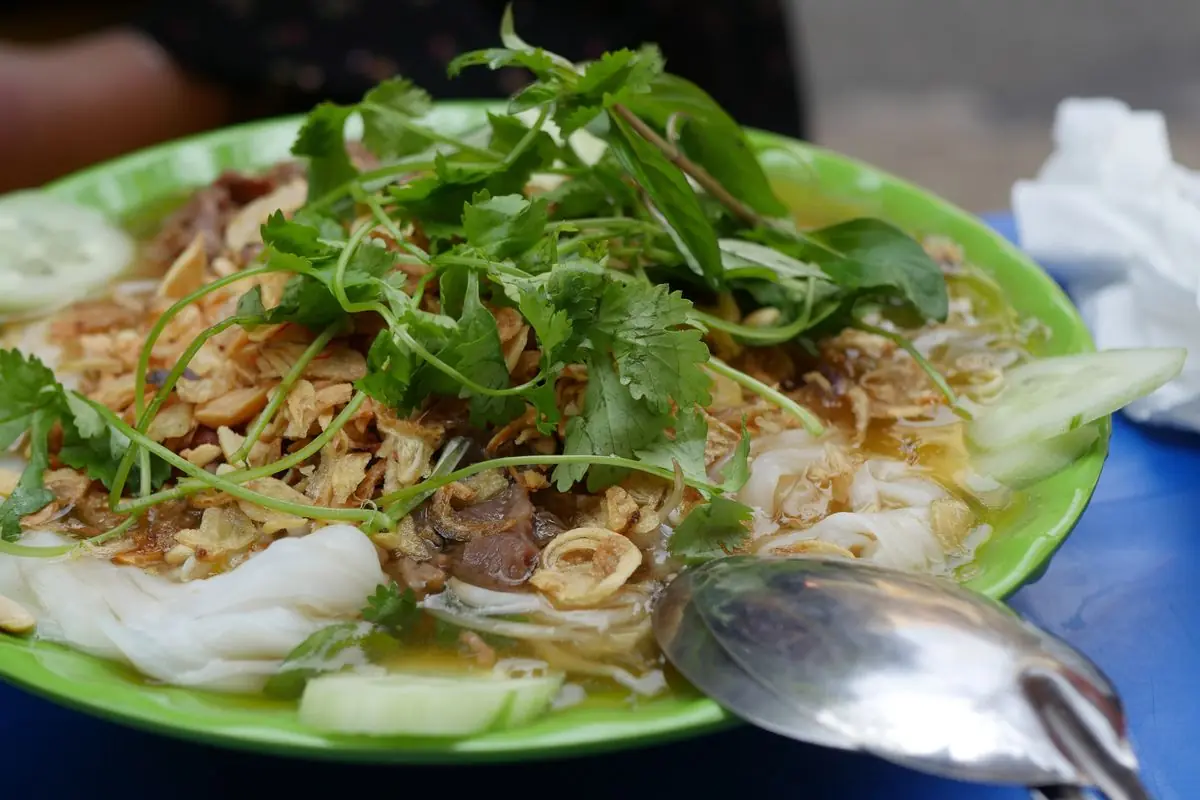
Steamed rice rolls in warm broth with fried shallots and herbs, a mild breakfast that suits first-timers.
6:30 AM is a good time to start exploring breakfast in Hai Phong. You can choose from crab noodle soup, spicy fish noodles, shrimp noodles, steamed rice rolls, or savory sticky rice. Between 7:00 and 8:30 AM is a particularly convenient window for visiting local breakfast spots, while a weekend food tour deserves two or three hours, including travel time and a coffee stop.
1. What to eat for breakfast in Hai Phong
Crab noodle soup is probably the first dish people associate with breakfast in Hai Phong. But a generous bowl of noodles with crab, fish cakes, and vegetables can easily keep you full until lunchtime, and the city has plenty of other morning specialties worth trying.
Shrimp noodles, steamed rice rolls, savory sticky rice, and rice porridge are all part of the local breakfast scene.
The easiest approach is to choose your first dish according to your appetite and morning schedule rather than working through a list of famous restaurants.
| Breakfast dish | Best for | Suggested time |
|---|---|---|
| Bánh đa cua (crab noodle soup) | First-time visitors and noodle soup lovers | 7:00-9:00 AM |
| Bún cá cay (spicy fish noodle soup) | Anyone who enjoys fried fish and rich broth | 6:30-9:00 AM |
| Bún tôm (shrimp noodle soup) | Visitors looking for a different seafood noodle dish | 6:30-8:30 AM |
| Bánh cuốn (steamed rice rolls) | Those who prefer a lighter, non-spicy breakfast | 7:00-9:30 AM |
| Xôi thịt, xôi pate (savory sticky rice) | Travelers wanting a filling, convenient meal | 6:30-9:00 AM |
| Cháo sườn (pork rib rice porridge) | Families with children or anyone wanting something soft and warm | Depends on the restaurant |
| Bún chả nem cua bể (noodles with crab spring rolls) | Visitors wanting to try crab spring rolls as a main dish | Depends on the restaurant |
| Bánh mì cay (Hai Phong spicy breadsticks) | Food tour groups looking for a small extra snack | Mid-morning |
These are suggested eating times, not universal opening hours for every restaurant.
Bánh đa cua or bún tôm makes an excellent first breakfast for international visitors staying in Hai Phong for just one night.
With two nights in the city, you have more room to explore. Try a seafood noodle soup on the first morning and something completely different, such as bánh cuốn or sticky rice, the next day.
For groups coming from Hanoi on a weekend food tour, the best strategy is one main dish, one smaller dish to share, and coffee afterward.
Three people do not need three full plates of sticky rice followed by three large bowls of crab noodles.
2. The best local breakfast dishes in Hai Phong
2.1. Bánh đa cua: a classic first breakfast
Bánh đa cua is an excellent starting point if you are unsure what to eat in Hai Phong.
The dish features distinctive reddish-brown rice noodles, a crab-based broth, vegetables, and various toppings that may include fish cakes, pork, or seafood.

One well-known place to try it is Bánh Đa Cua Bà Cụ, 179 Cầu Đất Street.
This restaurant serves customers during several parts of the day rather than operating exclusively in the early morning.
For a first visit, order a regular bowl before adding extra seafood or other toppings. A fully loaded serving can be surprisingly filling, particularly if you plan to try sticky rice or steamed rice rolls afterward.
Closing times listed for Bà Cụ are not entirely consistent. Arriving around 7:00 AM is a practical way to organize breakfast without relying on its evening operating hours.
The difference between red and white noodles, soup and dry versions, and more restaurant recommendations are covered in the separate guide to bánh đa cua in Hai Phong.
2.2. Bún cá cay: spicy fish noodles for a more flavorful morning
Bún cá cay is another signature Hai Phong breakfast dish.
A bowl typically contains rice vermicelli, fried fish, fish cakes, herbs, and a savory broth with sour and spicy notes. Depending on the restaurant, you may also find toppings such as fish roe or other fish parts.
Bún Cá Cay Cậu Đoành, 151 Hồ Sen Street, is one restaurant worth considering for breakfast.
The brand advertises bowls starting from VND 30,000, although that starting price does not cover every topping combination and should be checked at the restaurant for 2026.
The Hồ Sen location serves its morning session from 6:00 AM to 1:00 PM, before reopening in the evening.
There is no need to arrive at 6:00 AM unless your schedule requires it. Between 7:00 and 8:30 AM works well for visitors staying around Lạch Tray, Hồ Sen, or Hàng Kênh.
Fans of bold flavors and fried fish could make this their main breakfast of the day.
Spice levels and other places to try the dish are covered in the dedicated Hai Phong spicy fish noodle soup guide.
2.3. Bún tôm: a shrimp noodle soup worth waking up early for
Bún tôm receives less attention from tourists than crab noodle soup, but it deserves a place on any Hai Phong breakfast itinerary.
Shrimp is the defining ingredient, along with a broth that draws its sweetness from shrimp and bones. Some versions also include pork, fish cakes, or fresh herbs.
The flavor is usually more about the richness of the broth than intense chili heat.
One specific place to try it is Bún Tôm 164 Lương Khánh Thiện.
It is open daily from 6:30 to 11:00 AM.
Those are the opening hours, not a guarantee that every topping will remain available until 10:59 AM.
For a weekend food tour, arriving between 6:45 and 8:30 AM is a more comfortable plan.
This restaurant is particularly convenient if you are staying near Hai Phong Railway Station or elsewhere around Lương Khánh Thiện Street.
After breakfast, you can head toward Cầu Đất for another small dish or a morning coffee.
A sufficiently clear, current menu price for this particular restaurant is not posted, so ask about the cost of a regular bowl and any additional toppings before ordering.
Bún tôm is also worth considering if you are not keen on spicy fish noodles. However, it is unsuitable for anyone with a shrimp or shellfish allergy.
2.4. Bánh cuốn: soft, steamed rice rolls without the heat
Bánh cuốn is a gentle introduction to Vietnamese breakfast food.
Thin, soft sheets of steamed rice batter are served with fried shallots, dipping sauce, and sometimes pork or Vietnamese sausage. In Hai Phong, the accompanying sauce may be served warm and have a rich, savory flavor.
It is a good choice for international travelers who want to try local food without starting the day with something particularly spicy.
Depending on the menu, you may be able to choose plain rolls or meat-filled versions.
Bánh Cuốn Quyên, 222 Hai Bà Trưng Street, is one established address in the former An Biên area.
It is open from 7:00 AM to 9:30 PM daily, though some listings give an earlier opening time of 6:00 AM.
Because the opening times differ, arriving at 7:00 AM is a safer choice than planning around the earliest advertised opening.
Its online ordering menu lists items in the VND 10,000-45,000 range. That does not mean a complete plate of bánh cuốn necessarily costs VND 10,000.
In 2026, Bánh Cuốn Quyên at 208 Hai Bà Trưng Street charges an estimated VND 30,000-50,000.
Both house numbers, 208 and 222, appear in information about the brand. For the location discussed here, use 222 Hai Bà Trưng when looking up directions.
Bánh cuốn is easy to share, making it useful for a morning food tour.
Two people can start with one plate, then decide whether to order more or save some appetite for sticky rice.
2.5. Xôi thịt and xôi pate: a filling breakfast on Cầu Đất Street
Savory sticky rice in Hai Phong has its own appeal.
The rice is soft and chewy, often served with tender braised pork, rich meat sauce, pate, or other toppings.
At Xôi Bà Sai, 28A Cầu Đất Street, you can try this traditional style of sticky rice with meat.
In 2026, a serving costs approximately VND 20,000-40,000.
It is open from approximately 6:00 AM to 1:00 PM.
If sticky rice is your main breakfast, a regular portion with pork or pate is a practical choice.
For a food tour, consider sharing one portion between two people, especially if you have already eaten noodles.
Sticky rice can be quite substantial. Adding extra pork, pate, sausage, and sauce simply to sample every topping may leave you unable to enjoy anything else until lunch.
Hai Phong also has simpler sticky rice dishes, including xôi đỗ đen, made with black beans.
The beans give the rice a darker purple color and a nutty flavor. Depending on the preparation, it may be served with fried shallots or other accompaniments.
Sticky rice is also one of the most convenient breakfasts to take away.
You can bring it back to your hotel or eat it before checking out, although it is best enjoyed fresh and warm rather than left in a bag for hours.

2.6. Cháo sườn: warm rice porridge for a lighter morning
After an evening of seafood or fried dishes, pork rib porridge can feel like a welcome change.
Cháo sườn is typically cooked until the rice becomes soft and smooth. It may contain pork ribs and be served with dried pork floss, fried dough sticks, or herbs.
People who enjoy spice can add chili separately, while others can keep the porridge mild.

One central Hai Phong address is Cháo Sườn Thúy, 12 Phan Bội Châu Street.
It serves a morning session from 6:30 to 9:00 AM, Monday through Friday. On Saturdays and Sundays, it opens only in the afternoon.
That makes this a possible weekday breakfast stop, but not a reliable weekend morning recommendation without checking directly.
Weekday visits work best before 8:00 AM because the morning service window is short.
This is better suited to a quick meal than an extended breakfast with a large group.
For families with young children or older travelers, porridge may be a more comfortable alternative after several days of noodle soups and fried snacks.
Pork rib porridge is not vegetarian.
2.7. Crab spring roll noodles, spicy breadsticks, and everyday breakfasts
Not everyone wants to begin the day with a large bowl of soup.
Bún chả nem cua bể, which combines rice noodles with crab spring rolls and dipping sauce, is another possibility.
It allows you to enjoy Hai Phong’s famous crab spring rolls as part of a proper meal rather than a standalone snack.
Not every restaurant serving crab spring rolls opens in the morning, so check the hours of the specific place you intend to visit.
The different styles of spring rolls, how they are served, and specialist restaurants are covered in the separate Hai Phong crab spring rolls guide.
Bánh mì cay, Hai Phong’s small spicy breadsticks, is better suited to a short stop between larger meals.
These narrow, crispy breadsticks usually contain pate and are commonly eaten with chili sauce. They are easy to share, although a single small breadstick is not a substantial breakfast by itself.
Specific places and serving options are in the separate Hai Phong spicy breadsticks article.
There are also plenty of everyday breakfast foods on the city’s streets: steamed buns, bánh giò (steamed rice dumplings), pork sandwiches, sticky rice cakes with sausage, crab tomato noodle soup, pho, and duck noodles.
These are useful alternatives if you have already eaten the major Hai Phong specialties or simply do not want to travel across town for breakfast.
For example, someone catching a train may prefer a pork sandwich or steamed bun rather than waiting for a large bowl of noodles.
Travelers with a free morning can spend more time at a restaurant that serves only breakfast, then have a smaller snack later.
3. What time do Hai Phong breakfast restaurants open and sell out?
One of the easiest mistakes when planning breakfast is confusing a restaurant’s closing time with the time its signature dish sells out.
A restaurant listed as open until 11:00 AM might have run out of shrimp, fish, or certain toppings by 10:30.
On the other hand, a restaurant serving food all day does not require you to arrive at 6:00 AM.
The table below brings together several breakfast addresses with available operating-hour information.
These are the restaurants’ operating hours, not real-time confirmations that food will be available at a particular moment.
| Restaurant | Listed operating hours | Suggested arrival |
|---|---|---|
| Bún Tôm 164 Lương Khánh Thiện | 6:30-11:00 AM daily | 6:45-8:30 AM |
| Xôi Bà Sai, 28A Cầu Đất | Approximately 6:00 AM-1:00 PM | 6:30-8:30 AM |
| Bánh Đa Cua Bà Cụ, 179 Cầu Đất | Generally from around 7:00 AM; closing times vary | 7:00-9:00 AM |
| Bánh Cuốn Quyên, 222 Hai Bà Trưng | Approximately 7:00 AM-9:30 PM; some listings give 6:00 AM | 7:00-9:30 AM |
| Bún Cá Cay Cậu Đoành, 151 Hồ Sen | 6:00 AM-1:00 PM, then reopens in the evening | 7:00-9:00 AM |
| Cháo Sườn Thúy, 12 Phan Bội Châu | 6:30-9:00 AM Monday-Friday; no weekend morning session | 6:45-8:00 AM on weekdays |
Before 7:00 AM: prioritize morning-only restaurants
Early risers can begin with shrimp noodles on Lương Khánh Thiện Street or sticky rice on Cầu Đất.
Starting early gives you more flexibility. If your first choice happens to be closed, you still have time to find another breakfast place without disrupting the rest of the day.
However, there is little benefit in arriving before a restaurant’s opening time simply because it is famous.
The listed opening time, when the kitchen begins preparing food, and when customers are actually served may not be identical.
7:00-8:30 AM: the most convenient breakfast window
This is a comfortable time for most visitors staying in central Hai Phong.
Crab noodles, steamed rice rolls, sticky rice, and spicy fish noodles can all fit into a morning itinerary during these hours.
You do not have to search for a restaurant that opens at 5:00 AM just to enjoy a local breakfast before sightseeing.
Weekends may bring larger crowds to restaurants popular with food tour visitors.
Allow some flexibility for waiting for a table, and avoid scheduling your next activity immediately after breakfast.
After 9:00 AM: choose restaurants with longer hours
Waking up at 9:00 AM does not mean missing breakfast in Hai Phong, but your choice of restaurant should change.
A morning-only shrimp noodle or porridge shop is no longer the best place to travel a long distance for.
Bánh Cuốn Quyên, Bánh Đa Cua Bà Cụ, and Bún Cá Cay Cậu Đoành offer more flexibility because of their longer advertised service hours.
After 9:00 AM, it also makes sense to give up the idea of eating three full meals before lunch.
A leisurely late breakfast, followed by coffee and sightseeing, will usually be more enjoyable.
Put the morning-only dish you most want to try on your first morning and save the restaurants with longer hours for the next day.
4. Where to eat breakfast in Hai Phong based on your hotel location
You do not need to cross the city to find a good local breakfast.
Where you stay matters, particularly when you also have to check out, catch a train, or meet a driver.
Near Hai Phong Railway Station and Lương Khánh Thiện
Bún Tôm 164 Lương Khánh Thiện
Travelers staying near Hai Phong Railway Station can consider Bún Tôm 164 Lương Khánh Thiện.
It is a convenient option for travelers whose day starts early.
After breakfast, you can continue toward Cầu Đất and explore the city center rather than immediately heading across town to Hồ Sen.
Travelers arriving from Hanoi by train should pay attention to the train’s actual arrival time.
If you reach Hai Phong close to lunchtime, do not build your itinerary around a noodle restaurant that serves only in the morning.
Choose somewhere with longer operating hours and leave bún tôm for the next day.
Breakfast near the railway station can also be combined with the route described in the separate one-day Hai Phong itinerary.
Cầu Đất, Trần Phú, and the old city center
Xôi Bà Sai, Bánh Đa Cua Bà Cụ
The Cầu Đất area is especially convenient if you want a choice between noodle soup and savory sticky rice.
Xôi Bà Sai at 28A Cầu Đất and Bánh Đa Cua Bà Cụ at 179 Cầu Đất are on the same street.
You can choose one for your main breakfast and consider the other afterward without traveling to a completely different neighborhood.
Solo travelers should probably choose just one.
A full serving of sticky rice followed by a substantial bowl of crab noodles is more food than most people need before lunch.
After eating, you can explore nearby old streets on foot, depending on your accommodation and the weather.
Visitors staying around Trần Phú Street or Hai Phong Opera House can also use Cầu Đất as their main breakfast area instead of choosing a restaurant solely from online rankings.
Lạch Tray, Hồ Sen, and Hàng Kênh
Bún Cá Cay Cậu Đoành
Around Lạch Tray Street, Hồ Sen, and Lạch Tray Stadium, Bún Cá Cay Cậu Đoành at 151 Hồ Sen is worth considering.
This area is convenient if your morning plans take you toward the city’s larger roads or neighborhoods outside the immediate center.
Travelers renting a motorbike can explore farther away, but there is no need to make a long journey simply to add another bowl of noodles to the itinerary.
A practical plan is to eat spicy fish noodles between 7:00 and 8:00 AM, then find coffee near your hotel or your next destination.
Avoid choosing two restaurants far apart just because both appear on a popular food tour list.
Hai Bà Trưng, Cát Dài, and An Biên
Bánh Cuốn Quyên
The Hai Bà Trưng-Cát Dài area is useful for travelers who prefer steamed rice rolls, sticky rice, and everyday breakfast dishes that are not especially spicy.
Bánh Cuốn Quyên at 222 Hai Bà Trưng has relatively long advertised operating hours, making it a practical choice for visitors who wake up later or travel with children.
One plate of bánh cuốn can make a complete breakfast.
Groups can also share a portion and continue to a smaller snack nearby.
Visitors staying near Cát Dài Street do not necessarily have to travel to Cầu Đất for sticky rice.
Local sandwich stalls, steamed bun sellers, and neighborhood breakfast restaurants may be more convenient on a busy morning.
Tam Bạc Lake, Hoàng Văn Thụ, and Phan Bội Châu
Cháo Sườn Thúy, weekdays
Travelers staying around Tam Bạc Lake or the nearby streets of Hoàng Văn Thụ and Phan Bội Châu have breakfast options in the former central Hồng Bàng area.
On weekdays, Cháo Sườn Thúy at 12 Phan Bội Châu is one possible stop for a lighter meal.
Its morning operating window is short, so it should not be placed at the end of a route involving two other breakfast restaurants.
It has no Saturday or Sunday morning session, so on a weekend visit choose another option or confirm the hours directly.
After breakfast, the Tam Bạc Lake and Opera House areas are suitable for a short walk or coffee break.
Visitors spending only one night in Hai Phong can explore this area on their second morning before returning to check out.
Near Cát Bi Airport or Lê Hồng Phong Street
Eat near your hotel
Cát Bi Airport and the Lê Hồng Phong area are not immediately next to the central restaurants listed above.
Staying here means weighing the travel time before choosing breakfast.
For an early flight, eating near your hotel is usually more practical than traveling into the center for one famous restaurant and then returning toward the airport.
If you have the whole morning free, however, Cầu Đất, Lạch Tray, or Hai Bà Trưng may be worth visiting.
Do not confuse the residential Cát Bi area with Cát Bi Market.
The market remains a place for buying food, seafood, and local specialties, but market visits are covered separately in the Hai Phong markets guide.
5. Hotel breakfast or local street food: which is better?
For international travelers spending one or two nights in Hai Phong, this decision is worth considering when booking accommodation.
A hotel breakfast buffet is convenient.
You know where to go, do not need to arrange transport, can often choose familiar foods, and can return to your room immediately afterward.
Families with young children or travelers following a tight schedule may prefer this option.
But eating breakfast at the hotel on both mornings also means missing some of the city’s most interesting noodle shops, sticky rice stalls, and steamed rice roll restaurants.
When should you eat breakfast at the hotel?
Choose your hotel breakfast when it is already included in the room rate, your schedule is particularly tight, or someone in your group needs a special diet.
If you have to finish eating before a driver arrives, an unfamiliar restaurant several kilometers away may not be the best choice.
Remember to account for ordering, food preparation, payment, and the trip back to collect your luggage.
If you are traveling to Cát Bà early in the morning, confirm your pickup or transport departure time first.
Only then decide whether you have enough time to go out for a local breakfast.
When should you eat at a local restaurant?
If you have a free morning, enjoy trying new food, and want to experience everyday life in Hai Phong, spend at least one breakfast outside your hotel.
You do not need to book an organized food tour.
Choose one local restaurant, enjoy the meal, explore the surrounding streets, and stop for coffee afterward.
For a one-night stay, use your only morning for a signature Hai Phong dish, especially if the hotel buffet is not particularly important to you.
For a two-night stay, try bánh đa cua or bún cá on one morning, then bánh cuốn, bún tôm, or sticky rice on the next.
This gives you variety without making every breakfast excessively heavy.
When the hotel charges separately for breakfast, compare its current buffet price with your estimated street food budget.
There is no single buffet price that applies to all Hai Phong hotels.
6. Three Hai Phong breakfast food tour itineraries
A comfortable morning food tour should involve one main breakfast, one smaller dish to share, and a coffee stop.
Add a third dish only if your group still has room.
The schedules below are suggested travel plans, not restaurant reservations or guaranteed service times.
Itinerary 1: early shrimp noodles, then sticky rice on Cầu Đất
Best for: Two to four people who want several local dishes without starting at 5:00 AM.
| Suggested time | Activity |
|---|---|
| 6:45 AM | Bún Tôm 164 Lương Khánh Thiện |
| 7:30 AM | Travel toward Cầu Đất |
| 7:45 AM | Share sticky rice at Xôi Bà Sai |
| 8:30 AM | Morning coffee in central Hai Phong |
| 9:30 AM | Walk around the old streets or return to the hotel |
At the first stop, each person can order their own bowl of bún tôm if that is the main breakfast.
At the second stop, one or two servings of sticky rice may be enough for the whole group to share.
Still keen on bánh mì cay? Save it for later in the morning rather than eating it immediately after sticky rice.
The advantage of this route is its order.
The restaurant with the shorter morning service window comes first, while the sticky rice stall has longer advertised hours.
Itinerary 2: breakfast around Cầu Đất without much traveling
Best for: Visitors staying in the city center who have around two hours and do not want to rent a motorbike.
| Suggested time | Activity |
|---|---|
| 7:15 AM | Bánh Đa Cua Bà Cụ, 179 Cầu Đất |
| 8:00 AM | Walk along Cầu Đất Street |
| 8:15 AM | Visit Xôi Bà Sai, 28A Cầu Đất, and share a portion if hungry |
| 9:00 AM | Stop for coffee |
| 10:00 AM | Continue exploring central Hai Phong |
This itinerary is easy to adjust.
If your bowl of crab noodles is particularly filling, skip the sticky rice.
You will not miss anything essential by enjoying one good meal instead of forcing yourself to eat two.
Alternatively, if you already had bánh đa cua the previous evening, begin with sticky rice and save another noodle dish for the next day.
There is no need to return to a restaurant simply to complete a food tour checklist.
Itinerary 3: steamed rice rolls followed by spicy fish noodles
Best for: Weekend groups wanting to sample two different breakfast specialties.
| Suggested time | Activity |
|---|---|
| 7:15 AM | Bánh Cuốn Quyên, 222 Hai Bà Trưng |
| 8:00 AM | Short break and travel toward Hồ Sen |
| 8:45 AM | Bún Cá Cay Cậu Đoành, 151 Hồ Sen |
| 9:30 AM | Morning coffee |
| 10:30 AM | Return to the hotel or continue sightseeing |
This route works best when you travel with friends and share the steamed rice rolls at the first stop.
Eating a large plate of bánh cuốn and then ordering a fully loaded bowl of fish noodles may be too much.
The two restaurants are not as close together as the places along Cầu Đất, so allow time for the journey.
For a relaxed morning, simply choose one restaurant and spend longer over coffee.
A weekend breakfast does not need to become a race across Hai Phong.
7. How much does breakfast cost in Hai Phong?
The cost depends on whether you order one main dish or visit several restaurants, choose a basic portion or extra toppings, and stop for coffee afterward.
The figures below are reference prices for individual restaurants. They are not universal 2026 prices for every restaurant in the city.
| Restaurant or dish | Reference price (2026) |
|---|---|
| Xôi Bà Sai, 28A Cầu Đất | VND 20,000-40,000 per serving |
| Bún Cá Cay Cậu Đoành | From VND 30,000 per bowl |
| Bánh Cuốn Quyên, 208 Hai Bà Trưng | VND 30,000-50,000 |
| Bánh Cuốn Quyên, 222 Hai Bà Trưng | Listed menu items from VND 10,000-45,000 |
| Bún Tôm 164 Lương Khánh Thiện | No posted price; ask at the restaurant |
| Cháo Sườn Thúy, 12 Phan Bội Châu | No posted price; ask at the restaurant |
For Bánh Đa Cua Bà Cụ, the final price may depend on the type of bowl and additional toppings.
A price from December 2023 should not be treated as an exact restaurant price for a 2026 trip.
7.1. How much cash should one person bring?
If you plan to order seafood with several toppings, extra spring rolls, fried dough sticks, or additional drinks, check the total before ordering.
International travelers may find it useful to carry smaller Vietnamese banknotes, especially VND 10,000, VND 20,000, and VND 50,000 notes.
Paying at a small breakfast stall is often easier when you have the correct or nearly correct amount.
7.2. What is a reasonable budget for two people on a food tour?
For two people, a provisional budget of VND 200,000-350,000 for the morning is a practical starting point, depending on how many dishes you order, portion sizes, drinks, and whether you share.
You could order one bowl of noodles per person, share sticky rice or steamed rice rolls, and finish with coffee.
The actual total should be checked against the menus at the restaurants you visit.
Extra toppings, side dishes, takeaway food, and transport between neighborhoods can increase the cost.
7.3. How should a group of three or four order?
Traveling as a group makes it easier to try more dishes without buying a full serving of everything for each person.
However, sharing one bowl of noodle soup among four people while occupying a table for an extended period is not particularly practical.
Sticky rice, bánh cuốn, spicy breadsticks, and spring rolls are generally easier to share.
A good approach is for everyone to have one main breakfast first, then order one or two smaller dishes for the group.
Before paying, check whether additional toppings are charged separately.
A basic plate of steamed rice rolls can cost noticeably less than one with extra sausage or spring rolls.
8. How to order breakfast in Hai Phong as an international visitor
Many small breakfast restaurants in Hai Phong operate quite simply.
You find a table, order your food, wait for it to be prepared, and pay according to the restaurant’s usual arrangement.
Not every place has an English-language menu.
Saving the Vietnamese name of the dish, the restaurant address, and a photo of what you want can make ordering much easier.
For example, "Cho tôi một bát bún tôm, không ớt" means you would like one bowl of shrimp noodles without chili.
You can also say "Cho tôi một suất bánh cuốn, không cay" to request a serving of steamed rice rolls without spice.
General advice on QR payments, food allergies, and vegetarian ordering is in the separate Hai Phong food guide.
Which breakfast dishes are easiest for first-time visitors?
Bánh cuốn is one of the gentler choices.
The rolls are soft, and you can control how much dipping sauce or chili you add.
Bún tôm is another possibility for those who enjoy non-spicy noodle soups, but its shrimp-based broth is unsuitable for people with shrimp allergies.
Savory sticky rice has more recognizable ingredients, although travelers avoiding pork, animal fat, or meat should pay attention to the toppings and sauce.
Bánh đa cua is not necessarily spicy, but it contains crab and may include shrimp, fish cakes, or other ingredients.
For bún cá cay, some restaurants may be able to adjust the chili level, but you should not assume that the original broth is completely non-spicy.
Which restaurants are easier without speaking Vietnamese?
For a first visit, prioritize restaurants with clearly documented addresses, recognizable seating areas, and longer operating hours.
Bánh Cuốn Quyên and Bánh Đa Cua Bà Cụ can be easier to fit into a flexible itinerary than a tiny stall hidden in an alley that operates for only a short morning period.
You do not have to find the smallest, least touristy restaurant in the city to eat like a local.
A simple Vietnamese breakfast, served at the time local residents normally eat it, is already a worthwhile local experience.
9. Where to go for morning coffee after breakfast
Coffee makes an excellent final stop after a Hai Phong breakfast food tour, particularly when you have already tried two dishes and want a break before sightseeing.
Visitors in the city center can head toward Hai Phong Opera House, Trần Phú Street, or Tam Bạc Lake.
Around Lạch Tray, pick a café near your accommodation or next destination rather than traveling back toward the railway station for a single drink.
Cà phê cốt dừa, Vietnamese coconut coffee, is a popular choice among visitors to Hai Phong.
However, after a large serving of sticky rice or crab noodles, a rich coconut coffee may feel like another substantial course.
Black coffee, coffee with condensed milk, or tea may be more comfortable after a heavy breakfast.
If you especially want to try coconut coffee, consider saving it for later in the morning or the afternoon.
Cafés that open early, places serving coconut coffee, and recommendations based on atmosphere are covered in the dedicated Hai Phong coffee guide.
Allowing 30-45 minutes for coffee is usually enough when you still have sightseeing planned.
A late-morning checkout also needs time to return and collect your luggage, not just the journey from the café to your next attraction.
10. Common mistakes to avoid when planning breakfast in Hai Phong
Visiting all-day restaurants before morning-only stalls
A shrimp noodle restaurant that closes before lunch should usually come before a place serving food throughout the day.
Reverse that order and you may reach the first restaurant after its morning service has ended.
When planning, identify which restaurants have short morning sessions and which offer longer hours.
That matters more than their position on a list of popular places.
Trusting opening hours from just one website
Small restaurants can change their hours.
Weekdays, weekends, public holidays, and unexpected closures may all affect service.
Even different branches of the same brand may follow different schedules.
Planning three full bowls of noodles in two hours
Bánh đa cua, bún cá cay, and bún tôm are all substantial main meals.
Eating three full bowls back-to-back is unlikely to be the most enjoyable way to appreciate them.
Solo travelers should focus on one main dish and save another for the following morning.
Groups can share dishes that are easier to divide and avoid ordering extra toppings immediately.
Choosing a distant restaurant without considering the return journey
A restaurant several kilometers from your hotel may be worth visiting when you have an entire morning free.
But if you still need to pack, check out, or meet a driver, the journey can make the schedule unnecessarily stressful.
Choose somewhere near your accommodation before checkout.
Save more distant restaurants for a day when they fit naturally into your sightseeing route.
Assuming every local specialty is available at dawn
Crab spring rolls, spicy breadsticks, steamed rice rolls, and different kinds of sticky rice can be sold at various times.
A dish being famous in Hai Phong does not mean every restaurant serving it opens at 6:00 AM.
Do not apply one restaurant’s hours to another simply because they sell the same food.
Traveling across town because your first choice has sold out
If a restaurant runs out of the dish you wanted, choosing something else nearby is often better than crossing the city.
On Cầu Đất, you may be able to switch from crab noodles to sticky rice.
Around Hai Bà Trưng, you can choose steamed rice rolls or another neighborhood breakfast.
Travelers staying near Lạch Tray can keep their morning within that area instead of returning to the city center.
A good breakfast does not have to include every specialty on your original list.
11. Planning breakfast for a one- or two-night stay in Hai Phong
One night in Hai Phong calls for a breakfast area close to the hotel, one main dish, and a café.
A local market is a separate activity. Give it its own time rather than squeezing it between restaurants with short morning opening hours.
For a two-night stay, the options are more flexible. Try crab noodles or spicy fish noodles on the first morning, then shrimp noodles, sticky rice, or steamed rice rolls on the second.
You can use the same approach on future weekend visits to Hai Phong: start with restaurants that finish serving early, leave longer-hour places for later, and treat coffee as a break rather than another stop you must rush to reach.
Frequently asked questions
What is the best traditional breakfast in Hai Phong?
Bánh đa cua, bún cá cay, and bún tôm are three of the most distinctive noodle dishes to try. For something without broth, choose savory sticky rice or steamed rice rolls. First-time visitors can start with crab noodle soup, while those who have already tried it may prefer shrimp noodles or bánh cuốn.
What time do breakfast restaurants open in Hai Phong?
Many local breakfast restaurants begin serving around 6:00-7:00 AM, but there is no universal schedule. Bún Tôm 164 Lương Khánh Thiện is listed as opening at 6:30 AM, Xôi Bà Sai at around 6:00 AM, and Bánh Cuốn Quyên at either 6:00 or 7:00 AM, depending on the listing. Some restaurants stay open until lunch or evening, while small porridge stalls may operate only for a few hours.
Which area of Hai Phong has the most breakfast options?
Cầu Đất, Lạch Tray-Hồ Sen, Hai Bà Trưng-Cát Dài, and the streets around Hai Phong Railway Station all offer breakfast choices. Near the station, consider shrimp noodles; around Cầu Đất, sticky rice and crab noodles; near Hồ Sen, spicy fish noodles; and around Hai Bà Trưng, steamed rice rolls. Choosing an area close to your hotel helps save time.
How much does breakfast cost in Hai Phong?
Some 2026 reference prices include VND 20,000-40,000 for sticky rice at Xôi Bà Sai and spicy fish noodles advertised from VND 30,000 at Cậu Đoành. Actual prices depend on the restaurant, portion, and toppings. Carrying around VND 100,000 in cash is a reasonable allowance for a regular breakfast and some flexibility, rather than a fixed citywide meal price.
Which Hai Phong breakfast dishes are not spicy?
Steamed rice rolls, pork rib porridge, savory sticky rice, and some shrimp noodle soups are good starting points for visitors who avoid chili. Crab noodle soup can also be served without added chili, depending on the restaurant. For spicy fish noodles, ask whether a non-spicy version is possible, since some restaurants season the broth with chili during preparation.


