What to know before visiting Ba Vi for wild sunflower season
Ba Vi National Park expects wild sunflowers from October 17 to December 6, 2026, with the best display from November 1 to 23. The main flower walk starts near the 400 m pine forest, well below the summit.
 19 min read
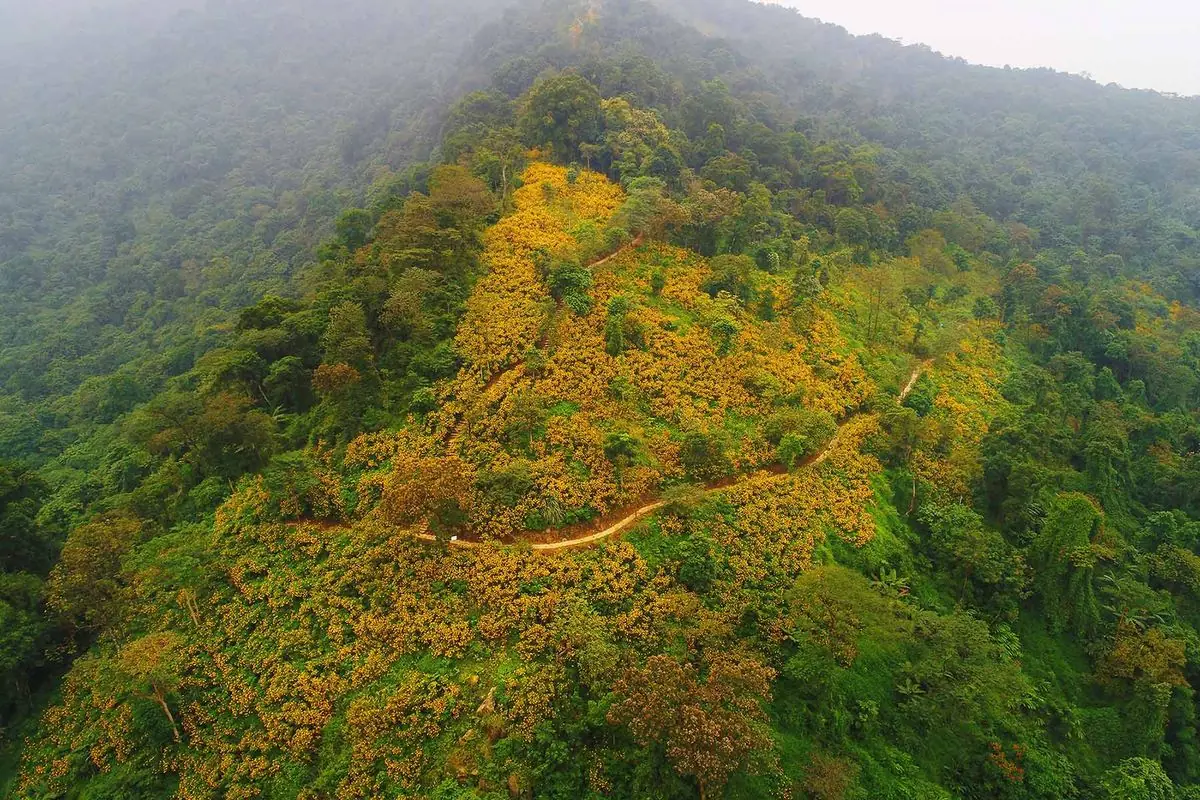
Wild sunflowers cover a Ba Vi hillside in gold.
To plan around wild sunflower season in Vietnam, start by putting November on your calendar and checking recent flower photos before leaving Hanoi. At Ba Vi National Park, the 2026 season runs from October 17 to December 6, with the strongest display expected November 1-23. The easiest plan is a single day at the flower forest near the 400 m elevation area, rather than trying to reach every viewpoint on the mountain.
What are Vietnam’s wild sunflowers?
The flowers called hoa dã quỳ in Vietnamese are Tithonia diversifolia, a tall, bushy member of the daisy family. You may also see the names Mexican sunflower, tree marigold and shrub sunflower. In Vietnamese, people sometimes call them cúc quỳ, sơn quỳ or hướng dương dại. They resemble small, bright sunflowers in photographs, but they are not the same plant as the familiar seed-producing sunflower grown in fields.
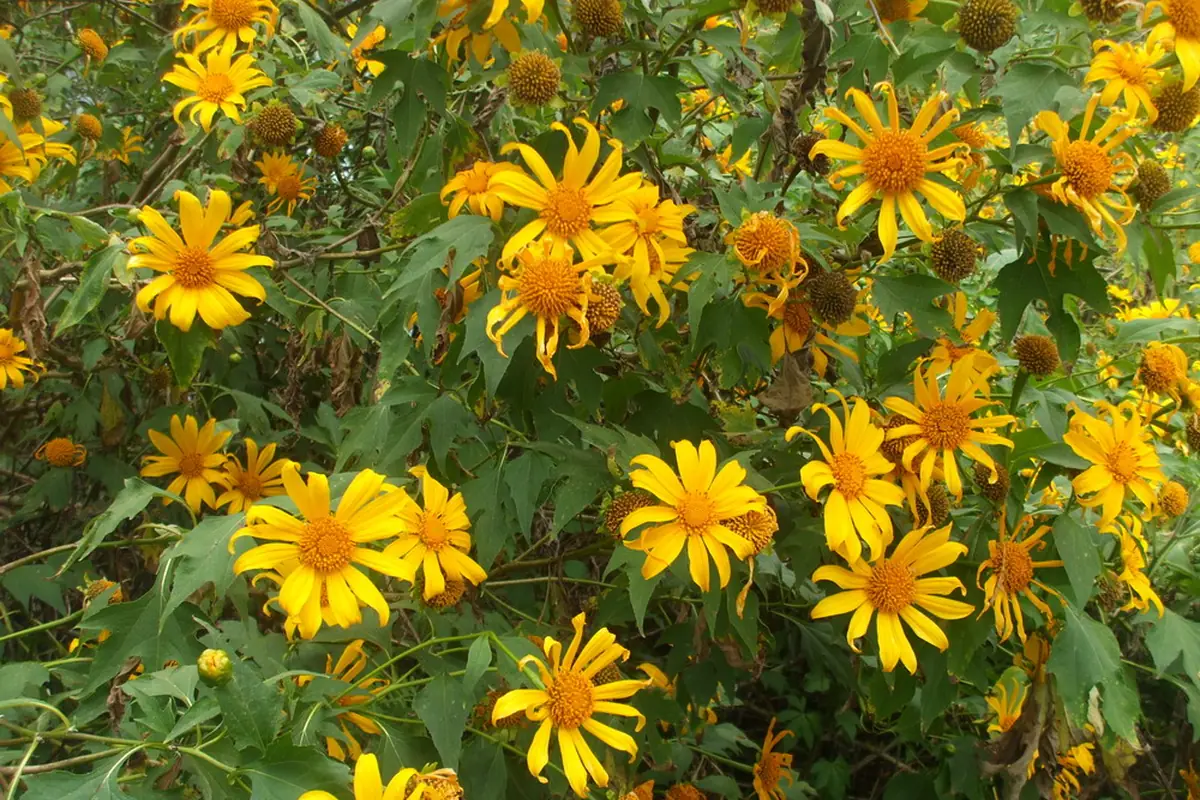
Look closely at a dã quỳ bush and you will see branching stems, broad leaves and flowers with yellow petals around a warm yellow-orange center. Some bushes rise above a person’s head while others grow low along a bank. The flowers rarely appear in perfect rows. They spread across road edges, slopes and sunny patches, creating irregular ribbons of yellow that look especially striking against dark forest or red highland soil.
The species is native to Mexico and Central America and has been introduced to tropical areas around the world, including Vietnam. Ba Vi National Park says the flowers were brought to the area by the French in the 1930s and later became established in the natural landscape. That history helps explain why dã quỳ feels like a familiar mountain flower in northern Vietnam even though it is not native to the country.
The best photographs usually come from letting the plant look like itself. A few tall stems in the foreground, a person walking on an existing path and the rest of the flowers in the background can make a much more natural picture than pushing into a bush. A close-up reveals the fine texture of the petals; a wide shot shows how the yellow patches follow the shape of the road. Good pictures do not depend on a perfectly uniform field.
There is one useful language detail for international visitors. If you ask a driver for “wild sunflowers”, they may not immediately know the exact place you mean. Say hoa dã quỳ, or show the name Vườn quốc gia Ba Vì together with the park’s flower-forest destination. Keep the Vietnamese place names saved offline, especially when mobile reception becomes patchy on the climb.
When is wild sunflower season in Vietnam?
Across much of Vietnam, these flowers are most associated with late October and November, with some areas still flowering in early December. Exact timing varies by elevation, rainfall, sunshine and location. A broad national flower calendar is useful for choosing a month, but it cannot tell you whether one particular roadside bush will be full of yellow blooms on your travel date.
In Ba Vi, the 2026 dates are unusually clear: the season is expected from October 17 to December 6, with the most attractive stretch from November 1 to 23. Early in the season, green foliage may still dominate some sections. Near the end, individual bushes can still look good even when the overall display is thinning.
This makes Vietnam flower season in November an easy idea to build into a northern Vietnam itinerary. You can visit Hanoi’s museums, cafés and Old Quarter on another day and leave a sunny weekday for Ba Vi. It is much harder to fit a flower trip around weather when you have only one spare morning, especially if your itinerary includes a long overnight bus or a flight the same evening.
Early September is too early, however pleasant the weather feels, and mid-December is worth checking against recent photos first. Before going, look for posts and photographs dated within the previous couple of days. Check that they are actually from Ba Vi rather than from Da Lat or Gia Lai. The same yellow flowers appear in several provinces, and an old viral photograph can be very convincing when its date is missing.
A dry weekday is often more comfortable than a busy weekend immediately after rainfall. It means fewer cars stopping near the flower sections, less pressure to move quickly through the popular spots and better walking conditions. Groups free only on Sunday can still go during peak bloom. Just expect other visitors in the background and leave yourself extra time at the gate.
Where to see wild sunflowers near Hanoi: Ba Vi National Park
Loading map…
- Ba Vi National Park: turnoff at Km 8+800, Road 414
- Chu Dang Ya: extinct volcano, Gia Lai
- Cam Ly-Van Thanh: Da Lat outskirts
- Ta Nung: Da Lat, Lam Dong
- Huyen Tran Cong Chua Street: Da Lat
- Prenn Pass: stretch near Da Lat
- Lung Cang: former Phong Quang area
- Ban Man: Ha Giang 2 Ward
- Pa Phach: Moc Chau, Son La
Ba Vi National Park is the most practical place to start for anyone staying in Hanoi. It is roughly 60 km from central Hanoi, depending on your starting point and route, and it works well as a full-day outing. Besides the yellow blooms, the park has winding forest roads, tall pine trees and old buildings higher on the mountain.
First, find the actual flower forest. After buying your ticket, follow the main road uphill towards the pine forest at the 400 m elevation mark, commonly called cốt 400 m in Vietnamese. Continue for approximately 200 m beyond that pine-forest section, park in the designated area, turn left and walk about 300 m to the Rừng hoa dã quỳ, or wild sunflower forest.
This main flower area covers nearly 10 hectares and has a walking trail of more than 3 km. It gives you the chance to walk among the flowers without treating the mountain road as a photography studio. You can take your time with different angles as the path curves through the landscape. Some flowers grow close enough to photograph from the trail. Others are set back behind taller foliage, which gives wide shots a pleasant sense of depth.
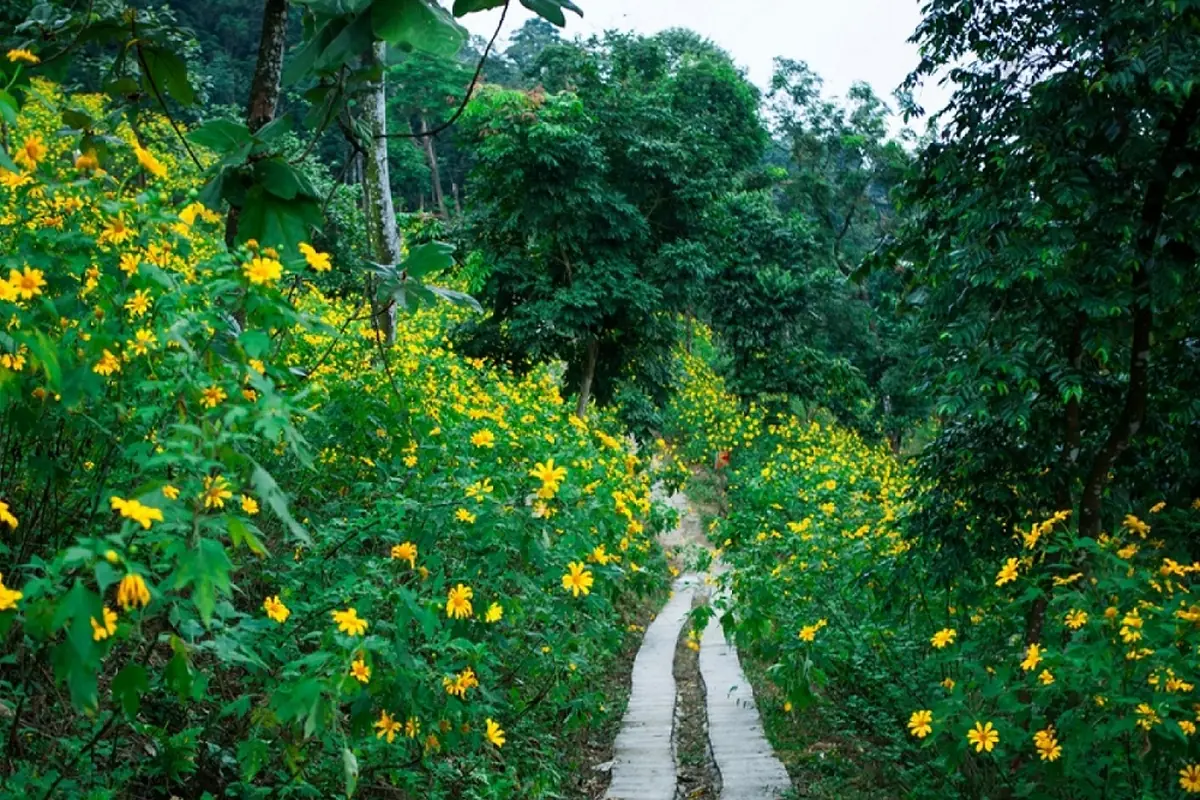
You will also spot flowers along the drive between the entrance and the pine forest. Pick a proper pull-off before stopping. The road carries motorbikes, cars and walkers, and visibility can be limited around tight corners. No safe pull-off means continuing to the parking area and walking back only where pedestrian access is permitted.
A common mistake is treating Ba Vi as one single viewpoint and aiming straight for the highest point on the map. That misses the reason for this particular outing. The main wild sunflower forest sits around the 400 m area, well below the 1,100 m road. You can visit higher viewpoints afterwards, but only if the people in your group still want to spend time on mountain roads after the flower walk.
Nobody has to finish the whole trail. A shorter walk can be enough for someone traveling with older relatives, young children or friends who are more interested in photos than hiking. Check the ground after rain, and do not let a long dress or slippery shoes decide how far everyone has to go. The flowers begin to feel much more enjoyable once you stop treating the entire loop as something you must finish.
Getting to Ba Vi from Hanoi
The two main approaches from Hanoi are via Thang Long Boulevard or National Highway 32, before joining Provincial Road 414, the Son Tay-Da Chong road. Look for the signposted turnoff at around Km 8+800 on Road 414. Put the full park name into your navigation app; typing only “Ba Vi” may take you to somewhere else in the wider district.
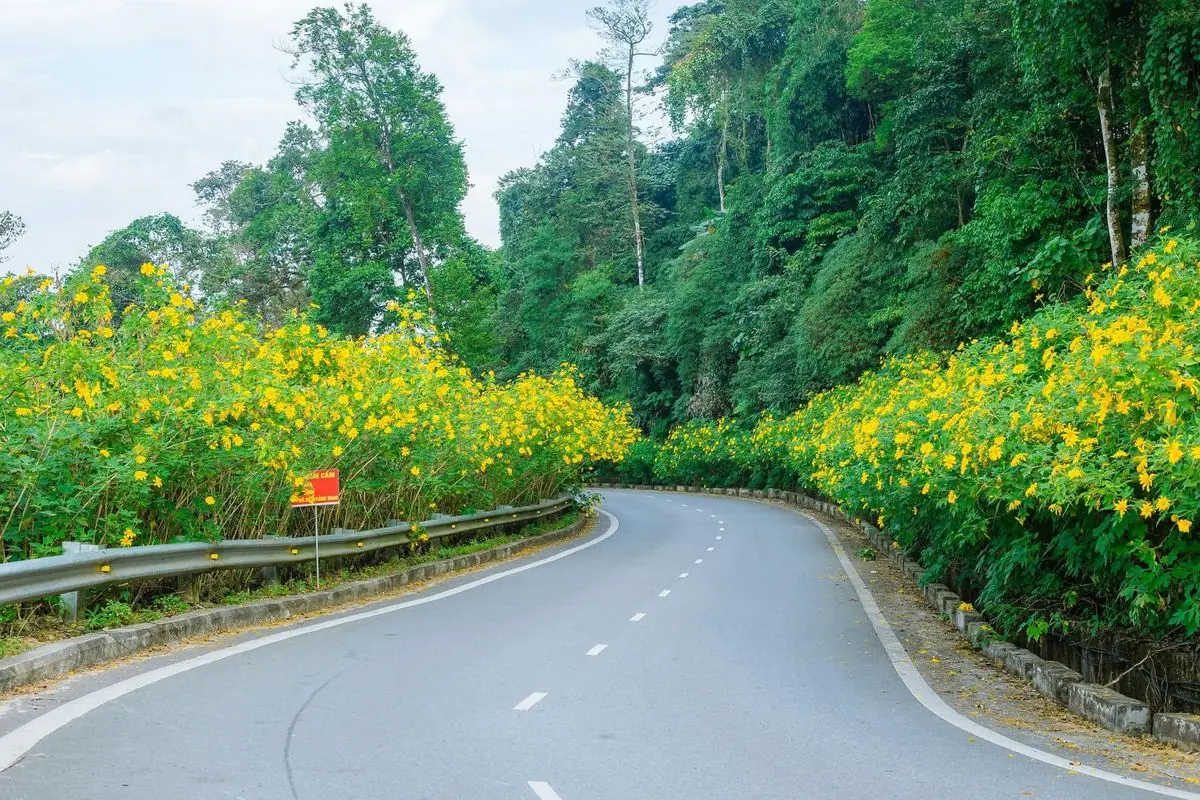
By private car or motorbike, allow roughly 1.5-2 hours from Hanoi to the park area under favorable traffic conditions, with extra time for the gate, the mountain climb and parking. The final uphill section is different from the main road out of the city. Expect slopes, sharp curves and sections where you cannot see oncoming vehicles until late. Fill the fuel tank before climbing and make sure brakes and tires are in good condition.
Public transport is possible, but it is less convenient than driving. One commonly used combination is bus 71 from My Dinh Bus Station to Son Tay Bus Station, followed by bus 110 towards Ba Vi National Park and Da Chong. The 110 route reaches the park’s ticket-gate area. It does not take you all the way uphill to the wild sunflower forest, so you still need to arrange suitable onward transport from the entrance and confirm your route back. Bus routes, times and stops can change, so check the current schedule close to your travel date.
It is worth planning your return before setting off. On buses, the last feasible connection matters more than a sunset photograph. Agree with a hired driver whether they will wait near the park entrance or accompany you to the parking area higher up. A long walk down a dark, winding road is not a good fallback plan.
Can you visit Ba Vi from Hai Phong in one day?
Yes, a day trip by car from Hai Phong is possible, but it is a much longer day than a departure from Hanoi. A typical road approach uses the Hanoi-Hai Phong Expressway, connects towards the western side of Hanoi and continues to the Ba Vi area. The route and travel time depend on where you start in Hai Phong, how you cross the Hanoi area and traffic conditions. An expressway estimate in your app does not include the climb to the flower trail.
Traveling together by car gives a group of friends control over stops and makes it easier to carry jackets, snacks and a change of clothes. An early start lets you reach the park while the light is still gentle, and it leaves room for a break before driving home. If everyone prefers a relaxed breakfast and a late departure, consider staying one night around Ba Vi or Son Tay rather than squeezing the whole trip into a few hours.
Going by train or coach from Hai Phong to Hanoi and then switching to local buses can be done, but it involves several legs. You may spend most of the daylight hours in transit. That makes more sense as part of a trip where you are already staying in Hanoi, or where you can leave the return journey until the following day. Settle how you will get back first, then see how much time is left for the flowers.
When planning a group trip from Hai Phong, decide what the actual priority is. Flowers and photographs call for the best part of the morning at Ba Vi’s flower forest and a flexible afternoon. A group that also wants a mountain climb, a picnic and multiple photo stops may get more out of a night away than out of saving the cost of a room.
Ba Vi National Park entrance fees in 2026
Entry for the 2026 season is VND 60,000 per adult per visit. Students pay VND 20,000 and school pupils VND 10,000. A VND 30,000 concession ticket covers groups that qualify under the park’s rules.
Motorbike parking is VND 5,000 per vehicle, per visit, per parking point, and bicycle parking VND 3,000 on the same basis. Car parking is charged by vehicle type and time. Vehicles of up to nine seats pay VND 25,000 for the first and second hours, VND 35,000 for the third and fourth, and VND 45,000 from the fifth hour onward. The electronic parking system already deducts time spent driving within the park, so pay the amount shown at the parking area.
Beyond park entry, there is no separate wild sunflower ticket to buy. Food, accommodation, camping services and any attractions operated separately may have their own charges. Check prices with the venue before booking a group meal. The main unavoidable costs are entry, transport and relevant parking; everything else depends on your choices.
From October 5 to December 13, 2026, the park opens earlier and closes later: 5:00 am-7:00 pm Monday through Thursday, and 4:00 am-8:00 pm Friday through Sunday. Special early ticket sales are for cloud-watchers and may be adjusted locally.
What time of day is best for photos?
Aim to reach the park entrance around 7:00-7:30 am, then walk the flower area between about 8:00 and 10:00 am. On a clear day the light is generally softer than at midday. The exact moment it reaches a particular group of flowers will depend on forest cover, the slope and the direction of the road. Morning sun on one section can mean deep shade on another just a short walk away.
Late afternoon, around 3:00-4:30 pm, can also work if the weather is dry and the path is not too misty. November cloud and fog can make the mountain feel cooler and darker than central Hanoi. Cloudy spells suit closer portraits with a softly blurred green background more than bright, wide landscape shots.
Midday usually means harder light, especially on exposed roadside sections. It can produce strong shadows under the eyes and make everyone squint. You can still enjoy the walk, eat something and take a few pictures in the shade, but there is no need to schedule a long portrait session in full noon sunshine. A midday-only visit still works in spots where the flowers are lit from the side rather than directly overhead.
Check the forecast for the Ba Vi mountain area, not just Hanoi city. A dry forecast for central Hanoi says little about visibility or trail conditions higher up. Light drizzle can make leaves look fresh and colorful, but wet paths and steep roads require more care. Bring a small waterproof bag for your phone and a light jacket for early morning stops.
What should you wear with yellow wild sunflowers?
White, cream, beige, pale blue, denim, navy and light brown are easy colors to wear against yellow wild sunflowers. A white knit top with jeans, a simple cream dress with sneakers or a pale blue shirt can work without looking overly styled. Groups look more natural in a loose palette of neutral colors than in identical outfits.
Bright yellow or orange clothing can look playful, but it can also disappear into a background full of flowers. If you really want a yellow sweater, pair it with dark trousers or take some pictures against green foliage so the colors do not merge. An all-black outfit provides strong contrast, though it can feel visually heavy in a scene with so much sunlight and bright vegetation.
Shoes matter more than many people expect. A long dress and heeled boots may photograph well by the roadside, but neither is comfortable on a damp woodland trail. Wear flat, grippy shoes for walking. If you want a different look for portraits, carry a small accessory or change into it only on a safe, level section. Do not let a photo outfit become a reason to step off the path or take unnecessary risks near the road.
For phone photos, place your subject slightly to one side, keep a few flowers in the foreground and include the curve of the path behind. Portrait mode works well when there is enough distance between the person and the background. Try taking one photograph at eye level and another from a slightly lower angle; the lower shot can make nearby flower heads look fuller without needing to move closer to the plants.
For three to five friends, standing at slightly different depths on a safe pedestrian path often works better than forming a straight line. Take a full-length shot, a closer portrait and a few relaxed pictures while the group is walking. Do not block the traffic lane to create a perfectly symmetrical composition. The safest photographer in the group is the one who notices approaching vehicles before worrying about the exact position of a sleeve.
Take the photos, but leave the flowers intact
A wild sunflower bush takes time to develop its branches and blooms. One person stepping inside it can break several stems even if the damage is invisible in the final photograph. Ba Vi National Park explicitly prohibits picking flowers, breaking branches and uprooting plants. Do not pull a stem around your shoulder, bend a branch towards your face or place a backpack on the foliage for a quick portrait.
Stick to the marked walking trails and respect any taped-off or restricted sections. The flowers that look best from a distance may be growing on fragile or uneven ground. Find another angle instead of creating your own route through the vegetation.
Mountain roads deserve the same respect. The park can refuse service to visitors involved in dangerous riding, speeding, stunts or other prohibited behavior. Standing in the middle of a blind curve is risky even if the road looks empty in your camera preview. For images of the winding road, choose a safe position outside the traffic lane and do not ask friends to stop moving vehicles simply to make the scene look deserted.
Carry bottles, tissues and snack wrappers back to a proper trash can. Eat at a rest area away from the flower bushes. Small habits make a difference in a place that may welcome thousands of visitors during peak weekends.
Where else can you see wild sunflowers in Vietnam?
Ba Vi is the easiest answer for a day out near Hanoi, but it is not the only place worth knowing. The broader wild sunflower season also brings yellow hillsides to the Central Highlands and smaller displays to parts of northern Vietnam. These destinations do not peak on exactly the same dates, and the experience changes from forest paths to volcanic slopes and long roadside drives.
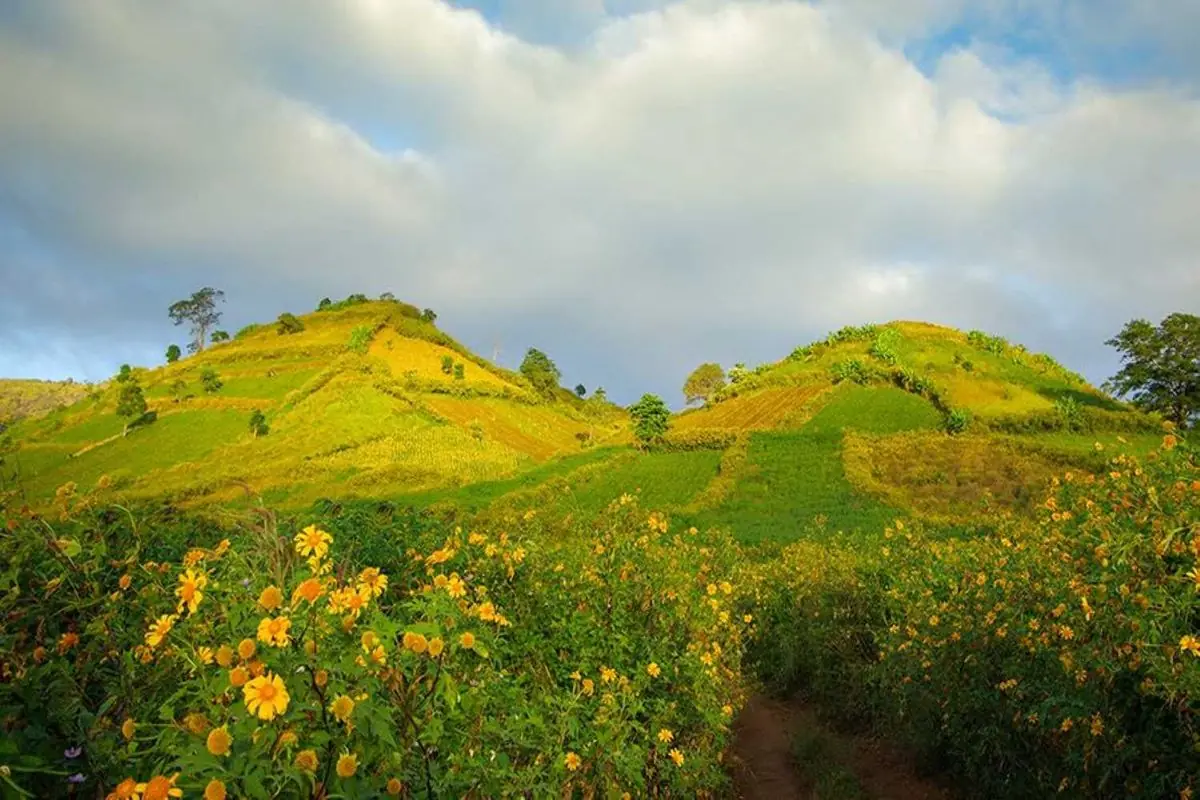
Chu Dang Ya, Gia Lai
Volcanic slopes and red earth
Chu Dang Ya, Gia Lai, is one of the best-known Central Highlands locations. Wild sunflowers grow around the slopes of an extinct volcano, making yellow patches stand out against red earth and farmland. November is the month to watch, and the area lies roughly 30 km from Pleiku. It is a different kind of outing from Ba Vi: a highland landscape rather than a woodland flower trail. The 2026 Gong Culture Festival - Wild Sunflower Week - Chu Dang Ya Volcano ran from October 30 to November 8, though the flowers are not limited to those days.
Da Lat, Lam Dong
Flower-lined suburban roads
Da Lat, Lam Dong, is popular for wild sunflowers beside suburban and mountain roads. The flowers tend to grow around Cam Ly-Van Thanh, the road towards Ta Nung, Huyen Tran Cong Chua Street and stretches around Prenn Pass. Watch conditions from late October through November, with some late flowers possible into early December. You may see a magnificent patch on one road and very little on the next. Choosing a recently photographed location is more reliable than following a years-old list of picturesque roads.
Ha Giang
Pair it with buckwheat season
Ha Giang, in northern Vietnam, has yellow wild sunflowers around the former Phong Quang area, now within Ha Giang 2 Ward, including Lung Cang and Ban Man. In November 2025, almost 3 km of roads at Lung Cang were lined with flowers. This is a worthwhile extra stop if you are already exploring the northern mountains, especially in the same period as buckwheat flowers. It is not a reason to assume every Ha Giang mountain pass will be lined with wild sunflowers. Check locally updated images before making a detour.
Moc Chau, Son La
Flowers on the way to the tea hills
Moc Chau, Son La, also has dã quỳ along roads and around tea-growing areas, typically from late October into November. Roads towards Tan Lap and Pa Phach, along with smaller lanes near the former town area, are places where visitors have found flowers. There is no single managed flower garden with one ticket counter. Think of the flowers as something to enjoy while traveling between tea hills and villages. Ba Vi still saves considerably more travel time on a simple day trip from Hanoi.
From a Hanoi base, the choice is straightforward. Pick Ba Vi for a flexible one-day outing, Ha Giang or Moc Chau when you already have a multi-day northern itinerary, and Da Lat or Gia Lai when you are traveling through the Central Highlands. A photo from one province tells you very little about the current bloom status in another.
How to turn the Ba Vi flower trip into an easy day out
Keep the itinerary loose. A realistic outline from Hanoi is to leave around 6:00 am, aim for the park gate around 7:30 am in favorable traffic, and spend the morning at the wild sunflower forest. Walk and take photographs until roughly 10:30 am, then stop for food or a break before deciding whether to continue uphill.
The pine forest right next to it is an easy addition after the yellow blooms. It gives you a green, shaded backdrop and a chance to put the camera away for a while. Farther uphill, the old French church ruins near the 800 m elevation mark have moss-covered walls and a completely different atmosphere. They are an appealing second stop if the weather is clear and everyone has enough energy.
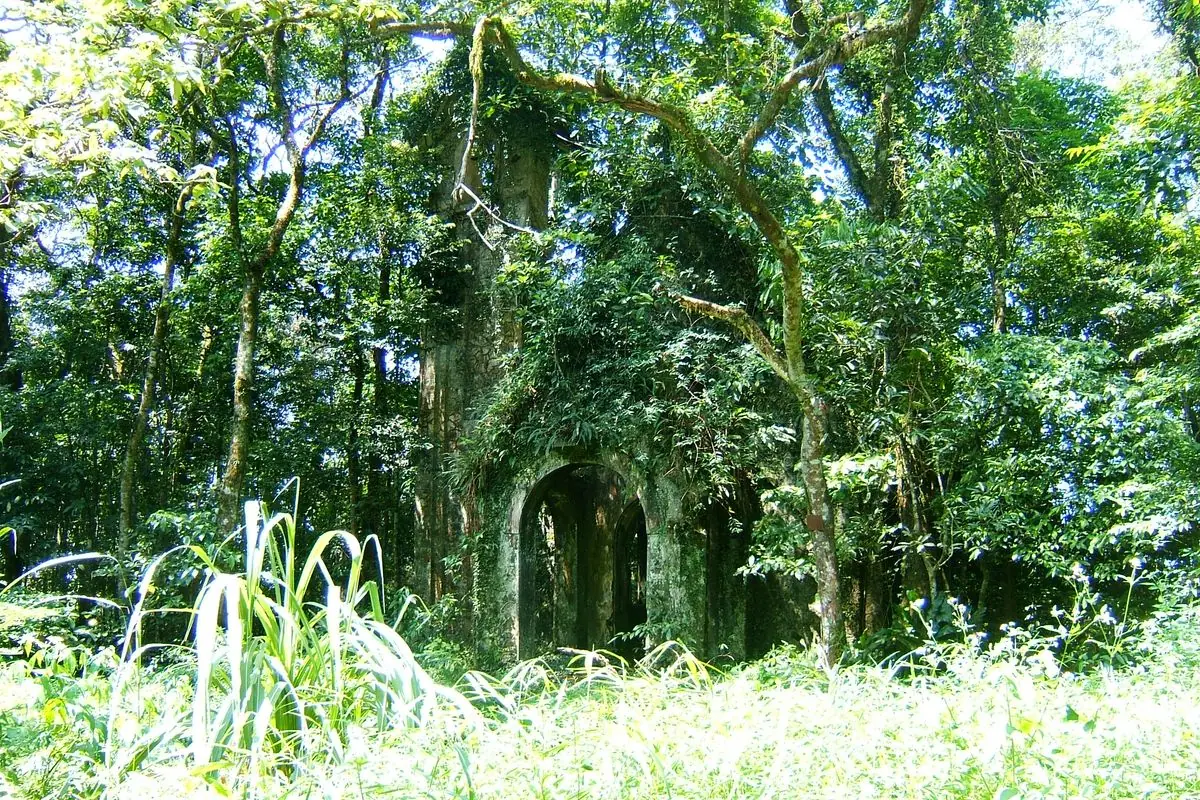
There are also stairways and religious sites at higher elevations, but do not underestimate the effort involved. The full flower trail, extra photo stops and a climb higher up can consume most of your daylight. You are not missing the point of the trip if you choose a quiet lunch instead of reaching another summit. The flowers are the reason you came.
Visitors from Hai Phong gain the most from a flexible afternoon, since the drive home is long. A relaxed meal and an early descent are often more pleasant than squeezing in one final attraction before dark. Staying overnight lets you divide the flower walk and mountain viewpoints between two days without racing the light.
The last decisions to make before leaving
Fewer crowds in your photos means a weekday during the park’s November 1-23, 2026 peak window and a morning arrival. A Saturday or Sunday still works: start early and accept that some of the popular photo spots will be busy. A busy trail can still be enjoyable when you are not trying to turn every corner into an empty background.
Persistent rain in the forecast is a reason to move the trip to a drier day; buying more photo props will not rescue it. On a short visit to Vietnam, the simplest arrangement may be a private car from Hanoi with the flower forest clearly specified as your stop. Visitors using local buses should confirm the return connection before climbing the mountain.
Farther afield, confirm the actual flowers near Chu Dang Ya, Cam Ly, Lung Cang or Tan Lap instead of assuming that all of Vietnam has a single November peak. Wild sunflower season in Vietnam is a good reason to get outside, and the best trip is one you can enjoy without rushing, damaging flowers or making unsafe stops.
Going on the weekend of November 21-22, 2026 means settling your transport and departure time before 8:00 pm on November 20, because Ba Vi’s peak window ends on November 23. For a day trip from Hanoi, aim to reach the entrance by 7:00-7:30 am and keep the morning for the flower forest.
Frequently asked questions
What month do wild sunflowers bloom in Vietnam?
Late October and November are the usual months to watch, with some locations still flowering in early December. For Ba Vi in 2026, the park expects flowers October 17-December 6, and the best window is November 1-23.
Where are wild sunflowers near Hanoi?
Ba Vi National Park is the easiest well-known option, roughly 60 km from central Hanoi. Follow the road towards the 400 m pine forest, continue about 200 m, park, then turn left and walk about 300 m to the flower forest.
Can I reach Ba Vi National Park without a motorbike?
Yes. A private car with a driver is straightforward, especially for visitors unfamiliar with mountain roads. Public transport can involve bus 71 from My Dinh to Son Tay and bus 110 towards the national park, but you still need onward transport up the mountain from the ticket gate.
What colors look best in wild sunflower photos?
White, cream, beige, soft blue, denim and light brown work well against yellow flowers. Wear flat shoes for the trail, take pictures from the path and leave the branches untouched.
How much is the Ba Vi National Park ticket in 2026?
The official entrance fee is VND 60,000 for adults, VND 20,000 for students and VND 10,000 for school pupils, with a VND 30,000 concession rate for eligible visitors. Motorbike parking is VND 5,000 per vehicle per visit per parking point; car parking varies by time and size.