Where to see Hanoi's November daisies, on flower bikes or in the gardens
For bicycles piled high with white daisies, you don't need to leave central Hanoi. For photos among rows of flowers, the gardens around Nhật Tân and the Red River banks are a better bet.
 24 min read
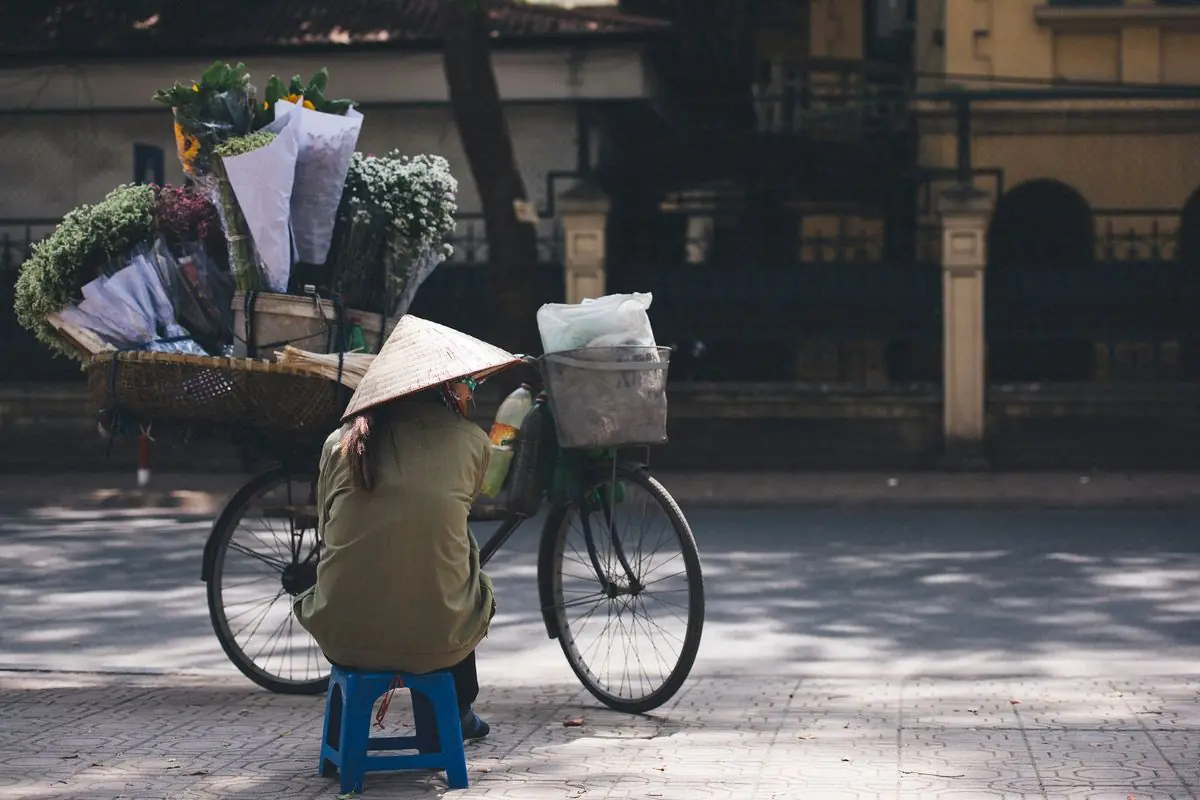
A vendor rests on a stool beside her flower bike.
At around 8 a.m. on Phan Đình Phùng Street, a bicycle piled high with little white flowers can make you stop in the middle of your morning walk. Those white petals surrounding yellow centers belong to cúc họa mi, the daisies associated with Hanoi’s transition from autumn to winter. November is the main season, particularly the middle and latter part of the month, though some flowers may remain into early December.
When is Hanoi daisy season?
A trip planned around the white daisies should aim for the second to fourth weeks of November. This is usually your best chance of finding both flower bicycles in town and gardens with enough blooms for photographs.
The season isn’t a fixed annual event. There’s no official opening date when every field turns white, and the flowers don’t follow an exact calendar.
Growers plant and harvest them according to local conditions. Rainfall, flooding, temperature and the timing of individual crops can all affect what visitors see.
A useful way to plan is to divide the season into three periods.
Late October to early November: The first bouquets may begin appearing on bicycles and at flower stalls. Some gardens will still have plenty of unopened buds, so a field photography session may be better saved for later.
Mid-to-late November: Usually the strongest window for white-daisy photographs. Flower vendors are more likely to have seasonal stock, and gardens may have more flowers in bloom.
Late November to early December: Still possible, but increasingly dependent on the year and the particular garden. A field photographed in November can look quite different two weeks later.
The most photogenic stage of an individual daisy crop can last only about two or three weeks. Staggered planting stretches the selling season across the city, but no single field stays in full bloom all through November.
This became especially clear in 2025. By November 10, many gardens in Tây Tựu and Nhật Tân had begun to flower, although heavy rain had damaged many plots. Yet on December 1, a garden near the Red River rock garden was still welcoming visitors for daisy photographs.
Both situations can happen in the same season.
The best weeks for Hanoi daisies in 2026
Hanoi’s daisy gardens don’t all reach peak bloom on the same date. Mid-to-late November is still the typical peak period.
If you’re booking time off, November 14-29, 2026 is a sensible window.
Avoid locking an entire morning into a particular flower garden weeks ahead. You may arrive to find that the first flowers have opened, but the field isn’t ready for photographs. Another garden nearby may be further along.
Early November still suits visitors more interested in the street vendors than a full field of white flowers.
December requires a different approach. In the first week, treat any daisies you find as an added pleasure.
A visit between December 5 and 10 might still bring some good bouquets. It might also be too late for the garden you had in mind.
What are the little white flowers on Hanoi’s bicycles?
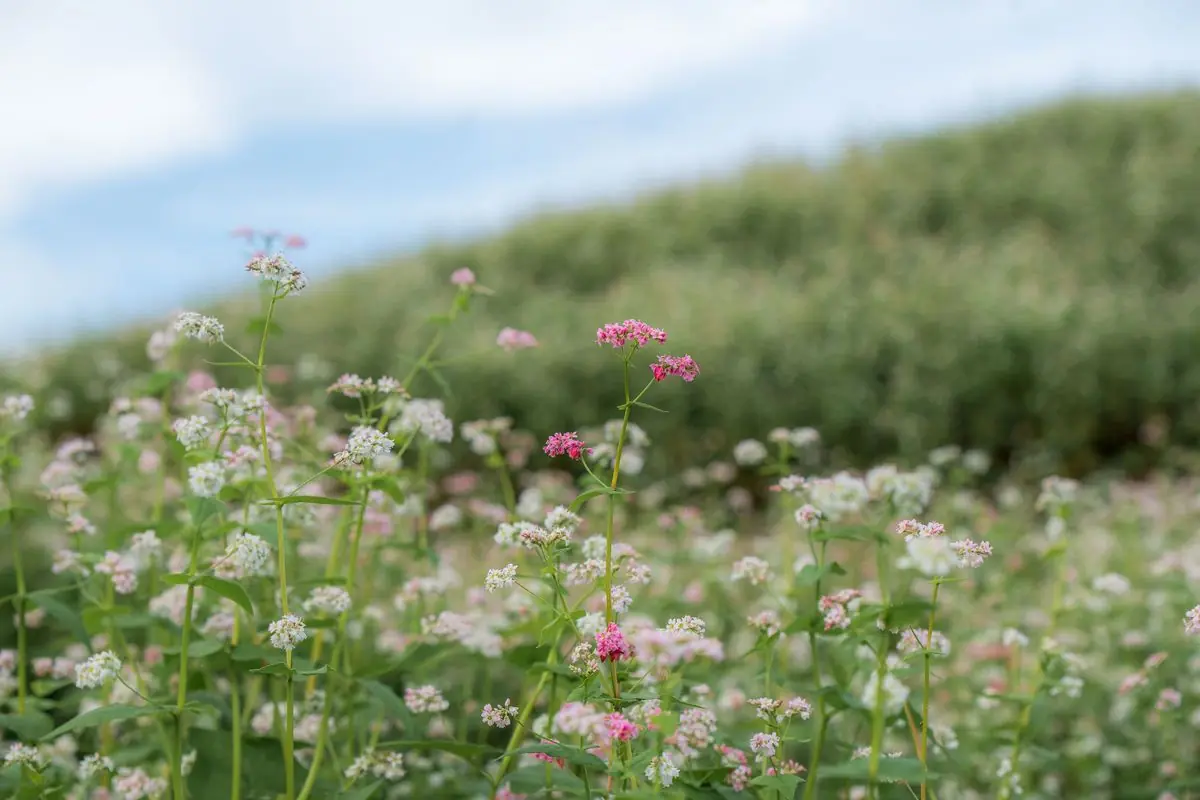
The flowers are locally called cúc họa mi. They’re small daisies with slender white petals arranged around yellow centers, usually growing in clusters on branching stems.
Unlike a single large rose or lily, each individual daisy is fairly modest. Together, however, dozens of flowering stems create a striking white display.
That’s why a traditional flower bicycle can look almost completely covered in white.
Some of the flowers will be fully open, while others remain in bud. Their stems and leaves form a green base beneath the blossoms.
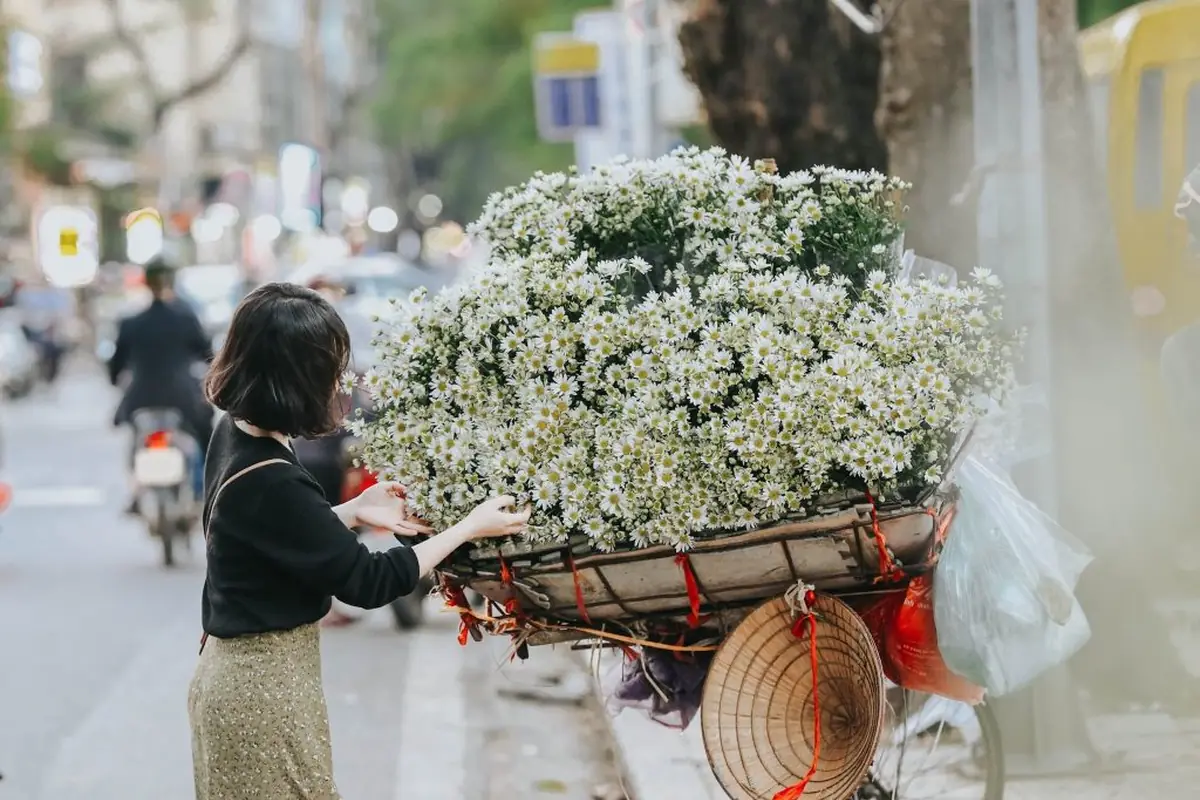
For English-speaking visitors, white daisies or Hanoi white daisies are the clearest everyday descriptions. Some people also call them ox-eye daisies.
Botanically, these names need some care. "Daisy" describes a broad range of flowers in the Asteraceae family, and a common name can cover several species or cultivars.
For shopping and travel purposes, the Vietnamese name is more useful. Ask for cúc họa mi or show the seller a picture, and they’ll generally understand which seasonal flowers you want.
Why are they associated with Hanoi’s early winter?
Hanoi has a strong tradition of selling fresh flowers from bicycles.
Depending on the time of year, the same sort of bicycle may carry roses, lilies, lotus flowers or other seasonal varieties. In November, small white daisies often become one of the most recognizable sights.
Flower-growing areas such as Nhật Tân and Tây Tựu supply seasonal flowers to markets and street vendors. From there, the bouquets travel into residential neighborhoods and the older parts of the city.
A bicycle is both transport and a mobile flower shop.
A vendor might stop near a tree-lined street to sell several bunches, then move on to another neighborhood. Others establish a regular selling spot, particularly where there are plenty of passersby.
This is part of what makes the flower bicycles memorable. They’re not permanent decorations set out for tourists. They belong to the city’s everyday trade.
The sight is especially appealing because it doesn’t last all year. By the time Hanoi settles further into winter, the familiar white bouquets can become harder to find.
Where can you find Hanoi’s white-daisy flower bikes?
Start with Phan Đình Phùng Street, Thanh Niên Road and Thụy Khuê Street. For years, these streets have been regular stops for Hanoi’s daisy vendors.
The bicycle you saw on a corner today may be somewhere else tomorrow. Vendors change routes, sell out, take days off and move when traffic or weather conditions make a location inconvenient.
Think of these streets as places to explore.
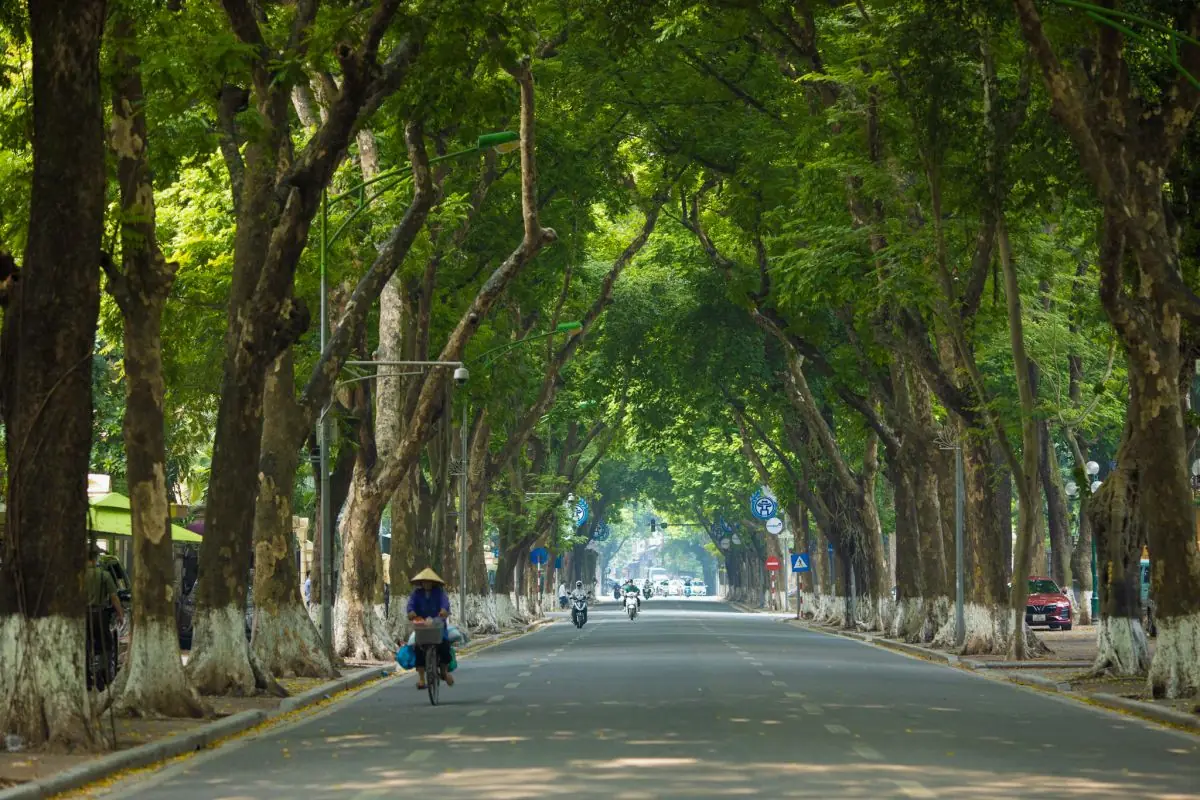
Phan Đình Phùng Street
The classic Hanoi flower-bike photograph
Phan Đình Phùng is probably the first place to consider if you’ve seen photographs of white daisies against Hanoi’s older architecture.
The street has large trees, stretches of attractive pavement, historic buildings and the distinctive atmosphere of northern Hanoi.
A bicycle carrying white daisies fits naturally into that setting.
The section around Cửa Bắc Church and Phan Đình Phùng High School is popular for seasonal photographs. It offers a combination of street scenery and architecture without requiring a trip outside the central area.
Spot a flower bicycle and you can ask permission to photograph it where it stands. Alternatively, buy a bouquet and walk to a quieter part of the pavement for portraits.
For softer light, try visiting between approximately 7 and 9 a.m. This is about the light; vendors keep no fixed timetable.
A weekday morning tends to give you more room to shoot.
The mistake is assuming that the best photograph must be taken right next to the bicycle. Sometimes the more interesting shot includes the entire bicycle, the pavement and a stretch of the street behind it.
Give yourself room to show where you are.
Thanh Niên Road
Daisies beside West Lake
Thanh Niên Road runs between West Lake and Trúc Bạch Lake, making it a pleasant place for a short walk in November.
Flower vendors often pass along this route during the daisy season. Checking for white-daisy bicycles is easy to fit into a walk around the lake area.
You could approach from the Quán Thánh area, continue north along Thanh Niên and pause wherever you find a safely parked flower bicycle.
If there are no daisies that morning, the lakeside walk is still worthwhile.
That’s the advantage of this area.
A quick photography stop might take 15 or 20 minutes, including asking permission and buying a bouquet.
Afterwards, you can continue around West Lake or find somewhere to sit with a coffee.
Thụy Khuê Street
A more everyday setting
Thụy Khuê offers a slightly different experience.
It’s a busy local street with homes, shops and ordinary daily traffic. Flower bicycles have long been a seasonal sight here.
Unlike a commercial flower garden, there may be no obvious photography area. A seller might be taking a short break, serving customers or preparing to move.
Approach politely and ask whether photographs are welcome.
On a motorbike, resist tailing a moving flower bicycle in the hope it stops somewhere convenient. Find a safe parking place first.
You can combine Thụy Khuê with Thanh Niên Road and the West Lake neighborhood rather than treating it as a separate journey.
This route works well for visitors who enjoy walking through residential Hanoi and watching the city go about its day.
Yên Phụ
And the Quảng Bá area
The Yên Phụ area is another place worth considering during daisy season.
It’s connected to the West Lake neighborhood and the wider flower trade around Quảng Bá and Âu Cơ Street. Seasonal vendors may appear at different points along nearby roads.
The area is useful if you want to see both street selling and the city’s flower-market culture.
However, it’s not essential to go all the way to the wholesale market just to photograph one attractive bicycle.
From the Old Quarter, start with Phan Đình Phùng. From West Lake, look around Thanh Niên, Thụy Khuê and Yên Phụ.
Trying to visit every flower-bike location in a single morning can turn an enjoyable walk into a rather pointless search.
Is Quảng Bá Flower Market worth visiting?
Quảng Bá is one of Hanoi’s major flower markets, located in the Âu Cơ Street area of Tây Hồ.
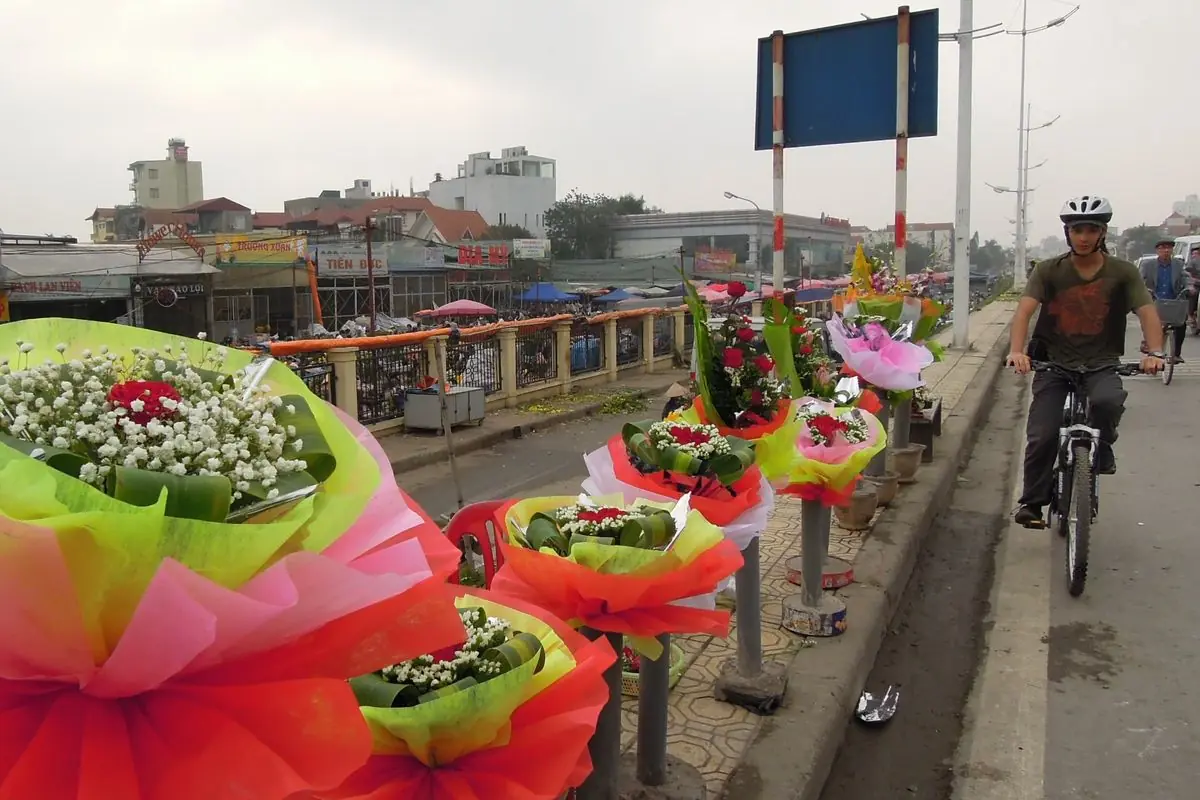
It’s much more than a white-daisy market. Sellers handle roses, chrysanthemums, lilies and many other flowers throughout the year.
The market generally trades from around 9 p.m. until 7 a.m. The busiest wholesale period is approximately 1-3 a.m., with activity starting to quiet down around 4-5 a.m.
Not every stall follows the same hours.
For visitors interested in flower trading rather than just shopping, around 4-5 a.m. can be a fascinating time.
Flowers arrive in bundles, buyers sort orders, and motorbikes carry large quantities away from the market.
There may also be retail sellers at that hour, although wholesale traders may give single-bouquet buyers little priority.
A bunch of daisies for your hotel room doesn’t justify a 3 a.m. alarm.
A street vendor later in the morning is likely to be more convenient.
How to behave at a working flower market
Quảng Bá is an active workplace, especially at night.
Keep your phone and belongings secure, and be prepared for uneven or wet ground.
Ask first before photographing an individual vendor. An open market isn’t a free pass to photograph every seller’s face or stall.
Ask whether a stall sells individual bouquets before separating a bunch from a larger order.
Someone buying a single bouquet may not get wholesale prices, either.
For a tourist, observing the market without interrupting it is often more enjoyable than trying to turn every transaction into a photo opportunity.
Flower gardens or street bicycles: which should you choose?
Skip the daisy fields if what attracted you to Hanoi’s flowers was the image of a bicycle on a tree-lined street.
The two experiences serve different purposes.
Street bicycles give you a sense of the city’s flower-selling culture. Gardens offer a larger floral setting, especially for portraits and traditional áo dài photography.
Your choice should depend on the photographs you want and how much time you can spare.
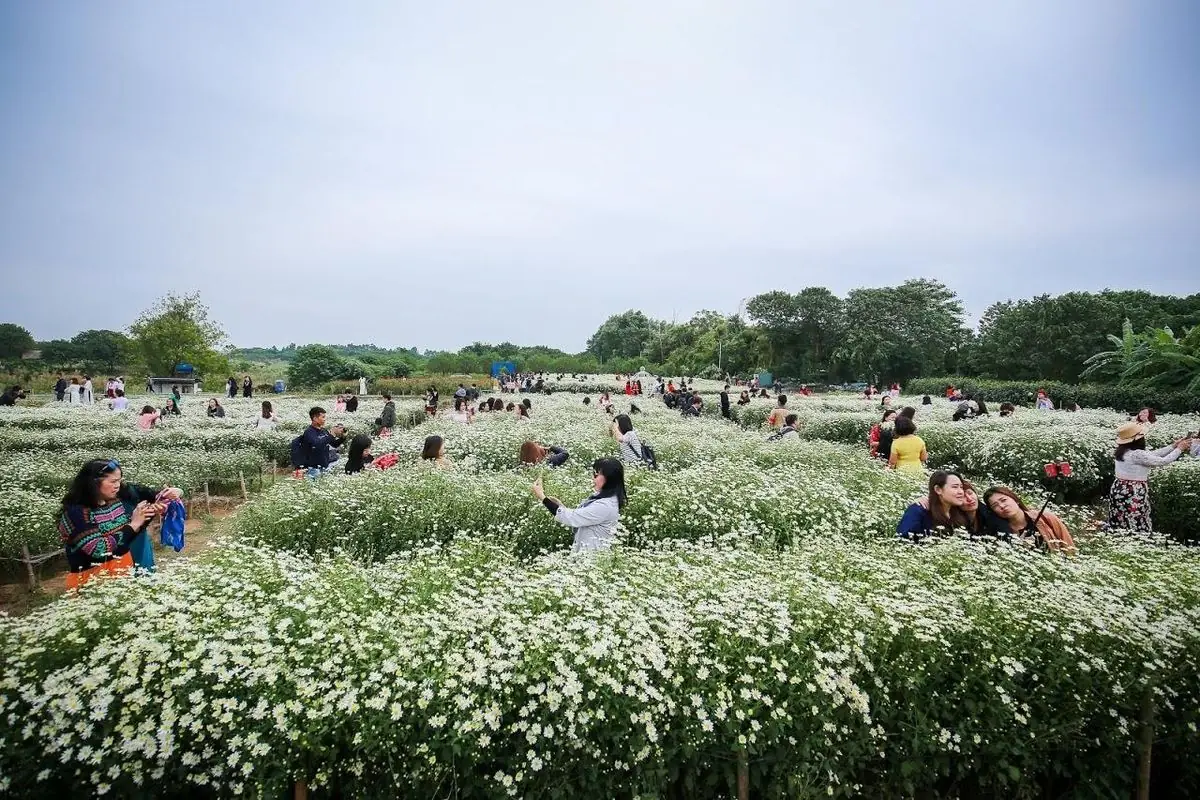
The Red River rock garden area
Alley 264 Âu Cơ
The gardens around the Red River rock garden, often approached via Alley 264 Âu Cơ, are among the well-known seasonal photography locations.
When daisies are flowering, some gardens provide rows of white blooms suitable for portraits.
They may also grow other varieties and set up photography features at different times of year.
In the 2025 season, one daisy garden in this area charged VND 40,000 per visitor.
Different gardens can have different operators, entrance arrangements and seasonal displays.
Before heading over, ask the specific garden whether its daisies are currently blooming, whether visitors can enter the flower beds and what admission costs.
Simply being told that "the Red River area has daisies" isn’t enough.
You could arrive at a garden where the flowers have already been harvested, while another plot nearby is still blooming.
Morning visits are generally more comfortable for photography, but rain can leave the paths between flower beds muddy.
Wear shoes that you can walk in without worrying about a little dirt.
Nhật Tân
Flower-growing area
Nhật Tân is widely known for its peach-blossom cultivation, particularly in the period before Tết.
It also has areas where white daisies are grown during the late-autumn season.
Because these are working flower fields, access differs from a commercial photography garden.
Some growers may welcome visitors or offer paid photography sessions. Others may be focused entirely on producing flowers for sale.
Ask the grower which paths are accessible for photographs. Stepping into the plants can damage stems and make harvesting harder.
Nhật Tân suits visitors interested in seeing where flowers are grown.
Tây Tựu
Flower village
Tây Tựu is another established flower-growing area, farther west of central Hanoi.
You’ll find a wider agricultural setting rather than a single purpose-built tourist attraction.
For someone interested in the flower trade, this can be rewarding. A visitor with only one afternoon free may find it requires more travel and preparation than expected.
A search for "Tây Tựu flower village" doesn’t identify one specific field that’s open for portraits.
Check with an individual grower or photography garden before traveling.
This is especially important late in the season, when some plots may already have been harvested.
On a short Hanoi itinerary, a street-bicycle session or a garden closer to West Lake will usually be easier to manage.
How to photograph Hanoi flower bikes respectfully
It’s natural to want a picture when you find a bicycle overflowing with white daisies.
But that bicycle is someone’s business.
The owner may have spent the early morning preparing and transporting the flowers. Every bouquet on the bike is stock they hope to sell.
The simplest rule is to ask permission before treating the bicycle as a photo prop.
Fluent Vietnamese isn’t required. A polite question, a smile and a little patience are usually enough to start the conversation.
If you want to pose next to the bicycle, make that clear.
Taking a quick photograph of the flowers from a distance is different from moving bouquets around, leaning against the bicycle or asking the vendor to reposition it.
Those actions need explicit permission.
Should you buy flowers before taking pictures?
Buying a bouquet is a thoughtful way to support the vendor, especially if you’d like to spend a few minutes taking pictures.
However, buying flowers doesn’t give you unlimited access to the bicycle or the seller.
Some vendors may be happy to let you take a few photographs after buying. Others may charge separately for using their flowers as photography props.
In the 2025 season, bouquet rental along Phan Đình Phùng Street cost VND 30,000-50,000 per session.
That money paid for borrowing the flowers for photos; the bouquet stayed with the seller.
Ask whether the amount quoted covers buying the flowers or using them temporarily for photographs.
Agree on the price before you begin.
If the seller doesn’t want to be photographed, respect that decision. You can still ask whether it’s acceptable to take a close-up of the flowers without including their face.
Don’t stop the vendor from selling
A bicycle surrounded by photographers may look appealing in pictures, but it can make business difficult.
Step aside when customers approach so they can examine the bouquets and make purchases.
Avoid holding the flowers while the vendor is trying to serve someone else.
Don’t remove a bunch from the bicycle unless invited to do so. The flowers may be tied together tightly to keep them secure during transport.
Pulling out stems for a photograph can damage the arrangement or break the flowers.
For group photos, agree on a few quick shots rather than expecting the vendor to wait while everyone takes an individual portrait.
Is it acceptable to photograph the flower seller?
Ask directly when the person will be recognizable in your picture.
This matters most if you intend to post the photograph publicly or use it in commercial content.
A seller standing beside flowers may not be posing for you. They may be resting, counting money or simply watching their stock.
A clear yes is better than interpreting silence or a polite smile as permission.
Travel bloggers should take extra care to distinguish a genuine street scene from a staged portrait that required the vendor’s participation.
There’s nothing wrong with arranging a photograph together, as long as the seller understands and agrees.
Tips for photographing white daisies with a phone
White flowers can be surprisingly difficult to photograph.
In strong sunlight, phone cameras sometimes overexpose the petals, turning a cluster of individual blooms into one bright white patch.
When taking a close-up, tap the flowers on your screen and reduce exposure slightly if necessary. This helps preserve the separation between the petals.
A darker background can make the white flowers stand out.
Green trees, old yellow walls and shaded areas often work better than a bright sky directly behind the bouquet.
Try placing a person holding daisies a little away from the bicycle. This gives you two distinct elements: the person with the bouquet and the larger arrangement behind them.
For full-body portraits, leave enough space to show part of the street.
A photograph filled entirely with flowers could have been taken almost anywhere. Including a small amount of Hanoi’s architecture makes the location more recognizable.
What should you wear for daisy photographs?
There isn’t a special dress code.
Plain colors such as cream, light brown, navy or muted green work nicely with white flowers. Traditional áo dài is also a popular choice for seasonal portraits.
But don’t let the outfit become more complicated than the outing itself.
A comfortable sweater, jeans and a simple bouquet can work just as well.
Prioritize shoes that won’t hurt after several hours of walking through Hanoi.
The weather can change quickly at this time of year, so having a jacket you can easily remove is useful.
What if the weather is cloudy?
Cloudy weather can actually suit white-daisy photography.
Soft, diffused light can reduce harsh shadows and keep the petals from becoming overexposed.
You may lose some of the warm glow of a sunny morning, but portraits can look more even.
Try keeping bright gray skies out of most of the frame. Use trees or buildings as the background instead.
If it’s raining, protect your phone and give the vendor room to cover their flowers. Don’t expect someone to uncover a bicycle full of stock just so visitors can get a better photograph.
How much does a bunch of Hanoi daisies cost?
Bouquet prices vary considerably.
A small hand-tied bunch from a street vendor isn’t directly comparable with the large bundles transported from a flower farm. Wrapped gift bouquets can also cost more than flowers sold without packaging.
Here’s what bouquets cost in Hanoi in the 2025 season.
| Seller or location | Price | Date |
|---|---|---|
| Grower Minh in Nhật Tân and the wider market at the same time | Approximately VND 90,000 for a large bunch purchased at the farm; VND 150,000-200,000 for large bunches sold on the market | November 17, 2025 |
| Flower vendors on Đinh Tiên Hoàng Street | VND 140,000-170,000 per bouquet | December 1, 2025 |
| Bouquet rental for photography on Phan Đình Phùng Street | VND 30,000-50,000 per rental session | December 1, 2025 |
The farm price, the street price and the rental fee aren’t interchangeable.
A smaller bunch may cost less. A large arrangement prepared for gifting may cost more.
Before buying, ask the vendor to show you which bouquet the quoted price covers.
Before you decide one seller is pricier, compare bouquet size and stem count.
It’s easy to compare two prices and overlook that one bouquet contains far more flowers.
How to choose fresh daisies
The brightest white bouquet may not be the freshest one.
Look for stems carrying a mixture of open flowers and firm buds. The fully open flowers make the bouquet attractive immediately, while the buds may continue developing after you bring it home.
Examine the petals for excessive browning, drooping or damage.
A few imperfect petals are normal in a large bundle of small flowers. But if most flower heads look tired, it may be better to choose another bunch.
The stems should feel reasonably firm rather than soft or slimy at the base.
Buy flowers that have been kept hydrated or protected from prolonged heat.
Avoid leaving a bouquet inside a warm car or motorbike storage compartment while you spend the afternoon sightseeing.
Should you buy a large bouquet for photos?
A large bouquet fills out a portrait, but think about what happens afterwards.
You’ll have to carry it while walking, eating and getting into vehicles. Long stems can bend or snap, and the wrapping paper may get damaged.
A medium-sized bunch is usually more practical for a full day in the Old Quarter.
For group photographs, one or two bouquets can be shared among several people.
Consider buying flowers toward the end of your outing. Alternatively, return to your room to put them in water before continuing with the rest of the day.
How to keep Hanoi daisies fresh in a vase
White daisies are cut flowers, so their vase life depends on the condition of the stems when purchased and the care they receive afterwards.
There’s no reliable fixed number of days that applies to every bouquet sold on the street.
Flowers that were freshly harvested and kept cool may last longer than flowers that have already spent hours exposed to the sun.
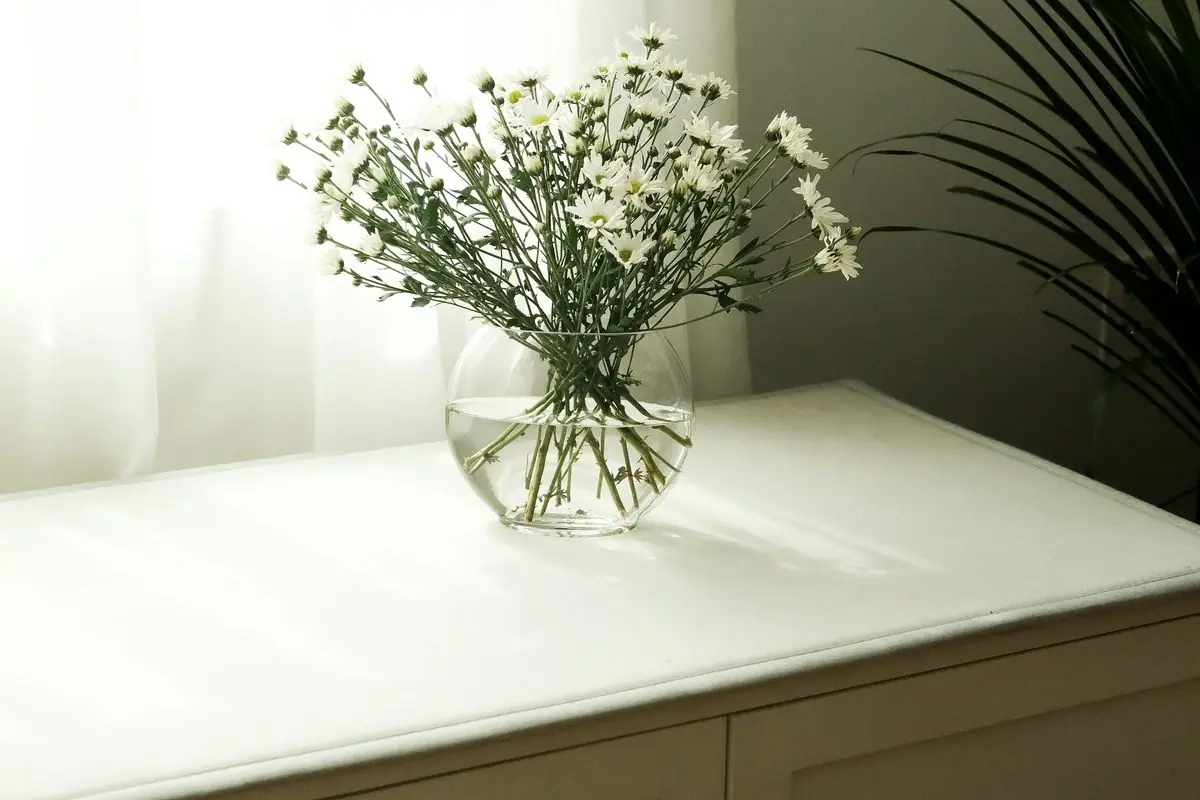
The most effective care is fairly straightforward.
Start with a clean vase
Wash the vase before arranging your flowers.
Bacteria and old plant material in the water can shorten the life of cut flowers. A clean container gives the new bouquet a better start.
Choose a vase with enough height to support the stems.
A very large bunch can be divided into two smaller arrangements.
This makes the flowers easier to arrange and prevents the stems from being packed too tightly.
Fill the vase with clean water so all stems can reach it.
A simple container is enough. A plain glass vase or ceramic jug suits a loose arrangement of small white daisies.
Trim the stems
Before putting the flowers into the vase, use clean, sharp scissors or garden shears to remove approximately 1-2 cm from the bottom of each stem.
A fresh cut helps the stems absorb water.
Place the flowers in water promptly after trimming.
Remove leaves that would sit below the waterline. Submerged leaves can decay and make the water cloudy.
Healthy foliage above the water can remain if you like a natural-looking arrangement.
Check that the bunch isn’t held together so tightly that the stems can’t spread comfortably.
Keep the flowers away from heat
A cool room is generally better than a windowsill receiving several hours of direct afternoon sunlight.
Avoid placing flowers beside cooking equipment, heaters or other heat sources.
Air-conditioning is fine, but don’t put the arrangement directly beneath a strong airflow.
If you’d like to photograph the vase near a window, move it into the light briefly and return it to a cooler position afterwards.
Change the water regularly
Check the water level every day.
Replace the water approximately every one or two days, or sooner if it becomes cloudy. Clean the vase as needed.
Every few days, trim a little from the ends of the stems again.
Remove flowers that have browned, broken or wilted badly. This also helps the remaining arrangement look fresher.
Commercial cut-flower food can be used according to the packet instructions.
Without it, clean water does the job. Skip random amounts of aspirin, fizzy drinks or sugar.
What if you’re staying in Hanoi for only a few nights?
A bouquet can still be worth buying, even if you’re leaving soon.
Ask your hotel whether it can provide a vase or a suitable container. A clean water jug may also work for a small bouquet.
In a small room, a modest bunch works better than the largest one on the bicycle.
And if you’re flying home, remember that taking fresh flowers across an international border may be subject to plant-health and customs rules.
A bouquet that is easy to buy in Hanoi may still be refused entry into another country.
When you’re unsure about the destination’s rules, enjoy the flowers during your stay rather than planning to carry them home.
What do white daisies symbolize in Hanoi?
For many people, cúc họa mi suggests simplicity, sincerity and a gentle kind of affection.
Their small white petals are often associated with purity and innocence, while their brief season can evoke memories of Hanoi’s late autumn.
Those meanings are cultural associations rather than universal rules.
A bouquet can mean something different depending on who gives it, who receives it and the occasion.
For friends, the flowers might simply be a seasonal gift: a little reminder that Hanoi is at its prettiest time of year.
White daisies can suggest uncomplicated affection and sincerity to a romantic partner.
For family members, they can be a thoughtful choice when the recipient enjoys delicate flowers rather than a large formal arrangement.
What does giving white daisies mean?
A bunch of white daisies generally conveys a feeling of gentle affection, appreciation or goodwill.
It’s less formal than an elaborate flower arrangement, which can be part of its appeal.
In Hanoi, the timing itself adds meaning to a gift of daisies. You’re sharing a flower associated with a season that passes quickly.
For a birthday, a small celebration or a simple thank-you, they’re an attractive choice when the recipient likes this kind of flower.
Flower symbolism varies among cultures and personal preferences.
Large white chrysanthemums can be used in different ceremonial contexts, while Hanoi’s tiny seasonal daisies are widely enjoyed as everyday decorative flowers.
As a gift for someone from another country, the simplest explanation may be the best: these are the little white flowers that appear in Hanoi as winter approaches.
Are there pink Hanoi daisies?
You may come across flowers marketed as pink daisies or even cúc họa mi hồng.
Daisy-like flowers exist in many colors, and some related horticultural varieties have pink petals.
However, the classic Hanoi November flower is the small white daisy with a yellow center.
A pink flower sold under a similar name may be a different variety, since sellers often borrow familiar names for look-alike flowers.
Ask specifically for cúc họa mi trắng to get the flowers you’ve seen on Hanoi’s November bicycles.
How to fit daisy season into a November or December Hanoi itinerary
An entire Hanoi holiday doesn’t have to revolve around daisies.
The most enjoyable approach is usually to add a short flower stop to a route you already want to take.
This is especially true if you’re visiting in November, when there’s plenty to do elsewhere in the city.
If you have one day in Hanoi
Start with the Old Quarter and set aside part of the morning for Phan Đình Phùng Street.
Around 8 a.m., you could walk the street, look for a daisy bicycle and take a few photographs if the vendor agrees.
Afterwards, continue toward West Lake or return to the main attractions in the city center.
Allow roughly 30-45 minutes for the flower stop.
The flowers should fit into your day.
If you have two or three days
A longer stay gives you the freedom to choose a better morning for photography.
Keep one day focused on the Old Quarter and central Hanoi. Use another morning to explore West Lake, Thanh Niên Road and, if the daisies are blooming, a garden near the Red River.
This works better than trying to visit Nhật Tân, Tây Tựu, Phan Đình Phùng and Quảng Bá one after another.
Those places have different purposes. Some are working flower-growing areas, others are streets with mobile vendors, and Quảng Bá is primarily a trading market.
Before leaving your accommodation, confirm that the garden you plan to photograph is open and flowering.
What to wear in Hanoi in November and December
November is often more comfortable for walking than Hanoi’s hot summer months, but the weather can still change.
Early mornings may feel cool, especially on windy days around West Lake. December can bring colder conditions, particularly when you’re standing outside for photographs rather than walking continuously.
Bring a light jacket or extra layer, and wear comfortable shoes if you expect to explore several neighborhoods.
Check the local forecast shortly before your outing.
Can you combine daisy photography with Hanoi Train Street?
You can include Train Street as a separate stop in a central Hanoi itinerary, but it’s not a particularly useful place to search for white-daisy bicycles.
Follow the railway access and safety rules. Don’t enter a restricted railway area or follow someone onto the tracks for a photograph.
Look them up before you decide to go.
A relaxed half-day Hanoi daisy route
Here’s a simple morning schedule starting from the Old Quarter.
| Time | Suggested plan |
|---|---|
| 7:30 a.m. | Leave your accommodation for Phan Đình Phùng Street |
| 8:00-8:40 a.m. | Walk the street and look for white-daisy bicycles |
| 8:40-9:00 a.m. | Ask permission for photos and buy a bouquet if you’d like one |
| 9:00-9:30 a.m. | Stop by the Cửa Bắc area or keep walking |
| 9:30-10:30 a.m. | Head toward Thanh Niên Road and enjoy the lakes |
| After 10:30 a.m. | Stop for coffee or return to your main sightseeing itinerary |
These times are only for planning; vendors don’t keep opening hours.
With no bicycle on Phan Đình Phùng, carry on toward Thanh Niên.
After two streets without daisies, stop searching and enjoy the lakeside neighborhood instead.
Visitors heading to a flower garden should plan a separate outing, particularly if they’ll be taking portraits and changing outfits.
A garden session can take longer because you need to travel there, locate the correct entrance, arrange admission and walk between flower beds.
What if you’re traveling with children?
A quick stop beside a flower bicycle is much simpler than a lengthy photography session in a field.
Children may enjoy choosing a small bouquet and looking closely at the white petals. But narrow pavements and busy roads require attention.
Keep children away from moving vehicles and ask the vendor before allowing them to touch the flowers.
A garden with clear visitor paths is a better choice than a working field where the flowers are easily damaged.
What if you prefer candid street photographs?
Posing with the bicycle is optional.
A picture of the bouquet, the bicycle’s handlebars and a stretch of pavement can tell the story of Hanoi’s daisy season without including anyone’s face.
Try photographing small details: the green stems beneath the white flowers, the way bouquets are tied to the bicycle, or the contrast between the flowers and an old yellow wall.
These images often convey a stronger sense of place than a heavily arranged portrait.
Just avoid getting so close that you interfere with the seller’s business.
The simplest choice for first-time visitors
First-time visitors in November can make Phan Đình Phùng and Thanh Niên part of a morning walk.
A portrait surrounded by thousands of flowers calls for a commercial garden near the Red River; verify its current blooms first.
A December visit needs a flexible plan.
The city is still worth exploring when the last daisy bicycles have disappeared.
Daisies bought early in the day should go back into water before several more hours of sightseeing. A clean vase and freshly trimmed stems will do more for the bouquet than keeping it beautifully wrapped until evening.
Frequently asked questions
When do white daisies bloom in Hanoi?
Hanoi's white-daisy season generally begins around late October or early November, with the best chances of abundant flowers in mid-to-late November. Some fields and street vendors may still have daisies in early December. The exact flowering period varies with the weather and planting schedule.
What do white daisies symbolize in Hanoi?
White daisies are commonly associated with simplicity, sincerity, innocence and gentle affection. They can make a thoughtful seasonal gift for friends, family or a romantic partner. These meanings are cultural interpretations rather than fixed rules, so the message you attach to the bouquet matters most.
What is cúc họa mi called in English?
For travel and everyday conversation, white daisy, white daisies and Hanoi white daisies are useful terms. You may also see the name ox-eye daisy. Because common names may refer to different plants, the Vietnamese name cúc họa mi is often the clearest choice when asking a Hanoi flower seller.
Can Hanoi daisies be pink?
Some daisy-like flowers and cultivated varieties have pink petals, and certain sellers may use names such as pink cúc họa mi. However, the traditional Hanoi flower seen on bicycles during November is white with a yellow centre.
Do you have to pay to photograph a flower bicycle?
There is no universal photography fee. Some vendors are happy for you to take a few pictures after buying a bouquet, while others may charge for renting flowers as props. Ask first and agree on any payment before taking photographs. In the 2025 season, renting a bouquet on Phan Đình Phùng Street cost VND 30,000-50,000 per session, and this year's rate may differ.