Choose where to stay in Sa Pa for an easier, more comfortable trip
Before booking accommodation in Sa Pa, mark your planned stops on a map. Stay in town if Fansipan and local restaurants are your priorities, or head into Muong Hoa Valley for rice terraces and quieter mornings. This guide covers the best areas, room prices, winter facilities, and transport arrangements.
 25 min read

Sa Pa Lake lies mirror-still, reflecting the row of lakeside hotels and the hill behind town.
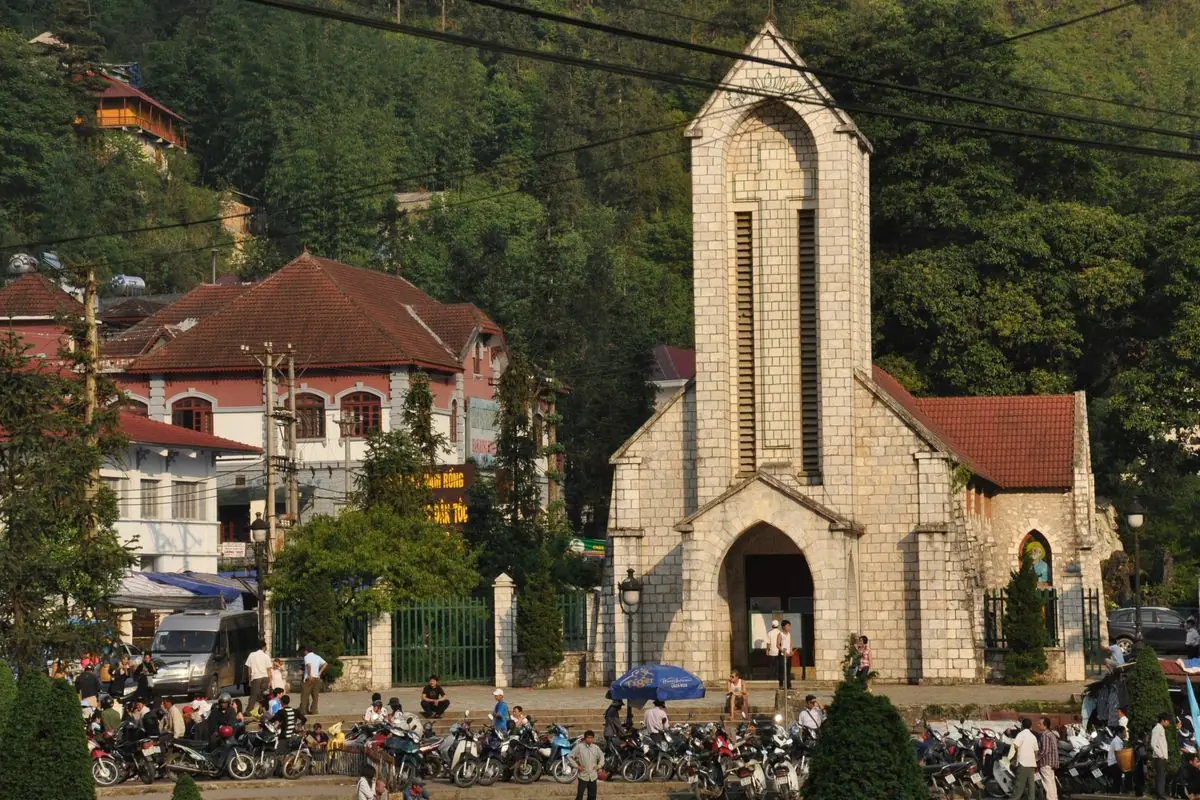
The Sun Plaza sign stands beside Hôtel de la Coupole on Hoang Lien Street, just a few minutes’ walk from Sa Pa Stone Church. For a one- or two-night visit, this central area and the streets around Sa Pa Lake are usually the most convenient places to stay. If you’d rather wake up to terraced rice fields outside your window, look toward Lao Chai, Ta Van, or the mountain lodges overlooking Muong Hoa Valley.
Which area of Sa Pa should you stay in?
There are two quite different ways to experience Sa Pa. In town, hotels, restaurants, cafés, and several attractions are within walking distance. Down in the valley villages, the houses are more spread out, the surroundings are quieter, and getting around often depends on transport arranged by your accommodation.
| Area | Best for | What to consider |
|---|---|---|
| Stone Church and Sun Plaza | First-time visitors, 1-2 night trips, Fansipan sightseeing | Busy on weekends; some rooms face noisy streets |
| Sa Pa Lake | Families, walkers, travelers wanting plenty of hotel options | Not every hotel has a mountain view |
| Muong Hoa Street and the hillside overlooking the valley | Couples and families wanting mountain views near town | Steep roads; some hotels have entrances at different elevations |
| Fansipan Street and the edge of town near Cat Cat | Travelers interested in mountain scenery and Cat Cat Village | Walking back into town may involve a steep uphill climb |
| Lao Chai, Ta Van, and Y Linh Ho | Trekkers, homestay guests, and travelers seeking village surroundings | Farther from town; return transport needs planning |
| Remote resorts and ecolodges | Couples, nature lovers, and travelers planning 2-3 relaxing days | Longer transfers and greater dependence on shuttle schedules |
An easy way to decide is to think about your evenings.
Would you like to finish dinner, stroll around the central square, stop at another café, and walk back to your hotel? Stay in town.
Would you rather have dinner at your accommodation, wake up near rice terraces, and spend the next morning walking around the village without returning to town? Lao Chai or Ta Van makes more sense.
For a three-night visit, you could spend two nights in town and one in Muong Hoa Valley. Just remember that changing accommodation also means checking out, moving your luggage, arranging transport, and possibly waiting for your next room.
Sometimes staying all three nights in one place is the more relaxing choice.
Central Sa Pa: the most convenient choice for first-time visitors
Around Sa Pa Stone Church and Sun Plaza
The area around Sa Pa Stone Church, the central square, and Hoang Lien Street is an easy starting point for international visitors unfamiliar with the town.
Restaurants, cafés, convenience stores, and tour services are nearby. Sun Plaza also houses the departure station for the Muong Hoa mountain railway, which connects with the onward journey toward Fansipan.
Hôtel de la Coupole - MGallery stands at 1 Hoang Lien Street, approximately a four-minute walk from the Stone Church. The hotel has a heated indoor swimming pool, making it an option for travelers who want resort-style facilities without staying outside town.
Other accommodation options in the central area include Sapa Horizon Hotel, Sapa Centre Hotel, and numerous smaller hotels along the surrounding streets.
Their locations may look almost identical when browsing hotel listings, but a closer look at the map reveals important differences. One property may be directly beside the square, while another requires walking uphill from a side street.
For families with young children or older travelers, a hotel close to the square may be worth more than a room with a beautiful balcony at the end of a steep road.
The neighborhood also offers plenty of dinner choices. You can find local grilled dishes, hotpots featuring salmon or sturgeon, and restaurants with English-language menus.
The disadvantage is the activity around the main streets.
Rooms facing busy roads may pick up traffic noise and evening activity, particularly on weekends and public holidays. Before booking, check whether your room faces the street or a quieter part of the building, and whether the windows offer adequate sound insulation.
Around Sa Pa Lake
The streets around Sa Pa Lake work well for travelers who want to stay centrally without being directly beside the main square.
Xuan Vien Street, Ngu Chi Son Street, and the surrounding neighborhood have hotels across different price ranges.
You can walk around the lake in the morning, find somewhere nearby for breakfast, or arrange a taxi to your next attraction.
This area also makes last-minute itinerary changes easier. If rain forces you to postpone a trek, you still have restaurants, cafés, and other activities close to your accommodation.
One detail is worth checking: a lake-view room isn’t the same as a mountain-view room.
Some hotels advertise lake views, while travelers searching for Sa Pa accommodation may be imagining the Hoang Lien Son mountains or Muong Hoa Valley.
Also check whether the hotel sits directly on the lakeside road or uphill behind it. A few hundred meters on a map doesn’t tell you much about the gradient of Sa Pa’s streets.
Hotels overlooking Muong Hoa Valley: mountain views without leaving town
If you want mountain scenery but still plan to eat and explore in town, the hotels along Muong Hoa Street are worth considering.
Several properties are built into the hillside. Their street-facing entrances may look fairly ordinary, while rooms on the valley-facing side overlook mountains, clouds, and distant terraced fields.
On a clear morning, the difference between a street-facing room and a valley-facing balcony can be considerable.
Some frequently listed options include:
- KK Sapa Hotel: The main lobby is at 25 Violet Street, with a secondary entrance at 036 Muong Hoa Street. According to the hotel, the secondary entrance connects by elevator to the 15th floor and is approximately 600 m from Sa Pa Stone Church. When arranging transport, specify which entrance you need.
- Pao’s Sapa Leisure Hotel: Located on Muong Hoa Street, this larger hotel offers views toward the valley and suits travelers who want mountain scenery without staying in a rural village.
- Bamboo Sapa Hotel: Located at 018 Muong Hoa Street, it offers several room categories and a mountain-facing pool area. Choose a room category that explicitly includes a valley view if scenery is your main reason for booking.
- Sapa Relax Hotel & Spa: Another option in the Muong Hoa Street area for travelers looking for convenient access to town and rooms with open views.
The most common misunderstanding comes from the location name.
A hotel on Muong Hoa Street in town is not the same as a homestay inside Muong Hoa Valley.
Both may use phrases such as "Muong Hoa Valley View" in their descriptions, but the experience of waking up in the middle of terraced fields is very different from looking down at them from a hotel balcony.
High-floor rooms are not necessarily ideal for everyone, either. Travelers uncomfortable with heights or multiple elevator journeys may prefer accommodation with easier access.
Check photos of the entrance, restaurant location, and route from your room to reception.
During winter, a well-insulated hotel building can be more comfortable than a poorly insulated wooden bungalow. However, don’t assume that every room in a higher-category hotel has heating.
Fansipan Street and the Cat Cat area: stay near the edge of town
Fansipan Street runs toward Cat Cat Village, passing small hotels, homestays, and hillside properties with mountain views.
Depending on the exact location, you may still be able to walk back into central Sa Pa. Other properties are better reached by a short taxi ride.
Cat Cat Village lies approximately 2-3 km from Sa Pa Stone Church along the usual access route.
The road descends steeply toward the village, so walking down tends to be easier than climbing back up.
If you plan to visit Cat Cat in the morning, accommodation on the Fansipan Street side of town may save you some travel time.
But don’t choose a room simply because its listing says "near Cat Cat."
The property might be beside the main access road, closer to the village entrance, or along a separate hillside lane.
Travelers carrying large suitcases should ask whether a vehicle can stop directly outside the property. A homestay overlooking the mountains may look wonderful in photographs, but reaching it down several dozen steps in the rain is another matter.
Room orientation matters here, too.
One side of a hotel may face the mountains, while the opposite side overlooks the street or neighboring buildings. Book a room category that specifically includes the view you want.
In winter, properties on the exposed edges of town can feel particularly windy. Ask whether large balcony doors and windows close securely, especially if you’re visiting during a cold spell.
Lao Chai and Ta Van: stay among the rice terraces
The atmosphere changes as you travel down toward Lao Chai and Ta Van.
Small roads pass terraced fields, family homes, streams, and guesthouses with gardens. The area suits travelers who want to spend more time outdoors and less time moving between shops and attractions in town.
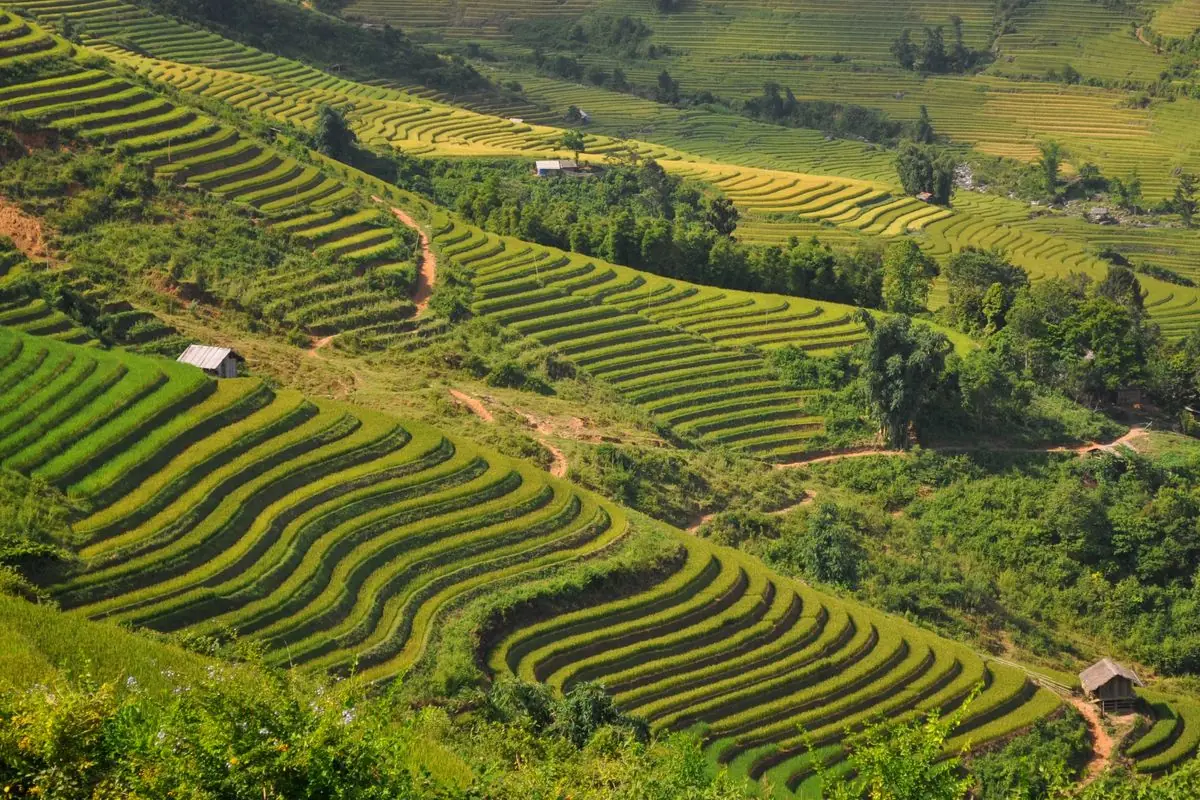
Lao Chai is roughly 7-8 km from central Sa Pa, while accommodation around Ta Van is commonly about 10-12 km away, depending on the exact property.
A car journey may take around 20-40 minutes. Allow longer when roads are wet, traffic is heavy, or your homestay is located away from the main road.
Who should stay in Lao Chai?
Lao Chai is a good choice for travelers interested in walking routes through terraced rice fields without staying as far from town as some remote resorts.
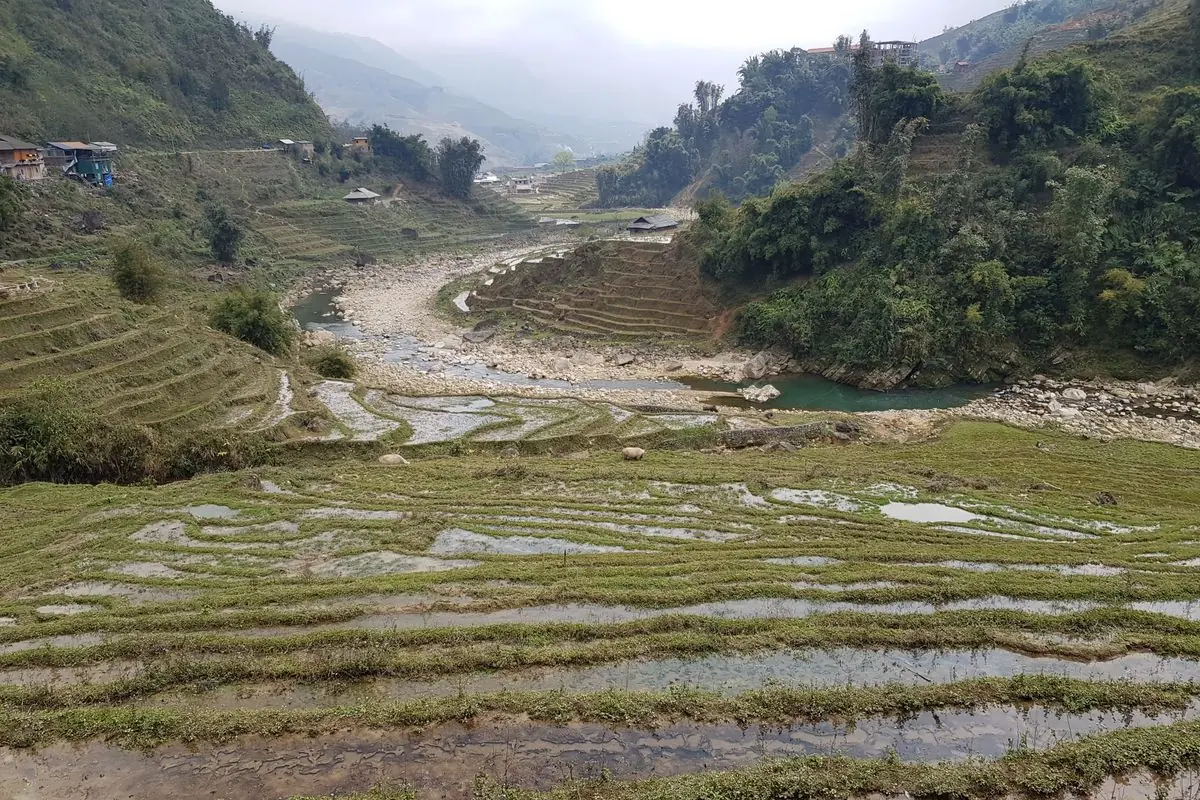
Eco Palms House is one accommodation option in Lao Chai that focuses on nature-oriented stays.
When comparing bungalow properties, check whether the room faces the rice terraces or sits farther inside the grounds.
Some accommodation in Lao Chai serves dinner on-site. That’s an important advantage because returning to central Sa Pa for dinner and then traveling back down the valley can be inconvenient, particularly after dark or when visibility is poor.
If photography is your priority, ask when the property’s promotional photos were taken.
Golden rice terraces don’t look the same throughout the year. Fields photographed during harvest season can look completely different a few weeks later.
Ta Van is better for a slower trip
Ta Van has numerous homestays, family-run guesthouses, and small bungalow properties.
Some offer shared dinners, while others operate more like independent guesthouses with private bedrooms and en-suite bathrooms.
The area suits travelers who want a quiet evening, village walks, and a morning away from the bustle of Sa Pa town.
You don’t need to book a trekking-focused homestay if your plan is simply to relax and explore the surroundings independently.
Pay attention to the exact location of the property.
One Ta Van homestay may be right beside a vehicle-accessible road. Another may require walking along a narrow path after the car drops you off.
With a small backpack and dry weather, that may be perfectly manageable. Wheeling a suitcase along a muddy path after heavy rain is considerably less pleasant.
International visitors should prioritize accommodation with clear check-in procedures, reliable communication, and support for the required temporary-residence declaration.
These requirements apply to entire-property rentals as well as hotels and homestays.
In winter, check the heating facilities separately. An electric blanket can keep your bed warm, but it won’t heat the bathroom, floor, or entire room.
Sa Pa resorts and remote ecolodges: plan time to enjoy the property
Not every Sa Pa resort is deep in the countryside.
Some resorts are only a few minutes’ drive from the central square, while others are far enough away that returning to town can take close to an hour.
Sapa Jade Hill Resort & Spa
According to its official website, Sapa Jade Hill is approximately 2 km from central Sa Pa.
The resort’s bungalows sit on a hillside among trees, with views toward Muong Hoa Valley.
It suits travelers who want a quieter resort setting without completely giving up access to restaurants and attractions in town.
Two kilometers doesn’t sound far, but Sa Pa’s hills mean a vehicle may be more practical than walking for some journeys.
Room categories also differ by view.
Mountain View accommodation looks toward the mountains and forest, while Panorama View offers a broader outlook across the valley.
Read the precise bungalow category rather than assuming every room has the same scenery shown in the main promotional photographs.
Silk Path Grand Sapa Resort & Spa
Silk Path Grand stands on Quan 6 Hill, approximately 1-1.5 km from Sa Pa Stone Church.
A drive from central Sa Pa usually takes around 5-10 minutes.
The resort appeals to families and travelers who want spacious surroundings, resort facilities, and the option of heading into town for dinner.
If you’re traveling with older family members, ask whether vehicles can drop passengers directly at reception and how much walking is required between the rooms and shared facilities.
Topas Ecolodge
Topas Ecolodge is quite different from the resorts closer to town.
According to its official guest information, it sits approximately 18 km from central Sa Pa, around 45 minutes away by car.
The property features stone bungalows, an infinity pool, and expansive valley views away from the town center.
The main reason to stay here is to enjoy the setting itself rather than use the property as a base for constant trips into Sa Pa.
Topas operates a complimentary shuttle between the ecolodge and its office in central Sa Pa.
The usual timetable shown in its guest information is:
- From the Sa Pa office to Topas Ecolodge: 2:00 PM.
- From Topas Ecolodge back to Sa Pa: 10:00 AM.
- Shuttle reservations should be made at least 24 hours in advance.
Schedules may change, and special packages may have different arrangements. The town pickup point is the Topas office, not automatically the entrance to whichever hotel you’re staying at.
The resort also sets a luggage allowance for the shuttle: one suitcase and one carry-on bag per guest.
With additional bags, contact the resort about alternative transport.
Topas lists check-in from 2:00 PM and check-out at 11:00 AM.
When planning your departure, account for the 45-minute drive back to town, plus any connection to your onward transport.
If you book two nights at Topas but plan to return to Sa Pa every day for lunch, shopping, and sightseeing, you’ll spend a substantial amount of time traveling.
A more relaxed itinerary is to finish your main town activities first, then transfer to the ecolodge and spend the remaining days enjoying the property.
More remote areas: Ta Phin and Ban Ho
Ta Phin has guesthouses, homestays, and activities associated with the local Red Dao community.
It’s worth considering if you want to explore somewhere beyond the familiar town center and Muong Hoa Valley route.
Ban Ho is farther from town and suits visitors looking for a rural stay who already have a transport plan.
Before booking, check whether the access road is suitable for your vehicle and whether someone can meet you on arrival.
Don’t choose a remote property simply because its nightly room rate is lower than those in town.
Return taxi fares and additional travel time can change the overall cost of your stay.
Hotel, homestay, resort, or ecolodge: which should you choose?
Accommodation labels on booking websites don’t always tell you exactly what to expect.
Sa Pa hotels are generally the most convenient option when you need reception services, elevators, private bathrooms, housekeeping, and help arranging transport.
They’re particularly suitable for first-time international visitors, families with children, and travelers carrying several bags.
Sa Pa homestays vary considerably.
Some are genuine family homes offering simple bedrooms and shared meals. Others operate as independent bungalow properties with private bathrooms and services closer to those of small hotels.
Before deciding, examine photos of the bathroom, bed, access road, and dining area.
Sa Pa resorts suit travelers who want to spend time enjoying the accommodation itself, including spas, pools, restaurants, and landscaped surroundings.
Some resorts are only a short drive from town, making them easier to combine with sightseeing.
Ecolodges generally emphasize natural surroundings, building materials, and a lower-density accommodation setting.
However, an "eco" label doesn’t guarantee central heating, good insulation, or easy vehicle access.
Check the facilities of the exact room category you intend to book.
For a visit in December or January, a three-star hotel with functioning heating, a well-sealed bathroom, and reliable hot water may be more comfortable than a beautiful but cold bungalow.
On a milder trip in May, you may have more flexibility to prioritize natural surroundings over indoor heating.
Sa Pa hotel prices in 2026: how much should you budget?
Room prices vary according to the day of the week, season, number of guests, and cancellation conditions.
It’s useful to establish a general budget first, then check actual prices for your intended dates.
Typical prices by accommodation type
The following 2026 ranges can be used for planning.
| Accommodation type | Indicative 2026 price |
|---|---|
| Basic homestay | VND 200,000-400,000 per night |
| Three-star hotel | VND 500,000-900,000 per night |
| Four- and five-star hotels | Around VND 1,200,000-3,000,000 per night and above |
These are general market ranges, not fixed quotes from individual properties.
For homestays especially, confirm whether the price is per person, per bed, or per room.
Comparing specific Sa Pa hotels
Indicative 2026 prices for some named hotels and resorts:
| Hotel or resort | Indicative 2026 price per room/night |
|---|---|
| Bamboo Sapa Hotel | VND 900,000-2,200,000 |
| KK Sapa Hotel | VND 1,400,000-2,800,000 |
| Pao’s Sapa Leisure Hotel | VND 1,900,000-3,800,000 |
| Hôtel de la Coupole - MGallery | VND 2,800,000-6,500,000 |
| Silk Path Grand Sapa Resort & Spa | VND 2,800,000-6,500,000 |
| Topas Ecolodge | VND 6,000,000-10,000,000 |
These figures were published as 2026 estimates. They should not be treated as confirmed rates or evidence of availability for your travel dates.
To see how promotional rates can differ, Topas Ecolodge advertised a Summer Escape package in 2026 starting from VND 5,590,000 per night for two guests, including breakfast.
The promotion had its own eligibility conditions for Vietnamese guests and foreign residents in Vietnam.
It would be misleading to use that figure to estimate the price of a Christmas or Tet stay.
When comparing listings, focus on the final amount payable, not just the headline price.
For example, the same room may appear under two rate plans: a cheaper non-refundable booking or a more expensive booking that includes breakfast and free cancellation until a specified date.
Because mountain weather can affect travel plans, cancellation conditions deserve attention.
Always enter the correct number and ages of children.
A quoted rate for two adults doesn’t necessarily apply to a family with two children, even if the children share an existing bed.
How do rice harvest season, Christmas, and Tet affect hotel prices?
Rice harvest season: book valley-view rooms early
Late August through September is a particularly popular period for travelers hoping to see Sa Pa’s terraced fields turn golden.
The exact timing of ripening and harvesting differs with elevation, location, and weather each year.
Don’t assume that every field will still be golden in October.
Rooms with balconies overlooking Lao Chai, Ta Van, and Muong Hoa Valley tend to attract more interest during this period.
Booking around 4-8 weeks ahead is recommended for September weekends.
For midweek travel, a lead time of 2-4 weeks may provide more flexibility.
If you have a specific room category in mind at KK Sapa, Pao’s, or a small rice-field bungalow, booking earlier is more sensible than waiting until the last few days for a discount.
Christmas and the year-end holidays
December 24-25 brings visitors to central Sa Pa who want to experience the town’s winter atmosphere.
Hotels around the Stone Church, Sun Plaza, and properties offering heated indoor pools are worth checking early.
But the room rate isn’t the only cost to examine.
Topas Ecolodge’s 2026 booking conditions included mandatory gala dinner arrangements for December 24 and 31, with prices starting from VND 2,500,000 per person, payable at the property.
Charges like these can significantly increase the cost of a holiday stay.
Before confirming a booking, read the accommodation policies, compulsory meal arrangements, and any costs excluded from the displayed total.
Tet, the Vietnamese Lunar New Year
Tet is a popular travel period for Vietnamese families, particularly when the public holiday allows for a longer trip.
Family rooms, connecting rooms, and resorts with children’s facilities are worth checking well ahead of time.
For travel during the main Tet holiday, start searching around 6-8 weeks in advance, or earlier for resorts with relatively few bungalows.
Also ask which services will operate normally during the holiday.
Restaurants, breakfast service, shuttle buses, spas, and taxi arrangements may follow different schedules.
Is the low season always cheaper?
Not necessarily.
Midweek stays during March-May or outside major holiday periods may offer more choice, but rates still depend on local events, weather, and room availability.
Rather than trying to identify one universally cheapest month, compare two or three nearby check-in dates.
Moving a stay from Friday night to Sunday night can sometimes make a noticeable difference, especially at small properties with limited rooms.
Will your Sa Pa room be warm enough in winter?
If you’re visiting in December, January, or February, heating may matter more than the view from your window.
Sa Pa experiences cold spells when temperatures approach or fall below 0°C.
Combined with damp conditions, poorly insulated rooms can feel particularly uncomfortable at night.
Booking websites may list facilities such as heated blankets, air conditioning, heating, or fireplaces.
These terms don’t mean the same thing.
Heating and reverse-cycle air conditioning
Reverse-cycle air conditioning can warm the room as well as cool it.
However, many hotel listings simply say "air conditioning", which doesn’t confirm that a heating function is available.
Ask whether your exact room has heating or cooling only.
Portable heaters are another possibility, but check whether they’re supplied automatically, available on request, or subject to an additional charge.
It’s also worth confirming that the equipment can be used safely in the room.
Electric blankets and heated mattress pads
Electric blankets and heated mattress pads are designed to warm your sleeping area.
Topas Ecolodge, for example, states that electric blankets are available on request for its standard bungalows.
The words "on request" matter.
If you need one, confirm it before arrival rather than asking just before bedtime when the property may be fully occupied.
An electric blanket also won’t heat the entire room.
The bathroom, floor, and seating area may still be cold even when your bed is comfortable.
Hot water and bathrooms
Ask three practical questions: does the property use a storage water heater or a centralized hot-water system, can it supply enough hot water for everyone to shower consecutively, and is the bathroom properly enclosed against cold drafts?
A wooden bungalow with large glass windows overlooking rice terraces may look beautiful in daylight.
An exposed bathroom during a winter cold spell is less appealing.
Families with young children should prioritize private bathrooms with dry changing areas.
Older travelers may also want to check for high steps, slippery floors, or outdoor passages between the bedroom and bathroom.
How to ask about heating clearly
Instead of asking whether a room is "warm", send the property a specific message:
"We’ll be visiting in December. Could you confirm whether our booked room has heating or a portable heater, an electric blanket, and hot water in the bathroom? Are these included in the room rate?"
International travelers can send this through the booking platform’s messaging system.
A written confirmation is more useful than relying entirely on a phone conversation.
Getting around from your accommodation: distance isn’t everything
In Sa Pa, distance and travel time don’t always follow the same pattern.
A hotel 700 m from the Stone Church may involve a steep climb, while a resort 2 km away with organized transfers could be more convenient for someone carrying luggage.
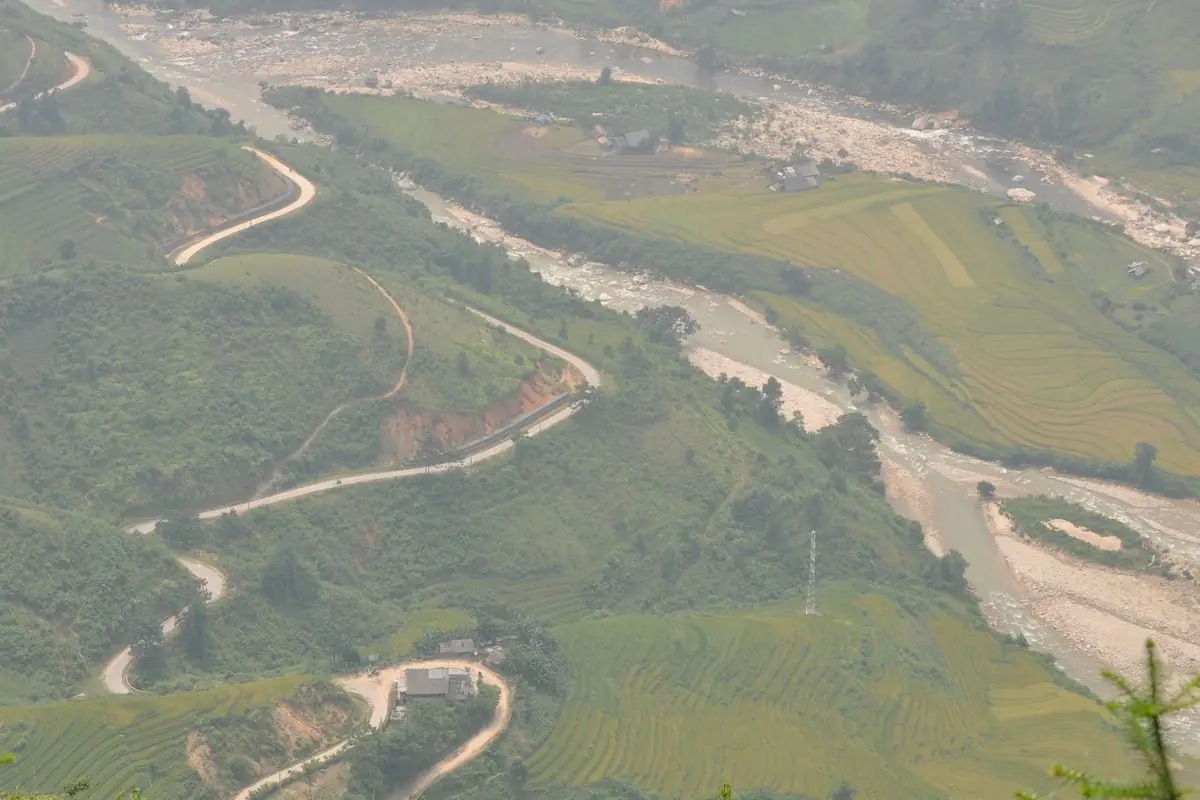
The following distances and travel times can help with initial planning.
| Accommodation area | Approximate distance or travel time from central Sa Pa |
|---|---|
| Stone Church and Sun Plaza | A few minutes on foot |
| Sa Pa Lake | Walking distance or a short drive, depending on the property |
| Silk Path Grand Sapa | Around 1-1.5 km; approximately 5-10 minutes by car |
| Sapa Jade Hill | Around 2 km |
| Cat Cat Village | Around 2-3 km to the village area |
| Lao Chai | Around 7-8 km |
| Ta Van | Around 10-12 km; often 20-40 minutes by vehicle |
| Topas Ecolodge | Around 18 km; approximately 45 minutes by car |
These are general reference points, not substitutes for checking each property’s actual location.
A homestay near the village entrance may be much easier to reach than one farther along a hillside track.
Taxi or hotel shuttle?
In central Sa Pa, hotel reception can usually help arrange a taxi to a restaurant, attraction, or bus departure point.
For accommodation in Ta Van, Lao Chai, or more remote resorts, organize transport with your host in advance.
Don’t assume a ride-hailing app will always find a driver willing to collect you from a remote location, especially after dark.
If you want to return to town for dinner, ask about round-trip transport costs and whether the driver can collect you at a specified time.
A cheaper room in the valley may no longer be the cheaper choice after several return taxi journeys.
Arriving with a suitcase on steep roads
Before departure, send your bus company the Google Maps location of your accommodation and ask where you’ll actually be dropped off.
Some services stop in central Sa Pa rather than continuing down narrow roads to individual homestays.
You may need a taxi, a local transfer, or help from the accommodation staff.
Don’t stop at asking, "Does the bus go to Sa Pa?"
The useful question is whether it stops at the bus station, company office, central square, or directly outside your hotel.
For village homestays, also ask how far you must walk from the vehicle drop-off point and whether the route includes steps.
Suitcase wheels work beautifully on an airport floor. They aren’t nearly as useful on a muddy hillside path after rain.
How to book accommodation in Sa Pa without choosing the wrong location
Once you’ve settled on an area, the booking process becomes much easier.
Check the map before the hotel list
On booking websites or Google Maps, search for the property’s name and open its precise location.
Zoom in to examine the main access road, smaller lanes, and nearby landmarks.
Don’t rely entirely on descriptions such as "Sapa center" or "near Muong Hoa Valley."
For example, Hôtel de la Coupole is beside Sun Plaza, while Topas Ecolodge is approximately 18 km away in a separate mountain setting.
Both may appear in Sa Pa accommodation searches, but they require completely different itineraries.
Check the exact room category
Many hotels use their most attractive room photographs as the main listing images, even when the cheapest displayed rate belongs to a lower-category room.
Open the details for the specific room you intend to book and check:
- View: City, mountain, valley, or panorama view.
- Beds: One large bed, twin beds, or an extra bed.
- Bathroom: Private en-suite or shared facilities.
- Winter comfort: Heating, reverse-cycle air conditioning, electric blankets, and hot water.
- Breakfast: Included or charged separately.
- Payment and cancellation: Deposit requirements, refundability, and cancellation deadline.
At resorts with multiple bungalows, two rooms of the same size may occupy very different positions.
Guests who need to stay near the restaurant or avoid climbing numerous steps should mention that requirement before confirming.
Compare final prices across booking channels
Compare the hotel’s official website with the prices shown on major booking platforms.
Even for identical dates and room categories, packages may differ in breakfast, transfers, or cancellation terms.
Check the full amount, including taxes, service charges, extra beds, mandatory dinners, and airport or station transfers where applicable.
If you’re booking through a Facebook page or messaging account, verify that the account genuinely belongs to the accommodation provider before transferring money.
KK Sapa Hotel has published warnings about fake booking pages impersonating the hotel.
A familiar logo, attractive room photographs, and a hotel name aren’t sufficient proof that you’re paying the correct business.
How far in advance should you book a Sa Pa hotel?
The right booking window depends on where you want to stay and how flexible your travel dates are.
| Travel period | Suggested booking lead time |
|---|---|
| Ordinary weekdays outside holidays | Around 2-3 weeks |
| Regular weekends | Around 3-4 weeks |
| Rice harvest season, August-September | Around 4-8 weeks, especially for terrace-view rooms |
| Christmas and year-end holidays | Around 6-8 weeks |
| Tet, the Lunar New Year | Around 6-8 weeks, or earlier for family rooms and small resorts |
These are planning recommendations, not hotel requirements.
Last-minute rooms may still be available, but your choice of location, views, and cancellation conditions can become more limited.
Booking early matters particularly when you’re traveling with four or more people and need adjacent or connecting rooms.
A hotel may still have two double rooms available without being able to place them near each other.
International travelers touring several destinations in Vietnam face another consideration: their Sa Pa schedule may depend on flights and onward transport through Hanoi.
In that situation, a refundable booking can provide useful flexibility. Record the exact date and time when free cancellation expires.
For remote resorts, arrange transport when booking the room.
A confirmed reservation is less helpful if your preferred shuttle is already fully booked.
What do international visitors need at check-in?
Foreign visitors staying in Sa Pa should bring their passport or another valid international travel document for accommodation staff to check during registration.
Under Vietnamese rules effective July 24, 2026, electronic temporary-residence declarations must be made as soon as a foreign guest arrives at an accommodation establishment.
The declaration is the responsibility of the property owner, legal representative, or an authorized person, with the guest providing the necessary information.
This applies to hotels, homestays, rented houses, and other accommodation establishments hosting foreign visitors overnight.
The 12-hour deadline, or 24 hours in remote areas, concerns submitting paper declarations in person. It isn’t permission to delay the electronic declaration.
When staying at a properly operated hotel, you generally don’t need to visit a police office yourself just to complete the accommodation registration.
For private house rentals and smaller homestays, however, confirm who handles the declaration and whether late-night arrivals are supported.
Another useful question concerns luggage storage.
Many travelers reach Sa Pa early in the morning after an overnight bus from Hanoi.
Arriving at 6:00 AM doesn’t automatically mean your room will be available, even if you’ve prepaid for your stay.
Ask whether the property can store your bags before check-in and when you can expect to access the room.
Sa Pa’s administrative addresses changed in July 2025
Some accommodation websites still display older administrative addresses such as "Sa Pa Town", "Hoang Lien Commune", or "San Sa Ho".
Vietnam reorganized local administrative units from July 1, 2025.
Under the 2025 resolution reorganizing Lao Cai Province’s commune-level administrative units, the relevant areas are now identified as follows:
- Sa Pa Ward, Lao Cai Province: Formed from the former Sa Pa, Ham Rong, O Quy Ho, Sa Pa, Cau May, and Phan Si Pang wards.
- Ta Van Commune, Lao Cai Province: Formed from the former Hoang Lien, Muong Hoa, and Ta Van communes, covering areas including Cat Cat, Y Linh Ho, Lao Chai, and Ta Van village.
- Ta Phin Commune, Lao Cai Province: Formed from the former Trung Chai and Ta Phin communes.
- Ban Ho Commune, Lao Cai Province: Formed from the former Thanh Binh and Ban Ho communes.
These administrative changes haven’t moved any hotels or villages.
Booking confirmation still uses an old address? Compare the accommodation name, telephone number, and map pin.
When arranging transport, sending the exact location is more useful than reading out a long administrative address.
There are also places with similar or identical names elsewhere in Lao Cai Province.
Searching only for "Lao Chai" may not be enough to identify the correct accommodation.
Where to stay in Sa Pa based on your trip length
Two days, one night
For a single-night stay, prioritize the area around the Stone Church, Sun Plaza, or Sa Pa Lake.
You can leave your luggage at the hotel, visit Fansipan or explore town, and then enjoy dinner within walking distance.
The following morning remains flexible enough for breakfast and a short walk before your departure.
Moving down to Ta Van just to sleep for a few hours may not make much sense if all your next-day activities are back in town.
You could spend more time traveling than enjoying the accommodation itself.
Three days, two nights
There are two sensible approaches.
For an itinerary built around Fansipan, Cat Cat, town restaurants, and cafés, stay both nights in central Sa Pa or at a hotel overlooking Muong Hoa Valley.
If you’d like to experience village accommodation, spend one night in town and the other in Lao Chai or Ta Van.
That gives you a morning in the valley without having to travel down and back on the same day.
Just pay attention to the room-change schedule.
Avoid booking an early-start tour for the same morning you need to check out, transfer your luggage, and wait for your next room to become available.
Four days, three nights
With three nights, you have enough time to combine sightseeing with a resort stay.
You might spend the first two nights visiting Fansipan, exploring the town, and seeing Cat Cat.
For the final night, move to a nearby resort or a more remote ecolodge, depending on your budget.
At Topas Ecolodge, consider staying two nights if you want time to enjoy the pool, mountain setting, and activities.
Arriving late in the afternoon and leaving the next morning would be a fairly short stay, particularly when each transfer takes around 45 minutes.
When trekking is your main priority, three nights in Lao Chai or Ta Van may be simpler.
You won’t need to change rooms or reorganize your luggage every morning.
At Topas Ecolodge, remember the 24-hour advance shuttle reservation requirement. Wherever you choose to sleep in Sa Pa, make sure you have three details before departure: the exact map location, your check-in time, and a working contact number for the property.
Frequently asked questions
Is it better to stay in central Sa Pa or Ta Van Village?
Central Sa Pa is better for first-time visitors, short stays, Fansipan sightseeing, and easy access to restaurants. Ta Van is better for rice terraces, trekking, and quieter surroundings. Ta Van is generally around 10-12 km from the town center, so you'll need to plan transfers and allow additional travel time.
How much do Sa Pa hotels cost during winter and rice harvest season?
Based on indicative 2026 rates, three-star hotels generally cost around VND 500,000-900,000 per night, while four- and five-star accommodation starts at approximately VND 1.2-3 million per night and can cost considerably more. Prices may rise on harvest-season weekends, Christmas, and Tet. Actual rates depend on the dates, room category, and hotel policies.
How far are Topas Ecolodge and village homestays from Sa Pa town?
Topas Ecolodge is approximately 18 km from central Sa Pa, about 45 minutes by car, and offers scheduled shuttle transfers. Lao Chai homestays are generally around 7-8 km from town, while Ta Van is about 10-12 km away. Actual journey times depend on the property's access road and traffic conditions.
Do Sa Pa hotel rooms have heating and electric blankets?
Not all rooms do. Some hotels offer heating or reverse-cycle air conditioning, while homestays and bungalows may provide electric blankets instead. Before booking winter accommodation, confirm whether your specific room has heating, an electric blanket, and reliable bathroom hot water, and whether these facilities are included in the price.
How early should I book accommodation for Christmas or Tet in Sa Pa?
Start looking around 6-8 weeks ahead. Book earlier if you need connecting rooms, a family suite, or a particular mountain-view bungalow at a small resort. Before paying, check holiday surcharges, compulsory dinners, and cancellation conditions.