Walking or ride-hailing in Hanoi: which is better for each trip?
Walking is ideal for exploring Hoan Kiem Lake and the Old Quarter, while Grab, Green SM and taxis are more convenient for longer journeys or when carrying luggage. Public buses help keep costs down, and the metro avoids traffic along its two operating routes.
 24 min read
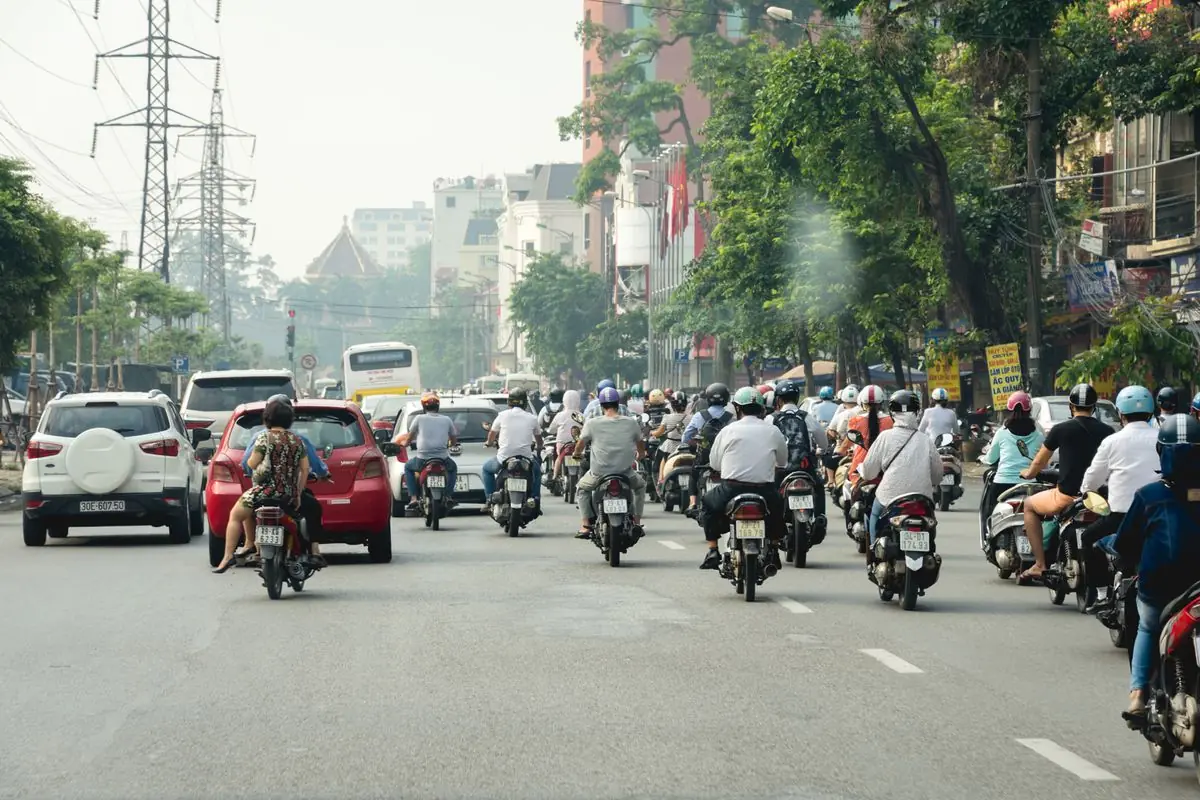
Motorbikes, cars and a city bus share a Hanoi street in the morning.
The easiest way to get around Hanoi is to combine walking in the Old Quarter, ride-hailing apps for longer journeys, and buses or metro trains when their routes match your destination. Grab, Be and Green SM are three useful apps to install before arriving. As for renting a motorbike, there’s no need to rush into it, especially if this is your first visit to Vietnam.
Choose your transport based on where you’re going
Some parts of Hanoi are wonderfully walkable. Others can take much longer to reach than the distance on a map suggests, particularly during busy traffic periods.
From Hoan Kiem Lake, you can easily walk to St. Joseph’s Cathedral. But if you’re heading to West Lake or My Dinh, it’s worth deciding how to travel before leaving your hotel.
| Transport | Best for | Cost |
|---|---|---|
| Walking | Hoan Kiem Lake, the Old Quarter and nearby attractions | Free |
| GrabBike, beBike | Solo travelers with little luggage | Check the app |
| GrabCar, beCar, Green SM | Groups, luggage, rainy weather or hot afternoons | Check the app |
| Traditional taxis | Travelers who prefer getting into a taxi directly | Metered fare |
| Hanoi public buses | Budget travel with flexible timing | Usually VND 8,000-20,000 per ride under the subsidized fare schedule; some journeys are free |
| Hanoi Metro | Traveling along either operating metro route | VND 9,000-19,000 for a cash single ticket, depending on the line and distance; day passes available |
| Cyclo | A leisurely sightseeing experience around the Old Quarter | Agree on the total price beforehand |
| Motorbike rental | Longer stays, experienced riders with valid licenses | Daily rental rate depending on the vehicle |
The regular public bus fares above follow the city schedule introduced in November 2024. A separate fare exemption for qualifying journeys within Ring Road 1 has applied since July 2026. Metro prices reflect the 2026 fare schedule.
If you’re spending only two or three days in Hanoi, there’s no reason to try every transport option. Comfortable walking shoes, mobile Internet and a ride-hailing app will cover most journeys.
Walking around Hoan Kiem Lake and the Old Quarter
Hoan Kiem Lake and Hanoi’s Old Quarter are among the easiest areas to explore on foot. Attractions sit fairly close together, and the narrow streets are filled with shops, cafés, food stalls and historic buildings.
However, walking isn’t always effortless. Some pavements are occupied by parked motorbikes, restaurant seating or shop displays. You may occasionally need to move around obstacles, so pay attention to nearby traffic.
Using Hoan Kiem Lake as a starting point, here are some approximate walking times:
- Hoan Kiem Lake to Ngoc Son Temple: The temple sits on a small island in the lake, reached via the red The Huc Bridge from Dinh Tien Hoang Street.
- Hoan Kiem Lake to St. Joseph’s Cathedral: Around 10-15 minutes, depending on where you start.
- Hoan Kiem Lake to Hanoi Opera House: Approximately 10-15 minutes from the southern end of the lake, heading toward Trang Tien Street.
- Hoan Kiem Lake to O Quan Chuong Gate: Around 15-20 minutes through the Old Quarter.
- Hoan Kiem Lake to Dong Xuan Market: About 15-20 minutes, depending on your route.
These are approximate walking times. They don’t include stopping for photos, waiting at crossings or browsing shops.
Explore the Old Quarter in one loop
A pleasant morning route starts near Hoan Kiem Lake and continues north along Hang Dao and Hang Ngang streets toward Dong Xuan Market.
From the market, head east to O Quan Chuong Gate, one of the remaining historic gates of Hanoi’s old citadel area. You can then return toward the lake through Hang Buom and Ma May streets.
Along the way, you’ll pass fabric shops, souvenir stores, small restaurants and narrow lanes connecting different streets. Stop wherever something catches your attention. There’s little reason to book a vehicle for every few hundred meters.
Just remember that the Old Quarter isn’t one enormous pedestrian-only area. Outside designated walking-street hours, motorbikes and cars still use many roads.
Even when a street looks quiet, check carefully at intersections.
When is walking no longer worth it?
Walking from Hoan Kiem Lake to the Temple of Literature is possible, but it usually takes around 30 minutes or longer.
Continuing from there toward the Ho Chi Minh Mausoleum or West Lake adds considerably more distance. On a hot summer afternoon, that can quickly become tiring.
On journeys like these, booking a short ride and continuing on foot once you arrive is often more practical.
Travelers with suitcases should also be realistic about walking in the Old Quarter. Pavements aren’t consistently clear, and small suitcase wheels can struggle with uneven surfaces and kerbs.
Ride-hailing in Hanoi: Grab, Be or Green SM?
Uber no longer operates in Hanoi as it once did. The company transferred its Southeast Asian operations to Grab in 2018.
Today, the three ride-hailing apps worth knowing are Grab, Be and Green SM.
Grab: a familiar starting point for international visitors
Grab offers two main transport categories that visitors commonly use:
- GrabBike: A motorbike ride for one passenger, useful when traveling alone with light luggage.
- GrabCar: A private car ride, more comfortable for couples, families or anyone carrying suitcases.
Open the app, enter your pickup location and destination, choose a vehicle type and check the quoted fare before confirming.
Once a driver accepts your booking, you’ll see the vehicle details, license plate and live location.
For example, suppose your hotel is near Ma May Street and you want to visit the Temple of Literature. Enter the attraction as your destination and choose a pickup point where the driver can legally and safely stop.
Don’t rely solely on your hotel’s name. Some hotels are tucked inside narrow lanes or areas with vehicle restrictions. The app may suggest a pickup point a few minutes’ walk from the entrance.
Be: another app worth checking
Be operates services including beBike and beCar.
The booking process is similar to Grab: enter your pickup and destination, select the transport type and review the fare.
Neither app is guaranteed to be cheaper all the time. Prices can change depending on driver availability, traffic conditions, weather and promotions.
Opening both apps to compare fares is perfectly reasonable. If one shows a long pickup time, checking the other may be faster than continuing to wait.
Green SM: electric taxis and a booking hotline
Green SM is the new name of Xanh SM, following the company’s rebranding on April 14, 2026.
You can book through the Green SM app or call its hotline at 1555.
According to the company, the hotline operates 24/7 and offers English-language assistance by pressing *. The published call charge is VND 1,000 per minute.
Green SM is particularly useful if you prefer traveling by electric car, especially with family members or luggage. Electric two-wheeler services may also be available depending on your location and the time of booking.
How do you pay for ride-hailing?
Before confirming a booking, check the payment method displayed in the app.
Cash and supported electronic payment options are commonly available, although the methods you can use depend on your account and the provider.
For cash payments, pay the amount confirmed at the end of the journey, including any legitimate additional charges where applicable.
With electronic payments, check your transaction history before handing over cash. This helps avoid paying twice.
Don’t rely on fixed ride prices found in old travel articles. A journey from Hoan Kiem Lake to West Lake may cost considerably more at 6 PM than at 11 AM.
There’s also a distinction between two Grab services: GrabCar generally displays a ride fare before booking, while GrabTaxi uses a metered taxi fare, with the app showing an estimate. Applicable tolls, parking fees or other legitimate surcharges may be added.
Three things to check before getting in
First, check the license plate. Your driver may call or message to confirm the pickup point, but the vehicle should match the information shown in your app.
Second, verify the destination. Hotels and attractions sometimes have similar names, so make sure the map pin is in the correct location.
Finally, confirm how you’re paying. If you’ve selected a card or digital wallet, there’s no reason to hand over an additional cash fare unless a legitimate outstanding charge has been confirmed.
Traditional taxis: convenient, but check the meter
Traditional taxis remain useful when you don’t want to install an app, your phone battery is running low or you find a taxi waiting outside your hotel.
You may see taxis from Mai Linh, G7 and other operators around the city. Green SM taxis can also be booked through the company’s hotline.
If your hotel receptionist arranges a taxi, ask which company will operate it and how the fare is calculated.
When getting into a taxi directly, look for the company’s branding, contact number, meter and vehicle information.
A metered taxi shouldn’t involve the driver inventing an arbitrary price at the end of your trip. If there’s a minimum fare, waiting fee, toll or other surcharge, you can ask about it before departing.
Be cautious of individuals who approach tourists near busy attractions and offer a ride without clearly identifying a taxi company. A verbal offer isn’t a substitute for transparent pricing.
For international visitors unfamiliar with Vietnamese currency, keeping some VND 20,000, VND 50,000 and VND 100,000 notes can make cash payments easier.
Pay attention when handling VND 20,000 and VND 500,000 notes. Both have somewhat similar blue tones at a glance, despite their very different values.
Hanoi public buses: affordable and extensive, but learn how tickets work
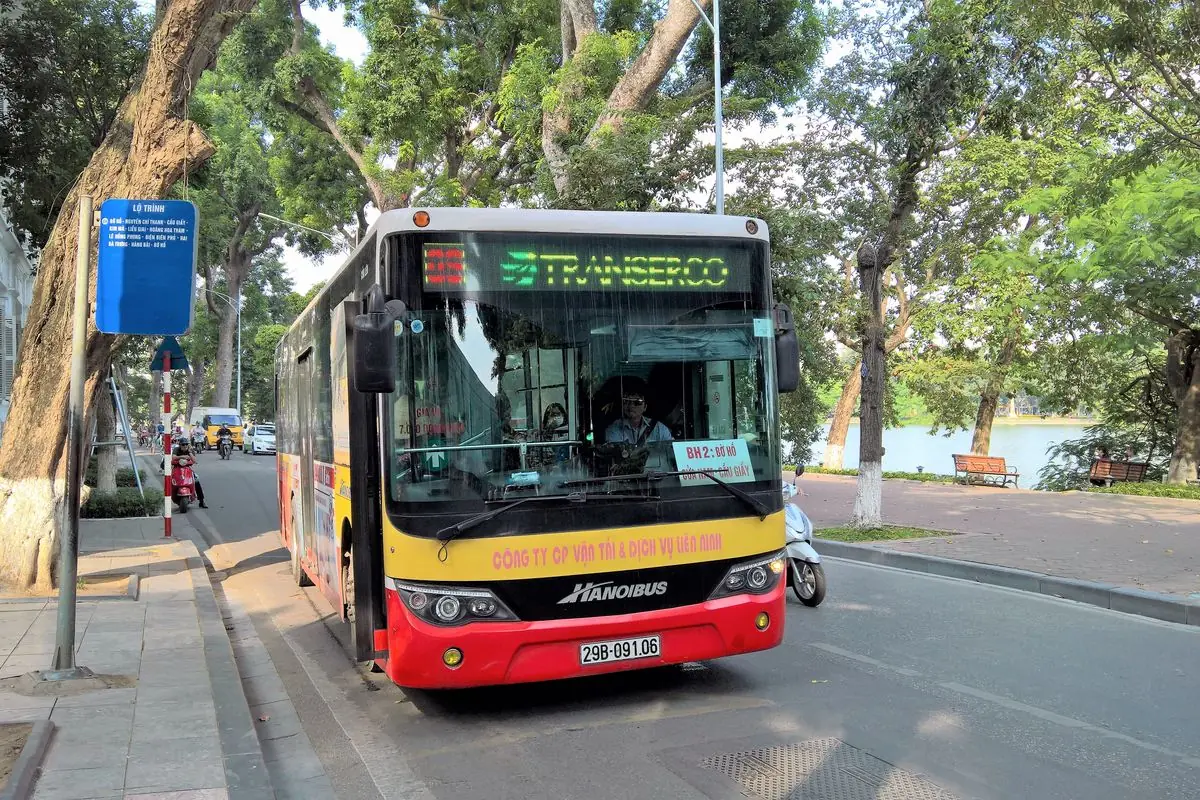
Hanoi’s public buses reach many neighborhoods that aren’t served by the metro.
Routes connect the city center with areas such as Cau Giay, My Dinh, Long Bien and Ha Dong, along with residential districts farther out.
Buses are worth considering if you have flexible timing, light luggage and don’t mind walking between the bus stop and your final destination.
How to find the right bus
Open Google Maps, enter your destination and select the public transport option.
The suggested journey may include a direct bus or a combination of routes.
Don’t check only the route number. Look at the direction of travel, the stop name and how far you’ll need to walk after getting off.
For example, traveling from the Old Quarter to Cau Giay might involve one direct route or a transfer, depending on your exact destination.
Compare the total time, including waiting and walking, against the time shown by a ride-hailing app.
At the bus stop, look for the route numbers displayed on signs. Where several routes share the same stop, check the destination displayed at the front of the approaching bus.
While onboard, keep track of your location. Prepare your belongings when you’re approaching your stop, and ask the bus attendant for help if needed.
Hanoi public bus fares in 2026
Under Hanoi’s subsidized bus fare schedule, effective November 1, 2024, regular single fares are:
| Full route distance | Regular single fare |
|---|---|
| Under 15 km | VND 8,000 |
| 15 km to under 25 km | VND 10,000 |
| 25 km to under 30 km | VND 12,000 |
| 30 km to under 40 km | VND 15,000 |
| 40 km or more | VND 20,000 |
These fares apply to subsidized public buses, not every service described as a bus.
Commercial buses, sightseeing services and other special transport services may follow different fare structures.
Under the traditional single-ticket system, prices generally depend on the full length of the route rather than the short section a passenger travels.
However, Hanoi introduced a separate fare exemption for eligible journeys within Ring Road 1 in July 2026.
Free bus travel within Ring Road 1 from July 2026
This is one of the most significant transport changes for visitors staying in central Hanoi.
Under a resolution passed by the Hanoi People’s Council in June 2026, Hanoi introduced free travel on subsidized buses for eligible journey segments within Ring Road 1.
The policy applies from July 1, 2026, through June 30, 2027.
It doesn’t cover commercial bus services or double-decker sightseeing buses. Metro services aren’t included in this ongoing bus fare exemption.
The important distinction is that traveling beyond Ring Road 1 doesn’t automatically make your entire journey free.
The electronic ticketing system identifies the section within the free zone and calculates any fare due for travel outside it.
For instance, suppose you board a public bus in central Hanoi and continue to a neighborhood outside Ring Road 1.
The eligible central section is covered by the exemption, while the part beyond the boundary may still be charged.
Tap or scan when boarding and getting off
With Hanoi’s integrated electronic ticketing system, recording both the boarding and exit points is essential.
- When boarding, tap your transport card or scan the QR code from a supported transport account or digital wallet.
- The system records where you board and may temporarily hold an amount based on traveling to the end of the route, after accounting for the free section.
- When getting off, tap or scan again using the same payment method.
- The system recalculates the charge based on your actual exit point and refunds any excess temporary hold where applicable.
The dedicated transport ticketing app is called Thẻ vé giao thông HN.
Frequent passengers can register an account or use a physical card. In-person support is available at the published service location at 1 Kim Ma.
For international visitors taking only a few buses and who don’t have a transport account, ask the bus attendant about purchasing a single ticket when boarding.
The system continues to support single-ticket sales through staff, including cash payments.
Don’t assume you can simply board every bus for free because you’re in central Hanoi.
If purchasing a paper ticket, keep it for inspection and ask how the free-fare policy applies to your particular journey.
When a bus isn’t the best choice
During morning and late-afternoon rush hours, buses still share congested roads with other vehicles, except where specific traffic arrangements apply.
A journey of only a few kilometers may take longer than a motorbike ride if the bus makes several stops or follows a less direct route.
Rain, uncovered bus stops and bulky luggage can make the experience less comfortable too.
On the other hand, buses remain a useful budget option for journeys where the metro doesn’t provide a convenient connection.
Hanoi Metro: two operating lines and how to choose the right station
Hanoi currently has two urban railway sections carrying passengers:
- Line 2A, Cat Linh-Ha Dong, entirely elevated.
- Line 3, currently operating only between Nhon and Cau Giay, also elevated.
Neither operating line currently reaches Hoan Kiem Lake or the heart of the Old Quarter.
The two operating sections also don’t yet offer a direct interchange.
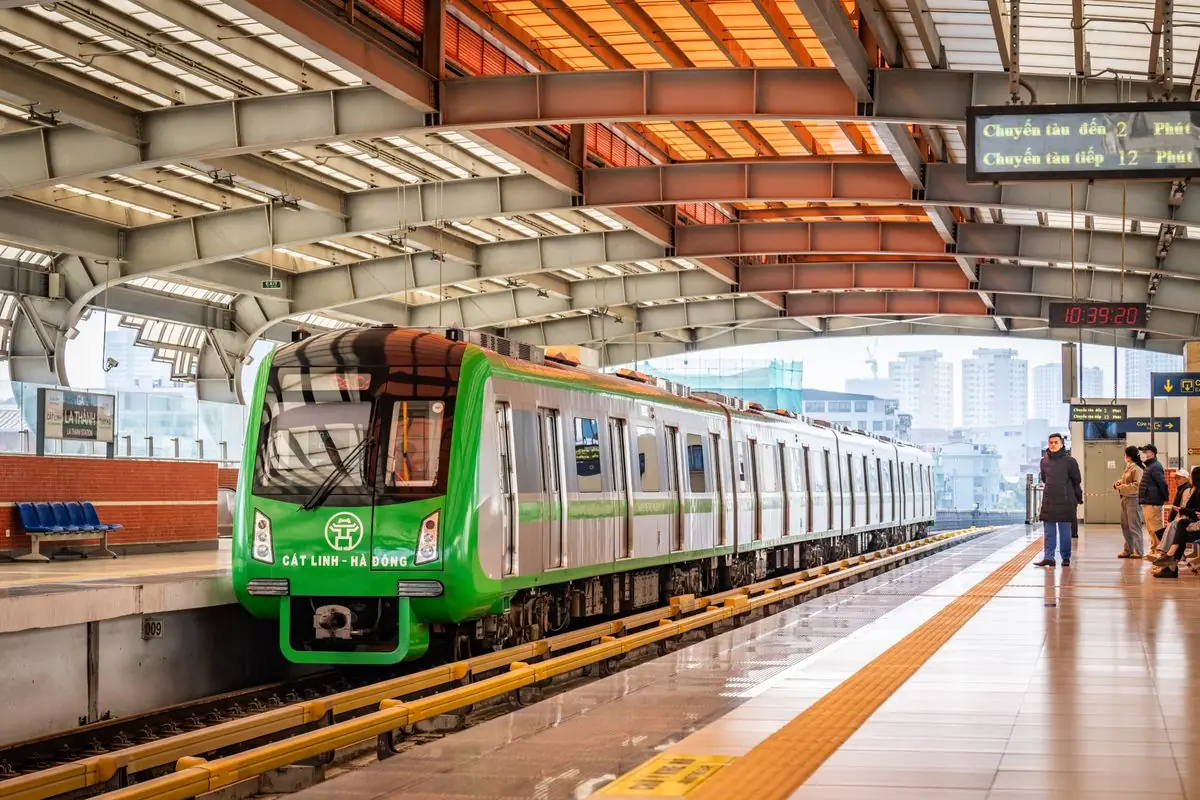
Line 2A: Cat Linh-Ha Dong
This line is approximately 13.1 km long and has 12 stations:
Cat Linh - La Thanh - Thai Ha - Lang - Thuong Dinh - Vanh Dai 3 - Phung Khoang - Van Quan - Ha Dong - La Khe - Van Khe - Yen Nghia.
It’s useful for traveling along Hanoi’s southwestern corridor, particularly around Nguyen Trai Road, Ha Dong and Yen Nghia Bus Station.
For example, if you’re near Cat Linh and need to reach Ha Dong, taking the metro can help you avoid road congestion along much of the route.
Go to Cat Linh Station, purchase a ticket for Ha Dong or another station near your destination, and walk or book a short ride for the final part.
But if you’re staying near Hoan Kiem Lake and visiting attractions in the center, don’t travel all the way to Cat Linh just to use the metro as a shortcut.
Getting to the station may take longer than the time you save on the train.
Nhon-Cau Giay line
The operating section is approximately 8.5 km long, with eight stations:
Nhon - Minh Khai - Phu Dien - Cau Dien - Le Duc Tho - Vietnam National University - Chua Ha - Cau Giay.
This line is convenient for journeys between Nhon, western Hanoi and the Cau Giay area.
One detail can be confusing: the full project is named Nhon-Hanoi Railway Station.
For now, passenger trains operate only between Nhon and Cau Giay. The next four underground stations aren’t open yet.
Construction continues on the underground section toward Hanoi Railway Station, with commercial operation targeted for late 2027.
You therefore can’t currently board at Nhon and ride directly to Hanoi Railway Station or the Temple of Literature.
Hanoi Metro operating hours
According to Hanoi Metro’s 2026 operating information, both lines run from 5:30 AM to 10:00 PM, including weekends and public holidays.
Typical weekday intervals are:
| Time | Approximate interval between trains |
|---|---|
| 6:30-9:00 AM | 6 minutes |
| 4:30-7:30 PM | 6 minutes |
| Other regular daytime hours | 10 minutes |
| 7:30-10:00 PM | 15 minutes |
On Saturdays, Sundays and public holidays, the typical interval is around 10 minutes.
The published 10 PM closing time doesn’t guarantee that you can arrive at any station entrance at exactly 10 PM and still board a train.
For late journeys, arrive earlier and check the last departure in your intended direction.
Hanoi Metro ticket prices in 2026
Published cash ticket prices are:
| Ticket | Price |
|---|---|
| Cat Linh-Ha Dong single ticket | VND 9,000-19,000 |
| Nhon-Cau Giay single ticket | VND 9,000-15,000 |
| Metro day pass | VND 40,000 |
| Metro weekly pass | VND 160,000 |
| Standard monthly metro pass | VND 280,000 |
Single-ticket prices vary according to the number of stations traveled. Some cashless payment methods offer lower fares under the applicable schedule.
The VND 40,000 day pass allows unlimited rides during its valid day and can be used on both operating lines.
However, since the lines don’t currently connect directly, you’ll need another mode of transport to travel between them.
If you’re only planning one metro journey, a single ticket is generally more economical.
A day pass becomes more attractive when several planned journeys follow the operating metro corridors.
How to buy Hanoi Metro tickets
You can buy a single ticket at a station ticket counter or ticket vending machine.
For international visitors without Vietnamese identification, purchasing a ticket at the counter is usually the simplest option.
The system issues a QR ticket that you scan at the fare gates.
You can also purchase tickets through the Hà Nội Metro app.
However, foreign visitors registering an account may need passport and facial identity verification. Hanoi Metro has stated that approval can take approximately three days.
If you only want to take one journey this afternoon, going through that registration process may not be worthwhile.
Some fare gates also support contactless payments with compatible bank cards, including Visa.
When paying directly with a card, use the same card to enter and exit, and ensure each passenger has a separate card.
At the platform, let arriving passengers get off before boarding.
Keep your ticket or QR code accessible until you’ve passed through the exit gates at your destination.
Taking a cyclo in Hanoi: worth trying, but not for getting somewhere quickly
A cyclo is better understood as a sightseeing experience than an everyday transport option.
You sit in a passenger seat at the front while the driver pedals from behind.
The slow pace allows you to watch street life, shopfronts, older buildings and small restaurants without having to navigate the traffic yourself.
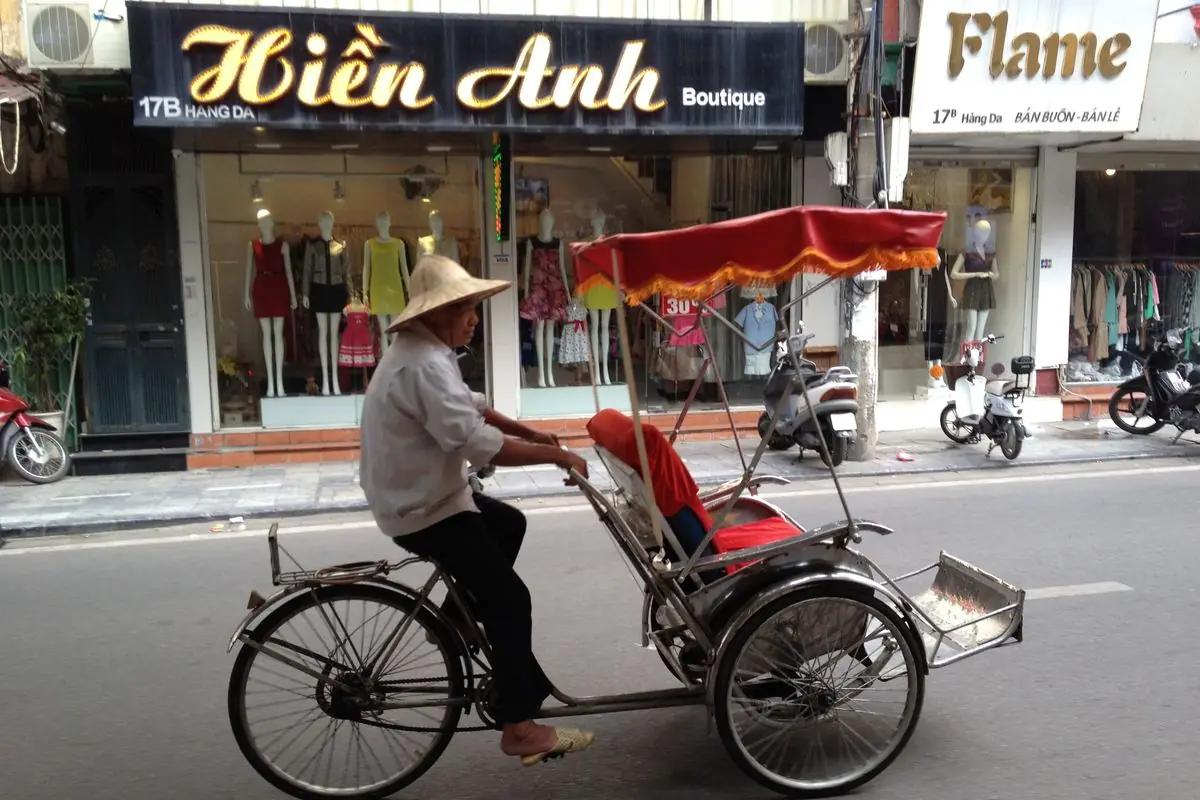
A ride of around 30-60 minutes through the Old Quarter is usually enough to experience it.
Spending much longer sitting in the sun or among busy vehicles isn’t necessarily more enjoyable than walking.
Agree on the cyclo fare before sitting down
There’s no single fixed fare that applies to every cyclo driver.
Prices depend on the provider, duration, route and whether you book independently or through a tour operator.
Rather than relying on a number quoted in an old travel guide, confirm four things:
- What’s the total price for the entire ride?
- Is the price per vehicle or per passenger?
- How many minutes does the ride last?
- Which streets will the driver cover, and where will the ride end?
Typing the details on your phone makes it easier for both sides to understand the agreement.
International visitors should be particularly careful about the difference between VND 100,000 and VND 1,000,000, especially when prices are spoken quickly or written without clear separators.
Alternatively, ask your hotel to arrange a cyclo ride or book through a tour provider that confirms the price beforehand.
You may have less flexibility than negotiating directly on the street, but you’ll know the duration and total cost.
If you need to reach an attraction at a specific time, choose another mode of transport.
Cyclos are slow, subject to traffic restrictions and unable to use every street.
Renting a motorbike in Hanoi: does it actually save money?
Renting a motorbike may sound appealing because it gives you control over your schedule.
But for someone visiting Hanoi for the first time, the benefits aren’t always as significant as they would be in a quieter destination.
You’ll need to navigate one-way roads, narrow lanes, turning restrictions, parking areas and heavy rush-hour traffic.
Hoan Kiem Lake also has vehicle restrictions at certain times, so renting a motorbike may simply mean leaving it outside the pedestrian area and continuing on foot.
Hanoi motorbike rental prices in 2026
For a concrete example, here are the published 2026 short-term rental rates from MOTOGO in Hanoi for rentals of one to five days:
| MOTOGO motorbike model | Published rental price |
|---|---|
| Yamaha Sirius 110cc | VND 130,000/day |
| Honda Vision 110cc | VND 180,000/day |
| Honda Air Blade 125cc | VND 200,000/day |
| Honda Winner 150cc | VND 300,000/day |
These are MOTOGO’s listed rates, not standard prices across all Hanoi rental shops.
The company states that its basic pricing policy has applied since April 20, 2022, with different rates depending on rental duration. Longer rentals may qualify for discounts.
MOTOGO lists locations at 81 Nguyen Kha Trac, Alley 267 Hoang Hoa Tham and near Noi Bai Airport.
Before visiting, confirm that your chosen pickup location is operating and that the model you want is available.
The daily rental fee isn’t the full expense.
You may also need to pay for petrol or charging, parking, vehicle delivery, late returns and other charges covered by the rental agreement.
Renting a motorbike for VND 130,000 per day when most of your sightseeing is around Hoan Kiem Lake may not save much compared with walking and booking one or two short rides.
Inspect the motorbike and rental agreement
Before signing anything, inspect the tires, brakes, lights, horn, mirrors, locks and fuel or battery level.
Take photos of existing scratches and damage on both sides of the motorbike.
If there’s a problem, ask the rental shop to record it in the agreement or confirm it through a message.
Check how the rental day is calculated. Does one day mean 24 hours or a calendar day?
Also confirm the return deadline, late fees, deposit and responsibility if the motorbike breaks down during the rental.
What driving license do foreign visitors need?
This is something to check before paying for a rental.
For motorcycles requiring a driving license, foreign visitors must hold a license recognized in Vietnam and valid for the appropriate vehicle category.
When using a valid International Driving Permit (IDP) under the 1968 Vienna Convention, you must carry the corresponding national driving license as well. Both documents must remain valid.
Vietnam and South Korea also have a mutual IDP recognition agreement. Under its conditions, an eligible Korean IDP can be used for up to one year from the date of entry, provided the documentation and vehicle category requirements are met. Recognition under the agreement also depends on the driver’s nationality.
Not every document sold online as an "international driving license" is legally recognized in Vietnam.
Likewise, holding a car license doesn’t automatically authorize you to ride a motorcycle.
Can you ride a 50cc motorbike without a license?
Under Vietnam’s 2024 Law on Road Traffic Order and Safety, a vehicle classified as a moped can be operated without the motorcycle driving license requirement when it meets the applicable legal definition:
- Maximum design speed of no more than 50 km/h.
- For an internal combustion engine, displacement of no more than 50 cm³; or for an electric motor, power of no more than 4 kW.
- The rider must be at least 16 years old and meet the applicable conditions for operating the vehicle.
The speed and engine-displacement or motor-power limits must both be satisfied.
Simply seeing "50cc" or "electric" in a rental advertisement doesn’t establish that a vehicle qualifies.
Motorcycles such as the Honda Vision 110cc, Yamaha Sirius 110cc and Honda Air Blade 125cc don’t fall within this moped exemption.
Even with valid documents, travelers unfamiliar with riding in Vietnamese cities should seriously consider using ride-hailing services instead.
Crossing the street in Hanoi: don’t run, but don’t step out blindly
Crossing the street can be one of the most intimidating parts of visiting Hanoi for the first time.
Motorbikes are everywhere, some pavements are obstructed, and vehicles may emerge from narrow lanes with little warning.
Even on a one-way road, watch for vehicles turning in from side streets or traveling in an unexpected direction.
The safest approach is to use pedestrian traffic lights, marked crossings, footbridges or clearly designated pedestrian areas whenever possible.
Where there’s no traffic light, look carefully in both directions, wait for a sufficiently safe gap and walk at a steady, predictable pace.
Avoid sudden running or abruptly turning back once you’ve started crossing.
That said, the often-repeated advice to "walk slowly and let traffic flow around you" shouldn’t be taken literally in every situation.
Cars, buses and trucks need considerable stopping distance. Never step directly into the path of a large vehicle that’s approaching.
Pay particular attention to these situations:
- At intersections, vehicles may turn from directions you weren’t initially watching.
- When a bus is stopped, don’t cross immediately in front of it.
- On multi-lane roads, check each lane and continue only when it’s safe.
- When walking with children, hold their hands and choose crossings with clear signals.
- Put your phone away while crossing.
At night, during heavy rain or at especially busy intersections, walking a little farther to find a safer crossing is worth the extra effort.
Are motorbikes and cars banned in Hanoi’s Old Quarter?
Hanoi began piloting low-emission zones in two areas of Hoan Kiem Ward on July 1, 2026.
One important clarification: Hanoi did not introduce a blanket ban on all petrol-powered motorbikes throughout Ring Road 1 on July 1, 2026.
Some older articles still reflect proposals published before the final pilot scheme was approved.
During the initial phase, from July 1 to December 31, 2026, the pilot covers:
- Area 1: The central zone around Hoan Kiem Lake, pedestrian streets and the night market.
- Area 2: A broader part of the Old Quarter within Hoan Kiem Ward.
In Area 1, cars, motorcycles and mopeds are prohibited during the designated hours of 7 PM to midnight on Fridays, Saturdays and Sundays, subject to exceptions such as authorized priority vehicles.
For petrol-powered ride-hailing motorbikes, the initial measures encourage operators to limit their use rather than imposing a blanket prohibition throughout Ring Road 1.
What does this mean for visitors?
If your hotel is inside the restricted area, you may need to walk from an accessible pickup or drop-off point on weekend evenings.
For example, after dinner near Hoan Kiem Lake, don’t assume your driver can reach the exact location where you’re standing.
Check the map for a pickup point outside the restricted streets and walk there.
Similarly, when returning to an Old Quarter hotel on Saturday night, your drop-off point may be a few minutes away from the entrance.
Share your hotel’s location and agree on the stopping point before the driver arrives.
Traffic arrangements can change during festivals or special events. Always follow current road signs and on-site instructions.
Planning transport in Hanoi: three common travel situations
One day exploring the Old Quarter
Start your morning near Hoan Kiem Lake and walk toward St. Joseph’s Cathedral before returning to the streets around Hang Gai, Hang Dao and Hang Ngang.
After lunch, continue toward Dong Xuan Market and O Quan Chuong Gate.
If you’re tired by the afternoon, book a short ride back to your hotel rather than pushing yourself through the heat.
This itinerary doesn’t require the metro or a motorbike rental.
Most attractions are concentrated in the same district, and walking gives you the freedom to stop wherever you like without constantly arranging pickups.
From the Old Quarter to the Temple of Literature, then Ha Dong
From your Old Quarter hotel, book a GrabCar, beCar or Green SM ride to the Temple of Literature.
After visiting, if you’re continuing toward Ha Dong, take a short ride to Cat Linh Metro Station.
Board Line 2A toward Yen Nghia and get off at the station closest to your destination.
This is a situation where combining ride-hailing with the metro makes sense.
The first part isn’t particularly well served by metro, but the longer journey toward Ha Dong follows an operating rail corridor.
If you’re simply visiting the Temple of Literature and returning to Hoan Kiem Lake, there’s little reason to make a detour to the metro.
Walking or booking a direct ride will be simpler.
An afternoon at West Lake
West Lake isn’t directly served by an operating metro route that takes visitors from Hoan Kiem Lake to the lakeshore.
You can consider a public bus if a suitable route serves your exact destination, or book a car when traveling with others.
West Lake is large, so avoid entering only "West Lake" as your ride destination.
Choose the specific place you want to visit, such as Thanh Nien Road, Tran Quoc Pagoda, Phu Tay Ho or a particular café.
These destinations are located in different parts of the lakeside area.
If you’re heading back toward the city center in the late afternoon, check the estimated travel time before deciding to stay longer.
The distance won’t change, but congestion can make the return journey considerably slower.
How to avoid being overcharged in Hanoi
Most transport journeys are straightforward, but a few simple habits help you manage costs, especially when you’re new to the city.
For ride-hailing, only board the vehicle assigned through your app. Don’t agree to cancel a booking and pay the same driver privately just because they offer a new price. Keeping the journey in the app also preserves the booking record if something goes wrong.
For taxis, choose a clearly identified operator with a working meter. If a driver offers a fixed fare instead, agree on the amount before departing rather than leaving the discussion until arrival.
For cyclos, confirm the total price, duration, number of passengers and route in writing or through a message. A verbally agreed figure can be misunderstood, especially across languages.
For buses, purchase the correct ticket or use the transport card and QR system as instructed. Subsidized bus fares are officially published, not something you negotiate with the attendant.
For motorbike rentals, request a contract or written confirmation showing the rental price, return deadline, deposit and responsibilities if the vehicle breaks down. Photograph the motorbike’s condition before leaving.
One more useful habit: save your hotel’s complete address in Vietnamese.
If your phone loses Internet access or a driver doesn’t understand the hotel’s English name, showing the written address can solve the problem quickly.
What about getting from Noi Bai Airport to the Old Quarter?
From Noi Bai International Airport, you can reach central Hanoi by airport bus route 86, regular public buses, taxis or ride-hailing services.
Airport journeys have their own travel times and possible additional charges, so don’t use short-distance city fares to estimate the cost.
When your hotel is in the Old Quarter, send the driver the full address and confirm where the vehicle can stop, especially when arriving on a weekend evening.
You don’t need to memorize every bus route or metro station in Hanoi. For a short visit, start by checking whether your destination is walkable, then compare ride-hailing prices with any convenient bus or metro option.
Before leaving your hotel tomorrow morning, save its address, open a ride-hailing app and pin your first attraction on the map.
Frequently asked questions
Is Uber available in Hanoi? Which app should I use?
Uber no longer operates its former ride-hailing service in Hanoi after transferring its Southeast Asian business to Grab in 2018. You can use Grab, Be or Green SM instead. Grab and Be offer motorbike and car rides, while Green SM provides electric transport services and can also be reached through its 1555 hotline. Always check the quoted fare in the app before booking.
How do you use Hanoi public buses, and are they free?
Use a map app to find the correct route and stop, board in the right direction, and purchase a single ticket or use the supported transport card and QR system. From July 1, 2026, through June 30, 2027, eligible sections of subsidized bus journeys within Ring Road 1 are free. When using the electronic system, tap or scan both when boarding and exiting so the correct distance is recorded. Travel beyond the free zone may still be charged.
Does the Hanoi Metro go to the Old Quarter or Hoan Kiem Lake?
Not yet. The operating services are Line 2A between Cat Linh and Ha Dong and the Nhon-Cau Giay elevated section of Line 3. To reach the Old Quarter, you'll still need a bus, taxi or ride-hailing service from a suitable station. The underground extension from Cau Giay toward Hanoi Railway Station remains under construction, with completion targeted for late 2027.
How can I cross the street safely in Hanoi?
Use pedestrian signals, marked crossings or footbridges whenever possible. Check both directions and begin crossing only when it's safe. Walk steadily, avoid sudden running or changes of direction, and never step in front of an approaching car, truck or bus. At particularly busy intersections, find a safer crossing rather than forcing your way through traffic.
Should foreign tourists rent a motorbike in Hanoi?
It's generally better not to rent immediately if you're unfamiliar with Vietnamese traffic. For motorcycles requiring a license, you need a valid license recognized in Vietnam and appropriate for the vehicle category. A qualifying IDP must be carried with the corresponding national license. Certain legally classified mopeds with engines no larger than 50cc, or qualifying electric motors, are exempt from motorcycle licensing requirements, but age and traffic rules still apply. For a short trip focused on the Old Quarter, walking and ride-hailing are usually easier.