What is expected at a Vietnamese year end party and what you can skip
Check the invitation for the dress code and whether guests are allowed before you plan your outfit. After that come the moments most guests run into, from the first toast to the final lucky draw.
 20 min read
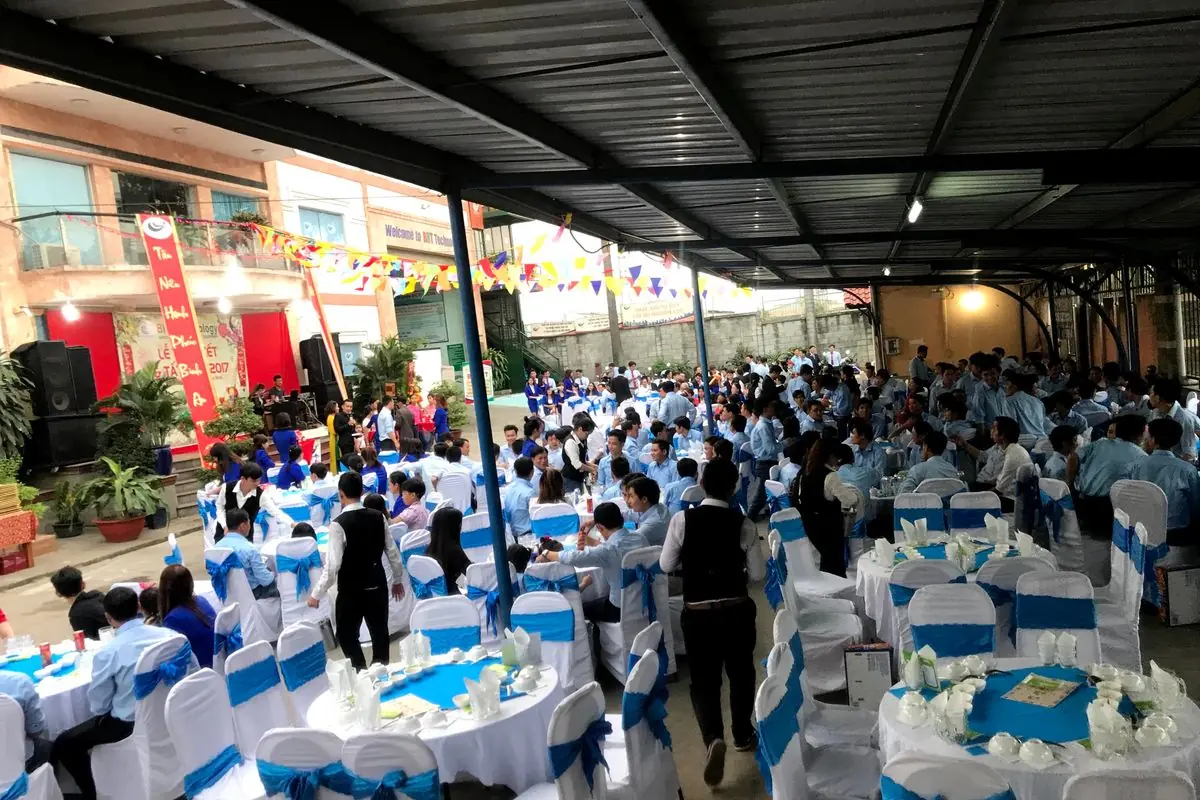
Factory staff at their year-end dinner.
At 6:30 p.m., a hotel function-room entrance displays a large “Year End Party” sign, and employees gather for a group photo before going inside. This is the kind of end-of-year gathering many companies in Vietnam arrange to thank their teams, look back at the year and share a meal before the next chapter begins. You can take part without drinking alcohol, performing onstage or knowing every Vietnamese toast.
What does tat nien mean in Vietnam?
Tat nien, more accurately written tất niên, means the end or completion of the year. Traditionally it refers to the closing days of the lunar year, when families prepare for Tết, the Vietnamese Lunar New Year. At home, it can involve an ancestral offering followed by a family meal. In an office, the same phrase is often used for a company dinner or gala marking the end of a business year.
That overlap can surprise someone new to Vietnamese office culture. A company might put “Year End Party 2026” on an invitation for December 2026, while an employee mentions going home for a tất niên dinner in February 2027. Both descriptions can be right. One follows the company calendar and the other follows the rhythm of the lunar holiday.
People may use “YEP,” “year-end party,” “gala dinner” and “tiệc tất niên” almost interchangeably at work. The wording does not tell you whether the event will be formal, expensive or enormous. A team of twelve might book a restaurant table and call it a year-end party. A large employer might hire a ballroom, an MC and a stage crew. The purpose is similar, but the experience is not identical.
For most newcomers, the useful translation of tất niên công ty is “our company’s end-of-year celebration.” A Vietnamese phrase on the invitation is no sign that you need religious items or knowledge of traditional ceremonies. The organizer will tell you if a particular part of the event has a ceremonial theme.
When are Vietnamese company year end parties held?
There is no nationwide company-party date. Some employers celebrate in December, close to the end of the Gregorian calendar year. Others prefer January or a date much closer to Lunar New Year. A business with several shifts may run separate events for different teams, while a small office might simply choose an evening when most colleagues can attend.
For the upcoming holiday cycle, the first day of Tết 2027 falls on Saturday, February 6, 2027. The approved Lunar New Year holiday for Vietnam’s public-sector employees runs from February 4 through February 10, 2027. Private employers set their own break, so the last working day can differ from one workplace to the next.
This makes an invitation arriving in late January perfectly normal, even when the event is labeled a party for 2026. The company may be celebrating the year just completed before staff leave for their hometowns. On the other hand, an invitation in December might be planned around financial reporting, visiting partners or the venue’s availability rather than Tết itself.
For events outside the office, ask about transportation before the evening. Some employers arrange a shuttle, while others expect everyone to make their own way to the venue. A restaurant across town means planning your route home as well as the route there. Late-year city traffic and a long dinner can make a seemingly simple trip feel more complicated.
What happens at a company year end party in Vietnam?
A larger company year end party in Vietnam often follows a loose sequence: employees check in, a host welcomes everyone, a representative of management speaks, and dinner begins. A video might show the team’s projects and photographs from the past year. Department performances, games, recognition awards and a lucky draw may follow between courses.
Each company adjusts the order to suit itself. Some workplaces favor a long seated meal; others invest heavily in games and stage performances. You may find a photo backdrop bearing the company logo, assigned tables organized by department and an agenda printed beside each place setting. At another venue, there may be no seating plan and just a couple of managers offering short remarks before everyone eats.
The management speech is usually a moment to thank employees, discuss achievements and perhaps mention the next year’s priorities. Putting your phone away and listening during the formal parts is appreciated. When an employee or team is called up for an award, join the applause even if you do not know them personally.
At a table, shared dishes are common in Vietnamese dining. Food may arrive in several rounds rather than as a single individual plate. Wait to see how your table is serving itself, and use serving utensils if they are provided. Anyone avoiding particular ingredients will find it easier to arrange a meal with the organizer ahead of time than to negotiate dish by dish at a busy table.
Once the formal agenda ends, the atmosphere may become much more casual. Colleagues move between tables, take photos, talk to people from other departments and offer more New Year wishes. A quiet employee is not expected to become the loudest person in the room. Staying friendly, responsive and respectful is already enough.
Where should you sit, and how much should you socialize?
Check the welcome desk before choosing a chair. At some events, a printed seating chart names the departments or even individual guests. At others, colleagues simply arrive together and choose a free table. A teammate can point you to the right table: just ask, “Where is our department sitting?” It is much less awkward than accidentally settling at a table reserved for partners or senior guests.
Being introduced to a senior manager does not require a speech. Say hello, introduce your department if useful, and thank them for the invitation. A handshake may be offered in some settings, but take your cue from the other person rather than trying to perform a fixed rule of Vietnamese etiquette. A friendly smile and a simple greeting travel well across cultures.
It helps to know when conversations should pause. During an awards announcement or a colleague’s performance, keep side conversations quiet and let others watch. Join your group for the company photograph unless you have a reason not to. Those pictures matter to teams because colleagues who seldom work in the same physical space may be together for one of the few times that year.
Photography deserves a little care. An informal party is still connected to work. Before posting an unflattering photo of someone eating, drinking or dancing, ask whether they are comfortable with it. Even if everyone is laughing at the table, a public social-media post can reach a very different audience the next morning.
Leaving early takes no more than a quick goodbye to your table and your team lead. Tell the organizer once any assigned duty is done. Check the departure point of any return shuttle and whether your name needs to be confirmed before you leave.
What to wear to a year end party in Vietnam
The most reliable answer to “what to wear to a year end party” is the invitation itself. Some companies announce “formal,” “smart casual,” “gala,” “all white” or a color theme such as red and gold. Others specify a company shirt for the group photo and allow guests to change afterward. These instructions matter more than any general article about party outfits.
For a formal hotel gala, a suit, blazer, smart trousers, neat dress or coordinated evening outfit can work well. For smart casual, think polished but comfortable: a clean shirt with tailored trousers, a simple dress, a skirt and blouse, or a tidy polo with appropriate shoes. You can skip the expensive outfit, even with a stage and professional photography.
With no dress code, the venue is your best guide. A restaurant dinner after work is usually less demanding than a ballroom event with senior guests and external partners. Look at what your colleagues tend to wear to company functions, not just what they wear to the office on a regular day. Asking one person in your team is often enough to avoid being significantly overdressed or underdressed.
Clothes also need to survive the journey. You may be getting to the venue by motorbike, taxi or ride-hailing car. A long trailing hem, uncomfortable shoes or an outfit that cannot handle sitting through dinner may be a poor practical choice. An outfit you can walk in, sit in and wear for a group photo is more useful than one that only looks good in a mirror.
Wear clothing that fits your personal style and the event’s requirements. For a themed costume night, ask whether the theme is mandatory or simply encouraged. The word “Vietnamese” in the event name is no reason for international employees to wear an áo dài, Vietnam’s traditional long tunic. Wear it when the theme or your own preference makes it appropriate; most company parties simply follow their own invitation.
Do you need to match the color theme exactly?
Usually, a color theme is meant to make the event look coordinated in photos. A single item in the requested color, say red, black or gold, may be enough. A red shirt with dark trousers or a small gold accent with a neutral outfit can respect the theme without turning the evening into a shopping project.
However, if the organizer specifies an actual uniform, performance costume or identical team T-shirt, follow that instruction or speak up early about any difficulty. A costume for a choreographed department performance is not the same thing as a general dress suggestion for guests.
Some companies add a best-dressed contest. Joining is optional unless your team has explicitly agreed on a group entry. The right outfit is the one that lets you enjoy dinner, move around the room and feel like yourself.
Toasting etiquette: can you refuse alcohol at a Vietnamese office party?
Yes. A toast is a social gesture; it does not require alcohol in your glass. During a Vietnamese year end party, someone may stand up and say “Chúc mừng năm mới,” meaning “Happy New Year,” or call out “Dô!” as the table raises its drinks. You can join with water, juice, soda or another nonalcoholic drink. Look toward the person speaking, raise your glass and offer a smile.

Vietnamese workplace dinners sometimes include enthusiastic invitations to drink beer or spirits. The invitation can come from a teammate, a client or a more senior colleague. You are allowed to say no. Short, calm phrases tend to work better than a lengthy explanation: “Cảm ơn, mình không uống rượu” means “Thank you, I don’t drink alcohol.” You can also say in English, “Thank you, I’ll toast with water tonight.”
A second invitation gets the same answer, without turning it into a debate. Skip the made-up medical condition or the story about medication. Someone may insist that everyone should empty a glass; you can still stay with your original choice. Courtesy lies in how you acknowledge the person and the celebration.
Do not treat a senior colleague’s invitation as an instruction to exceed your limits. Equally, do not make a scene about how other people choose to drink. The easiest balance is to participate in the friendly exchange while setting a clear boundary around your own glass.
The person proposing a toast can invite everyone to join with whatever they are drinking. A warm wish such as “To good health and a great new year” works just as well as a drinking challenge. Pressuring people to finish their glasses only makes a workplace celebration less welcoming.
Will you have to sing, dance or perform?
Department performances are a familiar feature at some Vietnamese company celebrations. Teams rehearse a song, a short dance, a funny sketch or a group routine to show on stage. The performers are often ordinary employees rather than hired entertainers. That shared effort can be a fun part of office life, although it can feel intimidating if you have just joined the company.

Performing is a separate request from the party invitation. Ask how participation in your department’s act is organized and what the rehearsals involve. You might enjoy singing in a group but not dancing; you might prefer preparing props, coordinating slides or checking audio. Volunteering for a behind-the-scenes role can be a good way to contribute without being in the spotlight.
If you genuinely cannot participate, say so early. “I’d love to help with the music, but I’m not comfortable performing” is clearer than agreeing to several rehearsals and then disappearing at the last minute. This matters especially when colleagues have arranged formations or shared parts that depend on everyone showing up.
Games are a little different. An MC may invite volunteers for a quiz, a team competition or a lighthearted challenge. You can cheer from your seat if you prefer. If your name is unexpectedly called, a polite decline is generally easier for the host to work around than an embarrassed silence. A formal role you have already accepted, such as presenting an award or hosting the event, means contacting the organizer in advance about any changes.
Rehearsal time can become an issue around a busy work schedule. Ask how many sessions are planned, where they will happen and what level of commitment is expected. New employees in particular sometimes say yes to every request because they want to make a good impression. Being dependable about the role you actually accept is far more useful than agreeing to something you cannot manage.
Lucky draws, recognition awards and year-end bonuses are not the same thing
A bốc thăm trúng thưởng, or lucky draw, is a prize draw. The organizer may issue a number at check-in, use an employee list or assign digital entries. Winners might be announced on a screen or called to the stage. Listen to the rules, keep any ticket you are given and find out whether you must be present to claim a prize.
The prizes can vary enormously. Some company events offer practical household items; others have far more substantial gifts. A story about one company giving away a vehicle is no reason to expect high-value prizes at every party. It is best to enjoy the suspense without making assumptions about the prize pool.
Recognition awards are different. The company picks recipients by its own criteria, such as individual performance, a successful team project or years of service. Employees or teams may be invited onstage, presented with a certificate, and photographed with managers. On stage, follow the directions and keep any thank-you words brief unless a longer speech is requested.
A lucky-draw prize, a performance award and a Tết bonus are separate ideas. A workplace may offer one, several or none of them. Ask your company’s HR team about employment benefits rather than trying to infer them from the event program.
Who pays for a company year end party, and should you bring a gift?
When an employer officially hosts the party, the meal and organized activities are commonly covered by the company’s event budget. Not every workplace does it this way, though. A department may also arrange an unofficial dinner among colleagues and ask participants to split the bill. Some teams organize voluntary contributions for decorations, a group gift or a separate after-party.
An unclear invitation is a reason to ask before committing money. A simple “Is the dinner company-sponsored or are we splitting the cost?” is not rude. It saves misunderstandings. Whoever is collecting money can tell you what the contribution covers, how much is expected and whether participation is optional. This is especially helpful if you are new and do not yet know which activities are official.
A wrapped present is not expected at an employer-hosted gala. Gift exchanges are a separate activity. If the program includes Secret Santa or a team gift swap, the organizer should explain the rules and suggest a spending limit. Without that instruction, do not feel obliged to buy gifts for managers or colleagues merely because the occasion has the word “party” in its name.
Chipping in for a teammate’s personal gift to a manager is your own choice. Be considerate of the group, but it is not part of your job. A friendly greeting and genuine thanks are perfectly appropriate forms of participation at a year-end dinner.
Can you bring your partner, spouse or children?
Only when the invitation or organizer allows it. Some businesses host family-friendly celebrations and explicitly welcome spouses, partners or children. Others reserve the event for employees, clients and designated guests. However close you are to your team, a partner is not part of an employee invitation unless the organizer says so.
For a family-friendly event, ask whether activities are designed for children and what time the evening is expected to end. A formal gala with a long awards ceremony, loud stage music and late-night socializing is different from a dedicated company family day. Even if children are welcome, parents may want to think about meals, bedtime and whether a crowded room is comfortable for them.
Do not bring someone along and try to sort out the question at the check-in desk. The organizer may be handling hundreds of names and assigned seats. A quick message a few days in advance avoids embarrassment for you, your guest and the person managing the list.
What if you are late, cannot attend or need to leave early?
Company organizers often confirm meal numbers and seating plans before the event. Let the relevant person know as soon as practical if your plans change after you have accepted. A short, clear message is enough. Clear information allows them to adjust the count or give your seat to someone else.
Text a colleague at your table when traffic makes you late, rather than calling someone who might be busy managing the program. When you arrive, use the designated entrance and avoid walking directly in front of the stage during a speech or award presentation. Find your seat quietly and join the next convenient conversation.
Assigned responsibilities are the only thing that makes leaving early complicated. A person handling presentations, coordinating guests or appearing in a performance should make sure someone else knows what to do. An ordinary attendee can usually say goodbye to their team and leave without a dramatic announcement. Check return transport arrangements before you head out.
Some celebrations are close to mandatory; others are completely optional. Employers differ in how they schedule annual reviews, employee meetings and social activities. Your manager can tell you which parts of the evening are required work commitments and which are purely social.
How is a family tat nien dinner different?
A family tất niên is more closely tied to Lunar New Year traditions. In many households, people prepare an offering to honor ancestors and then sit down together for a meal in the final days of the lunar year. The focus is homecoming, family ties and closing the year together rather than stage entertainment or corporate awards.
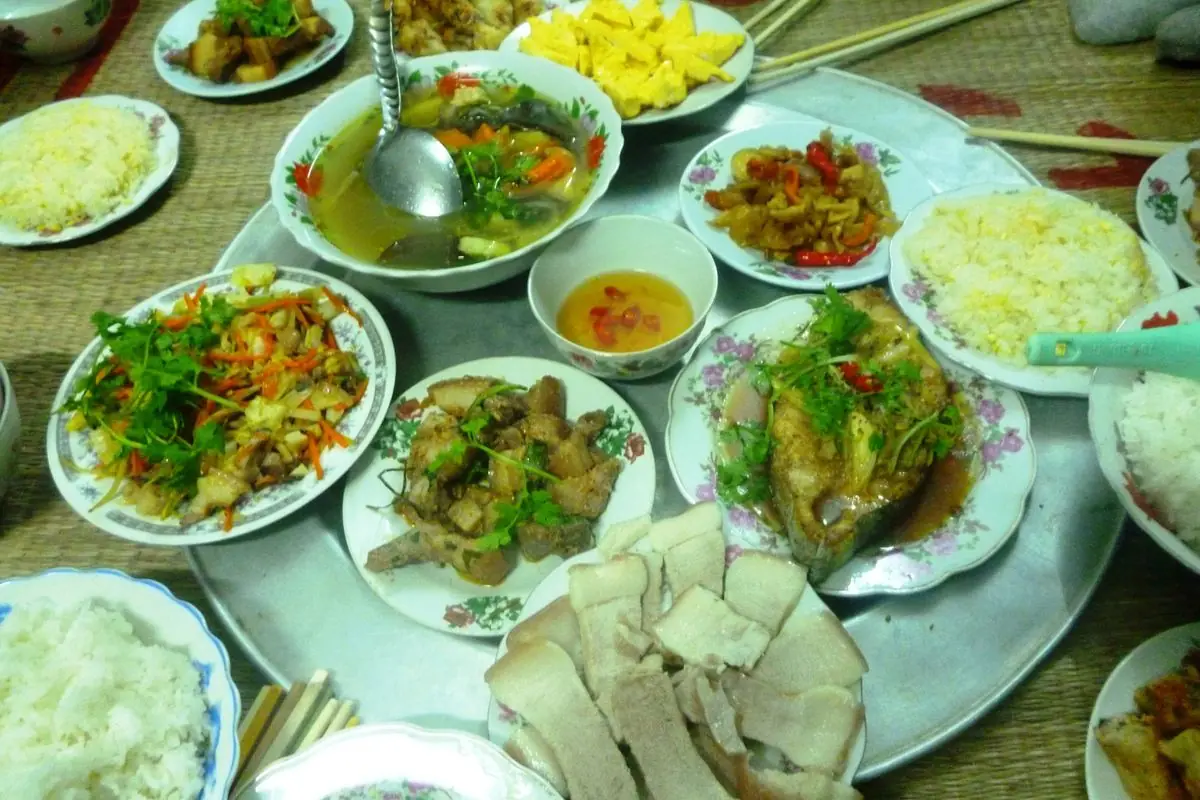
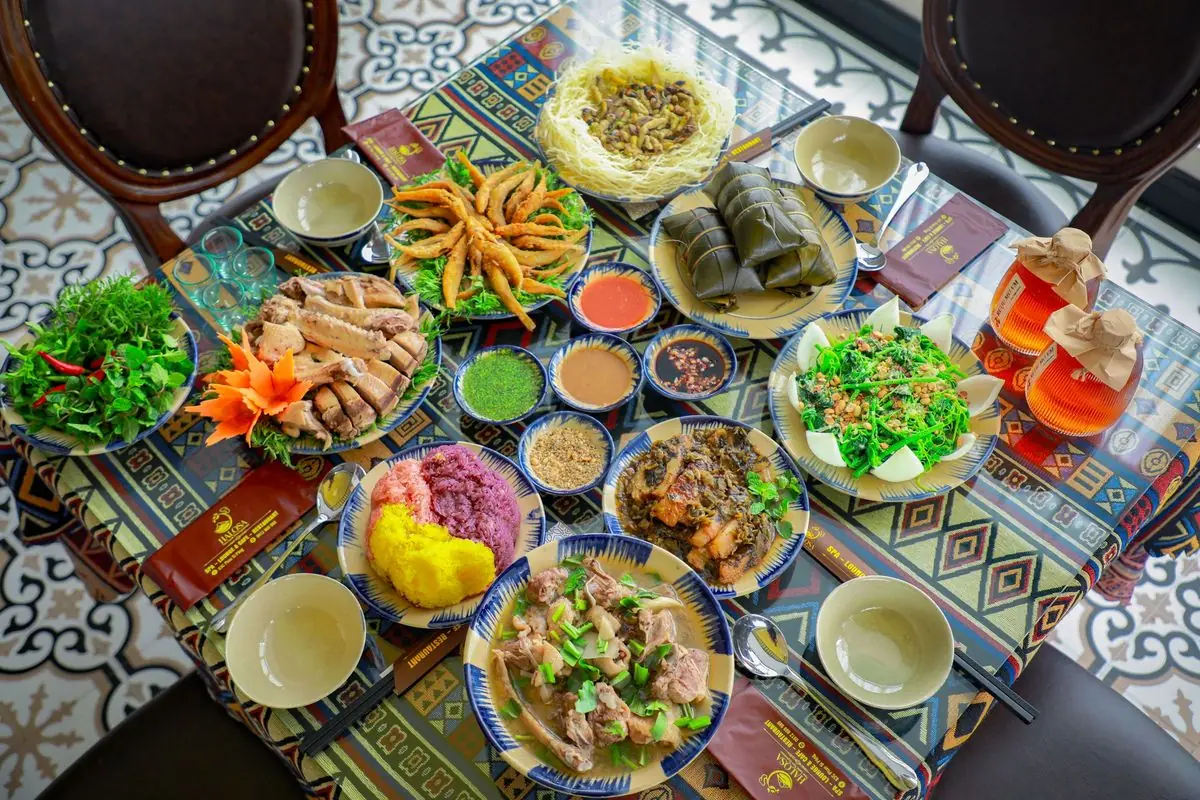
The food depends on the region and on the family. Northern tables might include bánh chưng, boiled chicken or spring rolls. In the south, bánh tét, braised pork or other family favorites may appear. No single menu speaks for every Vietnamese household. A family may adapt the meal to its budget, the number of relatives coming home and the dishes everyone actually enjoys.
The timing is flexible too. The last lunar month can have twenty-nine or thirty days. Some families gather on the final day; others arrange an earlier dinner so relatives working far away can attend. An early tất niên invitation is still a meaningful family gathering. There is no need to correct their calendar.
When invited into a Vietnamese home, ask what time to arrive and whether you should bring anything. Fruit or a modest shared food gift can be thoughtful if it suits the hosts, but an expensive present is not required. At the door, notice whether shoes are removed. During an ancestral offering, follow the host’s lead and wait until they indicate it is time to sit down to eat.
Rituals you do not understand are fine to watch from the side. Asking a respectful question is usually better than imitating a gesture blindly. Avoid filming family members or the altar without permission. Someone has invited you into their private holiday routine, which is quite different from attending a public-facing company dinner.
One more distinction matters to international visitors. A Tết visit on the first day of the new lunar year has its own customs about receiving guests, so it is not the time to drop in unannounced. A family tất niên invitation is personal and should be treated according to the time and arrangements your host gives you.
What about tat nien with friends?
Friends also use the expression tất niên for a final get-together before they scatter for the holidays. It may mean hotpot at a neighborhood restaurant, a meal at someone’s apartment or even a café visit after work. There is usually no MC, no departmental award and no pressure to talk about business performance. The aim is catching up before the holidays.
With friends, the money question tends to be more important than the dress code. Clarify whether you are splitting the bill, bringing dishes to share or taking turns covering different parts of the evening. A small agreement beforehand prevents the end of the meal from becoming awkward.
You might hear friends ask about holiday travel, relationships or year-end bonuses. Those questions can be ordinary conversation, but nobody has to share details about money or private life. If the topic becomes uncomfortable, change it. There is no requirement that an end-of-year dinner become a public review of everyone’s personal circumstances.
Similarly, alcohol should remain a choice. It is possible to have a lively celebration over soft drinks, dessert or coffee. The quality of the evening has much more to do with how comfortable everyone feels than with how many rounds of beer the group finishes.
Practical Vietnamese office culture tips for international colleagues
For international employees, a few expressions make the evening easier. “Chúc mừng năm mới” means “Happy New Year.” “Cảm ơn” means “Thank you.” “Không uống rượu” means “I don’t drink alcohol.” Imperfect pronunciation is fine. Most colleagues will understand your intent and appreciate that you are joining the exchange.
Vietnamese workplace relationships may involve forms of address such as anh, chị and em. Which one to use depends on the people involved and the habits of your team. Nobody expects you to master the whole system at a gala dinner. Follow the form of address colleagues already use, or ask a trusted teammate what sounds natural.
Colleagues coming over to your table with glasses are usually offering a social greeting rather than making a demand. Stand or remain seated as the situation suggests, acknowledge the toast and keep your drink choice. When everyone is taking a department photo, join in if you are comfortable. Small moments of participation often communicate warmth more effectively than a polished speech.
The event may be conducted largely in Vietnamese. Ask a nearby colleague to explain essentials such as when your department is called, whether your raffle number has appeared, or where to collect a prize. Award recipients and anyone with a formal role should ask for instructions beforehand so nothing on stage comes as a surprise.
Dietary needs are worth discussing early. Tell the organizer about food allergies or restrictions when you RSVP, not just when the first shared dish arrives. A formal meal may have assigned portions and catering arrangements, while a casual restaurant can sometimes offer more flexibility. Either way, clear communication is kinder than leaving your tablemates to guess why you are not eating.
It is still a work event, though. Friendly conversations can be informal, but avoid turning the evening into a discussion of confidential projects, salary disputes or colleagues who are absent. There is no need to perform a different personality. Showing interest, joining the appropriate moments and respecting other people’s boundaries is a strong first impression.
A few phrases for the situations people actually worry about
To find your table, try “Excuse me, where is our team sitting?” “Thank you, I’m having a soft drink tonight” is enough when someone offers you beer. For a surprise game, “Thank you, I’ll cheer for everyone this round” keeps your answer friendly and clear. You can say all of those things in English when that is the language you and your colleagues normally use.
A question about bringing a guest belongs before the organizer finalizes the seating: “Does the invitation include partners, or is this employees only?” A request to perform deserves two questions: what the rehearsal schedule is and whether you can help in another way. On your way out, say goodbye to your immediate team and hand over any event responsibility you accepted.
A toast needs no clever joke. “Wishing everyone good health and an easier, happier new year” is warm and appropriate. When people are closing a demanding year at work, simple wishes often sound better than a speech full of forced optimism.
The idea running through these situations is straightforward: ask about the arrangements, respect the hosts and retain the freedom to make sensible personal choices. Vietnamese year-end gatherings can be lively, but enjoying one does not require copying every action of the loudest person at the table.
One useful number to remember before you go
Aim to be at the venue 10-15 minutes before the official program begins, especially if the invitation gives a separate check-in time. That small buffer lets you find your seat, greet your team and start the evening without rushing.
Frequently asked questions
What is tat nien in Vietnam?
Tat nien means the end of the year. Traditionally it refers to the closing days of the lunar year and a family gathering before Tết. At work, it usually describes a company year-end meal or celebration.
What should I wear to a Vietnamese company year end party?
Follow the dress code on your invitation. If none is provided, choose neat smart-casual clothing and adjust to the venue, whether it is a hotel gala or an informal restaurant dinner. Traditional clothing is only needed for a traditional theme.
Do I have to drink alcohol or accept a toast?
You can join a toast with water or another nonalcoholic drink and politely decline alcohol. If you drink, arrange transportation that does not involve driving yourself, including on a motorbike.
Can I bring my boyfriend, girlfriend, spouse or children?
Only if the organizer permits additional guests. Some events include families, while others are employees-only. Ask before the RSVP deadline rather than arriving with an unregistered guest.
Do employees have to pay or perform at a year end party?
There is no single rule. Official company-hosted dinners are commonly covered by the employer, but informal team meals may be split. Performances and rehearsals depend on the event and your team's arrangements; clarify expectations before committing.