Before your first drinking night in Vietnam: bia hoi, toasting etiquette, splitting the bill, and getting home safely
From ordering your first glass of bia hoi to settling the bill, this guide explains what to eat, how to join a Vietnamese toast, and what to say when someone offers another drink. You'll also learn how to choose a drinking spot in Hai Phong and arrange a safe ride back to your hotel.
 23 min read
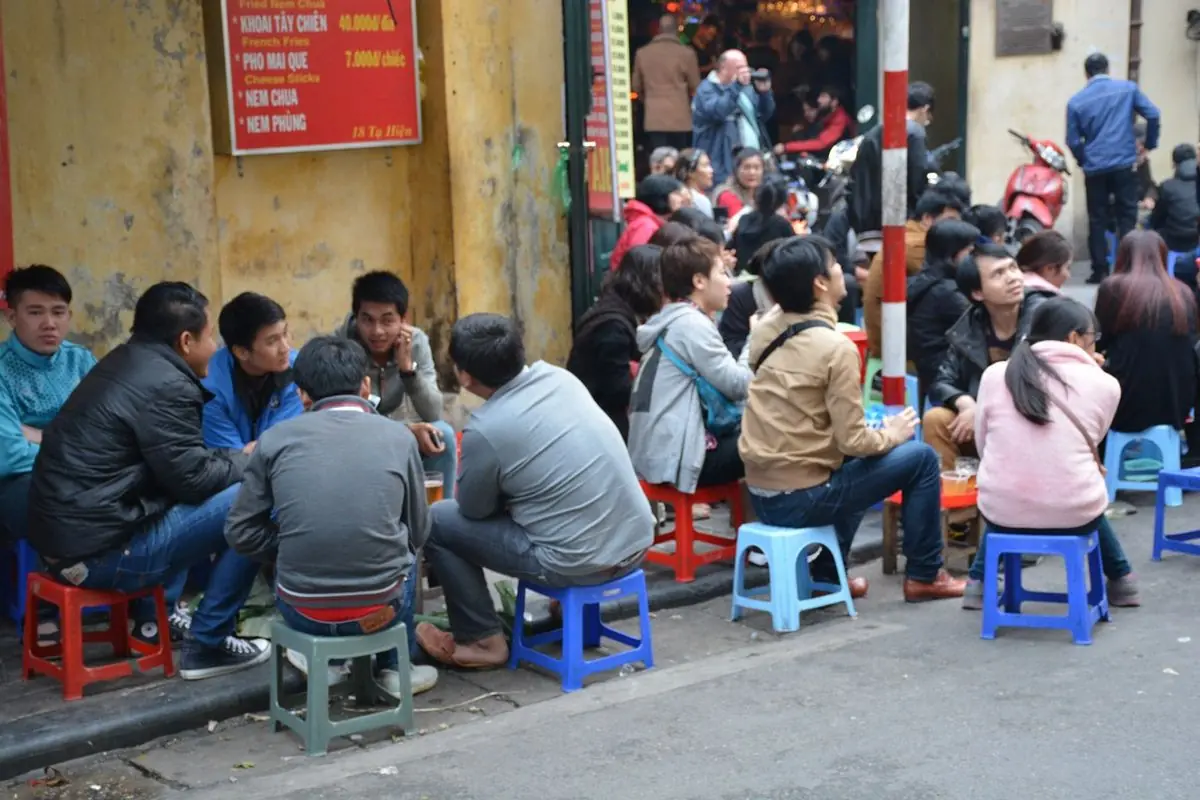
A sidewalk bia hoi spot on Ta Hien Street, Hanoi.
A colleague in Hai Phong invites you out for beers after work, or you pass a crowded sidewalk bar and wonder whether you can simply sit down and order a drink. Start by checking whether the place serves bia hoi, looking at the menu, and finding a table. Drinking in Vietnam is often as much about sharing food and conversation as it is about alcohol, and you can join in without drinking heavily - or drinking at all.
1. What makes Vietnamese drinking culture different?
In some countries, going out for drinks means meeting friends at a pub, ordering a pint, and chatting over the bar. In Vietnam, a drinking session often looks more like a shared dinner.
Several dishes sit in the middle of the table. Everyone reaches for food with chopsticks, glasses are raised throughout the meal, and the conversation moves easily between work, family, travel, and whatever happens to come up.
One person might be asking how long you’ve been in Vietnam. Someone else may offer you a piece of grilled squid. Before you’ve finished answering, another guest raises a glass and calls for a toast.
Drinking gatherings happen for all kinds of reasons. Colleagues may meet after work, old friends might catch up over dinner, or a family may invite a visitor to share a meal.
Some groups stay for less than an hour. Others order several rounds of food and continue talking late into the evening.
A few things are worth understanding before your first invitation:
- Food is usually shared. Rather than ordering an individual main course, people often choose several dishes for the whole table.
- Toasts can happen frequently. Guests may raise their glasses when someone arrives, when a new friendship begins, or simply when the conversation gets lively.
- Drinking places can be noisy. Conversations, orders shouted to staff, and the clinking of glasses may all happen at once.
- The meal can continue after the main dishes are finished. A group may order more peanuts, vegetables, grilled food, or drinks.
- Payment arrangements vary. One person might host the entire meal, or everyone may contribute.
These are common social habits, not rules followed by every Vietnamese person.
A business dinner with older colleagues can feel quite different from a casual evening with university friends or a family gathering.
The most useful thing to remember is that a friendly invitation to drink does not mean you’re expected to empty your glass.
2. What is bia hoi in Vietnam?
Bia hoi is a Vietnamese draft-style beer commonly served straight from a keg or dispensing system at local drinking establishments.
It’s especially associated with northern Vietnam, particularly Hanoi and Hai Phong.
Instead of receiving a sealed bottle or can, you’ll usually be served a glass of pale golden beer with a layer of foam on top.
At a simple sidewalk bar, the beer may arrive in a sturdy glass mug. Larger establishments sometimes serve it in pitchers or beer towers so that everyone can pour their own.
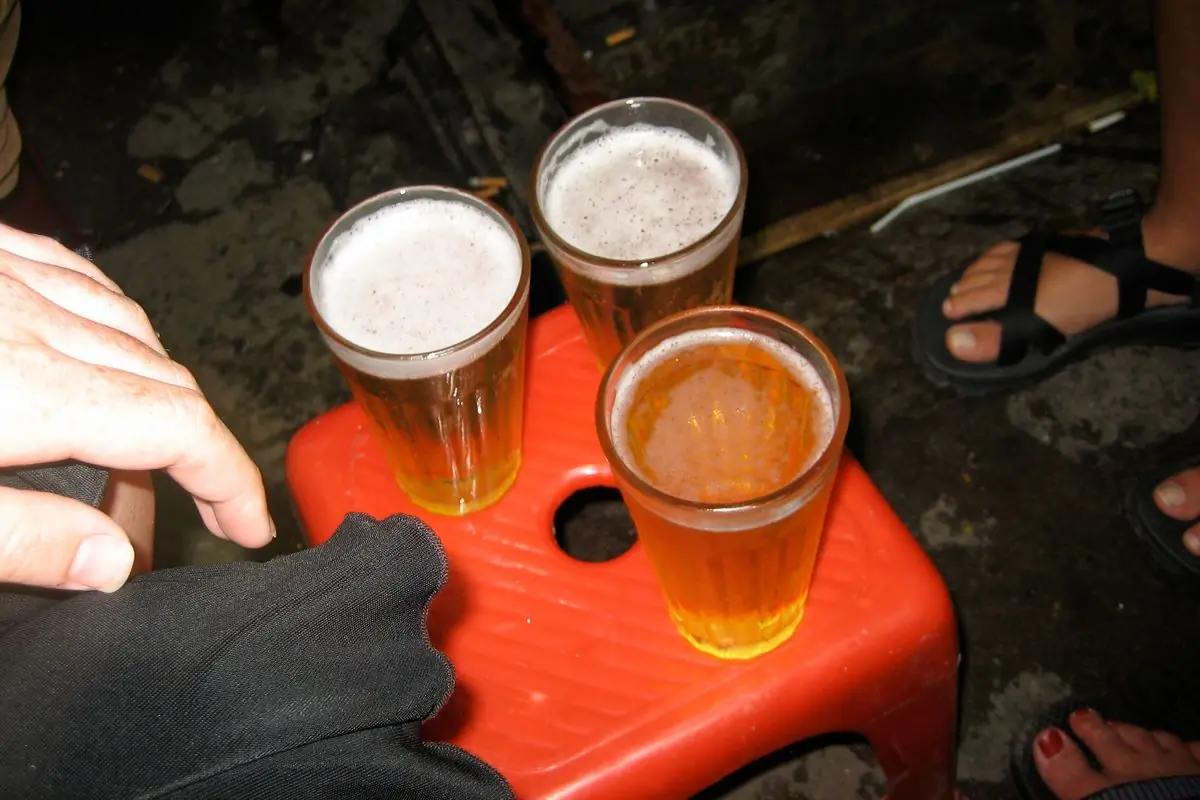
Bia hoi is not quite the same thing as craft beer.
Craft breweries may experiment with different grains, yeasts, fermentation techniques, and flavors. Traditional bia hoi is generally associated with a straightforward, refreshing drinking experience that goes well with shared food.
How strong is bia hoi?
The alcohol content depends on the producer and product.
For example, HABECO, the producer behind Hanoi Beer, lists its large-keg Bia Hoi Hanoi at 4% alcohol by volume (ABV).
Its Bia Hoi Hanoi 1-liter KEG product is listed at 4.3% ABV.
That gives you a useful reference point: some familiar bia hoi products are around 4% alcohol, but not every draft beer sold in Vietnam has exactly the same strength.
Other draft beers may be stronger.
If a restaurant offers several brands, ask the staff which beer they’re pouring or look for the alcohol percentage on the menu.
Bia hoi often feels light and easy to drink, especially when served cold. That doesn’t make it alcohol-free.
Several glasses consumed over a long conversation can add up faster than you expect.
How much does bia hoi cost in 2026?
As a broad travel-budget reference for 2026, VND 10,000-25,000 per glass is a useful range to consider, depending on the location and serving size. It is not a fixed nationwide price.
In 2026, bia hoi costs around VND 10,000 at a local establishment and VND 25,000 in a tourist-oriented setting.
Restaurants can also charge by the liter rather than by the glass.
For a specific Hai Phong example, Quán Men, at 3 Thuong Dat in the Tu Minh area, lists fresh bia hoi at VND 25,000 per liter on its 2026 online menu.
That is a per-liter price, not the cost of one glass.
This distinction matters. A price that looks unusually cheap may refer to a smaller serving, while another establishment may sell beer by the pitcher or liter.
You don’t have to order bia hoi just because you’re at a bia hoi bar. Many restaurants also offer bottled beer, soft drinks, bottled water, and other non-alcoholic options.
Should bia hoi be consumed immediately?
Bia hoi is generally intended to be enjoyed fairly soon after being poured, while it’s still cold and fresh.
It’s not a drink you’d normally buy and leave sitting in the heat for several hours.
Proper storage, clean dispensing equipment, and hygienic glasses matter.
However, claims that all bia hoi is brewed every morning or becomes unsafe after exactly 24 hours shouldn’t be treated as universal facts.
A beer that smells unusual, tastes noticeably wrong, or arrives in an unclean glass is a fair reason to ask the staff to check it or provide a replacement.
3. What should you order at a bia hoi bar?
You can walk into a local beer bar without recognizing dozens of Vietnamese dishes.
For two or three people, a simple approach is to order a couple of small snacks, add one substantial hot dish, and see how hungry everyone is before ordering more.
A straightforward first round might include:
- Lạc rang: Roasted peanuts.
- Đậu phụ rán: Fried tofu.
- Dưa chuột: Fresh cucumber.
- Bò xào: Stir-fried beef.
- Mực nướng: Grilled squid.
- Bia hoi, water, or soft drinks for each person.
Roasted peanuts are easy to share. Fried tofu usually arrives golden on the outside and soft inside, with a dipping sauce on the side.
Cucumber is a refreshing contrast to oily or grilled dishes.
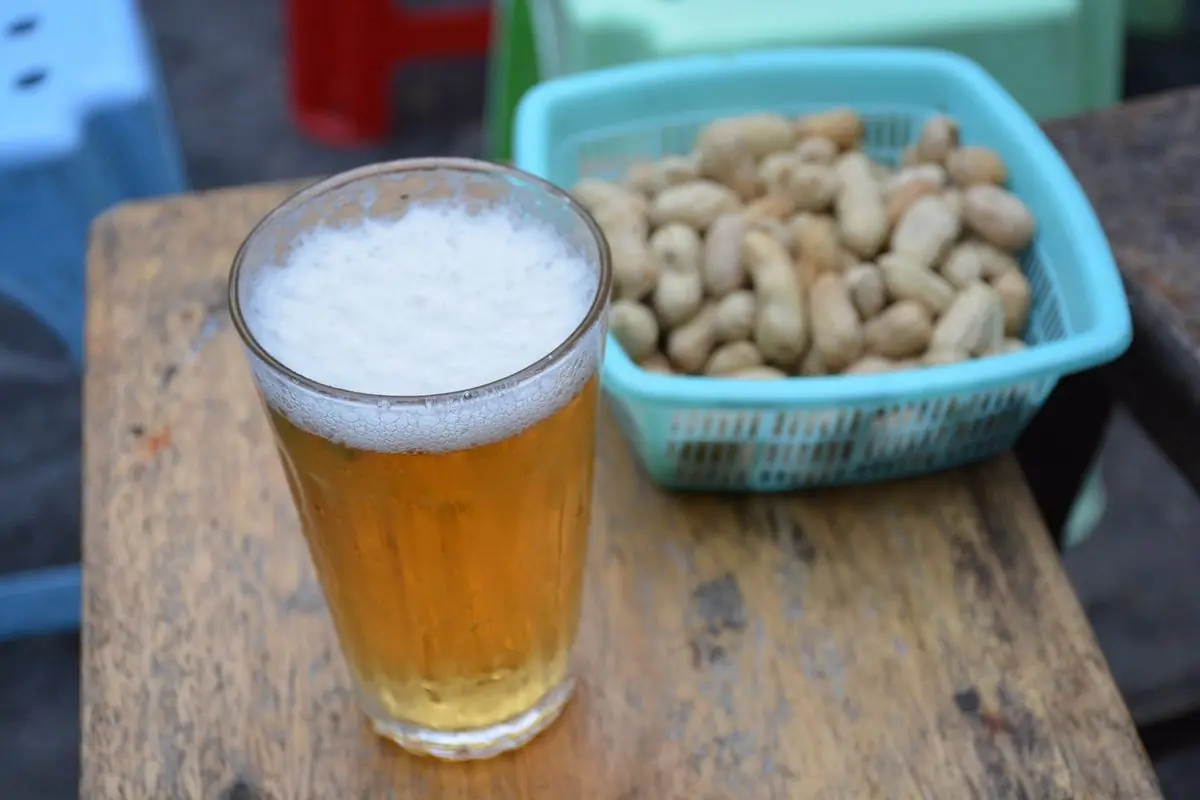
Add rice, noodles, chicken, or a hotpot to make it a proper dinner.
There’s no reason to order everything immediately. A table of four can easily end up with too much food if you order a whole chicken, several seafood dishes, and a hotpot before the first plates arrive.
Example food and beer prices in Hai Phong
To give you an idea of how prices appear on a real menu, here are several items published by Quán Men in the Tu Minh area of Hai Phong.
| Menu item | Published price, 2026 |
|---|---|
| Roasted salted peanuts | VND 19,000 |
| Cucumber with salt and pepper | VND 25,000 |
| Crispy fried tofu | VND 40,000 |
| Butter-fried corn | VND 40,000 |
| Grilled yellowstripe scad | VND 60,000 |
| Jellyfish salad | VND 100,000 |
| Fresh bia hoi | VND 25,000/liter |
These are published prices from one restaurant, not average prices for Hai Phong.
Quán Men is located in Tu Minh, in the former Hai Duong area that is now part of the expanded Hai Phong municipality. It isn’t within convenient walking distance of the historic city center around Hai Phong Opera House.
The useful lesson from this menu is to check both the price and the serving unit.
A dish priced per plate, per whole fish, per pot, or per kilogram can lead to very different bills.
4. How to toast in Vietnam: "mot, hai, ba, dzo!"
You’ll probably hear this before you’ve finished your first drink.
Someone raises their glass and calls:
"Một, hai, ba, dô!"
It translates roughly to:
"One, two, three, cheers!"
Everyone responds with a loud "Dô!" while raising or clinking their glasses.
For English speakers, "dô" is often approximated as "yo!" or "zo!" in travel guides. Nobody expects perfect pronunciation.
Raise your glass, smile, and follow the group’s lead.
Do you need to clink glasses with everyone?
No.
At a small table, people may clink glasses individually. At a larger gathering, simply raising your glass toward guests sitting farther away is perfectly reasonable.
There’s no need to stretch across a table full of hot dishes just to reach someone on the other side.
Clink gently. Some local bars use thick glass mugs, but glass can still break when people knock their drinks together too forcefully.
Should your glass be lower than an older person’s glass?
In some Vietnamese social settings, younger people hold the rim of their glass slightly lower than the glass of an older or more senior guest when toasting.
It’s a gesture of respect, not a compulsory rule.
At a work dinner or with a host family, watching how other guests behave is usually enough.
A friendly greeting and considerate manner will matter more than remembering every small detail of drinking etiquette.
What does "tram phan tram" mean?
You might hear someone say:
"Trăm phần trăm nhé!"
Literally, this means "one hundred percent."
At a drinking table, it’s an invitation to finish the entire drink, similar to saying "bottoms up."
You are not required to do it.
You can take a small sip, raise a non-alcoholic drink, or politely decline.
Joining a toast and accepting another full glass of beer are two different things.
5. How to refuse alcohol politely in Vietnam
One situation that can make visitors uncomfortable is being repeatedly offered drinks.
Someone may be trying to welcome you. Another guest may want to celebrate a new friendship. Sometimes the invitations become more persistent than you’d like.
Deciding on your drinking limits before arriving makes these situations easier to handle.
You don’t need an elaborate excuse.
Useful Vietnamese phrases for refusing a drink
| Situation | What to say |
|---|---|
| You don’t drink alcohol | "Cảm ơn, tôi không uống bia." - Thank you, I don’t drink beer. |
| You’d rather toast with a soft drink | "Tôi cụng bằng nước ngọt nhé!" - I’ll join the toast with a soft drink! |
| You’ve had enough | "Cảm ơn, tôi uống đủ rồi." - Thank you, I’ve had enough. |
| You want to concentrate on eating | "Tôi ăn thêm chút đã." - I’ll have some more food first. |
| You don’t want another refill | "Cho tôi xin dừng bia ở đây nhé." - I’d like to stop drinking beer now. |
| Someone asks you to empty your glass | "Tôi chỉ uống một ngụm thôi nhé." - I’ll just take a sip. |
When speaking to an older host, adding "ạ" to the end of a sentence makes it more polite.
For example:
"Cháu không uống thêm nữa ạ."
This is a respectful way for a younger person to say they won’t drink any more.
You don’t need to pretend to have a medical condition, invent an early flight, or make up another reason.
"I don’t drink alcohol" is a complete answer.
What if someone keeps pressuring you?
Repeat your refusal calmly and clearly. Put your glass down, switch to water, and continue the conversation.
If the person won’t stop, ask someone else in the group for support or leave the gathering.
No one needs to turn dinner into a legal debate. Just know that declining alcohol is entirely reasonable, and a polite refusal should be respected.
6. Who pays the bill at a Vietnamese drinking party?
There isn’t one payment rule for every Vietnamese drinking gathering.
The arrangement depends on the relationship between the people at the table, who organized the evening, and what everyone agreed to beforehand.
When a host or colleague invites you
If someone says:
"Hôm nay tôi mời."
It usually means:
"It’s my treat today."
The person is generally offering to pay for the meal.
You can thank them and offer to contribute once. If they clearly decline, there’s no need to turn the bill into a prolonged argument.
Sometimes another guest will return the hospitality by inviting the group out for coffee or dinner on a different day.
That’s a friendly gesture, not a debt that every foreign visitor is expected to repay.
When you’re out with a group of friends
Splitting the bill is common among groups who have arranged to meet casually.
One person may pay the restaurant, then send everyone a message with the total amount and their share.
You may hear:
"Chia đều nhé."
This means the bill will be split evenly.
It doesn’t necessarily mean each person pays for exactly what they consumed.
If you’re drinking water while everyone else orders several rounds of expensive beer or spirits, it’s reasonable to ask how drinks will be handled before the bill arrives.
Should you insist on paying to be polite?
Not necessarily.
At some Vietnamese meals, two people may reach for the bill at the same time or insist on treating the group.
This can be a genuine expression of hospitality, but it doesn’t mean every argument over payment is just a social performance.
If you want to treat everyone, say so clearly; to split the cost, agree on that before ordering large or expensive dishes.
When the bill arrives, check for extra items such as wet towels, additional drinks, service charges, or dishes ordered later.
A service charge isn’t the same thing as an optional tip.
7. Vietnamese drinking food: what is "do nham"?
Đồ nhắm is the general Vietnamese term for food eaten alongside alcoholic drinks.
It can mean something as simple as peanuts or fried tofu, but it also includes seafood, grilled meat, salads, hotpots, and more adventurous local specialties.
Not every dish will suit someone visiting Vietnam for the first time.
Easy dishes to start with
Roasted peanuts and fried tofu are familiar, uncomplicated choices. They arrive in small portions and are easy to share.
Butter-fried corn and French fries are common at casual drinking places and hotpot restaurants. They’re convenient while the group is deciding what to order next.
Grilled chicken, stir-fried beef, and cooked vegetables are generally approachable options for visitors who aren’t used to Vietnamese offal dishes or strongly flavored ingredients.
Grilled squid and steamed prawns are good choices for seafood lovers, although allergies and pricing deserve attention.
Ordering seafood in Hai Phong
Hai Phong is a coastal city with plenty of seafood restaurants serving prawns, crabs, swimming crabs, mantis shrimp, clams, oysters, and fish.
Unlike a plate of fried tofu with a fixed menu price, seafood may be charged by weight, by the animal, or by portion.
Before ordering a whole crab or plate of seafood, ask:
- How much is it per kilogram?
- How much does each crab or fish weigh?
- How many people will this portion serve?
- Does the price include preparation?
- Can the restaurant weigh it and confirm the total before cooking?
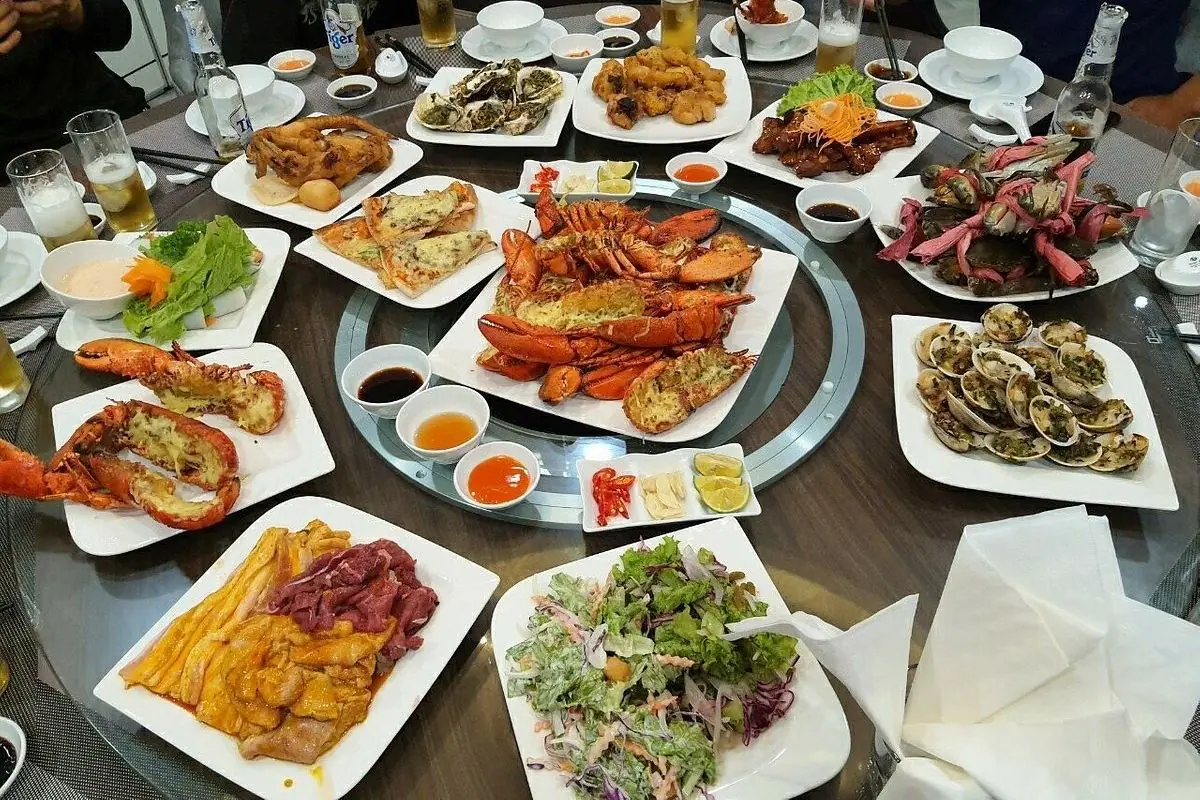
For example, asking "How much is a plate of crabs?" won’t help much if the restaurant charges by the kilogram.
Two small crabs and two large crabs could produce very different bills.
If you have a sensitive stomach or prefer to avoid higher-risk foods, choose properly cooked dishes rather than raw seafood, raw blood pudding, or undercooked meat.
Can you order drinking snacks without drinking?
Absolutely.
You can enjoy the same food with water, tea, or a soft drink.
There’s no need to sit separately or order an individual meal simply because you don’t drink alcohol.
If you have a peanut, shellfish, or other food allergy, tell the restaurant when ordering. Ask about ingredients and preparation rather than assuming that a familiar-looking dish is safe.
8. Types of drinking places in Hai Phong
Searching for "Hai Phong drinking places" or "quán nhậu Hải Phòng" brings up a broad mix of establishments.
You’ll find everything from simple sidewalk beer stalls to seafood restaurants and large indoor hotpot venues.
Rather than choosing somewhere solely because it’s popular, start with the kind of evening you want.
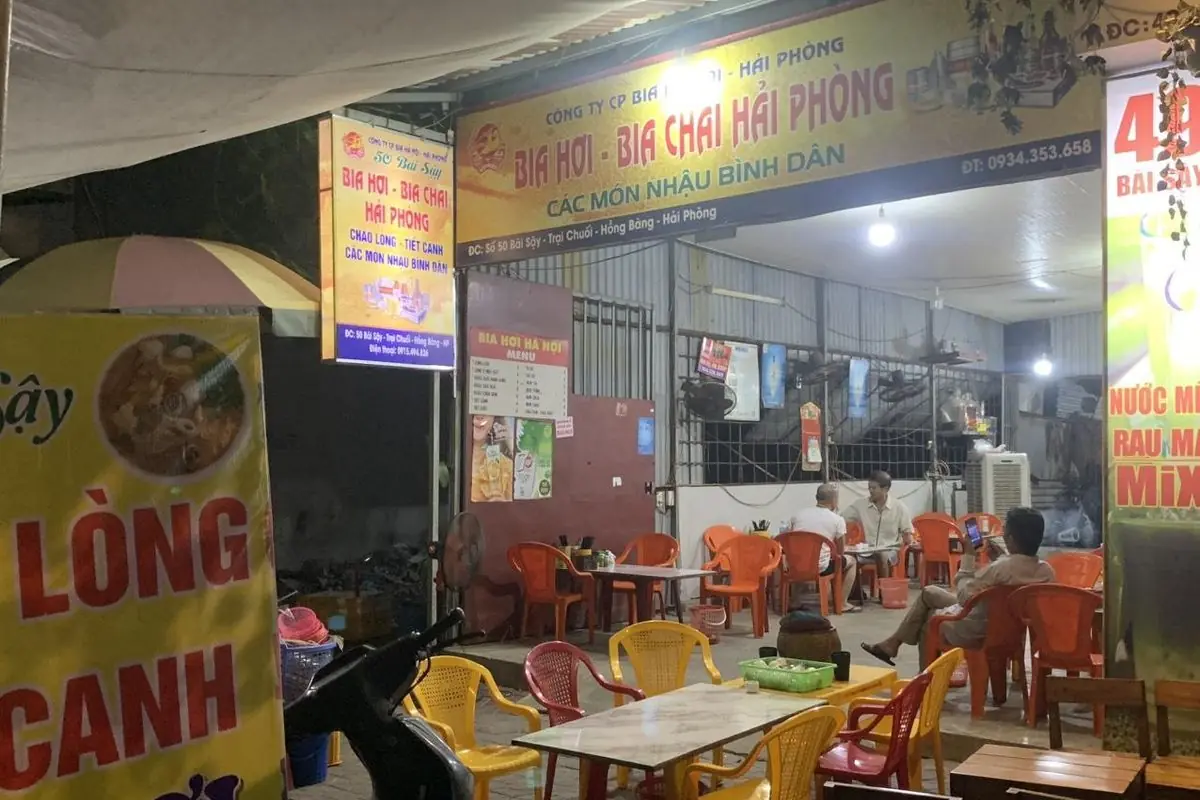
Sidewalk bia hoi bars
Short, casual, inexpensive dishes
You’ll recognize these right away by their simple tables, practical seating, freshly poured beer, and plates of food arranged in the middle.
Areas around Lach Tray, Cau Dat, and Van Cao have various places to eat and drink in the evening. Not every restaurant in those areas serves traditional bia hoi, however, and opening hours vary.
A sidewalk beer bar is a good choice if you want a casual drink, a few inexpensive dishes, and a lively local atmosphere.
The drawbacks are equally straightforward.
It can get hot in summer, noisy during busy periods, and uncomfortable when the weather turns wet.
It’s also not the most convenient place to settle down with luggage or large bags.
Seafood restaurants
A proper dinner, ask prices first
For a proper dinner with friends or colleagues, a seafood restaurant may make more sense.
You can order steamed prawns, clams, grilled fish, squid, crab, or other seafood dishes prepared to share.
Many seafood restaurants have larger tables and indoor seating, making them suitable for longer meals.
The main consideration is cost.
The seafood can easily account for much more of the final bill than the drinks, particularly when you order whole fish, crabs, or several dishes sold by weight.
Ask for the weight and total price before the kitchen begins preparing anything expensive.
Hotpot and barbecue restaurants
Groups staying a while
Hotpot and barbecue restaurants work well for groups with different preferences, including people who drink beer and those who don’t.
Guests can choose their own ingredients and cook food at the table.
Some restaurants use à la carte menus, while others offer buffet packages.
Before choosing a buffet, check whether there’s a time limit and whether drinks are included.
Beer and soft drinks aren’t automatically part of the buffet price.
Indoor hotpot restaurants can also be more comfortable than outdoor beer stalls during Hai Phong’s rainy periods or chilly winter evenings.
Late-night drinking places and beer gardens
Staying out later, with music
Some venues are designed for groups who want to stay out later.
They may have outdoor seating, music, large shared tables, or more elaborate drink menus.
A beer garden isn’t necessarily a traditional bia hoi establishment.
Some specialize in bottled beer, branded draft beer, or a wider range of alcoholic drinks.
Somewhere with loud music isn’t ideal for talking with a host family or getting to know new colleagues; a quieter restaurant may be more suitable.
For a birthday gathering with a group of friends, the opposite might be true.
Don’t assume that a venue with "beer" in its name serves bia hoi. Check the menu before heading over.
9. What time do drinking places in Hai Phong close?
Vietnam does not have a nationwide rule requiring every drinking establishment to close at 10 PM.
During discussions surrounding the 2019 Law on Prevention and Control of Harmful Effects of Alcoholic Beverages, there was a proposal to restrict alcohol sales during certain late-night hours.
That proposed nationwide restriction wasn’t included in the final law.
Actual closing hours depend on the establishment and other applicable business, public-order, and noise regulations.
For one specific example, Quán Men in the Tu Minh area of Hai Phong is open 7 AM-10 PM, seven days a week.
Other establishments may stay open later, but a name such as "late-night beer bar" doesn’t guarantee service until midnight or 2 AM.
Another detail worth checking is the kitchen’s last-order time.
A venue might remain open while the kitchen has already stopped preparing grilled dishes or hotpots.
If you’re planning to arrive late, ask:
- "Quán mở đến mấy giờ?" - What time do you close?
- "Bếp nhận món cuối lúc mấy giờ?" - What time is the last food order?
- "Sau 10 giờ còn phục vụ lẩu không?" - Do you still serve hotpot after 10 PM?
- "Có chỗ ngồi trong nhà không?" - Do you have indoor seating?
For a first evening out in Hai Phong, 6-8 PM is a practical time to begin dinner.
You’ll have enough time to order food, chat, settle the bill, and arrange transport without depending on restaurants that stay open very late.
10. Common misunderstandings at a Vietnamese drinking table
Is someone angry if they speak loudly?
Not necessarily.
In a crowded restaurant, people often raise their voices to be heard over music, traffic, and other conversations.
Some people in Hai Phong also communicate in a fairly direct, energetic way.
That doesn’t mean everyone from Hai Phong speaks loudly or that uncomfortable behavior should be excused as a local custom.
Pay attention to what the person is saying, their expression, and how they treat others.
What does it mean when someone puts food in your bowl?
At a familiar Vietnamese meal, a host or someone sitting nearby may place a piece of food into your bowl.
It can be a gesture of hospitality, particularly when they want you to try a local specialty.
You can thank them and eat it if you’re comfortable.
If you have an allergy or don’t eat that type of food, explain briefly.
You shouldn’t feel obliged to eat something that could make you ill simply to be polite.
Do you have to drink as quickly as everyone else?
No.
A lively table may have several rounds of toasts, but raising your glass doesn’t have to mean finishing your drink every time.
Keeping a glass of water nearby makes it easy to join in without consuming more alcohol.
Do Vietnamese drinking gatherings always involve strong spirits?
No.
Rice liquor and infused spirits appear at some gatherings, but plenty of people simply order beer or non-alcoholic drinks.
Some homemade or unlabeled spirits can have high or uncertain alcohol content.
There’s no reason to try a drink of unknown origin, ingredients, or strength just because someone offers it.
Can children join a meal at a drinking restaurant?
Families can eat at restaurants that also serve beer, provided the venue is suitable for children.
However, people under 18 are prohibited from consuming alcoholic beverages in Vietnam by law.
Selling or supplying alcohol to someone under 18 carries a fine of VND 1-3 million.
Alcohol retailers must also display a visible notice stating that alcoholic beverages are not sold to people under 18.
When visiting with young children, choose a quieter restaurant with suitable food and a comfortable place to sit, ideally away from smoking areas.
11. How to get back to your hotel after drinking
This is something to arrange before arriving at the restaurant, not after several beers.
Option 1: book a Grab car
Grab offers car-booking services in Hai Phong.
Open the app, enter your pickup point and hotel address, choose an available car service, and review the estimated fare before confirming.
A car is generally preferable to a motorbike taxi if you’ve been drinking, especially if you feel dizzy, tired, or unsteady.
Check the vehicle’s registration number and driver details before getting in.
Don’t accept a different vehicle simply because someone claims to be your driver.
Option 2: book a Green SM electric taxi
The Vietnamese electric taxi brand Xanh SM rebranded as Green SM in April 2026.
You can book through the Green SM app or call its nationwide hotline:
1555
The hotline operates 24 hours a day, seven days a week.
Press * for English-language support.
Calls cost VND 1,000 per minute.
Taxi fares depend on the route, vehicle type, time, and service availability, so check the estimate in the app rather than assuming a fixed fare back to your hotel.
Option 3: ask the restaurant to call a taxi
You can say:
"Anh/chị giúp tôi gọi taxi về khách sạn được không ạ?"
That means:
"Could you help me call a taxi back to my hotel, please?"
Vietnam’s 2019 alcohol law requires establishments serving alcohol for on-site consumption to remind customers not to drive after drinking and to help them arrange public transportation.
Asking staff for help is therefore reasonable, particularly if you don’t have a Vietnamese phone number or your transport app isn’t working.
If you arrived on a rental motorbike, arrange to leave it somewhere permitted, check when you can collect it, and return only when you’re legally and safely able to ride.
Don’t assume a short nap will guarantee that all alcohol has left your system.
12. A simple evening plan for first-time visitors
Visiting several drinking places isn’t necessary to experience Vietnamese drinking culture.
For a first night in Hai Phong, one restaurant with good food, clear prices, and convenient transport is enough.
Here’s a suggested schedule you can adapt. Adjust these planning times to the restaurant’s confirmed service schedule.
- 6:00-6:30 PM
Arrive and choose a table
If you’re with colleagues, let someone familiar with the restaurant explain the main dishes.
On your own, start by looking through the menu and checking drink prices.
A restaurant with clearly displayed prices is easier to navigate when you’re unfamiliar with local dishes.
- 6:30-7:00 PM
Order food
Begin with a couple of snacks and one substantial dish.
If you’re ordering seafood, confirm the price per kilogram, approximate weight, and cooking method before agreeing.
There’s no advantage in filling the entire table immediately.
- 7:00-8:30 PM
Eat and enjoy the conversation
Join the toasts when you’re comfortable.
You don’t have to finish a glass after every cheer.
Switch to water or a soft drink when you don’t want more alcohol.
This is also a good opportunity to ask your hosts about local food, travel recommendations, or places they enjoy visiting in Hai Phong.
- 8:30-9:00 PM
Check the bill and arrange transport
Ask the staff whether any ordered dishes are still being prepared.
If the bill is being split, settle your share before everyone starts leaving.
Then enter the restaurant’s exact address into your transport app and wait for your driver somewhere safe.
Don’t feel you have to stay until closing time just because other people want another round.
If you’re visiting Hanoi rather than Hai Phong, Ta Hien Street is another well-known place for beer and nightlife. Its atmosphere is different from a neighborhood bia hoi restaurant in Hai Phong.
13. Useful Vietnamese phrases for a night out
You don’t need to speak fluent Vietnamese to order food, join a toast, or ask for the bill.
A handful of practical phrases can make the evening much easier.
| Vietnamese | English meaning |
|---|---|
| "Cho tôi một cốc bia hơi." | One glass of bia hoi, please. |
| "Bia hơi bao nhiêu một cốc?" | How much is a glass of bia hoi? |
| "Cho tôi một đĩa lạc rang." | One plate of roasted peanuts, please. |
| "Món này có cay không?" | Is this dish spicy? |
| "Một, hai, ba, dô!" | One, two, three, cheers! |
| "Cảm ơn, tôi không uống bia." | Thank you, I don’t drink beer. |
| "Tôi uống đủ rồi." | I’ve had enough to drink. |
| "Cho tôi nước lọc nhé." | Water, please. |
| "Món này tính theo cân à?" | Is this charged by weight? |
| "Cho tôi xem hóa đơn." | May I see the bill? |
| "Mọi người chia tiền thế nào?" | How are we splitting the bill? |
| "Giúp tôi gọi taxi nhé." | Please help me call a taxi. |
One small language detail is useful when calling restaurant staff.
Vietnamese speakers often use "Anh ơi," "Chị ơi," or "Em ơi," depending on the person’s approximate age and relationship to the speaker.
These are common ways of getting someone’s attention.
You don’t need to shout repeatedly when staff are busy with another table.
Even without speaking Vietnamese, pointing to the menu and confirming the quantity with your fingers usually works.
For seafood sold by weight, use your phone or a calculator to confirm the total price.
14. What to prepare before your first drinking night in Vietnam
You don’t need anything complicated, but a little preparation can save you trouble later.
Save your hotel’s address. Keep the name and location on your phone, ideally including the Vietnamese address. An English hotel name alone may not always be enough for a driver to identify the right entrance.
Carry a backup payment method. Some smaller restaurants accept cash or Vietnamese bank transfers but not every international credit card. Don’t assume a neighborhood beer stall will have a card machine.
Check transport availability. Ride-hailing services may be easier to find in central areas than in quieter neighborhoods. If you’re eating far from your hotel, arrange a taxi option before the evening gets late.
Choose seating according to the weather. Hai Phong has hot, humid summers and periods of heavy rain. Outdoor beer tables can become uncomfortable during sudden downpours or on particularly hot evenings. In winter, exposed seating may also feel chilly when the wind picks up.
Tell the group if you’re not drinking alcohol. Saying so at the beginning prevents someone from automatically ordering beer for everyone at the table.
Know when you want to leave. Some people enjoy spending the whole evening at one table. Others prefer to head back earlier. It’s fine to thank your hosts and leave when you’re ready.
For a first drinking night in Hai Phong, arriving around 6-7 PM gives you time to eat, ask about beer prices per glass or liter, and check when the kitchen closes. Quán Men, for example, lists a 10 PM closing time, while other restaurants set their own hours; whatever time you leave, book a taxi rather than driving after drinking.
Frequently asked questions
What is bia hoi, and how much alcohol does it contain?
Bia hoi is a Vietnamese draft-style beer usually poured from a keg or dispensing system at local restaurants and beer bars. Its alcohol content depends on the product. HABECO lists its large-keg Bia Hoi Hanoi at 4% ABV and its 1-liter KEG version at 4.3% ABV. Bia hoi is not alcohol-free and shouldn't be consumed before driving.
How much does a glass of bia hoi cost in Vietnam in 2026?
A broad 2026 travel-budget range is VND 10,000-25,000 per glass, although prices and serving sizes vary. Some establishments charge by the liter rather than by the glass. For example, Quán Men in the Tu Minh area of Hai Phong publishes a price of VND 25,000 per liter on its 2026 online menu. Always check the serving unit before ordering.
Can I join a Vietnamese drinking party without drinking alcohol?
Yes. You can order water, tea, or a soft drink, join the toasts, and share food with everyone. Drinking alcohol isn't a requirement for participating in the gathering. Vietnamese law also prohibits forcing others to consume alcoholic beverages.
What time do drinking places in Hai Phong close?
There is no single closing time for all drinking establishments in Hai Phong. Some close around 10 PM, while others may remain open later. Vietnam's 2019 alcohol law does not require every beer bar to stop serving at 10 PM. If you plan to arrive after 9 PM, confirm both the kitchen's last-order time and the restaurant's closing time.
Can I ride a motorbike after drinking one beer in Vietnam?
No. Under Vietnam's Law on Prevention and Control of Harmful Effects of Alcoholic Beverages, operating a vehicle with alcohol in your blood or breath is prohibited. There is no exemption for drinking just one beer. Use a car-booking service, call Green SM on 1555, or ask the restaurant to arrange a taxi.