Why is Hanoi Train Street still so popular despite the restrictions?
Before visiting Hanoi Train Street, check the latest departures and arrivals at Hanoi Railway Station on dsvn.vn rather than relying entirely on train times shared online. Below, you'll find how the two main sections differ, which rules apply now, and how to plan a safer visit.
 14 min read
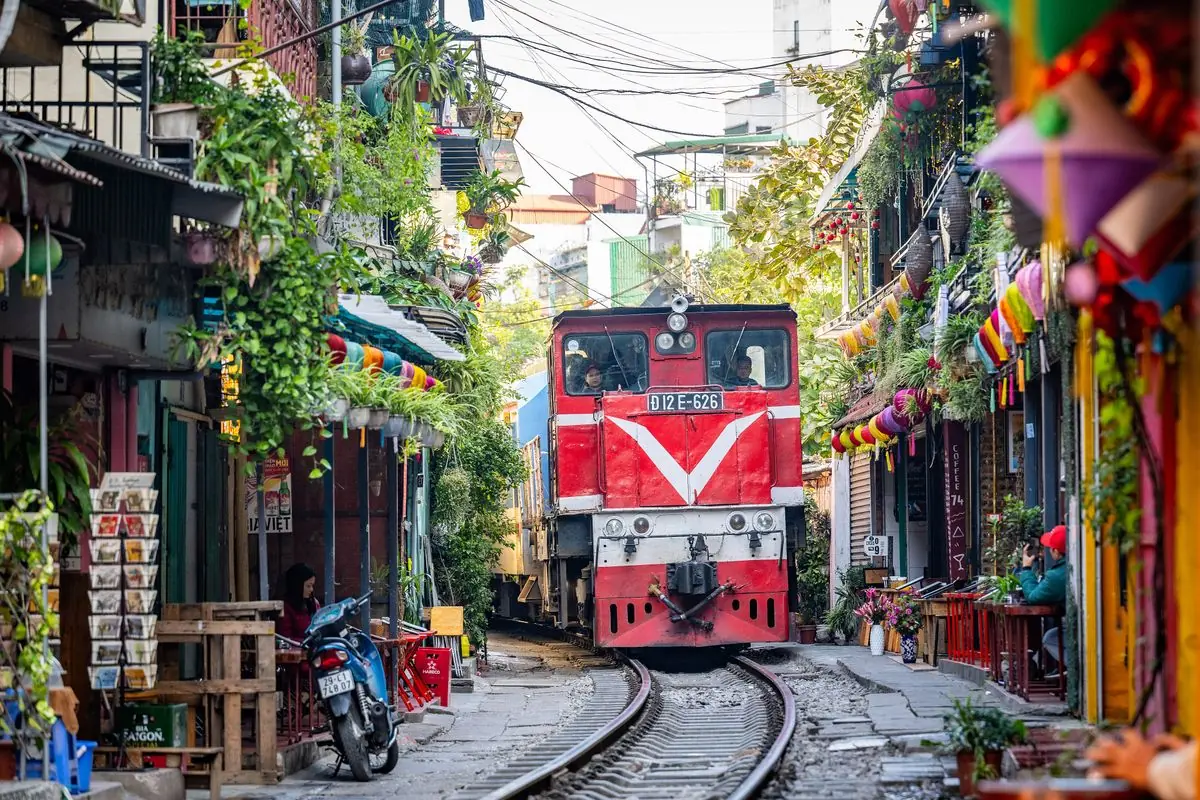
A red D12E locomotive pulls a train through the railway lane, its body almost filling the gap between houses hung with lanterns, plants and café furniture.
The more a street gets blocked off, the more curious travelers seem to become. That’s the strange story of Hanoi Train Street, where trains continue to squeeze between old houses even as the authorities repeatedly crack down on cafés operating beside the tracks. Turn up today and you may still find some cafés serving customers, but Train Street has not officially reopened as a tourist attraction, and entering restricted railway areas can result in a fine.
Is Hanoi Train Street banned?
Access to the railway is restricted, and activities that violate railway safety regulations are prohibited. However, the residential neighborhood is not entirely closed. People still live here, trains continue to operate, and some businesses remain open. What hasn’t been officially authorized is tourism and café seating within the railway safety corridor.
Hanoi Train Street is made up of narrow residential lanes where a single railway track runs between two rows of houses. Around 2018, photos and videos of trains passing close to balconies, café tables, and doorways began spreading across social media. International visitors soon followed, and more cafés opened along the tracks.
The growing crowds brought serious safety concerns.
In October 2019, Hanoi authorities ordered businesses encroaching on the railway safety corridor to close and installed barriers at several entrances. Over the following years, Train Street went through repeated cycles of enforcement, temporary closures, and cafés reopening.
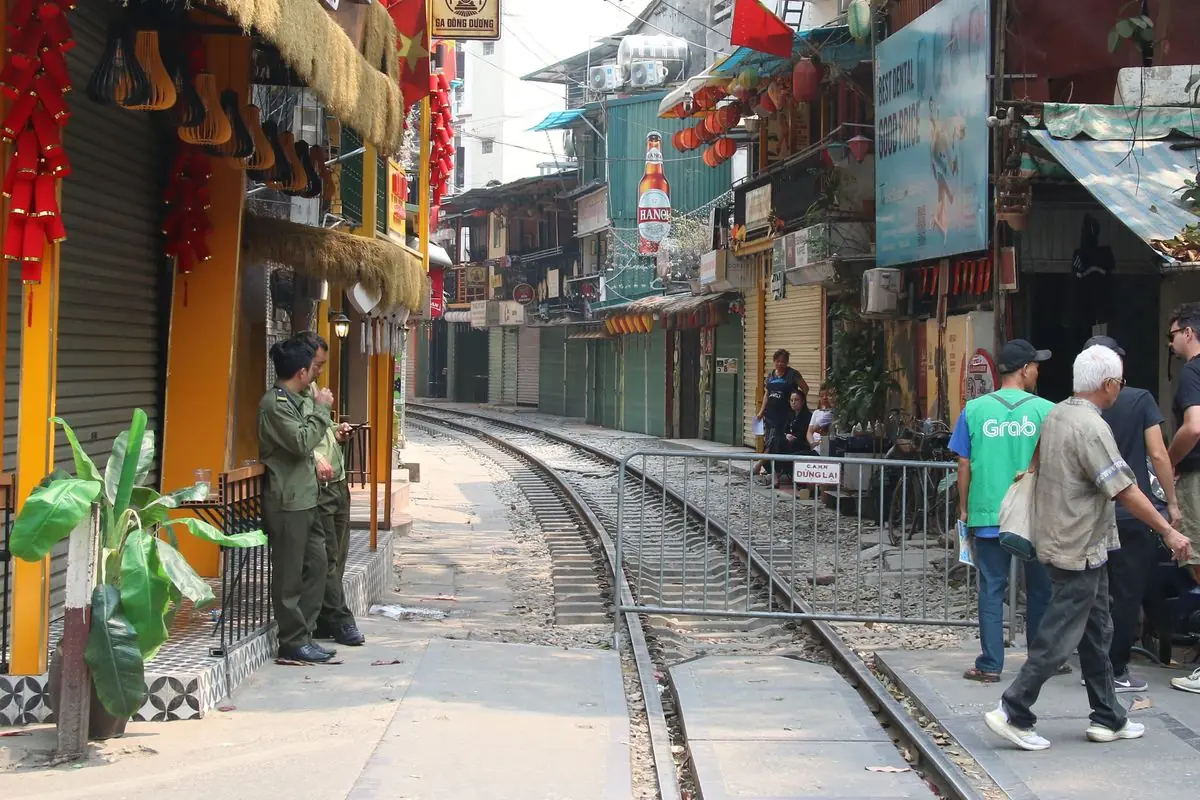
On March 7, 2025, the Hanoi Department of Tourism instructed travel agencies and passenger transport companies not to promote or organize tours bringing visitors into the railway café area. The directive also required businesses to inform their employees about the potential danger of railway accidents.
The restrictions remained in place throughout 2026, with several notable enforcement operations:
- February 3, 2026: authorities asked hundreds of visitors to leave the Kham Thien railway café area and ordered businesses to remove tables and chairs encroaching on the railway.
- March 5, 2026: Hoan Kiem Ward authorities continued inspections and enforcement around the Phung Hung - Tran Phu section.
- August 11, 2026: a café operator in Kham Thien was fined VND 2.5 million following an incident involving a tourist sitting dangerously close to the railway.
Hanoi Train Street still hasn’t been allowed to reopen as a freely accessible tourist destination.
An open café isn’t proof that it has permission to serve tourists beside the tracks.
Phung Hung vs. Kham Thien: which Hanoi Train Street is different?
Search for Hanoi Train Street on Google Maps and the photos and directions may point to two different places. Hanoi has two main railway café areas, on opposite sides of Hanoi Railway Station.
| Feature | Phung Hung - Tran Phu | Kham Thien - Le Duan |
|---|---|---|
| Location | North of Hanoi Railway Station, near the Old Quarter | South of Hanoi Railway Station, near the Nha Dau residential area |
| Atmosphere | Colorful cafés, popular with international tourists | Older residential setting with smaller local cafés |
| Train routes | Hai Phong, Lao Cai, and other northern services | North-South railway, including trains toward Vinh, Da Nang, and Ho Chi Minh City |
| Access | Barriers and tighter controls at several entrances | Multiple residential access points, but still subject to inspections |
| Situation in 2026 | Some cafés have closed during enforcement operations | Cafés have continued operating between enforcement operations |
| Can visitors freely enter the tracks? | No | No |
Phung Hung - Tran Phu Train Street
North of Hanoi Railway Station, near the Old Quarter
This is the section from Instagram, TikTok, and travel videos: old yellow walls, narrow balconies, strings of colorful lights, and tightly packed cafés lining the railway.
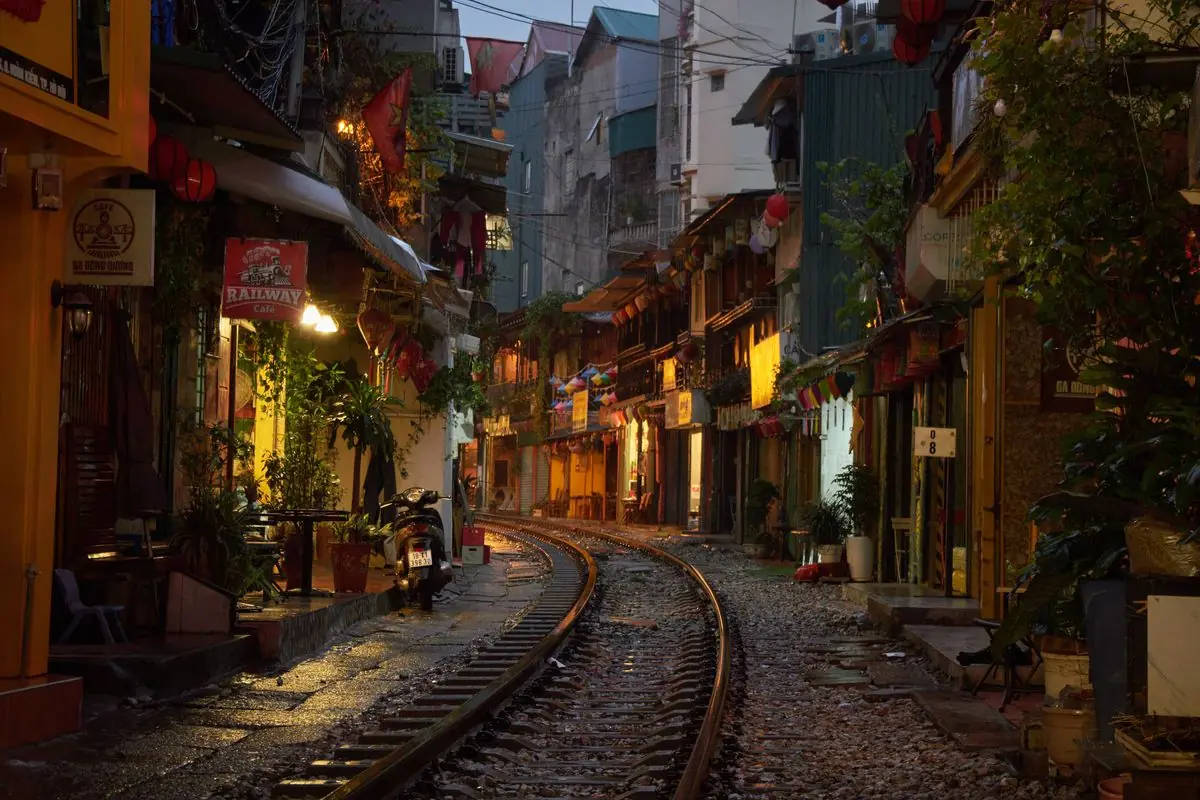
The area is near Phung Hung, Tran Phu, and Dien Bien Phu streets, making it convenient for visitors exploring Hanoi’s Old Quarter or Hoan Kiem Lake.
Entrances around Tran Phu and Phung Hung, though, have been subject to restrictions for years.
Café owners or staff sometimes offer to guide tourists inside. Such invitations are not official permission to enter restricted railway areas and do not override barriers or instructions from the authorities.
The Phung Hung section has attracted even more attention in 2026 because of plans to reduce passenger services and stop freight trains between Hanoi and Gia Lam stations.
Older travel videos showing dozens of people sitting beside the tracks may look nothing like what you’ll find there now.
Kham Thien - Le Duan Train Street
South of Hanoi Railway Station, near the Nha Dau residential area
The second well-known section lies south of Hanoi Railway Station, near Alley 224 Le Duan and the Nha Dau residential complex in Van Mieu - Quoc Tu Giam Ward.
This section is closer to an ordinary Hanoi neighborhood: old apartment buildings, narrow staircases, small windows overlooking the railway, and modest cafés, with fewer of the decorated fronts seen at Phung Hung.
Some visitors head here after discovering that entrances to Phung Hung Train Street are blocked.
Following an enforcement operation on November 25, 2025, some businesses set out tables and chairs again within a few days. Since then, cafés here have kept serving and trains still run through as usual.
That doesn’t make Kham Thien an officially approved alternative.
Authorities have repeatedly removed furniture, dispersed crowds, and penalized businesses for violating railway safety regulations in this section.
The comparison above helps with geography and train services, not with choosing a back entrance when Phung Hung is restricted.
Hanoi Train Street schedule: what time do trains pass in 2026?
There is no official train timetable specifically for Train Street visitors.
The time a train passes a particular alley depends on its departure or arrival at Hanoi Railway Station, railway operations, and conditions on the day.
Some cafés display estimated train schedules outside, while staff may announce when a train is approaching.
These estimates aren’t guaranteed. Trains can run late, have their schedules adjusted, or operate differently from the times posted online.
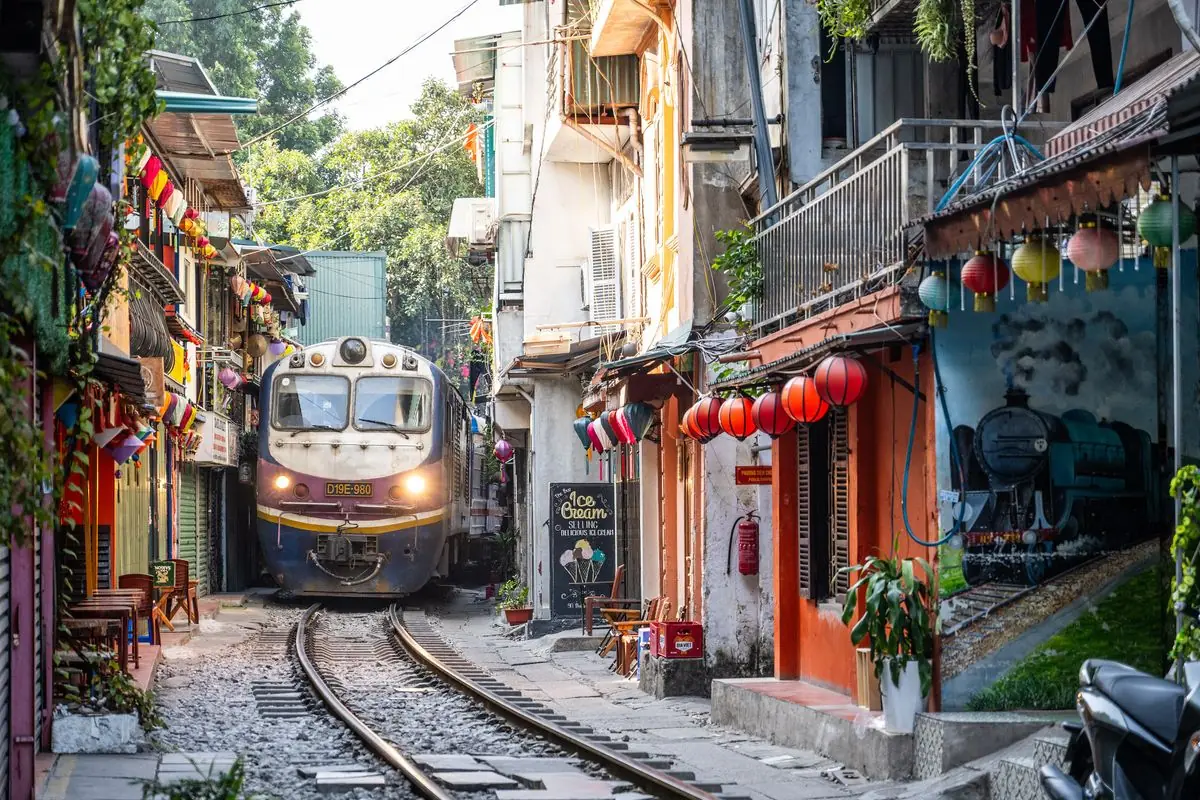
Train times at Phung Hung - Tran Phu
The Phung Hung section is on the railway heading north from Hanoi Railway Station toward Long Bien and Gia Lam, connecting with routes to destinations such as Hai Phong and Lao Cai.
| Route | Train | Time at Hanoi Railway Station |
|---|---|---|
| Hanoi → Hai Phong | HP1 | 6:00 AM |
| Hanoi → Hai Phong | LP3 | 9:25 AM |
| Hanoi → Hai Phong | LP5 | 3:15 PM |
| Hanoi → Hai Phong | LP7 | 6:10 PM, weekends and holidays |
| Hai Phong → Hanoi | LP2 | 8:49 AM, arrival |
| Hai Phong → Hanoi | LP6 | 11:52 AM, arrival |
| Hai Phong → Hanoi | LP8 | 5:40 PM, arrival, weekends and holidays |
| Hai Phong → Hanoi | HP2 | 9:15 PM, arrival |
| Hanoi → Lao Cai | SP15 | 9:45 PM |
| Hanoi → Lao Cai | SP3 | 10:00 PM |
| Hanoi → Lao Cai | SP7 | 10:40 PM |
| Lao Cai → Hanoi | SP16 | 5:15 AM, arrival |
| Lao Cai → Hanoi | SP4 | 5:40 AM, arrival |
| Lao Cai → Hanoi | SP8 | 7:30 PM, arrival |
These are station departure or arrival times, not the exact times trains pass individual cafés.
On weekdays, LP7 starts and LP8 ends at Long Bien Station, so these two trains only pass Phung Hung on weekends and public holidays.
The Lao Cai trains follow the railway operator’s new timetable. Actual services may vary by travel date.
The Hanoi - Lao Cai route went from two to three regular passenger train pairs in October 2026, so older articles listing two daily pairs are missing one.
Train times at Kham Thien - Le Duan
The Kham Thien section belongs to Vietnam’s North-South railway.
Trains traveling toward southern destinations such as Vinh, Da Nang, and Ho Chi Minh City pass through this area after leaving Hanoi Railway Station. Northbound services heading into Hanoi approach the station from the same direction.
The published schedule for North-South services after the summer peak in 2026 includes:
| Train | Departure from Hanoi | Direction |
|---|---|---|
| SE7 | 6:00 AM | Southbound |
| SE5 | 8:00 AM | Southbound |
| SE9 | 1:00 PM | Southbound |
| SE3 | 7:20 PM | Southbound |
| SE1 | 9:45 PM | Southbound |
Other services include northbound trains such as SE2, SE4, SE6, SE8, and SE10, along with additional regional trains depending on the operating period.
Southbound trains generally pass the Kham Thien section a few minutes after leaving Hanoi Railway Station. Northbound trains pass through before arriving at the station. The timetable only shows station times, not the minute a train passes the lane, so get there earlier than you think you need to.
These times are no basis for saving a chair beside the railway. They are passenger transportation schedules, not designated train-viewing times. No period between trains makes it automatically safe or legal to stand on the tracks.
How to check Hanoi train times for your visit
- Step 1
Open the timetable site
Visit dsvn.vn, the official Vietnam Railways ticketing website, or its railway timetable service.
- Step 2
Pick your exact date
Select your exact travel date rather than relying on an old timetable shared on social media.
- Step 3
Trains past Phung Hung
For Phung Hung, look for trains between Hanoi and Hai Phong or Lao Cai, including services in both directions.
- Step 4
Trains past Kham Thien
For Kham Thien, check trains departing from or arriving at Hanoi Railway Station along the southern routes toward Vinh, Da Nang, and Ho Chi Minh City.
- Step 5
Compare train numbers
Compare train numbers and departure or arrival times. For possible delays or schedule changes, contact the railway station or the railway operator’s customer service.
The booking system is built for passengers. It doesn’t provide guaranteed times for trains passing Train Street cafés, nor does it grant permission to enter railway property.
Can tourists be fined for visiting Hanoi Train Street?
Yes, certain activities at Hanoi Train Street can result in a fine.
A new set of fines for railway violations has applied since May 15, 2026.
Standing in front of an approaching train isn’t the only way to break the rules.
Posing between the rails, sitting on a railway track, or climbing over a barrier for a photo may be enough to result in enforcement action.
Can you be fined just for sitting at a Train Street café?
Not automatically.
Buying a coffee near a railway doesn’t, by itself, mean you’ll receive a VND 500,000 fine.
Sitting within a legally permitted business area outside restricted railway space is different from placing a chair on the railway or entering an area beyond a safety barrier.
Several Train Street cafés have still been penalized for operating within the railway safety corridor.
Customers sitting in an unauthorized area may be told to leave, even after ordering drinks.
Café owners can also face penalties.
On January 28, 2026, a café owner in Kham Thien was fined VND 2.5 million after a video showed customers sitting approximately 50 centimeters from the edge of the railway.
On August 11, 2026, another local business received a VND 2.5 million fine for violating railway safety corridor regulations.
These were penalties for particular violations, not a universal fine applied to every café.
Foreign tourists must follow the same railway safety rules in Vietnam.
Being invited inside by a café owner, paying for a drink, or being promised advance warning of an approaching train doesn’t exempt you from those rules.
Is it safe to watch trains from a Hanoi Train Street café?
In social media videos, a train approaches slowly, café staff pull chairs away, customers tuck their legs in, and everyone watches as the carriages pass just inches away.
It looks controlled on camera. The gaps are tighter than they look.
Some sections have extremely narrow gaps between the trains and surrounding buildings.
A locomotive, carriage step, handrail, or another protruding part of the train may extend farther than a visitor expects. Estimating clearance by eye is unreliable.
At approximately 1:30 PM on August 7, 2026, a female tourist from China was sitting close to the tracks in the Nha Dau residential area of Kham Thien while recording a video.
As the train passed, contact with the train caused her phone to be knocked away. Fortunately, nobody was hurt.
Another incident in October 2025 involved a train striking tables and chairs placed too close to the tracks.
Some cafés ask customers to move away approximately 15 minutes before a scheduled train, clearing furniture and directing people toward the walls.
However, these practices are not an officially certified railway safety procedure.
Neither side of an approaching train, left or right, is safer by default. The available clearance varies with the location, the type of train, and nearby obstacles.
Remember: Hanoi Train Street is also someone’s home
Behind the lanterns, colorful signs, and travel photos, Train Street is a residential neighborhood.
Some of the railway workers’ housing in the area dates back to the mid-20th century, and families have lived alongside the tracks for generations.
Residents still use the spaces around their homes for everyday activities: hanging laundry, parking motorbikes, cooking, and chatting with neighbors.
As tourism has grown, these ordinary routines have become harder, with strangers pointing cameras at front doors and filming family members throughout the day.
Even when walking along public streets outside the restricted railway corridor, a little consideration makes a difference:
Will Hanoi Train Street close permanently?
On March 2, 2026, Vietnam’s Ministry of Construction requested coordination with Hanoi on changes to railway operations between Hanoi, Long Bien, and Gia Lam stations.
The proposed measures included stopping freight services, reducing passenger and tourist trains, and arranging alternative transportation for affected passengers.
One proposal would have some northern train services terminate at Gia Lam Station instead of traveling through central Hanoi to Hanoi Railway Station.
Free passenger transfers between Gia Lam and Hanoi stations were also part of the proposed arrangements.
The plan was initially being pushed toward implementation before July 2026.
Passenger trains to Hai Phong and Lao Cai still run through the Phung Hung - Tran Phu section every day, so checking the timetable for your date is all you need before going.
An updated railway plan published in July 2026 also emphasized maintaining uninterrupted operations on Hanoi’s existing meter-gauge network until relevant bypass and replacement railway infrastructure becomes available.
Three separate things are in play: a proposal to stop trains passing through central Hanoi, short-term reductions in services, and long-term railway infrastructure planning. None of them means the railway has closed.
Over the longer term, the Ngoc Hoi - Gia Lam railway section is intended to transition toward local railway use when the necessary conditions are met.
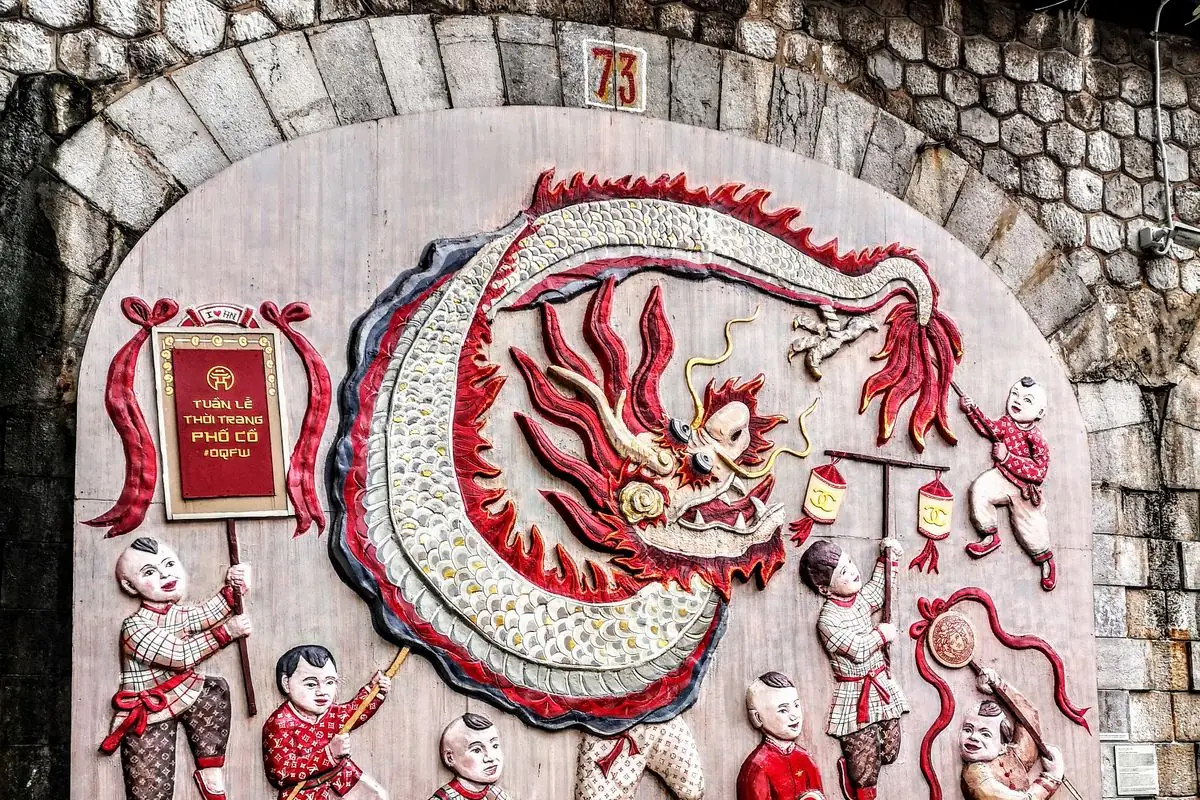
Hanoi has also been developing plans to improve the Phung Hung railway arch area, including 131 stone arches mentioned in the handover proposal.
The Kham Thien - Le Duan section, meanwhile, belongs to the North-South railway and isn’t the primary section covered by the Hanoi - Gia Lam service reduction proposal.
Fewer trains past Phung Hung would not mean trains stop running through both Train Street areas at the same time.
Safer and legal alternatives to Hanoi Train Street
There is another way to experience Hanoi’s railway atmosphere without waiting beside active tracks.
The main option is the Hanoi Five Gates tourist train, also known as The Hanoi Train or Hà Nội 5 Cửa Ô, where you watch the city from a carriage window.

The journey begins at Hanoi Railway Station, passes through Long Bien, Gia Lam, and Yen Vien, and continues toward Tu Son in Bac Ninh before returning to the capital.
The experience combines rail travel with cultural activities along the route.
Hanoi Five Gates train ticket prices
Advertised adult ticket prices in 2026 are:
| Ticket class | Price |
|---|---|
| Standard carriage, first level | VND 550,000 |
| Standard carriage, upper level | VND 650,000 |
| VIP carriage | VND 750,000 |
The round trip takes approximately 3.5 hours.
You can check availability and book through The Hanoi Train’s official booking channels, the 1900 2695 hotline, or the ticket counter at Hanoi Railway Station.
Checking availability two or three days ahead is a good idea for weekends and busy travel periods.
Riding the train won’t give you the photo of a locomotive passing inches from a café table. You do get to ride an operating railway without entering a dangerous or restricted area.
Another possibility is watching trains from a public location where stopping is permitted, completely outside the railway safety corridor and away from barriers or active level crossings.
Only stop where there is adequate public space and no prohibition on standing or filming. Never move close to the tracks at a level crossing just to capture a video.
If you’re passing through Hanoi on the way to Hai Phong, Ha Long Bay, or Ninh Binh, keep your bus and train plans fixed. An unconfirmed Train Street schedule isn’t worth a changed itinerary or a missed connection.
Is Hanoi Train Street worth visiting right now?
The sound of a train horn echoing between narrow buildings, weathered homes beside the railway, and the unusual sight of a large train moving through a residential neighborhood make Train Street unlike most places in Hanoi.
Still, given how things stand in 2026, leave café seats directly beside the tracks out of your plans.
You can explore permitted public streets around Phung Hung, appreciate the older architecture, and photograph the railway arches from outside restricted areas.
A café being open, or an employee inviting you inside, isn’t a good reason to cross a barrier.
Kham Thien may still have cafés operating at certain times, but enforcement actions and railway incidents in 2026 show that the risks there are very real.
Hanoi has plenty of other ways to spend an afternoon: wandering through the Old Quarter, enjoying coffee at a relaxed café, admiring Long Bien Bridge from an authorized viewpoint, or booking a proper railway experience.
Frequently asked questions
Is Hanoi Train Street open to tourists in 2026?
Some cafés are still open around Phung Hung and Kham Thien, but the railway café areas have not officially reopened as unrestricted tourist attractions. Access may be blocked or controlled, and visitors may be instructed to leave.
What time do trains pass Hanoi Train Street? Are they always on time?
Trains serving Hai Phong and Lao Cai use the northern Phung Hung section, while North-South services run through Kham Thien. Trains generally pass these areas a few minutes before arriving at or after departing from Hanoi Railway Station. However, there is no guaranteed Train Street viewing timetable. Check the schedule for your exact date on dsvn.vn and allow for delays, changes, or cancellations.
Which Hanoi Train Street is easier to access, Phung Hung or Le Duan?
Kham Thien - Le Duan has generally had more access points through residential lanes, while Phung Hung - Tran Phu has faced tighter controls and physical barriers. However, neither section allows unrestricted access to railway tracks. Don't cross barriers or enter the railway safety corridor to reach a café.
Can you be fined VND 500,000 for sitting at a Train Street café?
Not every person drinking coffee near the railway is automatically fined. The VND 300,000-500,000 penalty applies to specific violations such as illegally standing or sitting on the railway or crossing a separating fence. Businesses operating illegally within the railway safety corridor may also face penalties, and customers may be required to leave.
Are trains going to stop passing through Hanoi Train Street?
Hanoi and the Ministry of Construction have been working on plans to reduce passenger services and stop freight trains along the Hanoi - Gia Lam railway section. However, there's still no official date for ending all passenger services through Phung Hung. Kham Thien belongs to the North-South railway and is not covered by exactly the same service reduction plan.