Ninh Binh weather by month: 12 months of boat trips and Hang Mua hikes
June is the hottest month in Ninh Binh's climate data, with an average daily high of 34°C. August is the wettest, averaging 367 mm of rain, so choosing the right day for a boat trip or Hang Mua hike matters just as much as choosing the right month.
 24 min read
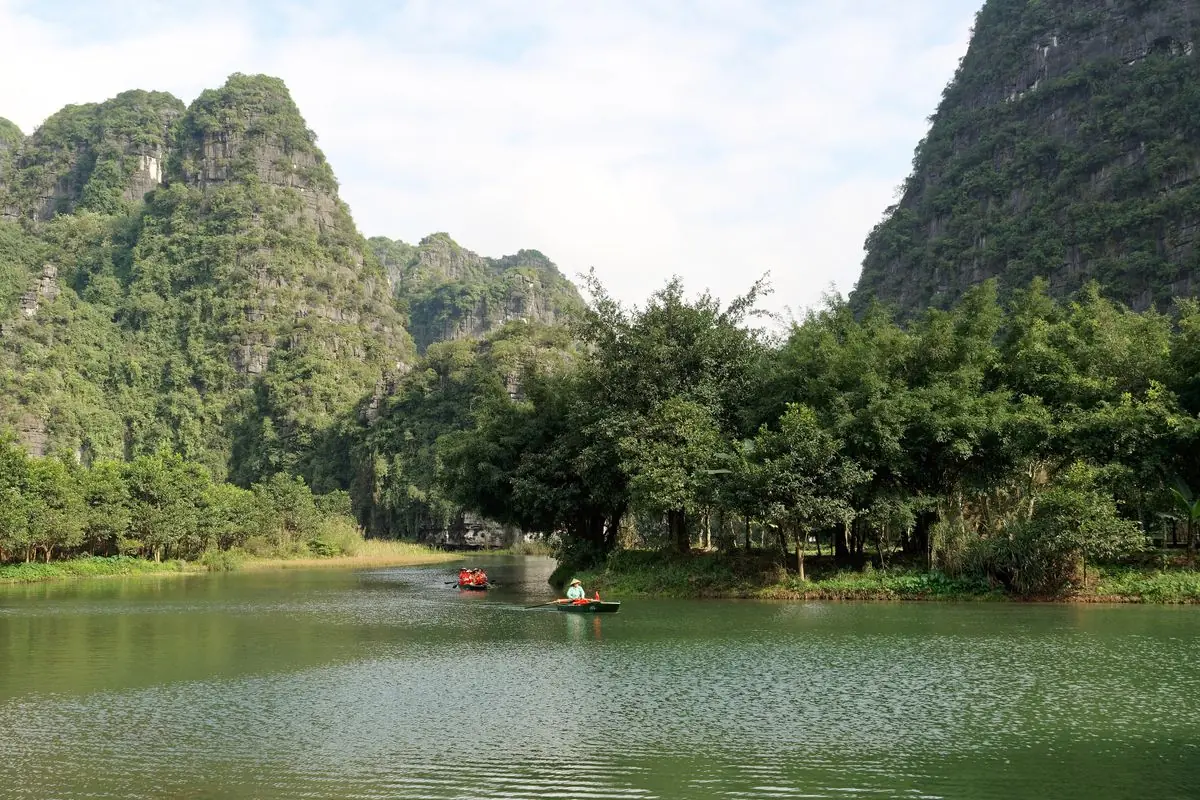
Rowing boats drift along the river at Trang An under a pale, cloudy sky, with tree-covered limestone cliffs on both sides.
Planning a day trip from Hanoi to Ninh Binh, with a boat ride through Trang An or Tam Coc followed by a climb up Hang Mua? Start by choosing a month that suits your tolerance for heat, cold and rain. March, April and November generally offer more comfortable conditions for outdoor sightseeing, while late May to early June brings Tam Coc’s golden rice fields along with considerably hotter weather.
What is the best time to visit Ninh Binh?
Choosing the best weather for Ninh Binh comes down to two very different experiences: spending two to three hours sitting in an open boat and climbing hundreds of stone steps to the viewpoint at Hang Mua.
On a boat, you cannot simply step into the shade whenever the sun gets too strong. At Hang Mua, the exposed stone staircase can feel much hotter than the temperature shown on your phone, particularly around midday.
These differences make some months better suited to certain activities than others.
| Period | Typical weather | Best for |
|---|---|---|
| January-March | Cool to cold, with possible mist, cloudy skies and drizzle | Boat trips, temples and travelers who dislike heat |
| April-June | Increasingly hot, with rainfall rising sharply from May | Golden rice fields, lotus flowers and landscape photography |
| July-September | Hot, humid and very rainy, with a risk of storms and flooding | Travelers with flexible schedules who can change plans |
| October-December | Rainfall remains significant in October, becomes lower in November, then temperatures turn cooler | Boat trips, Hang Mua hikes and cycling around Tam Coc |
April and November are two of the strongest choices if comfortable weather is your main priority. April has an average daily high of 29°C, while November averages 26°C. Both are generally easier for outdoor activities than the hottest summer months.
October also has pleasant temperatures, but its average rainfall remains relatively high at 230 mm. Autumn does not automatically mean dry weather in Ninh Binh.
Aim for mid-May to early June if your main reason for visiting is to see the famous golden rice fields along the Ngo Dong River. The scenery can be spectacular, but climbing Hang Mua in the midday heat becomes much more demanding.
Weather matters even more on a day trip from Hanoi. You have little opportunity to postpone a boat ride until the following morning or wait several hours for the mist to clear before climbing.
Staying overnight gives you more freedom to move outdoor activities between the morning and late afternoon. That flexibility is especially valuable during the hotter and wetter months.
This guide focuses on the Trang An, Tam Coc and Hoa Lu area, where most visitors spend their time, rather than treating the entire present-day Ninh Binh province as having identical weather conditions.
Ninh Binh weather by month: temperature and rainfall chart
Ninh Binh has noticeable seasonal changes. Winters are cool and relatively less rainy, summers are hot and humid, and July through September stand out for their heavy rainfall.
The table below provides a useful starting point for choosing your travel dates.
| Month | Avg. daily high | Avg. daily low | Avg. rainfall | Avg. rainy days |
|---|---|---|---|---|
| January | 21°C | 14.5°C | 63 mm | 11 |
| February | 22°C | 15°C | 43 mm | 9 |
| March | 26°C | 19°C | 58 mm | 10 |
| April | 29°C | 22°C | 97 mm | 10 |
| May | 32°C | 25°C | 198 mm | 18 |
| June | 34°C | 27°C | 167 mm | 16 |
| July | 33°C | 26°C | 298 mm | 19 |
| August | 32°C | 26°C | 367 mm | 24 |
| September | 31°C | 25°C | 341 mm | 23 |
| October | 28°C | 22°C | 230 mm | 17 |
| November | 26°C | 19°C | 85 mm | 10 |
| December | 22°C | 15°C | 46 mm | 7 |
Source: Open-Meteo Historical Weather API, using monthly averages for 2016-2025 at a representative location in the Hoa Lu-Trang An-Tam Coc area. The original requested coordinates were 20.24, 105.93, with the returned data point at 20.28, 105.90. High and low temperatures represent averages of daily maximum and minimum temperatures. Rainfall is the average monthly total across the study period, and a rainy day is defined as a day receiving at least 1 mm of precipitation. Average annual rainfall is approximately 1,990 mm. These figures describe past climate conditions, not the forecast for any particular day.
Three details are worth paying attention to.
First, January has the lowest average nighttime temperature, at 14.5°C. A morning boat ride can feel chilly, especially when the wind picks up or light drizzle settles over the river.
Second, June is the hottest month, with an average daily high of 34°C. This is not the maximum temperature that can occur during a heatwave. On especially hot days, the exposed steps at Hang Mua can feel considerably more uncomfortable.
Third, August has the most rainfall, averaging 367 mm and approximately 24 days with at least 1 mm of rain. September follows closely, with 341 mm and 23 rainy days.
A rainy day does not necessarily mean continuous rain from morning until evening. Some days bring only a brief shower. Others can involve prolonged heavy rain that disrupts sightseeing, boat operations and road travel.
Ninh Binh weather in each month: what to expect
January: chilly mornings, cloudy skies and occasional mist
January is the coldest month in the table, with an average daytime high of 21°C and a nighttime low of 14.5°C. How cold it feels will depend heavily on wind and humidity.
During a morning boat trip through Trang An or Tam Coc, you may encounter a thin layer of mist over the water. Limestone mountains in the distance can become partially hidden behind low clouds.
The scenery has its own appeal, but travelers hoping for clear panoramic photographs from Hang Mua may find the visibility disappointing.
If Hang Mua is on your itinerary, consider climbing in late morning or early afternoon, when visibility may have improved. There is little reason to rush to the summit at sunrise if the surrounding valley is completely hidden by mist.
Bring a warm jacket, long trousers, closed-toe shoes and a lightweight windproof outer layer. A thin fashion jacket might be comfortable while walking but insufficient when sitting still on an open boat.
February: the lowest rainfall, but not necessarily blue skies
February receives an average of 43 mm of rain, the lowest monthly amount in the table. The average daily high is 22°C, while the low is around 15°C.
This can be an excellent month for visitors who prefer cool temperatures. Walking through the ancient capital of Hoa Lu or climbing Hang Mua is generally less physically demanding than during the summer.
However, relatively low rainfall does not guarantee sunny weather.
Late winter and early spring in northern Vietnam can bring persistent cloud cover, light drizzle, mist and damp conditions. A little drizzle may not seem troublesome, but it can leave Hang Mua’s stone steps slippery.

If your visit coincides with Lunar New Year or the early-year festival season, allow extra time for transport, queues and temple visits. Popular sites can attract many domestic visitors during holiday periods.
A lightweight waterproof jacket is usually more practical than carrying a large umbrella up the staircase.
March: pleasant temperatures for boats and walking
By March, the average daytime high reaches approximately 26°C, while nighttime temperatures are around 19°C. Average rainfall remains relatively low at 58 mm.
March is one of the months worth considering for a first visit to Ninh Binh, especially if you want to combine Trang An, Hoa Lu and Hang Mua in a single day.
You could take a boat trip in the morning, stop for lunch and climb Hang Mua later in the afternoon. On cloudy days, the cooler conditions make the long staircase less exhausting.
Nevertheless, March can still bring mist and drizzle.
To plan for panoramic photography, look at cloud cover and visibility forecasts rather than checking only whether rain is expected.
This is also a good period for cycling around Tam Coc, where quiet roads wind between rice fields, villages and limestone cliffs.
April: one of the most comfortable months for exploring
April has an average daily high of 29°C and a low of 22°C. The weather is noticeably warmer, but the hottest part of the year has not yet arrived.
It is a particularly appealing month for travelers who want to enjoy both a boat excursion and a Hang Mua hike without arranging the entire day around extreme heat.
Your schedule can be more flexible.
A practical plan is to visit Trang An in the morning, take a lunch break and climb Hang Mua at around 3:00-4:00 PM.
When skies are clear, the softer late-afternoon light is well suited to photographing the Tam Coc valley from above.
Average rainfall reaches 97 mm in April, higher than in March, so you should still check the forecast close to your travel date. An afternoon thunderstorm can force changes to a planned hike.
Pack breathable clothing, a wide-brimmed hat, sunscreen and enough drinking water. A compact rain jacket is still worth carrying.
May: golden rice fields begin to appear, but the heat increases
May is when many travelers start checking Tam Coc weather to plan a visit during the golden rice season.
From the middle toward the end of the month, rice fields along the Ngo Dong River begin turning yellow. Late May is particularly attractive for travelers who want to take a boat through the fields or photograph them from Hang Mua.
The trade-off is the weather.
The average daily high rises to 32°C, while nighttime temperatures remain around 25°C. Average rainfall reaches 198 mm, with approximately 18 rainy days.
Climbing Hang Mua at noon is considerably harder than it is in March. Nearly 500 stone steps in hot weather, combined with frequent photography stops, can leave you exhausted.
Travelers staying overnight in Tam Coc should use the early morning for outdoor activities, take a proper midday break and continue in the late afternoon.
For travelers coming from Hanoi on a day trip, it makes sense to choose one main boat destination.
Trying to fit Trang An, Tam Coc and Hang Mua into a single hot day leaves very little time to enjoy any of them.
June: the hottest month, with rice fields and lotus flowers
June has an average daily high of 34°C, the highest in the table. The average nighttime low is still around 27°C, meaning temperatures do not drop as much overnight as they do in spring.
Early June can still offer golden rice fields in Tam Coc, depending on the harvest schedule.
This is also when lotus flowers around Hang Mua become a major attraction, particularly during June and July.
The scenery can be beautiful, but midday is a poor time to climb.
Between roughly 11:00 AM and 2:00 PM, strong sunshine can make the stone staircase extremely hot. Many sections are exposed, with limited shade.
A more comfortable schedule is to take a boat ride early in the morning, rest during the hottest hours and consider climbing Hang Mua after 3:30 or 4:00 PM, provided there is enough time before the site’s confirmed closing time.
June receives an average of 167 mm of rain. Summer thunderstorms can develop quickly, and sunshine at 10:00 AM does not guarantee a dry afternoon.
June is rewarding for seasonal scenery, but it is not ideal for visitors who want to remain outdoors continuously from morning until evening.
July: heavy rainfall becomes a bigger concern
July has an average daily high of 33°C, approximately 298 mm of rainfall and 19 rainy days.
This is when checking the weather close to departure becomes increasingly important.
Some mornings are sunny, with boat tours operating normally. On other days, heavy rain or thunderstorms can lead to changes or temporary suspensions.
Both Trang An and Tam Coc involve boat routes through limestone landscapes, including caves and waterways.
When heavy rainfall raises water levels, certain sections may become unsafe or inaccessible.
Hang Mua requires caution too. After rain, stone steps can become slippery, particularly on steep sections near the summit.
During thunderstorms, it is not safe to climb to high, exposed viewpoints just to take photographs.
In July, choose transport and accommodation with suitable cancellation or date-change policies.
A two-day stay also provides more flexibility than a single day trip.
August: the wettest month, so keep a backup plan
August is the rainiest month in the climate data, averaging 367 mm of precipitation and around 24 rainy days.
The average daytime high remains at 32°C.
Rain does not necessarily make the whole day cool. When showers stop, high humidity can leave the air feeling heavy, especially while walking or climbing.
For visitors planning a trip in August, the important question is not simply whether rain is forecast. You also need to consider how heavy it may become and whether there are warnings for thunderstorms, flooding or rising river levels.
When conditions are unsafe, boat routes may be shortened, changed or temporarily closed.
A forecast showing a few dry hours is not enough to assume a boat pier will be operating.
August is not a good month for an overly tight schedule, particularly one that connects a boat tour directly to a return bus or train without spare time.
If several consecutive days of heavy rain are forecast, moving outdoor activities to another day may be the better option.
September: rain remains heavy as temperatures begin to ease
September has an average daily high of 31°C and a low of 25°C. Average rainfall reaches 341 mm, only slightly below August.
Many travelers associate September with autumn in northern Vietnam and expect cooler, more settled weather.
Around Tam Coc and Trang An, that assumption can be misleading.
September remains a period when heavy rain and changing water conditions deserve attention.
Prolonged rainfall may raise water levels inside caves and affect boat operations.
During heavy-rain and flooding events in September 2026, Trang An temporarily suspended operations, while Tam Coc adjusted its sightseeing route.
This does not mean boat trips close every September. It does show that conditions on the day matter more than the date printed on your ticket.
For a September visit, check both official weather warnings and announcements from the attraction before leaving Hanoi.
October: cooler weather, but rainfall is still significant
October has an average daytime high of 28°C and nighttime temperatures around 22°C.
These conditions are generally more comfortable for walking and climbing than the summer heat.
However, average rainfall remains at 230 mm, with approximately 17 rainy days. Compared with November, October still carries a greater risk of rain disrupting plans.
During a settled spell of weather, it can be a lovely time to explore Trang An, Tam Coc and Hang Mua.
The air feels less oppressive, and spending several hours on an open boat is generally more comfortable than in June or July.
On the other hand, you should not assume the rainy period has ended simply because September is over.
If landscape photography is your main goal, October is a month when checking the forecast for your actual travel dates matters more than relying on general descriptions of autumn.
November: comfortable conditions for a Ninh Binh day trip
November is one of the most appealing months for combining several outdoor activities.
The average daytime high falls to 26°C, while the nighttime low is around 19°C. Average rainfall drops considerably to 85 mm, with approximately 10 rainy days.
You do not need to start quite as early to avoid the heat as you would in June.
At the same time, conditions are generally not as cold as they can become during winter cold spells.
A day trip from Hanoi might begin with a Trang An or Tam Coc boat ride, followed by lunch and a Hang Mua climb in the afternoon.
Still, November does not guarantee completely clear skies. Cloudy mornings and humid conditions can sometimes reduce the visibility of distant limestone mountains.
If your time in northern Vietnam is limited and you want a relatively straightforward month for arranging outdoor activities, November should be near the top of your list.
December: cool and relatively less rainy, with a chance of mist
December has an average daily high of 22°C and a nighttime low of 15°C. Average rainfall is 46 mm, with around seven rainy days.
This makes it an attractive period for visitors who enjoy walking, exploring temples and climbing Hang Mua without intense heat.
The main consideration is the cold, particularly in the morning and while sitting on a boat.
Wind and humidity can make the temperature feel lower than the number shown on your weather app.
Mist may also appear, partially hiding the limestone mountains in the distance.
For some photographers, a misty river framed by limestone cliffs is part of the attraction. For others, especially those hoping for a crisp panoramic view from Hang Mua, it can be disappointing.
Bring a windproof jacket, long trousers and closed-toe shoes.
If you are traveling with children or older family members, pack an extra warm layer specifically for the boat ride.
Can you take a Trang An or Tam Coc boat tour during the rainy season?
Yes, boat tours can operate during the rainy season, but they cannot run safely under every weather condition.
Whether a route opens depends on rainfall, thunderstorms, water levels, currents and the operator’s safety assessment.
This is an important distinction for travelers who check only the rain icon on their weather apps.
Light rain does not always mean cancellation
A little rain may make a boat trip feel cooler and more comfortable than sitting under strong sunshine.
Depending on actual conditions, the tour may continue operating normally.
However, light rain is very different from a thunderstorm, heavy rainfall or several days of prolonged rain.
Water levels inside caves cannot be judged accurately simply by looking at the river near the ticket counter.
Even when the rain has stopped outside, some cave passages may still have unusually high water levels, requiring the operator to change the route.
Trang An and Tam Coc have changed operations during floods
On August 23, 2026, tourism authorities in Ninh Binh reported that Trang An temporarily suspended all operations because of storm-related rain and flooding. Some regular sightseeing routes had already been replaced with alternative arrangements.
During another period of heavy rain and flooding in September 2026, operators again had to make changes.
Trang An suspended operations from September 17, while Tam Coc shortened its boat journey, rather than following the usual route through all three caves.
These were temporary measures during specific weather events, not a statement about the attractions’ current operating status.
A storm does not necessarily close every tourist attraction in Ninh Binh at the same time.
One boat pier may suspend tours while another attraction remains open after completing its own safety checks.
Confirm boat operations before leaving Hanoi
When heavy rain or a tropical storm is forecast, contact the attraction directly.
Do not ask only whether the attraction is open.
For a boat trip, ask whether your intended route is operating normally or has been shortened because of water conditions.
Booked a tour from Hanoi? Ask the company to confirm the boat operator’s status and explain what happens if the attraction suspends operations.
Refunds, date changes and alternative itineraries depend on the booking conditions.
Best time of day to climb Hang Mua: avoiding heat and mist
Hang Mua has nearly 500 stone steps leading to its famous viewpoints.
It is one of the places in Ninh Binh where weather can make the biggest difference to your experience.
Climbing at 8:00 AM in cool conditions is very different from climbing at 12:30 PM under the June sun.
Summer: before 9:00 AM or late afternoon
Between May and September, avoid climbing Hang Mua around midday, especially on days with strong sunshine.
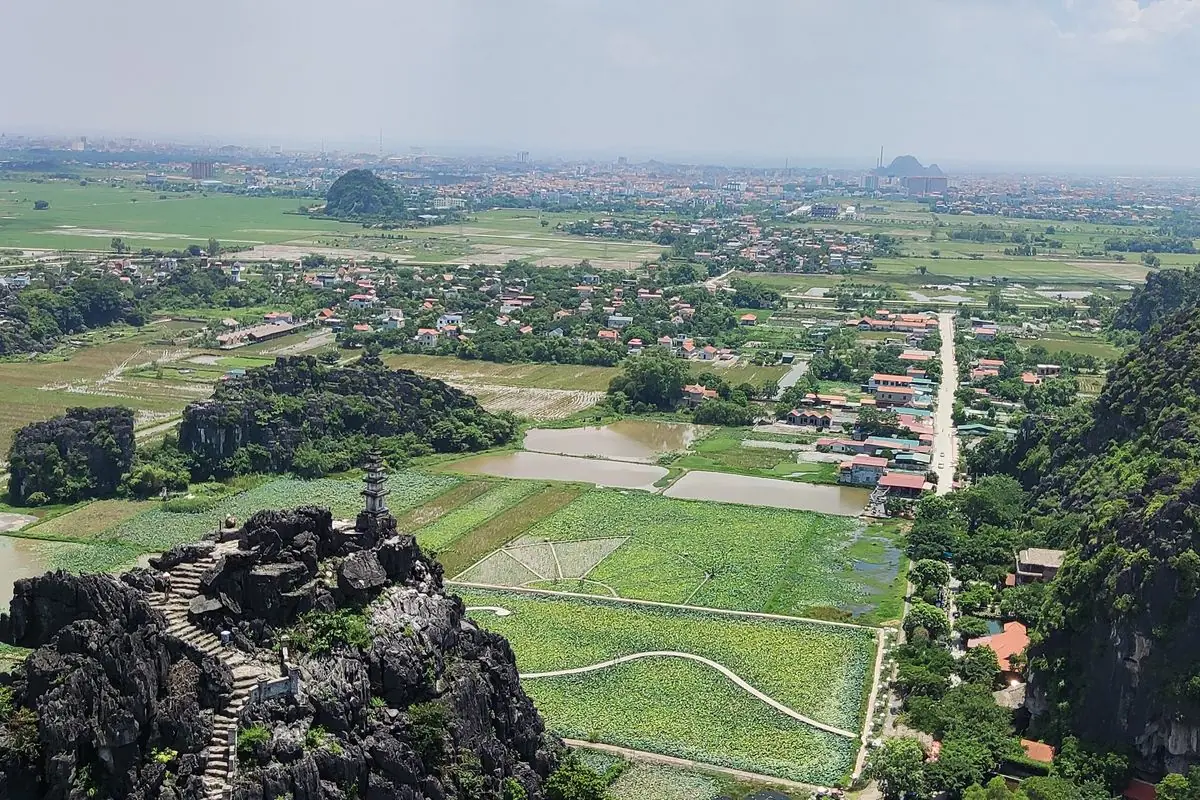
Early morning offers lower temperatures and a better opportunity to climb slowly, stop for photographs and descend before the heat becomes oppressive.
Late afternoon can be another good option when the weather is stable.
However, begin only when there is enough time to climb, rest, enjoy the viewpoint and return before the site’s confirmed closing time.
Operating hours may change, particularly during adverse weather.
Consider carrying roughly 500 ml to 1 liter of drinking water per person, depending on the temperature, how long you expect to spend climbing and your individual needs.
Take regular small drinks rather than waiting until you are very thirsty.
Winter: give the mist time to clear
From December to February, temperatures are much more comfortable for hiking, but mist can limit the view.
Before starting, look toward the distant mountain ridges.
If even the nearer limestone cliffs are difficult to distinguish, the panoramic view from the top may be obscured.

On days with improving visibility, moving the climb to late morning or early afternoon may work better than going up very early.
There is no guaranteed time when the mist will disappear.
On some days, visibility improves quickly. On others, clouds remain over the valley for much of the afternoon.
After rain: watch the steps, not just the scenery
The Hang Mua staircase has steep, narrow and uneven sections.
After rainfall, the stone surface may become slippery.
Walking shoes or trainers with good grip are much more suitable than flip-flops, smooth-soled sandals or high heels.
Avoid exposed high points during thunderstorms, lightning or strong winds.
It is better to postpone the climb or remove it from your itinerary than to continue in unsafe conditions.
Tam Coc rice season and Hang Mua lotus season
Many visitors choose their Ninh Binh travel dates based on photographs: golden rice fields beside the Ngo Dong River or pink lotus flowers beneath Hang Mua’s limestone peaks.
Both seasonal highlights occur during relatively hot weather.
Tam Coc golden rice season: mid-May to early June
The rice fields along the Tam Coc boat route generally turn golden between mid-May and early June, with late May and early June being especially attractive periods.
The exact timing varies each year according to crop development and harvesting.
Arriving on the same date as a photograph taken in a previous year does not guarantee the fields will look identical.
For the best chance of seeing golden rice, check recent photographs from Tam Coc before booking your accommodation.
From a weather perspective, prepare for summer heat and occasional thunderstorms.
Hang Mua lotus season: June and July
Lotus flowers in the area beneath Hang Mua generally appear from around May to early July, with June being a particularly notable month.
An early-morning visit offers an opportunity to see the flowers against the surrounding limestone landscape.
Midday sunlight can be harsh for both sightseeing and photography.
Planning a 1-2 day Ninh Binh itinerary around the weather
Not everyone visits Ninh Binh in the same way.
Travelers arriving from Hanoi for a single day need to think about transport connections and how much time they have before returning.
Those staying overnight in Tam Coc have more opportunities to choose a clear morning or a cooler afternoon.
One-day trip from Hanoi in March, April or November
The relatively comfortable temperatures during these months make it easier to combine a boat trip with a Hang Mua hike.
Here is a sample schedule.
| Time | Activity |
|---|---|
| 6:00-6:30 AM | Depart from Hanoi |
| 8:30-9:00 AM | Arrive at Trang An and prepare for the boat trip |
| 9:00-11:30 AM | Explore Trang An by boat |
| 11:30 AM-1:30 PM | Lunch, rest and travel to the next attraction |
| 2:00-3:30 PM | Climb Hang Mua and enjoy the viewpoint |
| From 4:00 PM | Prepare to return to Hanoi |
These are suggested times, not confirmed bus departures or fixed boat schedules.
Travel time depends on your pickup location, road conditions and queues at the boat pier.
A Trang An boat excursion can take approximately two to three hours, depending on the route and operating conditions.
For this reason, avoid booking your return journey too close to the estimated time your boat should finish.
If morning mist is expected in March, you could consider changing the order of activities, but first assess whether visibility is likely to improve later.
With Tam Coc instead of Trang An, allow enough time to enjoy the boat journey along the Ngo Dong River.
Visiting both boat destinations in one day may be possible with a carefully organized schedule, but it also means spending much of the day on boats with less time for breaks.
Two days and one night in May or June
During the hotter months, give the coolest parts of the day to outdoor activities.
- Day 1
Check in, climb Hang Mua late
Travel to Ninh Binh, check into accommodation around Tam Coc and rest during the hottest hours. Around 4:00 PM, consider climbing Hang Mua if weather conditions are stable and the attraction’s remaining opening hours allow enough time.
- Day 2
Morning boat, home by afternoon
Take a morning boat trip through Tam Coc to see the rice fields, or choose Trang An if limestone caves and dramatic scenery are your priority. Have lunch, check out and return to Hanoi.
Staying near Tam Coc is convenient when you want to begin sightseeing early without leaving Hanoi before sunrise.
If thunderstorms are forecast for the late afternoon, move the Hang Mua climb to another suitable time.
There is little reason to insist on a sunset viewpoint when conditions are unsafe.
July to September: leave room for changes
During the wettest months, avoid planning every activity around an inflexible timetable.
You might expect to take a boat at 9:00 AM, climb Hang Mua at 1:00 PM and return to Hanoi at 5:00 PM. But that schedule may become impractical if heavy rain or flooding affects operations.
Prepare two versions of your day instead.
Plan A, for stable weather: Take a boat trip in the morning, have lunch and climb Hang Mua when the steps are dry and there are no dangerous weather warnings.
Plan B, for heavy rain: Postpone the boat trip or hike according to safety announcements, choose another suitable attraction that remains open, or move the entire excursion to another day.
Check cancellation and rescheduling rules before paying.
Transport companies, hotels and tour operators have different policies. Rain does not automatically entitle every traveler to a refund.
Where to check today’s Ninh Binh weather forecast
Monthly climate averages are helpful for choosing a travel season.
To decide whether you should take a Trang An boat trip tomorrow morning, you need a short-term forecast.
A weather forecast labeled simply "Ninh Binh" may not accurately represent conditions at Trang An, Tam Coc or Hang Mua at the same hour.
Start with official meteorological information
Two useful sources are the Vietnam National Center for Hydro-Meteorological Forecasting and the Ninh Binh Provincial Hydro-Meteorological Station.
The provincial station provides daily forecasts, 10-day forecasts, heavy-rain warnings, thunderstorm alerts and hydrological information.
These sources are particularly important when storms, heavy rainfall or flooding are possible.
A warning about high river levels may be more relevant to your boat trip than the forecast temperature.
Use hourly forecasts for your actual destination
Open-Meteo, Google Weather and Windy are also useful for checking conditions by the hour.
Rather than searching only for the province, look for Trang An Landscape Complex, Tam Coc or Hang Mua, depending on your itinerary.
Pay attention to four types of information:
- Rain: Check when rain is expected, how much may fall and the probability of precipitation.
- Thunderstorms: Look for lightning warnings and strong wind alerts, not only rain icons.
- Temperature: Compare the hour you plan to climb Hang Mua with cooler periods of the day.
- Cloud cover and visibility: These matter if you want clear panoramic photographs of the limestone mountains.
Hourly rain forecasts can change as your departure date approaches.
A forecast checked one week before your trip is useful for preparation, but it should not be the sole basis for deciding whether to take a boat or climb a mountain in potentially dangerous weather.
Check the forecast three times
- 5-7 days before
Look at the general pattern
Look for the general weather pattern. Are there signs of a cold spell, heavy rainfall or a heatwave that could affect your itinerary?
- 24 hours before
Check the hourly forecast
Review the hourly forecast for Trang An, Tam Coc and Hang Mua. Decide which activity to do first and prepare appropriate clothing.
- Morning of trip
Check the latest bulletin
Check the latest forecast, weather warnings and attraction operating notices, especially if you have a bus or tour leaving Hanoi.
For example, a forecast showing dry weather at 9:00 AM does not mean the boat pier will necessarily reopen at 9:00 AM.
After heavy rain, operators may still need to inspect water levels and route safety before allowing boats to depart.
What to pack for Ninh Binh in each season
A trip to Trang An, Tam Coc and Hang Mua does not require complicated equipment.
However, what you pack should change with the season. Sitting on a boat and climbing a mountain create very different needs.
| Period | What to pack |
|---|---|
| December-February | Warm jacket, windproof layer, long trousers, closed-toe shoes, light rain jacket |
| March-April | Breathable clothing, hat, sunscreen, drinking water, lightweight rain jacket |
| May-June | Wide-brimmed hat, sunscreen, plenty of water, sweat-absorbing towel, quick-drying clothes |
| July-September | Raincoat, waterproof bag, shoes with good grip, spare clothes, power bank |
| October-November | Light jacket, walking shoes, sunscreen and rain protection |
A few items are useful regardless of when you visit.
Shoes with good grip: Hang Mua is not a good place for smooth-soled footwear. Some sections of the staircase are high and steep, and descending can require more caution than climbing.
A waterproof phone pouch: During boat tours at Tam Coc or Trang An, travelers frequently take out their phones for photographs. A simple waterproof pouch is easier than constantly worrying about splashes.
Drinking water: Bring water before beginning the Hang Mua climb. Even in cool weather, you will need to stay hydrated. In May and June, carry enough for the duration of your hike.
A compact raincoat: When light rain occurs and the operator considers a boat trip safe, a raincoat is generally more convenient than a large umbrella. It does not, however, make boating during dangerous storms safe.
A windproof jacket: Winter temperatures may not look particularly low on paper, but sitting still on an open boat in damp, windy weather can feel colder than walking around town.
Young children or older relatives in the group? Consider their tolerance for heat, cold and climbing steps.
Not everyone in your group needs to reach the summit of Hang Mua for the trip to be enjoyable.
Which month should you choose if you can visit Ninh Binh only once?
When Ninh Binh is part of a longer northern Vietnam itinerary with Hanoi, Ha Long Bay or Sa Pa, you may not be able to choose your travel month freely.
The most practical approach is to decide what matters most to you.
For a relatively comfortable trip combining boat rides and hiking, April or November would be among the first months to consider. March is another good option, although cloudy or misty conditions can still occur.
For the golden rice fields of Tam Coc, aim for late May to early June. The scenery may be at its most photogenic, but the weather will be much hotter. Plan outdoor activities for the early morning or late afternoon.
June and July are attractive months for lotus flowers around Hang Mua. Be prepared for summer heat and possible thunderstorms.
If you are visiting between July and September, keep extra time in your schedule, choose flexible bookings where possible and check boat operations shortly before arrival.
During December through February, daytime temperatures are generally cooler and more comfortable for walking, but cold mornings, drizzle and mist are possible.
Misty limestone mountains can look beautiful if you enjoy quiet, atmospheric scenery. They are not a guarantee of the clear blue-sky landscape photographs that many visitors hope to capture.
Choosing a month is only the first step. For an itinerary spent largely outdoors, your final decisions should be based on the forecast close to your travel date.
Frequently asked questions
What is the best month to visit Ninh Binh for Trang An and Tam Coc?
April and November are two of the best choices if you want relatively comfortable temperatures for both boat trips and a Hang Mua hike. March is another good option, although cloudy skies and morning mist are possible. If your priority is seeing Tam Coc's golden rice fields, late May to early June is a better choice.
When is the rainy season in Ninh Binh, and can boat tours still operate?
Rainfall generally increases from May through October, with July to September receiving particularly heavy amounts. Boat tours at Trang An and Tam Coc can still operate during the rainy season when weather and water conditions are safe. During heavy rain, flooding or thunderstorms, routes may be changed, shortened or temporarily suspended.
Is Ninh Binh cold or foggy in December and January?
Yes, it can be. The average nighttime low is around 15°C in December and 14.5°C in January. Temperatures can fall below these averages during cold spells. Mist, low clouds and drizzle are also possible, particularly in the morning, and may limit visibility from Hang Mua.
When are Tam Coc's rice fields golden, and when do lotus flowers bloom at Hang Mua?
Tam Coc's rice fields generally turn golden between mid-May and early June, depending on crop development and harvesting dates. Lotus flowers around Hang Mua usually appear from May to early July, with June being a particularly attractive month. Both seasons fall during hot weather, so morning visits are often more comfortable.
Where can I check Ninh Binh's weather today or tomorrow?
Check the Vietnam National Center for Hydro-Meteorological Forecasting, the Ninh Binh Provincial Hydro-Meteorological Station, or hourly forecasts from Open-Meteo, Google Weather and Windy. Search for Trang An, Tam Coc or Hang Mua rather than relying only on a province-wide forecast. When heavy rain is expected, confirm attraction and boat operations before leaving Hanoi.