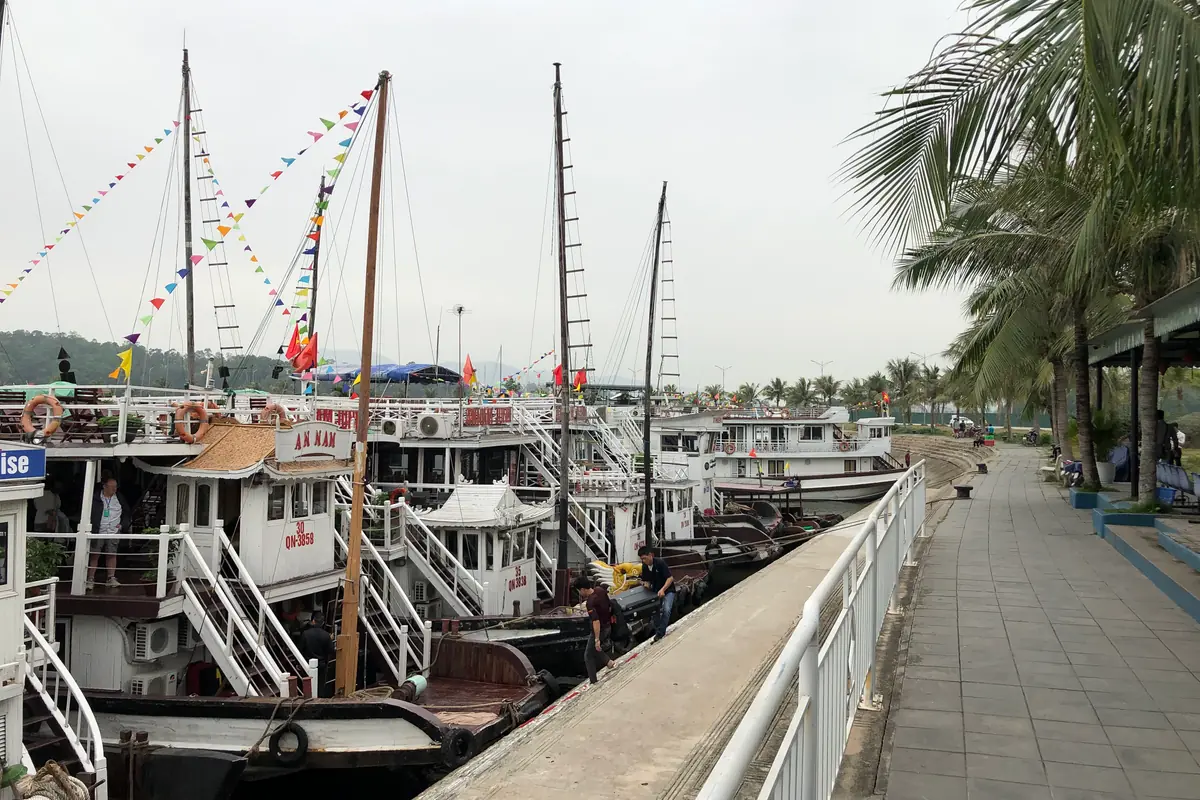
Already visiting Ha Long Bay? Is Ninh Binh worth adding to your trip?
Squeezing Trang An, Tam Coc, and Hang Mua into a single day turns a Ninh Binh visit into a rush from one pier to the next. Pick one boat route first, then add whichever nearby stop fits the hours left.
 19 min read

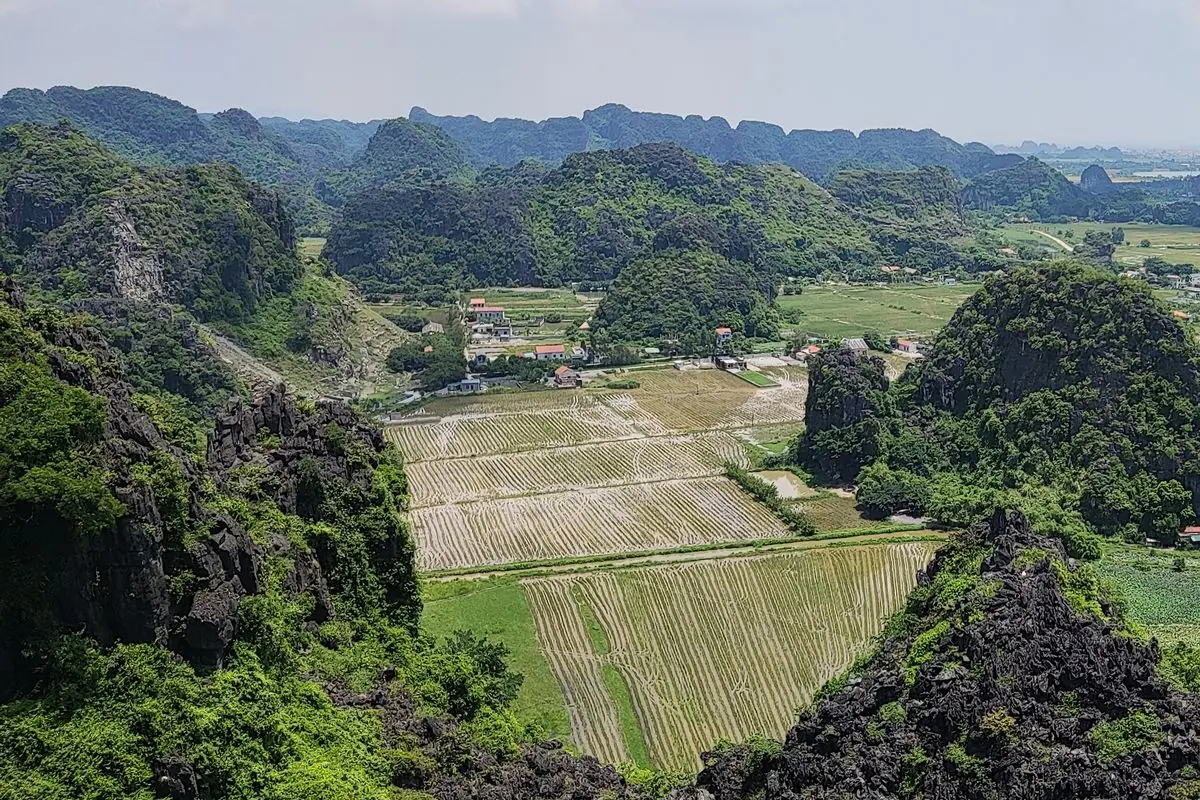
The stone steps to Ngoa Long peak follow the ridge up to a small pagoda on the top of Hang Mua, above ponds crossed by winding walkways; the valley was deep in haze that day.
Already planning to visit Ha Long Bay or Cat Ba Island? Ninh Binh is still worth an extra day or two, especially if you love limestone mountains, rice fields, peaceful rivers, and historic temples. One day is enough for a scenic boat tour and a nearby attraction, while two days give you room to explore at a slower pace. On a first visit, one boat trip at either Trang An or Tam Coc is enough to see the limestone and river scenery the region is known for.
1. Is Ninh Binh worth visiting after Ha Long Bay or Cat Ba?
Ninh Binh is often called "Ha Long Bay on land," but that nickname only tells part of the story.
In Ha Long Bay and Lan Ha Bay, towering limestone islands rise straight out of the sea. You can spend the night on a cruise, paddle a kayak, explore beaches, or watch the sunset from the water.
Ninh Binh offers a completely different atmosphere. Here, limestone mountains rise between rice paddies, small villages, and winding rivers. Traditional rowing boats glide through caves beneath the mountains, occasionally emerging into hidden valleys surrounded by greenery.
Both are karst landscapes, but in one you watch them from a cruise deck at sea, and in the other from a small rowing boat between rice fields.
Ninh Binh also has a long history. The Trang An Landscape Complex was inscribed on the UNESCO World Heritage List in June 2014, becoming Vietnam’s first mixed cultural and natural World Heritage Site.
The protected landscape includes the ancient capital of Hoa Lu, the Trang An-Tam Coc-Bich Dong scenic area, and Hoa Lu’s protected forest. Beyond its limestone scenery, the region contains archaeological evidence of prehistoric human settlement in its caves.
When should you add Ninh Binh to your itinerary?
Adding one or two days is worthwhile if you enjoy nature, photography, cycling through rural landscapes, or learning about Vietnamese history.
It also fits easily into a route for international visitors who are combining Hanoi with Ha Long Bay, Hai Phong, or Cat Ba Island.
On the other hand, travelers with only a few days in northern Vietnam who mainly want beaches, cruises, and island activities may prefer to skip Ninh Binh rather than rush between destinations.
One night in Ninh Binh gives you the countryside in the early morning, a cooler climb up Hang Mua, and no rush back to Hanoi right after your boat tour.
A convenient travel sequence is Hanoi - Ninh Binh - Ha Long Bay or Cat Ba, or the same route in reverse. Allow time for road transfers and any ferries or boats to the islands, since Ninh Binh is not right next to Ha Long Bay.
2. What to do in Ninh Binh: the attractions worth prioritizing
Ninh Binh has plenty of places to explore, but most first-time itineraries focus on Trang An, Tam Coc, Hang Mua, and the ancient capital of Hoa Lu.
Bai Dinh Pagoda is another worthwhile stop, particularly for travelers interested in Buddhist architecture or those with extra time.
Trang An
A boat journey through caves and ancient temples
Recommended time: approximately 2-3.5 hours.
Trang An suits a first visit to Ninh Binh, unless you arrive during Tam Coc’s golden rice season.
From the main pier, traditional rowing boats take visitors through peaceful waterways surrounded by limestone mountains. Some sections pass beneath low cave ceilings, while others open into green valleys with old temples built against the cliffs.
Trang An offers three main circular boat routes, all starting and finishing at the central pier:
- Route 1: The longest route, passing through nine water caves and several spiritual sites. It is ideal for travelers who enjoy exploring caves and have plenty of time on the water.
- Route 2: Combines caves with temples and historic sites. This is a balanced choice for anyone interested in both nature and culture.
- Route 3: Features scenic waterways, caves, and dramatic limestone formations, making it appealing to travelers who enjoy landscapes and photography.
All three routes have the same standard ticket price, so you can choose based on your interests rather than cost.
Individual cave routes may temporarily close during periods of heavy rain. Route 3, for example, was suspended on July 31, 2026, because rising water levels made the caves unsafe. It reopened on the morning of August 2, while Routes 1 and 2 continued operating during the closure.
In the rainy season, ask which routes are running before you head to the pier.

Tam Coc
A peaceful boat ride through rice fields
Recommended time: approximately 2 hours round trip.
Tam Coc feels more open, rural, and peaceful than Trang An.
Boats depart from Van Lam Pier and follow the Ngo Dong River, passing through three caves: Hang Ca, Hang Hai, and Hang Ba.
Hang Ca, the longest of the three, measures approximately 127 meters. After emerging from its shadowy interior, you find yourself surrounded by limestone cliffs and farmland again.
At the end of the route, the boat turns around and follows the same river back to the starting point.
Rice grows along both banks of the river, and from around mid-May to early June the fields gradually turn golden as the rice approaches harvest. These weeks are Tam Coc’s busiest photo season, with photographers coming from across Vietnam and abroad.
Bich Dong Pagoda, a historic temple complex built into a mountainside not far from Van Lam Pier, is reached on foot and is not part of the three-cave boat journey.

Hang Mua
The best panoramic views over Tam Coc
Recommended time: approximately 2-3 hours.
Hang Mua is the place to visit when you want to admire Ninh Binh from above.
Despite its name, which means "Dancing Cave," people come here for the steep stone staircase leading up Ngoa Long Mountain.
After climbing approximately 500 steps, you reach viewpoints overlooking the winding Ngo Dong River, the rice fields of Tam Coc, and layers of limestone mountains stretching into the distance.
The climb is hard work: many of the stone steps are steep and uneven, and much of the route is exposed to direct sunlight. During summer, the heat can make the climb surprisingly tiring.
The easiest times to climb are the early morning, roughly between 7 and 9 AM, or later in the afternoon when temperatures begin to drop.
Bring drinking water, wear shoes with good grip, and allow time for breaks. Travelers with knee problems or mobility difficulties may prefer exploring the gardens and scenery around the base instead of climbing to the summit.
Another highlight is the lotus pond at the foot of the mountain, where pink flowers usually bloom among broad green leaves around June and July.
Hoa Lu Ancient Capital
Discover Vietnam's early royal history
Recommended time: approximately 1-1.5 hours.
Hoa Lu served as Vietnam’s capital for 42 years, from 968 to 1010, during the Dinh and Early Le dynasties and the beginning of the Ly dynasty.
In 1010, King Ly Thai To moved the capital to Thang Long, the historic predecessor of modern Hanoi.
Today, the main attractions at Hoa Lu are the temples dedicated to King Dinh Tien Hoang and King Le Dai Hanh. They stand within the historic area of the former royal capital.
Hoa Lu has little to do beyond the temples, and walking around them gives you a better understanding of the history behind Ninh Binh’s UNESCO-listed landscape.
The site is approximately 5 km from Trang An Pier, making it an easy stop after a boat tour.

Bai Dinh Pagoda
Buddhist architecture on a grand scale
Bai Dinh is a vast Buddhist complex consisting of an older mountain temple area and a large modern complex developed from 2003 onward.
The site covers more than 500 hectares, with monumental halls, long corridors, statues, and religious structures spread across the grounds.
Exploring Bai Dinh is quite different from visiting Hoa Lu Ancient Capital. The focus here is on Buddhist architecture and religious traditions rather than the history of Vietnam’s early royal court.
Entry to the complex is free, but electric shuttle services and certain experiences have separate charges.
Because the site is so large, it’s hard to squeeze it into a day that already includes a long boat tour and the Hang Mua climb.
Bai Dinh fits more comfortably into a second day or an itinerary focused on culture and spirituality.

3. Trang An or Tam Coc: which should you choose?
| Feature | Trang An | Tam Coc |
|---|---|---|
| Scenery | Limestone mountains, water caves, hidden valleys, temples | Ngo Dong River, rice fields, limestone mountains, three caves |
| Boat tour duration | 2-3.5 hours | Approximately 2 hours |
| Adult ticket in 2026 | 300,000 VND | 250,000 VND |
| Main highlight | Cave exploration and varied landscapes | Rice fields and peaceful countryside |
| Best time | Many months of the year, weather permitting | Late May to early June |
| Nearby attractions | Hoa Lu Ancient Capital, Bai Dinh | Hang Mua, Bich Dong |
| Best for | First-time visitors wanting a varied experience | Travelers who love rural landscapes and photography |
Only one day in Ninh Binh? Go with Trang An. One boat trip there covers caves, mountains, waterways, and temples.
Visiting during the golden rice season? Pick Tam Coc. Trang An has no stretch where the boat floats between golden rice fields like this.
Love photography and mountain viewpoints? Tam Coc and Hang Mua pair well. They are only around 4.5 km apart, so visiting both in a day is straightforward.
Traveling with children or older family members? Tam Coc has a shorter boat ride, which may be more comfortable. Still, consider everyone’s ability to sit for an extended period and the weather conditions on the day.
Do you need to visit both Trang An and Tam Coc?
Not on a one-day trip.
Although the scenery differs, both attractions involve a traditional rowing boat journey through limestone landscapes and caves. On a short visit, one boat tour leaves time for Hang Mua, Hoa Lu, or cycling through the countryside.
Visiting both is worthwhile when you have two days in Ninh Binh, particularly during rice season or when scenic boat trips are one of your favorite travel activities.
4. Ninh Binh ticket prices in 2026
Many older travel guides still quote outdated admission fees, while Tam Coc, Hang Mua, and the Bai Dinh shuttle all changed their prices in 2026.
| Attraction | Adult ticket | Children and discounted tickets |
|---|---|---|
| Trang An | 300,000 VND | Height 1-1.3 m: 150,000 VND; under 1 m: free; visitors over 60: 150,000 VND |
| Tam Coc - Bich Dong | 250,000 VND | Height 1-1.3 m: 120,000 VND; under 1 m: free |
| Tam Coc package with electric shuttle | 350,000 VND | Height 1-1.3 m: 190,000 VND |
| Hang Mua | 150,000 VND | Free for children under 1 m |
| Hoa Lu Ancient Capital | 20,000 VND | Ages 6-15, visitors aged 60 and over, and visitors with disabilities: 10,000 VND |
| Bai Dinh Pagoda | Free entry | Electric shuttles and additional services cost extra |
| Bai Dinh round-trip electric shuttle | 150,000 VND | Height 1-1.3 m: 100,000 VND |
Prices may change during the year.
Important ticket details
The standard Trang An ticket costs 300,000 VND and includes the boat tour on any of the three main routes. The information hotline is 1900 9251.
For Tam Coc, the 2026 adult ticket is 250,000 VND, combining admission and the standard boat ride. Older guides that calculate 120,000 VND per person plus 150,000 VND per boat are no longer using the current pricing system.
The 350,000 VND package includes electric shuttle transportation between designated attractions. Tam Coc’s information hotline is 1900 9157.
The Hang Mua entrance fee increased to 150,000 VND for visitors taller than 1 meter on April 1, 2026, replacing the previous 100,000 VND rate.
At Bai Dinh, the 150,000 VND round-trip electric shuttle fare took effect on February 15, 2026.
There is also a 300,000 VND adult package that includes electric transportation between attractions, a visit to the Bao Thap tower, and a foot-soaking experience.
How much should you budget for Ninh Binh attractions?
Totals at standard adult prices:
- Tam Coc + Hang Mua: 400,000 VND per person.
- Trang An + Hoa Lu Ancient Capital: 320,000 VND per person.
- Trang An + Hang Mua + Hoa Lu: 470,000 VND per person.
- Trang An + Tam Coc + Hang Mua + Hoa Lu: 720,000 VND per person.
5. Ninh Binh one-day itinerary
A day trip to Ninh Binh works well for travelers staying in Hanoi or those with limited time between other northern Vietnam destinations.
Arrive by morning so there is time for one boat trip and one nearby stop. Trying to fit every famous place into one day turns it into box-ticking.
Option A: Trang An and Hoa Lu Ancient Capital
For a first visit, this is the simplest day to plan.
- 8:00-11:30 AM
Trang An boat trip
Arrive at Trang An Pier, purchase your ticket, and choose one of the three boat routes.
Because the journey can take between two and three and a half hours, give yourself the entire morning.
- 12:00-1:30 PM
Lunch break
Stop for a relaxed meal. Ninh Binh is known for dishes such as goat meat, crispy rice, and traditional Vietnamese home-style cooking.
- 2:00-3:30 PM
Hoa Lu Ancient Capital
Visit Hoa Lu Ancient Capital to explore the temples dedicated to Kings Dinh and Le.
The drive from Trang An is only about 5 km, so the transfer is relatively short.
You are done by about 3:30 PM, in time to return to Hanoi or continue toward your next destination. The day involves limited climbing and mixes scenery with history.
Option B: Tam Coc and Hang Mua
Choose this itinerary during rice season or when photography is your main priority.
- 8:00-10:30 AM
Tam Coc boat trip
Take a boat from Van Lam Pier through Tam Coc’s three caves and enjoy the scenery along the Ngo Dong River.
- Late morning
Tam Coc village, Bich Dong
Walk around Tam Coc village, stop for coffee, or visit Bich Dong Pagoda if time allows.
- Lunch
Rest out of the heat
Enjoy a meal and take a proper break. Climbing Hang Mua during the hottest part of the day is best avoided.
- 3:00-5:00 PM
Climb Hang Mua
Travel to Hang Mua and climb toward the summit of Ngoa Long Mountain.
Adjust your starting time based on the weather, your fitness level, and the attraction’s operating hours.
In June and July, the lotus pond at the base of the mountain is worth an extra stop.
6. Ninh Binh two-day, one-night itinerary
Two days covers Ninh Binh’s highlights without rushing.
- Day 1
Trang An - Hoa Lu - overnight stay
Arrive in Ninh Binh in the morning, leave your luggage at your accommodation, and head to Trang An for a boat tour.
In warmer months, board before 9 AM, or the midday sun will catch you halfway through a long boat ride.
After lunch, visit Hoa Lu Ancient Capital.
Spend around an hour exploring the temples and learning about the history of the former royal capital.
The rest of the afternoon can be as relaxed as you like. Check in to your homestay, enjoy the mountain scenery, or rent a bicycle and explore the rural roads around Tam Coc.
In the evening, travelers staying near the town center can visit Hoa Lu Ancient Town beside Ky Lan Lake.
Entry to the area is free, while an evening lantern boat ride costs 100,000 VND per adult. A VIP boat option is available for 150,000 VND.
- Day 2
Hang Mua - Tam Coc - Bich Dong
Start your morning at Hang Mua.
Climbing early means cooler temperatures and a better chance to enjoy the viewpoints before the hottest part of the day.
After descending, make your way to Tam Coc for a two-hour boat tour along the Ngo Dong River.
During the golden rice season, leave extra time for the fields and mountains and don’t schedule the next stop too tightly.
In the afternoon, you can explore Bich Dong Pagoda or simply enjoy lunch and a quiet coffee before leaving Ninh Binh.
It is a fairly active day, but the attractions are close enough together to make the route practical.
What if you want to visit Bai Dinh Pagoda?
Bai Dinh can take the place of the Tam Coc boat tour on Day 2.
The pagoda is approximately 14 km from Trang An Pier, or around 20 minutes by car in favorable traffic.
Plan at least two to three hours for the temple complex itself, not including potential waiting time for the electric shuttle.
Another option is to visit Trang An and Bai Dinh on the first day, followed by Hang Mua and Tam Coc on the second.
That makes a much fuller schedule, especially for families with young children or older travelers.
7. Where to stay in Ninh Binh: Tam Coc, Trang An, or the city center?
Not every hotel advertised as being in Ninh Binh is close to the main tourist attractions, and travel times can add up when you move between the countryside and town.
Stay in Tam Coc for countryside views and convenience
The area around Van Lam Pier has a wide selection of homestays, bungalows, and small hotels.
Some properties sit among rice fields, beside limestone mountains, or near quiet cycling routes.
From many accommodations you can walk to Tam Coc Pier, find restaurants and cafés nearby, and reach Hang Mua in roughly 10 minutes by car.
For a first overnight stay, Tam Coc makes the easiest base, especially when you want to enjoy the rural atmosphere rather than spend all your time traveling between attractions.
Stay near Trang An for a quieter retreat
The Trang An area also has homestays and resorts, although they are generally more spread out than those around Tam Coc.
Many look out over mountains, lakes, or quiet valleys.
This location is especially convenient for visiting Trang An, Hoa Lu Ancient Capital, and Bai Dinh Pagoda.
The trade-off is that some accommodations are relatively far from restaurants and other services.
Before booking, check on a map how far the property is from the nearest restaurant, rather than relying only on the hotel’s description.
Stay in central Hoa Lu for transport and city convenience
The central area around Ninh Binh Railway Station is better suited to travelers who prioritize transportation connections, conventional hotels, and easy access to restaurants.
It is also convenient for visiting Hoa Lu Ancient Town in the evening.
The main attractions are not within walking distance: Ninh Binh Railway Station is approximately 6 km from Tam Coc Pier and 9.5 km from Trang An Pier, so you will still need transport to explore the surrounding countryside.
8. Best time to visit Ninh Binh
Ninh Binh is a year-round destination, but the scenery and travel experience vary considerably with the seasons.
| Period | Weather and scenery | Best for |
|---|---|---|
| January-March | Cooler temperatures, relatively little rain, busy festival season | Sightseeing and temple visits |
| April | Increasingly warm weather and green landscapes | Boat tours and historic attractions |
| Mid-May-early June | Golden rice fields around Tam Coc | Rice field photography |
| June-July | Lotus flowers bloom; hot and humid weather | Lotus photography and early-morning sightseeing |
| July-September | Heaviest rainfall, occasional disruption to boat routes | Travelers with flexible plans |
| October-November | More comfortable temperatures and pleasant countryside | Independent travel, walking, and cycling |
| December | Cool to mildly cold, sometimes cloudy | Relaxed sightseeing and countryside stays |
When is the golden rice season in Tam Coc?
The spring rice crop along the Ngo Dong River generally begins turning yellow around mid-May.
The fields often look their best in late May, with harvesting taking place around the beginning of June.


In 2026, Ninh Binh Tourism Week ran from May 23 to May 31, with the Golden Tam Coc-Trang An Festival taking place on the morning of May 24.
Rice ripening and harvesting dates shift from year to year depending on the weather and farming schedule.
Checking recent local photos shortly before your visit is the easiest way to avoid arriving after the fields have already been harvested.
When do the lotus flowers bloom at Hang Mua?
The lotus pond beneath Hang Mua usually reaches its most attractive period around June and July.
The pink blossoms and broad green leaves sit right against the limestone mountains.
It is also one of the hottest times of the year. Average daytime highs during June and July can reach approximately 33-34°C, making midday climbing uncomfortable.
For lotus photography, the early morning is usually a better choice.
Should you visit Ninh Binh during the rainy season?
July through September brings the heaviest rainfall.
Average monthly precipitation can reach approximately 300-370 mm, with rain occurring on many days.
Heavy rainfall may affect photography, outdoor sightseeing, and the operation of certain cave boat routes.
The two easiest windows are late May, for the golden rice fields, and October-November, for more comfortable outdoor sightseeing.
December through March is another good option for travelers who prefer cooler conditions, although cloudy or overcast days are common.
9. Festivals worth knowing about in Ninh Binh
Ninh Binh has several traditional festivals connected to its history, religious beliefs, and local culture.
The Hoa Lu Festival took place from April 25 to 27 in 2026, corresponding to the ninth through eleventh days of the third lunar month.
The festival honors King Dinh Tien Hoang, King Le Dai Hanh, and other historical figures linked to the ancient capital.
The Trang An Festival was held on May 3, 2026, the seventeenth day of the third lunar month.
Its ceremonies and traditional activities on the waterways create a distinctive atmosphere within the scenic landscape.
The first two lunar months are also popular for spring pilgrimages and temple visits.
Bai Dinh Pagoda and the major boat piers can become particularly crowded during weekends and festival periods.
Because many Vietnamese festivals follow the lunar calendar, their Gregorian dates change each year. For another year, convert from the lunar dates given above.
10. Should you take a Ninh Binh tour or travel independently?
A guided day tour is convenient when you want transportation, tickets, and sightseeing arrangements handled for you.
Many tours depart from Hanoi and combine Trang An or Tam Coc with Hang Mua, Hoa Lu, or Bai Dinh.
The catch is a fixed schedule, with less room for photography, spontaneous stops, or lingering at one attraction.
Independent travel is better for people who enjoy exploring at their own pace.
Get to Ninh Binh by train, limousine van, or private car, then arrange taxis, a vehicle with a driver, or a motorbike for local transportation.
Traveling by road from Hanoi typically takes around 1.5-2 hours, depending on traffic and your departure location.
Train journeys to Ninh Binh Railway Station generally take about 2-3 hours, depending on the service.
Motorbike rental can be convenient for confident riders, but you need the appropriate valid driving license and should check insurance requirements, especially when traveling internationally.
Families with children or older travelers may find a private car more comfortable.
For travelers coming from Hai Phong, Cat Ba, or Ha Long Bay, pay close attention to pickup locations and transfer arrangements.
Avoid booking onward trains, buses, or ferries too close to the end of your sightseeing activities.
11. Practical tips for a better Ninh Binh trip
Before heading out, check the weather forecast and the current operating hours of the boat piers.
Trang An generally begins welcoming visitors around 7 AM, with ticket sales ending at approximately 4:30-5 PM, although exact hours can vary by season and operating conditions.
Tam Coc also generally operates during daylight hours, so arriving late in the afternoon may leave you too late for a boat.
When visiting temples and pagodas, dress respectfully and follow any rules concerning photography, noise, and access to worship areas.
Ninh Binh’s administrative addresses have also changed.
On July 1, 2025, the new Ninh Binh Province began operating following the merger of the former Ninh Binh, Ha Nam, and Nam Dinh provinces.
Under the new administrative structure:
- Tam Coc is in Nam Hoa Lu Ward.
- Trang An Pier and Ninh Binh Railway Station are in Hoa Lu Ward.
- Hoa Lu Ancient Capital and Bai Dinh Pagoda are in Tay Hoa Lu Ward.
Some hotel booking platforms and maps may still display older addresses, so search for the exact attraction or pier name rather than the administrative address.
How many days should you spend in Ninh Binh?
For anyone planning a northern Vietnam itinerary covering Hanoi, Ha Long Bay, Cat Ba, or Hai Phong, Ninh Binh adds a different kind of landscape.
Instead of islands rising from the sea, you find limestone mountains surrounded by rice fields, peaceful rivers, ancient temples, and small rural communities.
Only have one day? Choose Trang An with Hoa Lu Ancient Capital, or Tam Coc with Hang Mua.
Have two days? Spend a night in the countryside and enjoy both the scenery and the quieter atmosphere after day-trippers leave.
With room for only one boat trip, take Trang An on a first visit and Tam Coc during the golden rice season.
Frequently asked questions
Is Ninh Binh worth visiting if you've already been to Ha Long Bay or Lan Ha Bay?
Yes, particularly if you enjoy nature and rural landscapes. Ha Long Bay and Lan Ha Bay are known for limestone islands rising from the sea, while Ninh Binh offers limestone mountains surrounded by rice fields, rivers, caves, and historical sites. The experiences complement each other rather than feeling repetitive.
Is one day enough for Ninh Binh?
One day is enough for one boat tour and a nearby attraction. You can combine Trang An with Hoa Lu Ancient Capital or Tam Coc with Hang Mua. For both boat routes, an overnight homestay, or an additional visit to Bai Dinh, plan at least two days.
Should you choose Trang An or Tam Coc?
Trang An is better for first-time visitors who want a varied journey through caves, limestone mountains, and temples. Tam Coc is at its best when the rice fields along the Ngo Dong River turn golden from mid-May to early June. Trang An boat tours take roughly 2-3.5 hours, while Tam Coc takes about two hours.
How many steps are there at Hang Mua, and when should you climb?
There are approximately 500 stone steps leading up Ngoa Long Mountain. Early morning or late afternoon is generally more comfortable, especially during summer. Bring water, wear shoes with good grip, and allow around 2-3 hours for the entire visit.
Is it better to stay in Tam Coc or central Ninh Binh?
Tam Coc is ideal for travelers who want countryside homestays, rice field views, and convenient access to the boat pier and Hang Mua. Central Hoa Lu is better for train connections, restaurants, and visiting Hoa Lu Ancient Town in the evening. For a quieter retreat surrounded by mountains, accommodation near Trang An also works well.