Hanoi to Ha Giang: the cheapest bus isn't always the best choice
Before booking your bus, check when it arrives in Ha Giang, not just when it leaves Hanoi. This guide compares bus types, ticket prices, pickup locations, early-morning arrivals and return journeys after the Ha Giang Loop.
 23 min read

The Lo river runs through former Ha Giang city between riverside streets and stone embankments, with limestone ranges in the distance.
Ha Giang is no longer a separate province. On July 1, 2025, the former Ha Giang Province was merged into Tuyen Quang Province. Bus tickets, maps and travellers still use the name Ha Giang, though, and the destination remains the former Ha Giang City, roughly 286 km by road from Hoan Kiem Lake in Hanoi. Most buses take around 6-8 hours.
You don’t need to change buses in Tuyen Quang City to reach Ha Giang. Check instead where your bus picks you up in Hanoi, where it drops you off in Ha Giang and what time you arrive.
How far is Hanoi from Ha Giang, and how long does it take?
The driving distance from central Hanoi to the former Ha Giang City is generally quoted as 280-320 km, depending on the starting point and route. From Hoan Kiem Lake, approximately 286 km is a useful estimate.
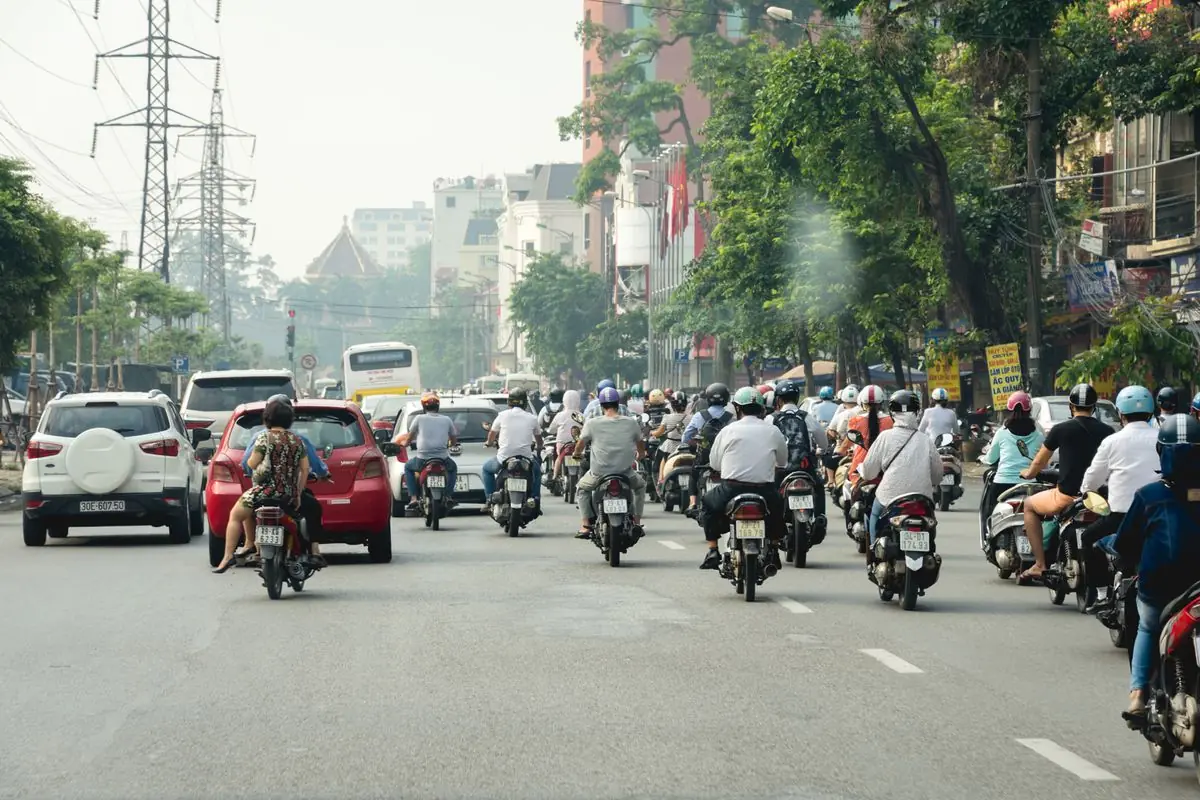
Buses usually travel north through the Phu Tho and Tuyen Quang areas before following National Highway 2 towards Ha Giang. Much of the earlier journey is relatively straightforward, but the road becomes more winding as you head farther north, with trucks and other traffic sharing the route.
Almost 300 km might not sound particularly far on a map. In practice, getting to Ha Giang takes up most of a morning, an afternoon or an overnight journey.
Allow approximately:
- Standard sleeper bus: 6-8 hours.
- Cabin sleeper bus: 6-8 hours, not necessarily faster than a regular sleeper.
- Seated limousine minibus: 6-7 hours.
- Private car with driver: 5-7 hours, depending on stops and pickup location.
Journey times can increase during holidays, busy weekends or heavy rain. A bus scheduled to arrive at 1:30 PM doesn’t guarantee you’ll be standing at your hotel reception desk at exactly 1:30 PM.
Ha Giang has no commercial airport or direct passenger railway connection with Hanoi. Road transport is therefore the usual way to reach the starting point of the Ha Giang Loop.
Sleeper bus, cabin bus or limousine: which is best?
All three can take you from Hanoi to Ha Giang, but the experience is quite different.
A standard sleeper saves money, a cabin bus gives you more privacy, and a seated limousine is particularly convenient if you prefer travelling during the day.
Hanoi to Ha Giang transport comparison for 2026
| Transport | Approximate one-way fare | Travel time | Common Hanoi pickup points | Best for |
|---|---|---|---|---|
| Standard sleeper bus | 200,000-350,000 VND/person | 6-8 hours | My Dinh, bus offices, selected Old Quarter pickups | Budget travellers |
| Single cabin sleeper | 315,000-550,000 VND/person | 6-8 hours | My Dinh, Tran Quang Khai, designated pickup points | Travellers wanting privacy |
| Seated limousine minibus | 285,000-450,000 VND/person | 6-7 hours | Offices near the Old Quarter, My Dinh, selected Noi Bai stops | Daytime travellers |
| Private 4-7-seat car | About 3.8-5.5 million VND/vehicle | 5-7 hours | Hotel or airport | Families and small groups |
These are indicative prices, not fixed fares for every date.
For example, Bang Phan’s listings included standard sleeper tickets from approximately 235,000 VND, 13-seat limousine tickets from around 285,000 VND and promotional cabin fares starting at 315,000 VND. Manh Quan had tickets listed from 320,000 VND, while Sao Viet fares started at around 350,000 VND.
For private transfers, reference prices are approximately 3.8 million VND for a four-seat car and 4.5-5.5 million VND for a seven-seat vehicle. Confirm whether the quotation includes tolls, fuel and waiting time.
Hanoi to Ha Giang bus schedules worth checking
To understand how departure and arrival times work, it helps to look at specific services.
Bang Phan’s listings provide several examples.
| Bang Phan bus type | Departure | Hanoi pickup | Scheduled arrival | Ha Giang drop-off |
|---|---|---|---|---|
| 13-seat limousine | 07:00 | 156 Tran Quang Khai | 13:30 | Ha Giang Bus Station |
| 24-cabin sleeper | 09:00 | 156 Tran Quang Khai | 15:30 | Ha Giang Bus Station |
| 24-cabin sleeper | 13:30 | My Dinh office | 19:45 | Ha Giang Bus Station |
| 44-seat sleeper | 20:30 | 156 Tran Quang Khai | 04:25 next day | Ha Giang Bus Station |
| 24-cabin sleeper | 21:00 | My Dinh Bus Station | 03:30 next day | Ha Giang Bus Station |
| 34-single-cabin sleeper | 21:00 | 156 Tran Quang Khai | 04:00 next day | Ha Giang Bus Station |
These are examples from published booking schedules, not guaranteed departures for every travel date. Operators can change timetables, use transfer vehicles or adjust pickup arrangements.
Notice that leaving later doesn’t always mean arriving later.
The 21:00 cabin bus from My Dinh is listed as arriving at 03:30, while the 20:30 sleeper from Tran Quang Khai is scheduled to arrive at 04:25.
Different pickup routes, intermediate stops and operating schedules account for some of these differences.
If you’re staying in Hanoi’s Old Quarter, 156 Tran Quang Khai may be much easier to reach than My Dinh. Staying in western Hanoi? The opposite may be true.
Standard sleeper bus: cheapest, but not always comfortable
A typical Hanoi to Ha Giang sleeper bus has rows of reclining sleeping berths arranged on two levels.
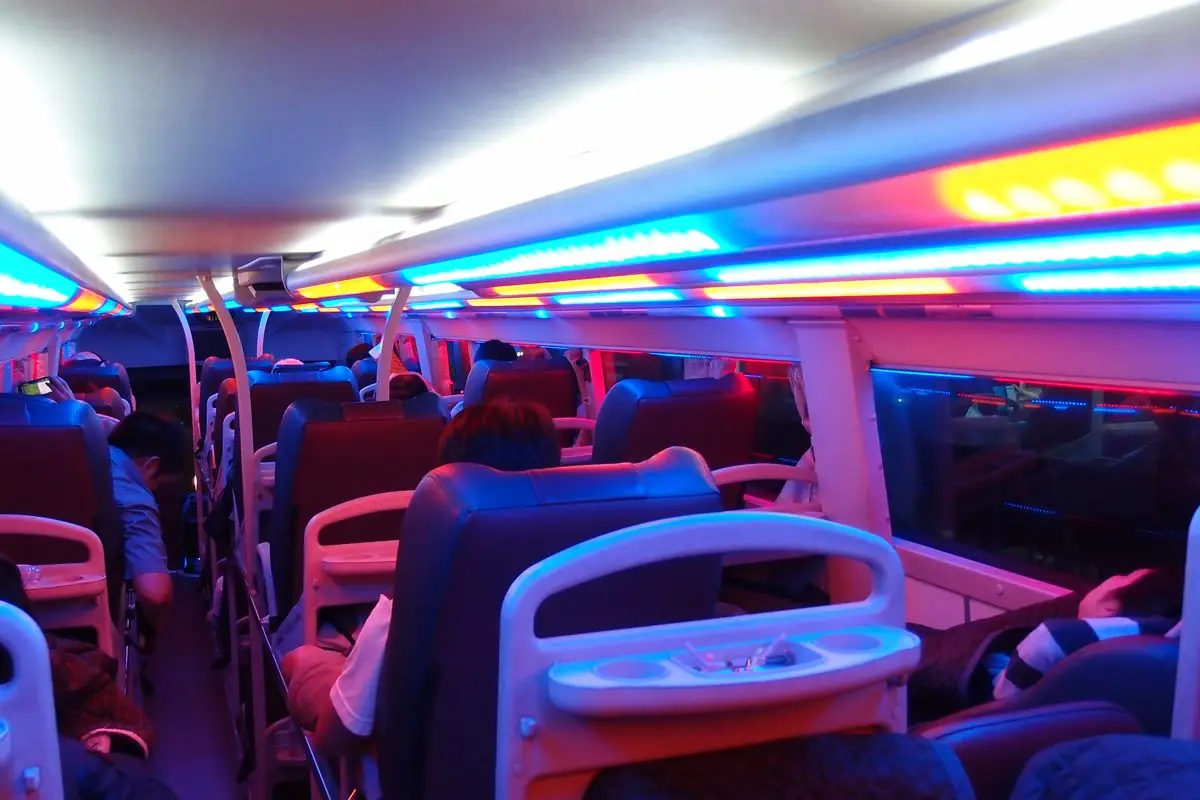
Each passenger gets an assigned berth, usually with air conditioning, a blanket and some form of divider or curtain, depending on the bus.
The biggest advantage is the price.
You can leave Hanoi in the evening, spend the night on the road and arrive in Ha Giang the following morning without paying for another hotel night in Hanoi.
The trade-off is personal space.
Sleeper berths have fixed dimensions. Taller passengers may find them short or narrow, while anyone who struggles to sleep on moving vehicles may find the journey tiring.
Engine noise, braking, winding roads and intermediate stops can all interrupt your sleep.
Passengers are commonly asked to remove their shoes before entering the sleeping area. A clean pair of socks, a light jacket and a small bag for your passport, phone and valuables are more useful than having everything packed in a suitcase beneath the bus.
If you’re travelling on a budget and can sleep reasonably well on buses, a standard sleeper is a sensible option.
Anyone who rarely sleeps on moving vehicles may find a daytime service worth the extra time, even if the overnight ticket looks cheaper.
Cabin sleeper bus: is the upgrade worth it?
Cabin buses offer individual sleeping compartments rather than ordinary open berths.
Depending on the vehicle, your cabin may have a curtain or door, individual lighting, charging ports and more separation from other passengers.
Some operators advertise their vehicles as palace cabins, VIP cabins, single rooms, double rooms or mobile hotels.
These are marketing descriptions. They don’t guarantee identical dimensions or facilities across different companies.
The extra cost over a standard sleeper may be fairly small during a promotion, or several hundred thousand dong on a more expensive service.
A cabin is particularly useful for solo travellers who want privacy, couples travelling together and anyone who dislikes sleeping close to strangers.
A curtain also makes it easier to change position, read or use your phone without disturbing everyone around you.
However, a cabin doesn’t turn an overnight bus into a hotel room.
You’ll still feel the vehicle turning, braking and moving over uneven sections of road.
Before booking, check whether the fare is charged per person or per cabin, whether the berth is long enough for you, and whether your compartment is upstairs or downstairs.
Double cabins may have different pricing rules when occupied by only one passenger.
Motion-sickness sufferers should consider where the cabin is located. A beautiful compartment at the back of the bus may be less comfortable than a more basic berth closer to the front.
Limousine from Hanoi to Ha Giang: a good daytime choice
Seated limousine minibuses usually carry fewer passengers than full-sized coaches. Seats typically recline, with more legroom than an ordinary bus.
One example is Bang Phan’s 13-seat limousine, listed with a 07:00 departure from 156 Tran Quang Khai and a scheduled 13:30 arrival at Ha Giang Bus Station.
That timing gives you the afternoon to eat, check into accommodation and prepare for the following day’s Loop.
The main benefit is arriving while it’s still light.
You don’t have to find somewhere to sleep at 4 AM, and you won’t spend the night trying to rest on a moving bus.
The downside is that travelling takes up a large part of your day. You’ll generally need to stay overnight in Ha Giang before beginning the Loop the following morning.
A daytime limousine is particularly suitable for travellers arriving from a long international flight, older visitors or anyone who wants to begin the mountain journey well rested.
Don’t assume a limousine will be suitable for working on a laptop throughout the journey. Some road sections are bumpy, mobile reception can be inconsistent and not every vehicle has a suitable workspace or charging outlet.
Private car: pay more for a flexible schedule
For a group of three or four, a private car becomes more appealing because the cost can be shared.
You can arrange pickup directly from your Hanoi hotel, Noi Bai Airport or another agreed location without carrying bags to a bus office.
Families with children, older travellers and groups with large suitcases will notice the difference.
You can decide when to leave, stop for food and bathroom breaks when needed, and avoid waiting for a bus to collect passengers from several pickup points.
Still, a private car uses the same roads as other vehicles. Don’t expect a nearly 300 km trip to take only three or four hours.
When requesting a quotation, give the company your passenger count, number of large bags, pickup time and exact destination.
A four-seat car might have enough seats for your group but insufficient luggage space if everyone has a large suitcase.
Overnight bus or day bus to Ha Giang?
This decision can shape your entire Ha Giang Loop itinerary.
Take an overnight bus to start the Loop the next morning
A common schedule is to leave Hanoi around 20:30-22:30, arrive in Ha Giang between roughly 03:30 and 05:30, rest for a few hours and start the Loop around 08:30-09:00.
The main advantage is saving daylight hours.
With only four days available, an overnight bus can allow you to spend almost three full days on the Loop while using the nights for transport.
But you need somewhere to go after getting off the bus.
Imagine arriving at Ha Giang Bus Station at 04:25 while your tour begins at 08:30.
That leaves just over four hours.
It’s enough time to take a shower, eat breakfast and rest briefly, but not enough to recover completely if you barely slept on the bus.
Overnight travel makes more sense when you’re joining an organised tour with an Easy Rider and your accommodation is ready to receive you before departure.
Riding a motorbike yourself makes being tired before the first mountain road a much bigger concern.
Take a day bus and sleep properly before the Loop
Another option is to leave Hanoi at 07:00, arrive in Ha Giang around 13:30 and spend the afternoon checking into your hotel, organising your luggage and confirming your tour details.
The following morning, you can have breakfast at a normal hour before setting off.
This takes another day out of your schedule and may mean paying for an additional hotel night.
But you won’t have to start a mountain ride after a sleepless night.
If you’ve just arrived at Noi Bai on a long-haul flight, another six or seven hours on a bus can feel especially exhausting. Spending a night in Hanoi before travelling north is often more comfortable than attempting an immediate connection.
What about an afternoon bus?
Afternoon departures can work well if you want to spend the morning in Hanoi.
For example, Bang Phan’s published schedules have included a limousine leaving Tran Quang Khai at 16:00 and reaching Ha Giang around 22:30.
You can still check into a hotel that night, provided you’ve informed the property about your late arrival.
However, by the time you reach the hotel, complete check-in and organise your belongings, it may be close to midnight.
Starting a tour at 08:30 the next morning could still feel rushed.
Compared with an overnight bus arriving at 04:00, an afternoon service is a better option when your hotel room is ready on arrival and you’d rather sleep in a real bed.
Where do Hanoi to Ha Giang buses pick up passengers?
Not every bus departs from the same station.
Even a single company may operate services from a central office, My Dinh Bus Station, Noi Bai Airport or a designated transfer point.
If you’re staying in Hanoi’s Old Quarter
For travellers based around Hoan Kiem, a pickup near your accommodation is usually the most convenient choice.
Two addresses appearing in bus listings are:
- 156 Tran Quang Khai: A Bang Phan pickup office.
- 11 Hang Ruoi: A pickup location used by Bus Vip Limousine Ha Giang.
Tran Quang Khai runs along the eastern side of the Old Quarter and is generally much easier to reach from Hoan Kiem Lake than My Dinh.
But a nearby office doesn’t necessarily mean the company offers hotel pickup.
Some services provide a shuttle from hotels in the Old Quarter. Others require passengers to reach a fixed pickup location independently.
Narrow streets, traffic restrictions and weekend pedestrian areas can also prevent larger vehicles from stopping directly outside your hotel.
The day before departure, send the operator a Google Maps pin for your accommodation and ask whether they can collect you there.
If you need to walk to a meeting point, request the exact location and the time you should arrive.
If you’re staying near My Dinh
My Dinh Bus Station is one of Hanoi’s main departure points for buses heading towards Ha Giang.
The station is commonly listed at 20 Pham Hung, Hanoi.
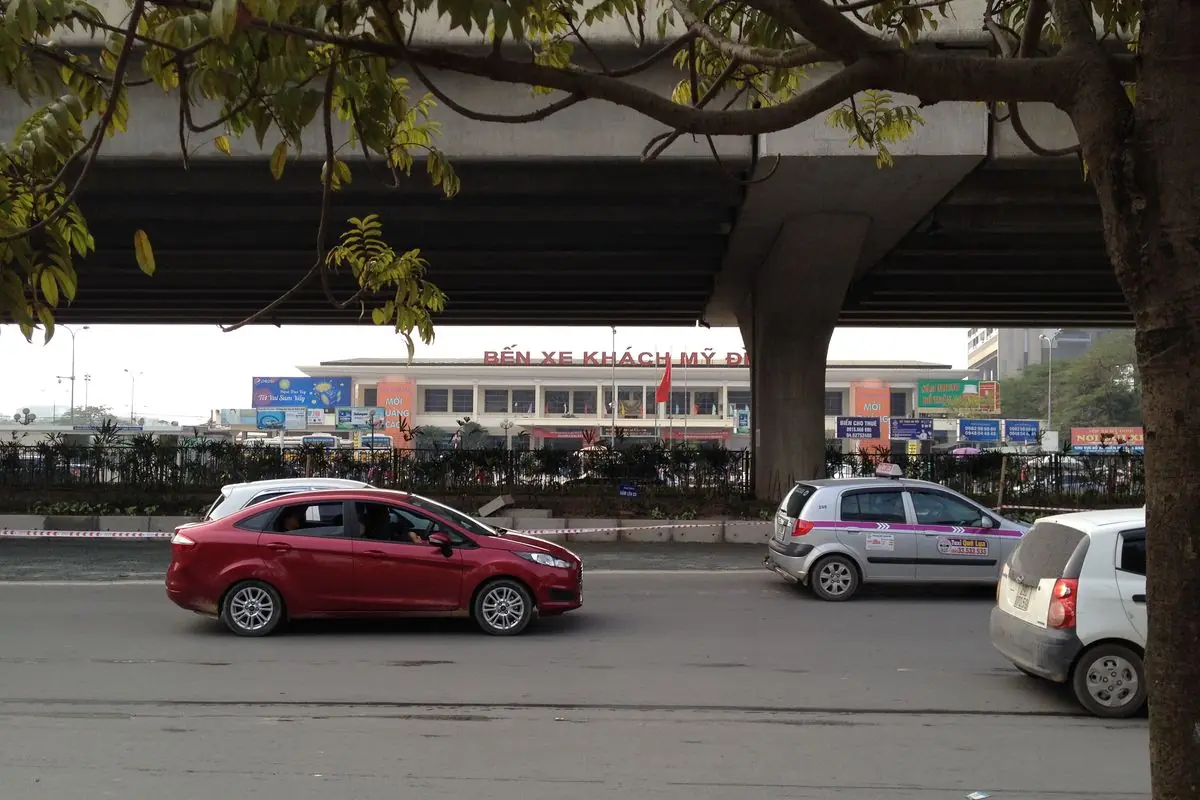
Some operators, however, use their own offices along Nguyen Hoang Street or elsewhere nearby rather than boarding directly inside the station.
If your ticket specifies a bus office, counter or boarding point, go to that exact location.
Arriving at the main entrance of My Dinh Bus Station and searching for the company’s name may not lead you to the correct vehicle.
Travellers staying around Cau Giay, My Dinh or western Hanoi often have little reason to travel all the way into the Old Quarter simply to catch a bus heading to the same destination.
If you’ve just landed at Noi Bai Airport
You don’t necessarily need to travel into downtown Hanoi before taking a bus to Ha Giang.
Some companies offer pickups in the Noi Bai Airport area.
For example, Bang Phan’s listings included a sleeper service with a pickup around 21:30 at the domestic terminal and around 21:35 at the international terminal, with an expected arrival in Ha Giang at 04:25.
Noi Bai has two main passenger terminals:
- Terminal T1: Domestic flights.
- Terminal T2: International flights.
Make sure you know which one your bus uses.
Also, three similar-looking pickup descriptions can mean very different things.
Noi Bai Airport, Terminal T1 or T2 suggests an airport terminal pickup or a specified meeting point in the airport area.
Noi Bai Intersection (Nga Tu Noi Bai) refers to a road junction, not necessarily the passenger terminal.
An office or transfer point near Noi Bai may require an additional short journey after leaving the terminal.
For international arrivals, immigration, baggage collection and other airport procedures can take unpredictable amounts of time.
A flight scheduled to land at 20:00 doesn’t guarantee you’ll be ready to board a bus at 21:00.
Choose a departure with sufficient connection time and a clear policy in case your flight is delayed.
When booking, share your flight number, arrival terminal and a phone number or WhatsApp contact that works in Vietnam.
Where do buses drop you off in Ha Giang?
You may see several different drop-off descriptions while searching for tickets: Ha Giang Bus Station, the Cau Me area, offices along Nguyen Trai or Tran Phu, and other city locations.
They aren’t all the same place.
For example, listings showed:
- Bang Phan: Ha Giang Bus Station.
- Manh Quan: 75 Cau Me.
- G8 SAPA OPEN TOUR: 223A Nguyen Trai.
Before booking, open the map location of your hostel or Ha Giang Loop operator and compare it with the bus’s drop-off address.
Don’t choose a ticket solely because the destination field says Ha Giang.
What happened to Ha Giang’s address after the administrative merger?
Since July 1, 2025, the former Ha Giang Province has been part of Tuyen Quang Province.
The area formerly known as Ha Giang City now includes two administrative wards called Ha Giang 1 and Ha Giang 2.
Ha Giang 1 Ward was established from the former Nguyen Trai Ward, Phuong Thien Commune, Phuong Do Commune and part of the former Quang Trung Ward.
Ha Giang 2 Ward includes areas formerly belonging to Ngoc Ha, Tran Phu, Minh Khai, the remaining part of Quang Trung and Phong Quang Commune.
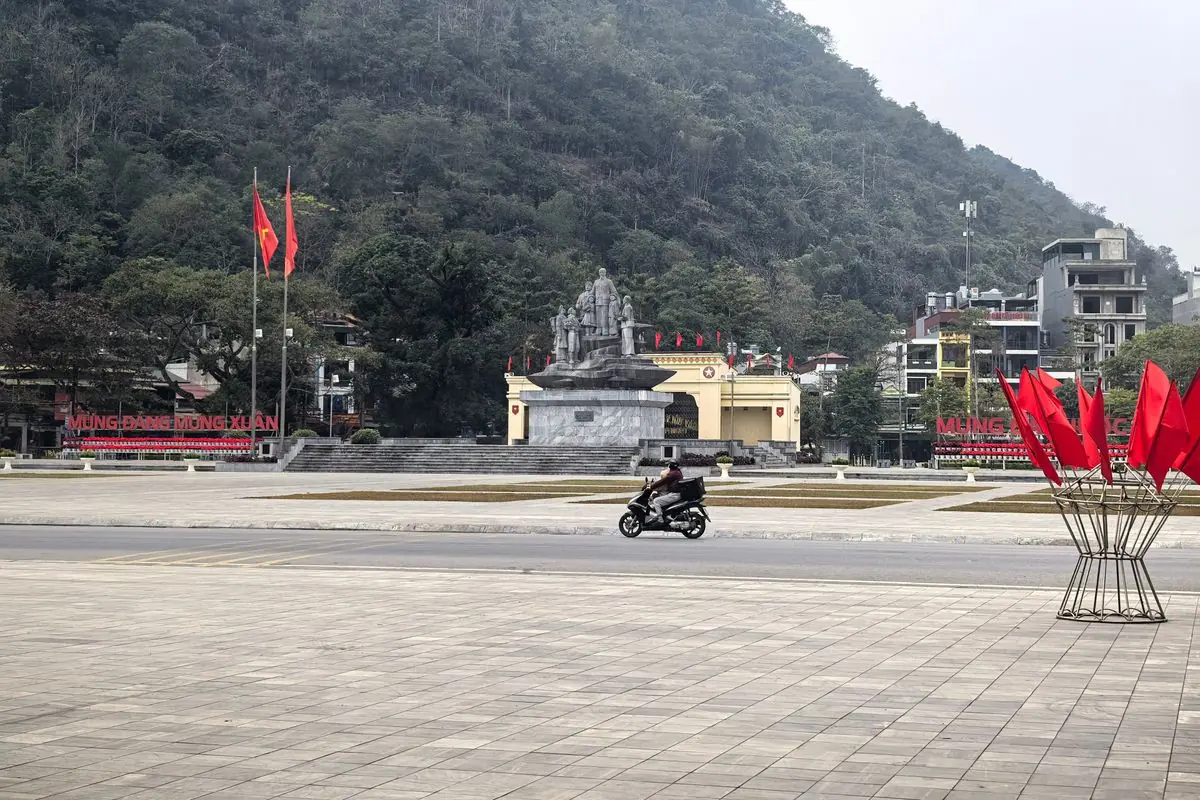
This explains why a hotel might display its new address as Ha Giang 1 Ward, Tuyen Quang Province, while an older booking page or map still shows Ha Giang City, Ha Giang Province.
Both may refer to the same physical property.
When contacting a bus operator, send the property name, street address and a map pin rather than relying on the ward name alone.
What should you do when you arrive in Ha Giang at 4-5 AM?
This is something to organise while you’re still in Hanoi.
After a night on the bus, you may reach Ha Giang before sunrise, well before normal hotel check-in hours.
Breakfast restaurants may not be open yet, either.
Ideally, you should already know where you’re going after getting off, who will receive you and whether there’s a bed available.
Option 1: rest at your Ha Giang Loop operator’s hostel
Many Ha Giang Loop companies arrange accommodation or a rest area for guests arriving on overnight buses.
Sometimes it’s included in the tour package.
For example, Ha Giang Ali Travel’s Ali Hostel, located in the Me Thuong area of Ha Giang 1 Ward, has published arrangements allowing eligible tour guests to use dorm beds after arriving from 04:00, before a 09:00 departure. The property also advertises hot showers, breakfast facilities and luggage storage.
BiBi Ha Giang Loop lists an 08:30 departure from BiBi Hotel and provides accommodation and breakfast arrangements according to the tour booking conditions.
However, don’t assume every hostel offers free beds at 04:00 or that anyone arriving by overnight bus can sleep there without a reservation.
Ask whether early-morning rest is included in the price, whether you’ll have an actual bed or only a shared waiting area, and who you should contact when the bus arrives.
If you’ve arranged your bus and motorcycle trip independently, book somewhere to rest rather than trying to find a room after arriving.
Option 2: book a hotel room for the previous night
This is the simplest solution if you want a proper night’s rest.
Suppose your bus arrives in Ha Giang at 04:30 on Friday.
You could book a room for Thursday night and tell the hotel that you’ll arrive at approximately 04:30 on Friday morning.
Make sure the hotel confirms someone will be available to let you in and that your room will be held for your late arrival.
Booking the room for Friday instead means normal check-in may not begin until the afternoon.
Paying for an additional hotel night might make the overnight journey less economical than you originally expected.
But for someone coming off a long international flight, or planning to ride a motorcycle through the mountains, a few hours of proper rest can be more valuable than a small saving.
Option 3: shower, have breakfast and start the tour
Arrive around 04:30 with somewhere to rest already arranged, and your morning might look like this:
| Time | Plan |
|---|---|
| 04:30-05:00 | Get off the bus and reach your hostel |
| 05:00-06:30 | Rest, charge your phone and freshen up |
| 06:30-07:15 | Have breakfast and drink some water |
| 07:15-08:00 | Organise luggage and prepare your Loop essentials |
| 08:00-08:30 | Meet the tour team, collect safety gear and attend the briefing |
| 08:30-09:00 | Set off according to the operator’s schedule |
This is a suggested plan, not the fixed timetable of a particular tour.
Some operators begin at 08:00, others at 08:30 or 09:00.
For breakfast, Pho Van Dung at 296 Nguyen Van Linh opens from around 06:00. Check its current hours before going, especially during public holidays.
In practice, breakfast at your hostel or included with your tour is often much easier.
You won’t have to move around town with a suitcase, helmet and backpack while trying to work out where your group is meeting.
Can you leave your large suitcase in Ha Giang during the Loop?
Many international travellers arrive with large backpacks or suitcases after visiting other parts of Vietnam.
Taking all that luggage on a motorbike for three or four days isn’t practical.
Many hostels and Loop operators provide luggage storage, but you should confirm the arrangements before arriving.
Pack only what you need for the Loop: suitable clothing, a warm layer, rain protection, essential documents, medication and a few personal items.
Keep your passport, money and valuables secure. Don’t leave important possessions in storage without understanding how the facility handles them.
A tour that finishes at the same hostel where you left your luggage makes collecting it before boarding your return bus straightforward.
Book your return bus before starting the Ha Giang Loop
Travellers often spend plenty of time choosing their bus to Ha Giang, then leave the return journey until the final day of the Loop.
That can become a problem if you’ve already booked a flight, reserved a hotel in Ninh Binh or planned to continue elsewhere immediately afterwards.
Three-day Ha Giang Loop tours typically finish during the afternoon on day three.
BiBi Ha Giang Loop, for example, publishes a return time of approximately 16:00-16:30, depending on the actual itinerary.
Ha Giang to Hanoi return bus schedules
Some examples from Bang Phan’s listings:
| Departure from Ha Giang | Bus type | Pickup | Scheduled arrival in Hanoi |
|---|---|---|---|
| 07:00 | 13-seat limousine | Ha Giang Bus Station | 13:35 |
| 16:00 | 13-seat limousine | Ha Giang Bus Station | 22:35 |
| 17:30 | 24-cabin sleeper | Ha Giang Bus Station | 00:15 next day |
| 18:00 | 44-seat sleeper | Ha Giang Bus Station | 01:20 next day, My Dinh |
| 18:00 | Single-cabin sleeper | Ha Giang Bus Station | 01:30 next day, Tran Quang Khai |
Other operators, including Ha Giang Express Bus, have advertised return departures around 07:00, 11:30, 16:00, 18:00 and 21:00.
The actual pickup time depends on the vehicle and departure location.
Say your Loop finishes at approximately 16:30: an 18:00 bus might look convenient.
But that leaves only about 90 minutes to finish everything, without allowing for the group returning late.
A later departure usually gives you more breathing room, especially if you want to shower, eat dinner and reorganise your luggage after several days on the road.
Ask your tour provider when groups usually get back, whether they drop guests at the bus station and how much extra time they recommend.
Then book the return journey.
Can you get from Ha Giang to Noi Bai Airport in time for your flight?
Plan around the time you need to arrive at the airport, not just your flight’s departure time.
Suppose you have an international flight from Noi Bai at 20:00.
The airport recommends arriving at least three hours before an international departure, putting your target arrival time at approximately 17:00.
If you leave Ha Giang by bus at 11:00, a six-to-seven-hour road journey already takes you close to or beyond that deadline, without accounting for delays, transfers or the journey from the drop-off point to the correct terminal.
That’s not a safe connection.
Even if your bus ticket says Noi Bai Airport, check exactly where the vehicle stops.
Some services may drop passengers at an intersection or nearby transfer point rather than directly outside Terminal T1 or T2.
Before booking, ask the operator whether the bus drops you at the terminal, what time it is expected to arrive, and whether a connecting shuttle is provided if it doesn’t enter the airport.
Three return-travel situations
International flight the following morning
Return to Hanoi the previous afternoon or evening, then stay overnight in the city or near the airport.
This removes the risk of making your flight depend entirely on a long-distance bus arriving on time.
International flight in the evening
An early-morning bus from Ha Giang may be possible, but leave a generous buffer.
A service scheduled to reach Hanoi around 13:30 gives you more flexibility than one arriving around 16:00 when you need to check in for a flight by 17:00.
Continuing to Ninh Binh, Sa Pa or another destination
Check whether you genuinely need to return to central Hanoi or whether there is a more convenient connection.
If you have to change vehicles, choose a drop-off location close to your next departure point rather than booking solely on the advertised arrival time.
A long-distance bus can arrive early or late.
An itinerary involving a bus, a shuttle and a flight has more opportunities for delays than a journey with fewer connections.
Three ways to plan Hanoi - Ha Giang - Hanoi
Itinerary 1: limited time, three-day Loop with overnight buses
This works best if you’ve already rested in Hanoi, have an organised tour booked and want to preserve as many daytime hours as possible.
- Evening, Day 0
Have dinner in Hanoi, reach your pickup point at the required time and board a sleeper or cabin bus around 20:30-22:30.
- Morning, Day 1
Arrive in Ha Giang around 04:00-05:00. Go to your prearranged hostel, shower, eat breakfast and start the Loop around 08:30-09:00.
- Day 2
Continue the Loop according to your tour itinerary.
- Day 3
Finish the Loop in the afternoon, collect your luggage and take an evening bus back to Hanoi.
- Early, Day 4
Arrive in Hanoi.
The advantage is that most of your daylight hours are available for the Loop.
The downside is two nights spent travelling, with no guarantee you’ll sleep particularly well.
Itinerary 2: a more relaxed journey with a full day to reach Ha Giang
This is a better fit for independent motorbike riders, travellers arriving after long flights and anyone who dislikes overnight buses.
- Day 0
Leave Hanoi on the 07:00 limousine and reach Ha Giang around 13:30. Have lunch, check into your accommodation, organise your belongings and rest.
- Day 1
Eat breakfast, inspect your rental motorcycle or meet your tour guide before departure.
- Days 2-3
Continue the Loop. On the final day, return to Ha Giang and stay another night if you want time to relax.
- Day 4
Travel back to Hanoi during daylight hours.
This schedule uses more time for transport, but it avoids rushing straight from a night bus onto mountain roads.
It also gives you more flexibility if your bus schedule or the weather changes.
Itinerary 3: travel directly from Noi Bai Airport to Ha Giang
This can suit travellers comfortable with airport-to-bus connections who don’t need to spend time in central Hanoi.
- Day 0
Land at Noi Bai Airport, collect your luggage, complete arrival procedures and reach your confirmed bus pickup point.
- Night, Day 0
Take the bus from the Noi Bai area towards Ha Giang.
- Morning, Day 1
Arrive at the hostel or accommodation that has confirmed early access. Rest before beginning the Loop.
This saves a trip into central Hanoi.
However, it’s not a good plan when your flight lands too close to the scheduled bus departure.
If your plane arrives late at night and the connection is tight, spending the night in Hanoi is easier to manage than risking a missed bus.
What to check before booking a Hanoi to Ha Giang bus
Tickets can be booked through platforms such as Vexere or 12Go, or directly through the operators’ websites, offices and contact channels.
Ha Giang Loop tour companies can often arrange both your outbound and return buses.
When comparing prices, make sure you’re looking at the same travel date, bus type and pickup arrangements.
A 350,000 VND cabin ticket departing from My Dinh isn’t directly equivalent to a 400,000 VND ticket that includes pickup from your Old Quarter hotel.
Before paying, check the following:
- Departure date and time: Overnight trips can cross midnight, making it easy to book the wrong date.
- Actual vehicle type: Standard sleeper, single cabin, double cabin or seated limousine.
- Exact boarding location: Street address, bus station, office or airport terminal meeting point.
- Ha Giang drop-off: Bus station, operator office or your hostel.
- Luggage allowance: Number of bags, large suitcase restrictions and storage arrangements.
- Cancellation and changes: Particularly important if your flight or Loop dates change.
On busy weekends, during buckwheat flower season around October-November and over major Vietnamese holidays, it’s sensible to book earlier.
Cabins and popular berth positions may sell out before standard sleeper tickets.
For international travellers, getting the pickup details confirmed in writing is especially useful.
Not every driver or pickup assistant will speak English, particularly late at night.
Save a screenshot of your ticket, the pickup point’s map location and the operator’s contact information so you can access everything without mobile data.
Should you book your bus separately or together with a Ha Giang Loop tour?
Booking your transport and Loop together is often convenient.
The tour company knows when you’re due to arrive, can arrange somewhere to rest and may help coordinate your return bus after the tour.
However, check whether the package actually includes round-trip transport from Hanoi.
Some companies charge separately for bus tickets, while others simply make the reservation on your behalf.
A package advertised as "all-inclusive from Hanoi" isn’t enough information to understand exactly what’s included.
Booking your buses independently offers more flexibility if you want to add a night in Ha Giang before or after the Loop.
You can also take a daytime limousine to Ha Giang and return on an overnight sleeper. There’s no reason to use the same type of transport in both directions.
Remember 4:00-5:00 AM: that’s when many overnight buses from Hanoi reach Ha Giang, well before normal hotel check-in hours and before most Loop tours begin. Booking a seat north is easy enough; arranging somewhere to rest on arrival and a return bus that doesn’t disrupt your next destination takes a little more planning.
Frequently asked questions
How far is Hanoi from Ha Giang, and how long does the bus take?
The driving distance from Hoan Kiem Lake to the former Ha Giang City is approximately 286 km. Standard sleeper and cabin buses generally take 6-8 hours, while seated limousine minibuses often take around 6-7 hours. Actual distances and travel times depend on your pickup point, route and traffic conditions.
Is a cabin sleeper bus worth the extra money?
A cabin bus is worth considering if you want more privacy, a curtain or door separating your space from other passengers, and a more comfortable overnight setup. However, it isn't necessarily faster than a standard sleeper and won't guarantee a good night's sleep. If you're travelling on a budget and sleep easily on buses, a regular sleeper can be perfectly reasonable.
Can Hanoi to Ha Giang buses pick me up in the Old Quarter or at Noi Bai Airport?
Some services offer pickups in both locations, but not every departure does. Old Quarter pickup points include 156 Tran Quang Khai and 11 Hang Ruoi, while selected departures serve the Noi Bai Airport area. Always confirm whether pickup is at your hotel, a company office, a terminal meeting point or a nearby road junction.
Can I sleep at a hostel if I arrive in Ha Giang at 4 AM?
It depends on the accommodation and your booking conditions. Some Ha Giang Loop operators provide early-morning rest facilities for overnight bus passengers, while others require advance arrangements or an additional fee. Confirm access before leaving Hanoi, especially if you have large luggage or need a shower before your tour.
If my Ha Giang Loop finishes at 4 PM, can I book a 4 PM bus back to Hanoi?
No. Your tour may finish later than expected, and you'll still need time to collect luggage, change clothes and reach the bus pickup point. Choose a later departure with enough buffer time. If you're flying out of Noi Bai, returning to Hanoi the previous day is generally safer than relying on a tight same-day connection.