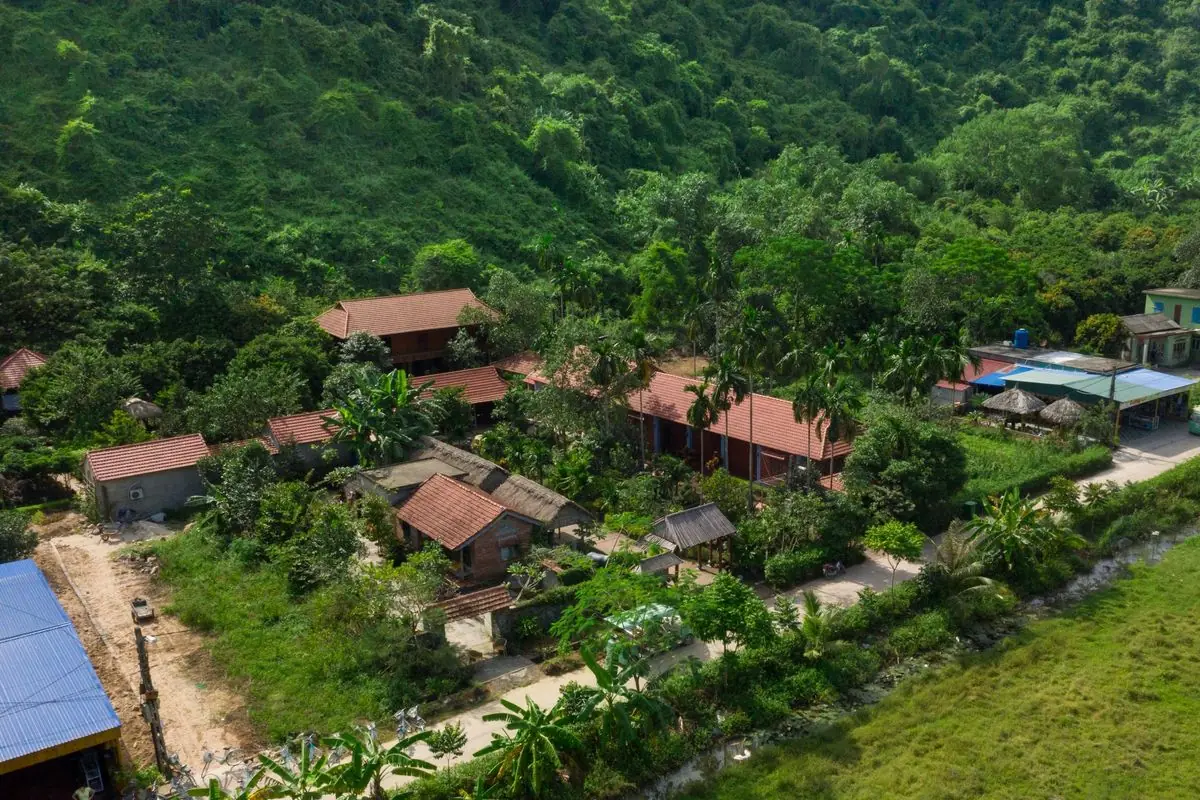
Rock climbing in Cat Ba: how to choose between top-rope, deep water soloing, and kayaking
Top-rope climbing with a guide is the best starting point for beginners, while deep water soloing suits experienced climbers who are confident swimmers. Butterfly Valley offers more independent sport climbing, but kayaking in Lan Ha Bay remains restricted in 2026, so confirm the permitted paddling area before booking.
 18 min read
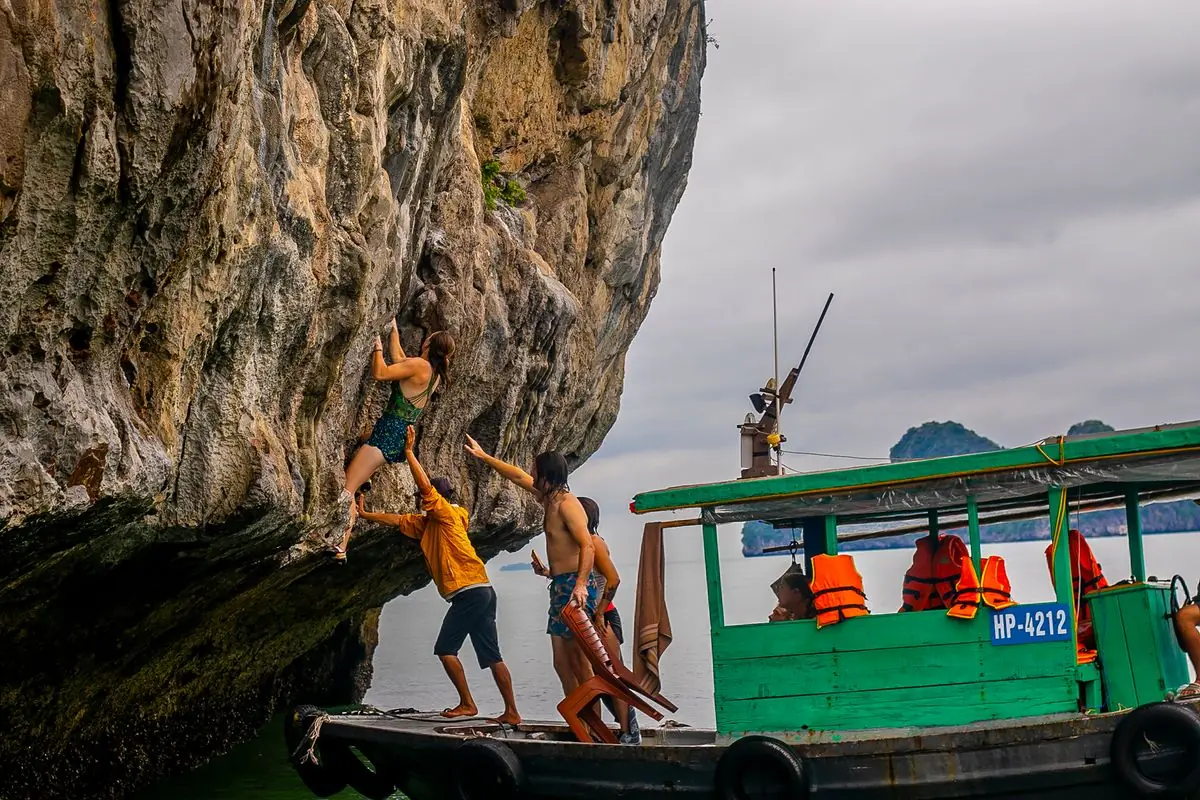
A climber hangs on an overhanging limestone wall right beside the bow of a green wooden boat while two friends on deck reach up to spot her; more karst islands sit under a cloudy sky behind.
You’re visiting Cat Ba, looking up at the limestone cliffs rising above Lan Ha Bay, and wondering what it would feel like to climb one. Where should you start? A guided top-rope session at Moody Beach is the easiest introduction; deep water soloing can wait until you know the rock and swim well. Once you’re comfortable on the rock, Butterfly Valley and the cliffs scattered across the bay offer plenty more to explore.
1. What types of rock climbing can you do in Cat Ba?
Cat Ba’s limestone comes in several settings. Some cliffs sit deep inside green valleys, others overlook small beaches, and many rise directly out of the sea.
The three main options are top-rope climbing, deep water soloing, and sport climbing on bolted routes. Kayaking is a separate water activity that can complement a climbing trip wherever licensed operations are permitted.
| Activity | Best for | Can you go independently? |
|---|---|---|
| Top-rope climbing at Moody Beach | Beginners, families, and first-time climbers | A guided tour is recommended |
| Deep water soloing in Lan Ha Bay | Experienced climbers who swim well and are comfortable with heights | No independent trips; use an authorized operator |
| Sport climbing at Butterfly Valley | Climbers experienced in lead climbing and rope safety | Yes, with suitable skills, equipment, and access permission |
| Kayaking in the bay | Travelers looking for light to moderate exercise on the water | Only in permitted areas through an authorized arrangement |
Cat Ba’s cliffs are open to first-timers: with the right tour, you climb real outdoor rock, take in the sea views, and pick up a new skill.
2. Top-rope climbing at Moody Beach: the best place to start
Top-rope climbing uses a safety rope anchored above the climbing route. A qualified guide sets up the rope system, checks the equipment, and manages the belay while you climb.
When properly operated, the belay system catches you if you slip or lose your grip.
If you have never climbed outdoors, start here.
What happens during a climbing session at Moody Beach?
Moody Beach is located in Lan Ha Bay and features limestone climbing routes ranging from easy to intermediate difficulty. Some routes reach approximately 23 meters above the water.
You travel to the climbing area by boat with your guide, who prepares the necessary equipment before the session begins.
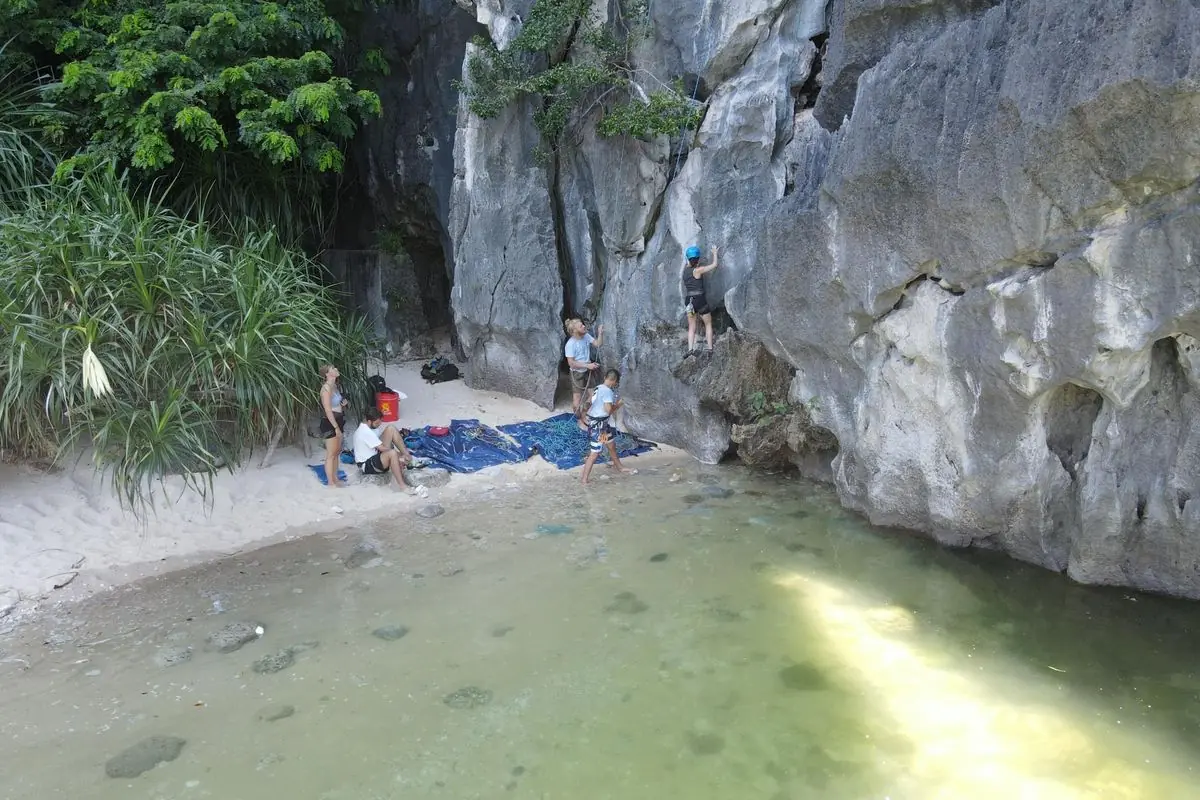
First, you’ll get familiar with the harness, climbing shoes, helmet, and basic climbing commands. Your guide will explain how to use footholds, position your body, and communicate while climbing.
After that, you’ll start on a route suited to your ability.
Reaching the top is up to you. Some people climb a few meters before deciding they’ve had enough, while others complete their first route and immediately want to try another.
Some operators accept children from around six years old. Confirm minimum ages, equipment sizes, and participation requirements with the tour provider.
When should you climb, and what should you bring?
During summer, afternoon climbing is generally more comfortable because the Moody Beach cliffs receive shade later in the day.
In winter, morning sessions are often preferable, allowing climbers to enjoy the warmth of the sun.
Wear flexible long trousers, a breathable shirt, and suitable sun protection. The harness may rub against your legs, and limestone can scratch exposed skin when you climb close to the rock.
Bring a dry change of clothes too.
Climbing in wet clothing after swimming or kayaking can feel uncomfortable, especially when the wind picks up.
3. Deep water soloing in Cat Ba: climb without ropes and drop into the sea
Deep water soloing, commonly shortened to DWS, involves climbing without ropes or a harness.
In Cat Ba, DWS takes place on limestone cliffs rising directly from the sea. The water below provides the landing area when climbers fall or deliberately jump off.
Can beginners try deep water soloing in Cat Ba?
Some operators advertise easier routes for newcomers, but deep water soloing is best left until after your very first climbing experience.
You need to manage your movements on the rock, stay comfortable with exposure to heights, and handle entering the water after a fall.
Participants should be confident swimmers, able to remain calm in the water, and physically prepared for the activity. Health conditions that could make climbing or water entry dangerous should also be considered.
DWS routes around Lan Ha Bay cover a wide range of difficulties, commonly described as approximately 5b to 7c on the French grading scale, or roughly 5.8 to 5.12c on the American scale.
Even an easier climbing grade doesn’t remove the risks that come with falling into water.
Already climbed in a gym or tried outdoor top-rope climbing? DWS could be an exciting next step once an experienced guide has assessed your ability.
For complete beginners, spending half a day climbing with a rope first makes much more sense.
Learning to balance on tiny limestone footholds is already an adventure.
Why are tides so important for deep water soloing?
Unlike rope climbing, DWS depends heavily on the water depth below the cliff.
Lan Ha Bay experiences predominantly one high tide and one low tide each day, with tidal ranges that can reach approximately three meters.
A cliff might offer a suitable landing zone at higher water levels, while low tide could expose submerged rocks or create an unsafe distance between the climber and the water.
Some cliffs also have overhanging bases eroded by waves. At low tide, climbers may need to negotiate difficult bouldering moves simply to reach the main route.
That’s why DWS tour times move with the tides.
Some days are suitable for morning sessions, while others work better in the afternoon. Days when the tides allow a full-day excursion are less common.
Tour operators use small boats to transfer climbers from the main vessel to the base of the cliffs. Guides select routes, assess landing areas, explain safe water-entry techniques, and supervise the activity.
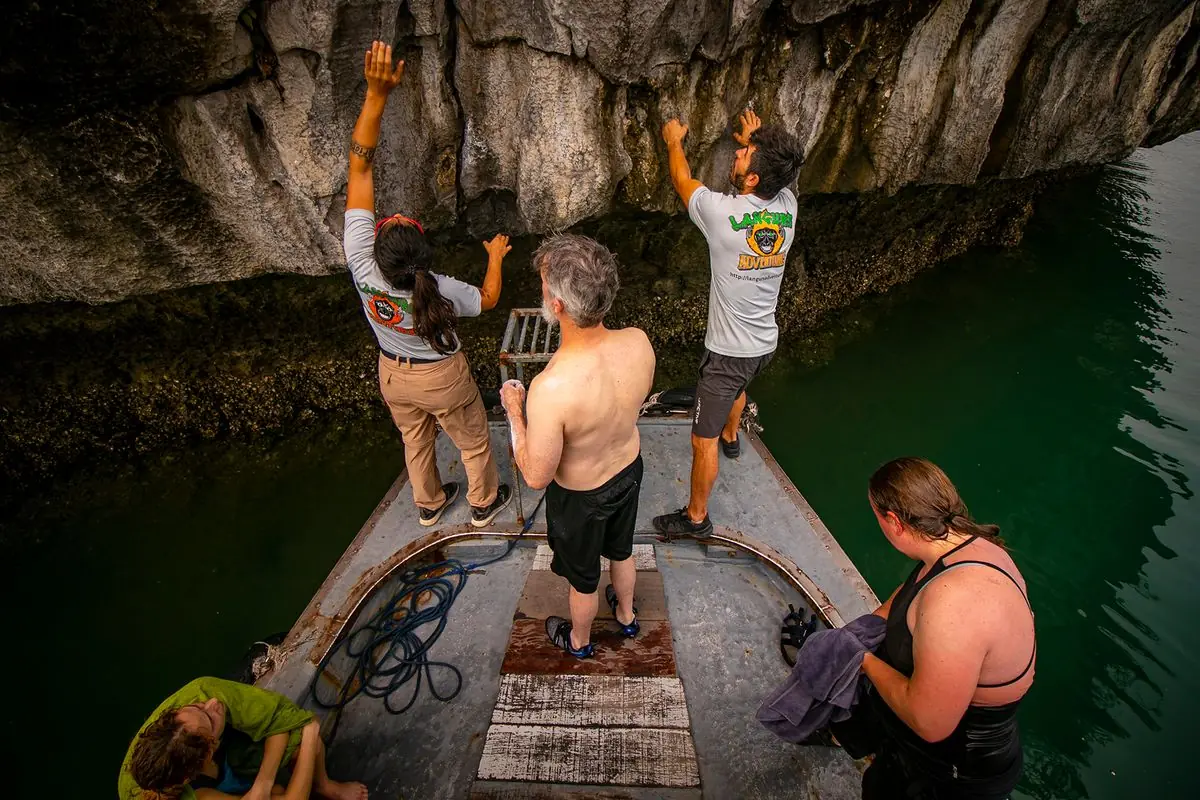
4. Butterfly Valley Cat Ba: a destination for sport climbers
Butterfly Valley, also known locally as Lien Minh Valley, lies in the central part of Cat Ba Island, approximately 10 kilometers by road from Cat Ba Town.
Unlike the sea-facing cliffs at Moody Beach, Butterfly Valley features green fields, rural scenery, limestone walls decorated with formations, and climbing routes surrounded by vegetation.
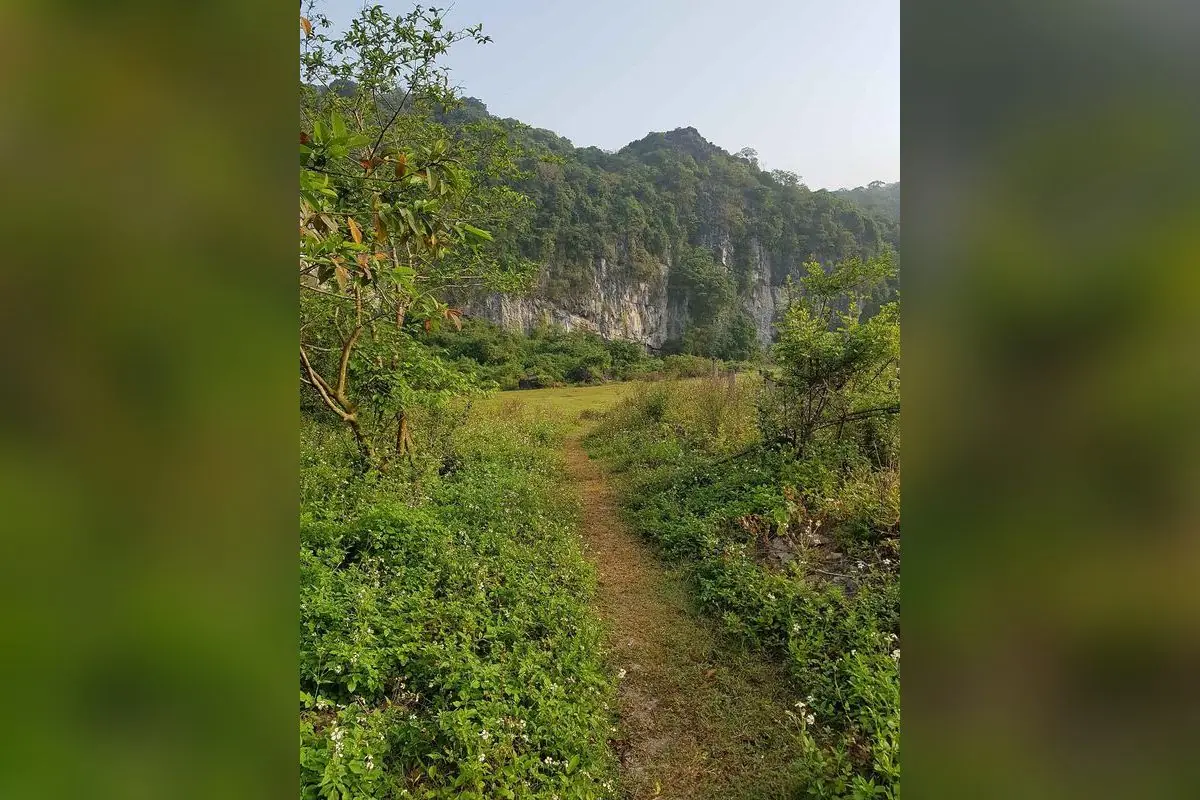
It’s one of Cat Ba’s main sport climbing areas, commonly described as having around 60-70 bolted routes.
Many routes fall between approximately 5.10- and 5.12+ on the American grading scale, although some easier options also exist.
Can you climb independently at Butterfly Valley?
Experienced climbers who are competent in lead climbing, rope management, and belaying can organize their own sessions with a qualified climbing partner, provided they’ve obtained permission to access the area.
You’ll need suitable equipment, including a rope long enough for your intended routes, quickdraws, a harness, helmet, climbing shoes, belay device, and the necessary equipment for safe lowering.
Don’t assume climbing gear will be available to rent at the crag.
If you haven’t learned to lead climb, hire a qualified guide to set up top-rope on suitable routes.
Do you need to buy a ticket for Butterfly Valley?
Yes, access to the climbing area generally involves paying a land-access fee.
Much of the surrounding land belongs to local families, so climbers need permission from the owners or the people managing access.
The Hive, a local home and restaurant in the valley, is a familiar place to ask about climbing access and fees.
The valley fee is about VND 50,000 per person, paid in cash at a small hut near the parking area.
A local climbing shop or the landowner can confirm the amount before you go.
The access fee is separate from any guide or equipment rental charges.
Camping without permission isn’t appropriate because the valley is private land. Most climbers stay in Cat Ba Town and visit the climbing area during the day.
How do you get to Butterfly Valley?
From central Cat Ba Town, travel inland toward the Lien Minh area.
The route includes hills, curves, and narrow sections near residential areas. After rain, both the roads and walking approaches to the cliffs can become slippery or muddy.
Renting a motorbike can be convenient for travelers who are comfortable riding on hilly island roads.
Foreign visitors using an International Driving Permit should check that their permit is recognized in Vietnam and carry their valid national driving license for the appropriate vehicle category.
An IDP issued under the 1968 Vienna Convention is a recognized type under applicable Vietnamese regulations.
If you’re unfamiliar with the roads or don’t have a valid license, book a taxi or arrange a transfer instead.
Walking all the way from Cat Ba Town to the valley isn’t a practical way to save transport costs.
Some overhanging cliffs remain relatively dry during light rain, but that doesn’t make the entire climbing area safe in bad weather.
Flooded ground, slippery rock, and rockfall risks are all good reasons to postpone a session.
5. How much does rock climbing in Cat Ba cost in 2026?
Prices vary depending on the activity, tour duration, location, group size, and included services.
For climbing areas around the bay, boat transfers and sightseeing fees may account for a noticeable portion of the total cost.
These are indicative prices per person for 2026.
| Activity | Approximate price | Operator or notes |
|---|---|---|
| Half-day top-rope at Moody Beach | VND 1,300,000 | Cat Ba Climbing, Cat Ba Beyond |
| Half-day top-rope or lead climbing on the island | VND 1,150,000 | Cat Ba Climbing |
| Half-day deep water soloing | VND 1,150,000 | Cat Ba Climbing |
| Half-day deep water soloing | VND 1,300,000 | Cat Ba Beyond |
| Full-day island rock climbing | VND 2,585,000 | Cat Ba Climbing |
| Half-day DWS | USD 68 | Published price from Cat Ba Ventures |
| Private half-day kayaking | From VND 980,000 | Advertised by Cat Ba Beyond; only when legally permitted |
| Full-day climbing or DWS combined with kayaking | Around VND 1,680,000 | Indicative Langur’s Adventures price; reconfirm pricing and kayak availability |
Langur’s Adventures also has indicative prices of around VND 1,300,000 for half-day climbing or DWS, and kayaking activities starting at VND 780,000.
These are guide prices rather than a quote from the company, so request an updated quotation for your intended date.
Guided climbing tours usually include specialist equipment, instructors, and transport to the climbing location.
Tours in the bay may also include boat transportation, sightseeing fees, drinking water, and lunch.
For example, Cat Ba Beyond advertises its Moody Beach climbing experience from VND 1,300,000 per person, including a guide, climbing equipment, lunch, water, and applicable access fees.
Its half-day DWS tour is also priced at VND 1,300,000 and includes boat transportation.
Inclusions differ between companies.
Before paying, check whether the final price covers climbing shoes, harnesses, helmets, ropes, boat transfers, hotel pickup, lunch, sightseeing fees, and insurance.
Is the Lan Ha Bay entrance fee included?
From January 1, 2026, daytime sightseeing fees for designated routes in the Cat Ba archipelago are:
- Adults: VND 120,000 per visit.
- Children aged six and over: VND 60,000 per visit.
- Children under six: Free under the applicable fee policy.
This is a sightseeing admission fee, not the cost of hiring a boat or guide.
Some climbing tours include the fee in their published price, while others may charge it separately.
Ask the operator to confirm the final total so there are no unexpected charges at the harbor.
6. Is kayaking still allowed in Cat Ba and Lan Ha Bay in 2026?
Many booking websites still display pictures of visitors paddling through caves, exploring enclosed lagoons, or kayaking at night to see glowing plankton.
From November 15, 2024, local authorities in Cat Hai required commercial kayaking services across the archipelago’s bays to stop operating until the necessary legal conditions were met.
The suspension followed concerns about unregulated operations and visitor safety.
A previous incident involved two foreign visitors who paddled to an island, remained out of contact for several hours, and prompted a search by local authorities.
Cruise operators were still working under that suspension in 2026.
Several cruise providers confirmed that their kayaking activities across Lan Ha Bay, including the Dark and Bright Cave area, would stop from February 1, 2026, until further notice.
Why are some companies still advertising kayaking tours?
Tour companies tell different stories.
Some cruise operators have suggested that kayaking at Ao Ech may be possible under particular arrangements.
However, statements from individual businesses aren’t sufficient proof that all visitors are legally allowed to kayak at Ao Ech.
Other tour websites continue to advertise Bat Cave kayaking, sunset kayaking, and nighttime kayaking.
A tour appearing on a website doesn’t establish that its kayaking activity is authorized on your departure date.
Don’t rent a kayak at Ben Beo Harbor and paddle into the bay on your own.
Likewise, don’t book a tour simply because its description says "kayaking included."
What should you ask before booking a kayaking tour?
- Exactly where will the kayaking take place, and is it permitted on my travel date?
- Is your company authorized to operate kayaking activities in that location?
- What activity will replace kayaking if it cannot go ahead?
- Will the kayaking portion be refunded or the tour price adjusted if it’s canceled?
Get the answers in writing through email or a messaging app before paying.
Where kayaking isn’t operating, common alternatives include traditional bamboo boats rowed by local residents, small-boat sightseeing excursions, and stops at designated swimming areas.
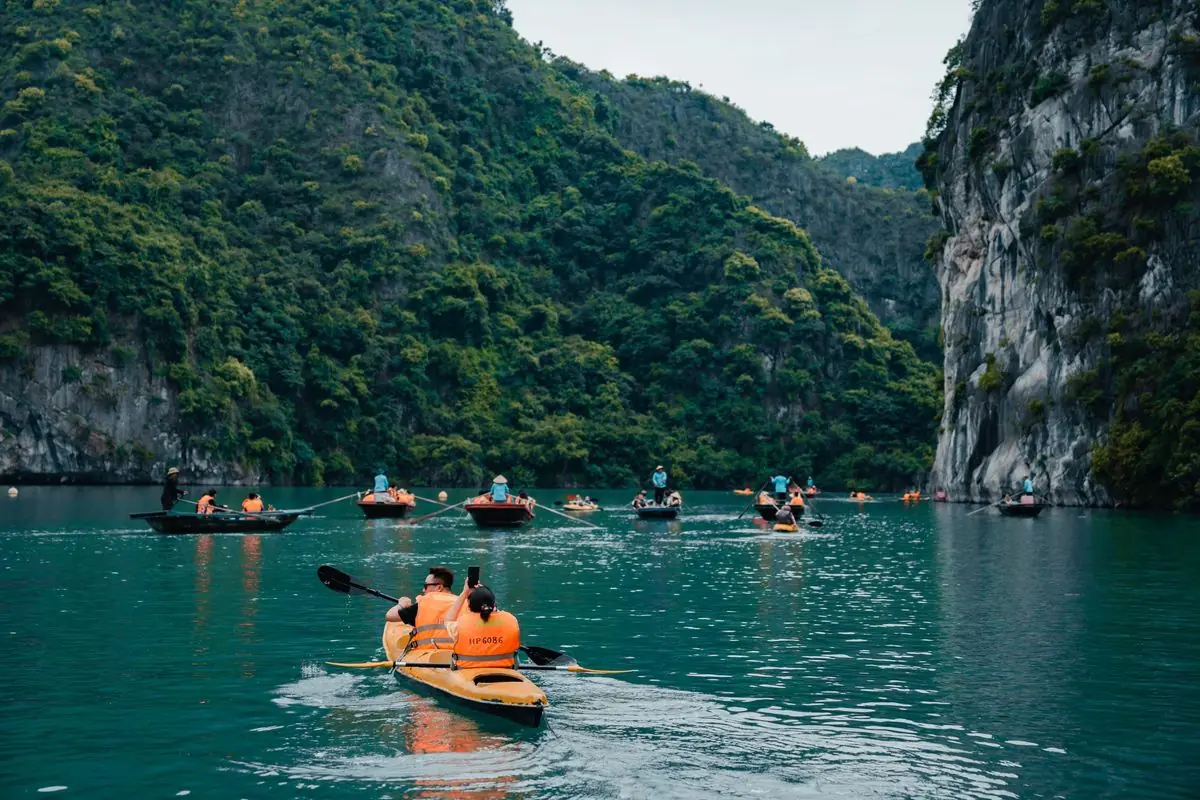
Can non-swimmers join a kayaking tour when it is permitted?
Some guided operators accept non-swimmers provided they notify the guide in advance, wear properly fitted life jackets, and receive appropriate supervision.
Tandem kayaks are often easier for beginners to manage.
However, even once you’re accepted onto a tour, the activity still carries risk.
Anyone who panics in the water or cannot meet the operator’s safety requirements is better off on a traditional rowed boat.
Lan Ha Bay’s limestone islands and caves create a complicated network of waterways.
Changing tides can lower cave entrances or alter the routes available to paddlers, while fog, wind, and currents can make navigation difficult.
Never separate from your group or paddle to another island independently.
Keep your phone, camera, and valuables in a waterproof bag, and expect to get wet during the activity.
7. Which tour operators should you consider in Cat Ba?
Cat Ba has specialist climbing providers as well as companies organizing boat tours with outdoor activities.
Pick the operator by your main activity: rope climbing, DWS, or a boat tour.
Langur's Adventures
Rock climbing and deep water soloing
Langur’s Adventures specializes in outdoor activities around Cat Ba, including rock climbing, DWS, and advertised kayaking experiences.
Its activities include top-rope climbing at Moody Beach and deep water soloing arranged around suitable tides.
The company publishes DWS schedules for selected periods. For example, its October 2026 climbing schedule was promoted in late September.
The company’s newer contact address is 122 Nui Ngoc Street, Cat Ba Town.
Some older materials still list 225 Mot Thang Tu.
Ask here for DWS dates, especially when the tides decide where and when you can climb.
Cat Ba Climbing
A range of rope climbing and DWS tours
Cat Ba Climbing is located at 120 Nui Ngoc Street, Cat Ba Town.
The company publishes prices for top-rope climbing, lead climbing, DWS, and more advanced climbing adventures.
Its listed activities include half-day island climbing from VND 1,150,000, Moody Beach climbing at VND 1,300,000, and half-day DWS at VND 1,150,000.
It also advertises multi-pitch climbing at Tiger Beach.
Multi-pitch routes demand more technical skills, making them unsuitable for complete beginners.
Before booking, ask about fitness requirements, group sizes, insurance, and the experience necessary for your chosen route.
Cat Ba Beyond
Half-day climbing tours with published prices
Cat Ba Beyond advertises half-day top-rope climbing at Moody Beach and half-day DWS, both starting from VND 1,300,000 per person.
Its activity descriptions distinguish between beginner-friendly top-rope climbing and DWS, which is recommended for people with previous climbing experience.
Moody Beach tour schedules also change throughout the year.
Summer programs commonly begin around 11 a.m., with climbing in the early afternoon, while winter programs may meet at 8 a.m. to make use of the morning sunshine.
Exact departure times still depend on the date, weather, and boat operations.
Cat Ba Ventures
Boat tours, DWS, and multi-day adventures
Cat Ba Ventures has an office at 223 Mot Thang Tu Street, Cat Ba Town.
It suits trips that combine boat travel, deep water soloing, bay exploration, or longer outdoor adventures.
Its advertised tour options include:
- Half-day Lan Ha Bay boat excursions, commonly departing around 8 a.m. or 1 p.m.
- Full-day tours combining Lan Ha Bay and Ha Long Bay.
- Half-day DWS experiences, advertised at USD 68 per person for groups of fewer than ten.
- Sunset and nighttime kayaking to see bioluminescent plankton, with advertised schedules from 4 p.m. to 8:30 p.m.
- Two- or three-day adventures combining boating, national park trekking, Viet Hai Village, and water activities.
Private boat tours are priced according to group size and vessel type.
Packages may include bay admission fees, English-speaking guides, dry bags, snorkeling equipment, and kayaks, while drinks and tips may cost extra.
For multi-day climbing trips, Cat Ba Ventures can help arrange access to climbing areas, but technical rope-climbing equipment is not included by default.
Experienced lead climbers should confirm equipment requirements and bring their own specialist gear where necessary.
Kayaking: Cat Ba Ventures’ tour descriptions still list it, and the paddling part may not be allowed to go ahead.
For nighttime kayaking in particular, confirm authorization, location, and alternative arrangements before booking.
8. When is the best time for rock climbing in Cat Ba?
The best time depends on what you want to do.
Climbers who prefer dry rock and cooler weather often choose the cooler months, while DWS requires additional attention to sea temperatures and tidal conditions.
| Period | Typical conditions | Suitable activities |
|---|---|---|
| November-April | Cooler temperatures, generally less rainfall, occasional mist or drizzle | Top-rope and inland sport climbing |
| April-May | Warmer temperatures and often pleasant weather | Rope climbing and DWS when tides are suitable |
| June-August | Hot weather, warm sea, heavy rain, and thunderstorms | DWS on suitable days; shaded climbing routes |
| September-November | Gradually cooler weather, with many potentially suitable DWS dates | DWS and inland climbing when the rock is dry |
Cooler months are good for climbing on dry rock
From November through April, Cat Ba generally receives less rainfall than during summer.
Average temperatures in December are around 21°C for daytime highs and 18°C for lows. January is cooler, with averages around 17-19°C.
These conditions can make climbing much more comfortable than during the hottest summer months.
However, late winter and early spring sometimes bring mist and drizzle that leave the limestone damp and footholds slippery.
Summer brings warm water but more unpredictable weather
From June through September, Cat Ba experiences hot temperatures and heavier rainfall.
Sea temperatures can reach around 30-31°C during midsummer, making water entry after DWS more comfortable than in winter.
The trade-off is a greater risk of thunderstorms and rapidly changing weather.
August is generally among the wettest months of the year.
For DWS, suitable tidal days are often concentrated between approximately June and November, although not every day during those months is suitable.
Should you check the tides before booking DWS?
Yes. Ask the operator about the tides before finalizing your dates on Cat Ba Island.
Some operators organize DWS around broad time windows such as 8 a.m.-2 p.m. or 11 a.m.-5 p.m., but the actual departure and climbing times depend on the water levels that day.
Full-day trips are possible only when both tides and sea conditions allow.
Contact your intended operator several days in advance, share your travel dates, and explain your climbing experience.
They can advise which sessions are likely to be suitable.
Don’t look at a tide table and independently decide which cliffs are safe.
Water depth depends on underwater terrain, submerged rocks, currents, and sea conditions, not just the published tide height.
9. Essential safety tips for climbing and water activities
Outdoors you deal with things a gym doesn’t have: damp rock, tides, waves, and storms.
On the rock, check the rope, harness, carabiners, anchors, and belay system with the person responsible before every climb.
Use properly maintained equipment, and never disconnect or adjust the safety system without understanding the procedure.
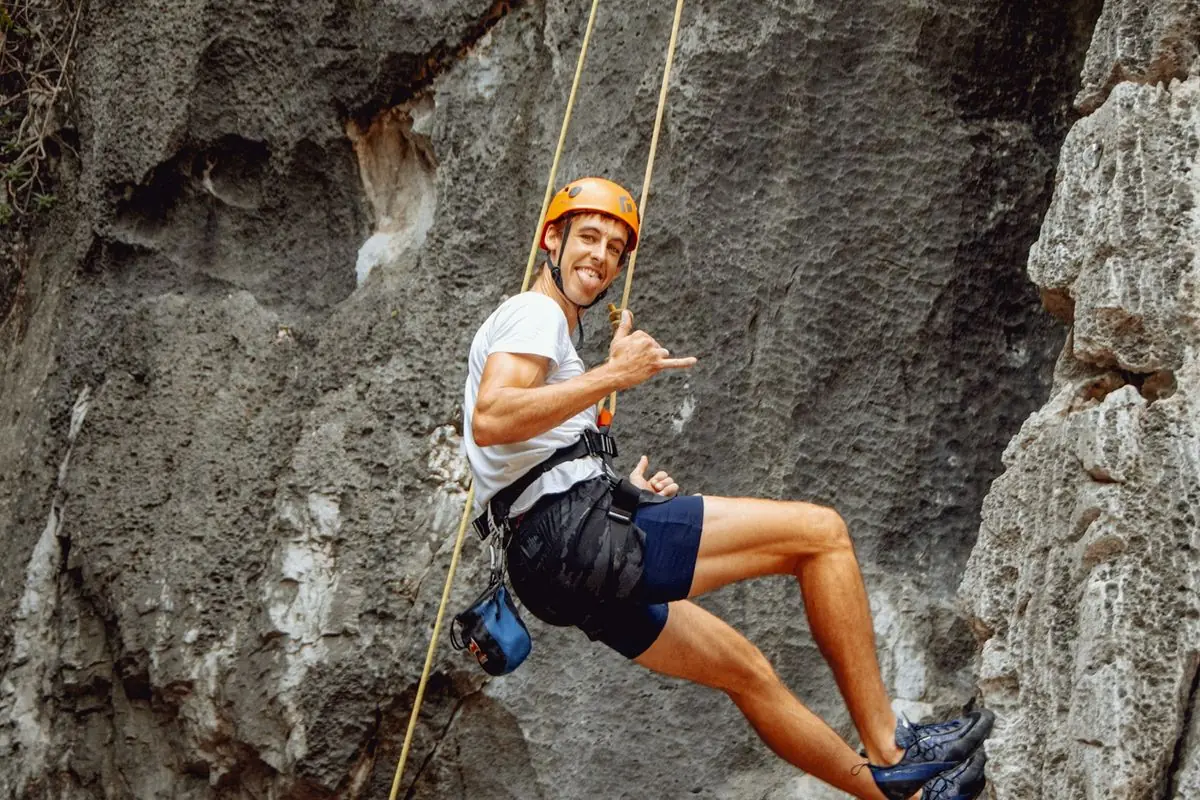
During top-rope climbing, the person belaying must have the necessary skills.
At Butterfly Valley, older bolts and lowering anchors require careful inspection, particularly where there are signs of corrosion, cracks, or movement.
During deep water soloing, you need to be a confident swimmer, respect the agreed height limits, and enter the water only in a landing area that has been checked.
Avoid jumping when visibility is poor, don’t switch routes without informing the guide, and never continue climbing when you’re exhausted.
On boats and kayaks, wear a life jacket as required and avoid alcohol before or during your activities.
Keep your phone in a waterproof bag and pack dry clothing that you can easily reach afterward.
The regional typhoon season generally runs from around June through October. Even without a typhoon, boats may stop operating due to high waves or thunderstorm warnings.
During Typhoon Maysak in July 2026, Hai Phong suspended marine activities from 4 p.m. on July 3, including tourist boats and recreational activities in coastal and island waters.
Bans like this can cancel or reschedule a tour very close to departure.
Choose operators with clear refund and rescheduling policies, and leave enough flexibility in your itinerary to avoid feeling pressured to go out in unsafe conditions.
10. How should you plan your first Cat Ba climbing trip?
Never climbed before? Spend half a day top-rope climbing at Moody Beach. You’ll have a guide, specialist equipment, and routes selected for your ability. Use the rest of the day to relax or explore the island.
Climbed in an indoor gym? Try an outdoor rope-climbing session to get used to limestone. Once you’re comfortable and have strong swimming skills, consider DWS on a suitable tidal day.
Already an experienced lead climber? Butterfly Valley deserves more of your time. Bring appropriate equipment, check route conditions, and arrange permission to access the climbing area before visiting.
More interested in kayaking than climbing? First establish whether any permitted operation is available at your intended location. While commercial kayaking remains suspended, a locally rowed bamboo boat or conventional sightseeing boat is a more practical alternative.
With one day on Cat Ba, pick one main adventure.
Your body needs time to recover between top-rope climbing, DWS, and kayaking, and getting between climbing areas depends on boats, travel arrangements, and weather.
Frequently asked questions
Is kayaking allowed in Lan Ha Bay in 2026?
Commercial kayaking services in the Cat Ba archipelago remain suspended or restricted by location, and there's been no official word on a full reopening. Some businesses mention specific areas where kayaking may be permitted, but you should verify the operator's authorization and exact location before booking.
Can someone who has never climbed before try deep water soloing in Cat Ba?
Some tours advertise easier routes for newcomers, but DWS involves falling into water from a height and isn't the ideal first climbing experience. Start with top-rope climbing, and only consider DWS when you can swim confidently, meet the physical requirements, and have been assessed by an experienced operator.
How much does rock climbing cost in Cat Ba, and is equipment included?
Half-day top-rope and DWS tours generally have indicative prices of around VND 1,150,000-1,300,000 per person with selected operators. Guided tours usually provide appropriate climbing shoes and safety equipment, but you should separately confirm boat transfers, meals, admission fees, and insurance.
Do you need to pay an entrance fee or hire a guide at Butterfly Valley?
The climbing area is on private land, and an access fee generally applies. Experienced lead climbers with suitable equipment and permission may organize their own climbing sessions with a competent partner. Beginners should hire a guide. Check current access fees locally because older published prices may no longer apply.
What tours does Cat Ba Ventures offer, and is kayaking guaranteed?
Cat Ba Ventures advertises half-day and full-day Lan Ha Bay boat trips, DWS, sunset kayaking, nighttime kayaking, and multi-day adventures combining trekking, boating, and Viet Hai Village. However, kayaking can only take place where current regulations permit it. Ask for written confirmation of the location, replacement activities, and refund arrangements if kayaking is canceled.