Is Cannon Fort in Cat Ba still worth visiting?
Cannon Fort on Cat Ba Island remains closed to tourists. No official reopening date has been announced, so it is not worth setting aside an entire afternoon to visit the fort for sunset.
 22 min read
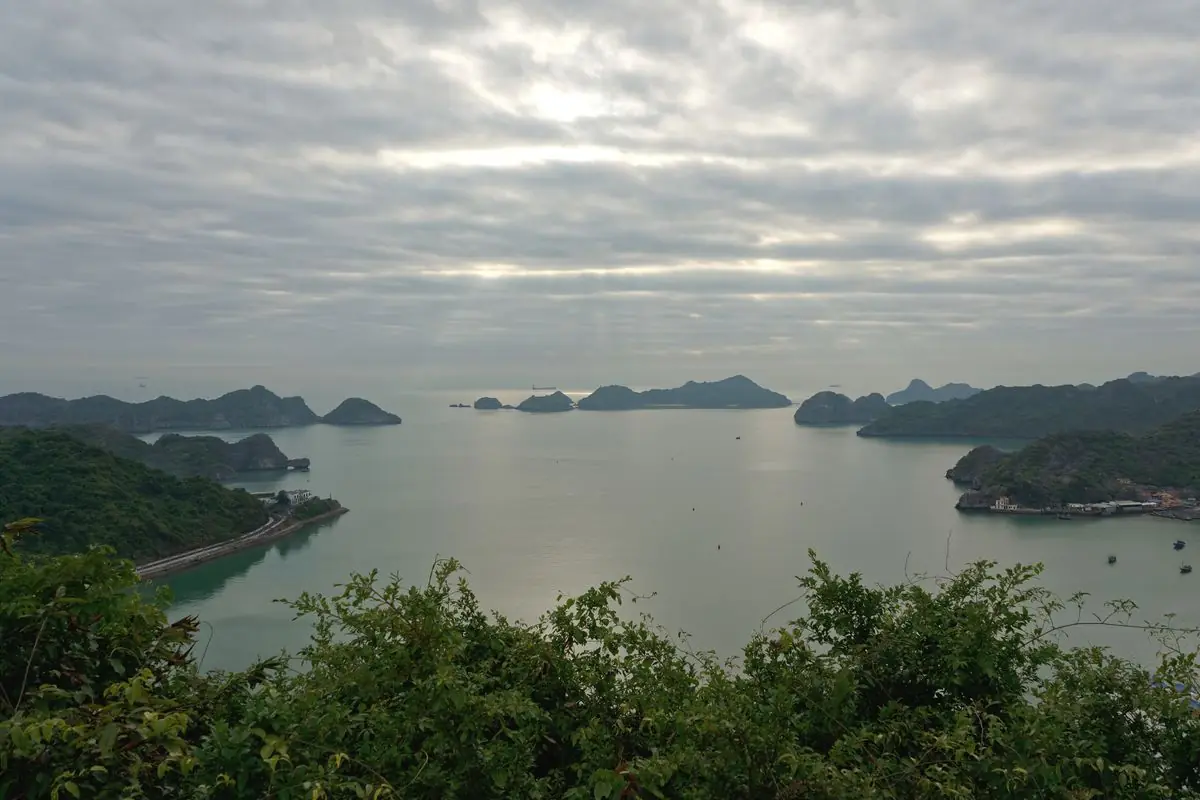
From Hill 177, the sea and limestone islands around Cat Ba, with waterfront buildings and moored boats on the right.
At around 4:45 PM, looking up from the waterfront along 1/4 Street in Cat Ba Town, you can see the hillside where Cannon Fort stands on Hill 177. On Google Maps, it looks like a short trip from the town center, somewhere you might visit just before sunset. But the old photos of observation decks and a hilltop café no longer reflect what visitors can actually access.
Is Cannon Fort in Cat Ba open?
Cannon Fort has not reopened to tourists. The site is still closed, with barriers sometimes blocking the access road and the café at the top no longer operating.
No official announcement has given a reopening date, new visiting hours, or updated ticket prices.
This is particularly important for first-time visitors to Cat Ba Island.
Search for Cannon Fort on Google Maps and you will still find a marked location above the town, along with photographs of enormous coastal guns, underground passages, and viewpoints overlooking the sea. Some travel websites also display admission prices, opening hours, and directions for reaching the hill by motorbike.
Most of that information describes the period when Cannon Fort was operating as a tourist attraction.
The official information portal for Cat Hai still contains articles published in August 2013 about visiting Hill 177 and enjoying coffee at the summit. They are useful historical references, but they do not confirm that the site remains open today.
Several local tourism businesses still warn that visitors cannot enter Cannon Fort. Some accommodation websites have added closure notices while retaining their older descriptions of the attraction.
Before visiting, ask your hotel reception or a local tour operator whether official access has resumed. The question to ask is straightforward: has Cannon Fort officially reopened and started selling admission tickets again?
Where is Cannon Fort, and why is it called Hill 177?
Cannon Fort stands on a hill above central Cat Ba Town, in the Cat Hai Special Zone of Hai Phong, northern Vietnam.
In Vietnamese, it is known as Pháo đài Thần Công. You may also see it described as Cứ điểm 177, Cao điểm 177, or simply Hill 177.
The number refers to the hill’s approximate elevation of 177 meters above sea level.
Unlike the medieval castles and fortified walls found in parts of Europe, Cannon Fort was designed as a coastal military position. Its structures included artillery emplacements, shelters, defensive trenches, connecting passages, and observation positions arranged around the natural terrain.
From this height, military personnel could monitor vessels moving through the surrounding waters and important sea approaches to Hai Phong.
The location also explains why Cannon Fort later became such a popular tourist attraction.
Visitors could once look across Cat Ba Town, the harbor, the Cat Co beaches, and the limestone islands scattered around the surrounding bays.
Older travel guides often describe the journey from central Cat Ba Town to Cannon Fort as roughly 2 kilometers, depending on your starting point. Although the distance is short, the road climbs steeply and has several bends.
What distinguishes Hill 177 from an ordinary viewpoint, however, is the military history behind the landscape.
The history of Cannon Fort in Cat Ba
A coastal defense position built in the early 1940s
Cannon Fort was established in the early 1940s, when the waters around northern Vietnam held considerable strategic importance for military operations and maritime transport.
The French built the fortifications.
Accounts differ on the precise construction year and some details of the site’s occupation during World War II, so the early 1940s is the more reliable description.
What is clear is that the hill was equipped with large coastal artillery guns and a network of defensive structures.

These were not small field guns designed to be moved easily from one battlefield to another.
Coastal artillery required solid foundations, carefully selected firing positions, and equipment capable of supporting heavy weapons.
Components of the artillery pieces were transported up the mountain and assembled at the site.
That detail alone shows the scale of the work involved.
Building Cannon Fort meant more than placing a gun on top of a hill. The installation needed protected routes, observation positions, firing platforms, and supporting infrastructure to function as a defensive system.
Its role during Vietnam’s wars
After its original construction, the fortifications became connected with Cat Ba’s military history during the wars against French colonial forces and later American military intervention.
Vietnamese forces repaired part of the artillery’s firing mechanism so that the weapons could be used during the resistance against France.
Observation points, concrete bunkers, and protective passages also formed part of the island’s coastal defense network.
For an island positioned near important maritime routes, a high observation point offered obvious advantages.
Personnel could monitor ships approaching from the surrounding waters, while underground and partially sheltered structures provided protection and allowed movement between defensive positions.
The number of guns originally installed and the number later displayed at the site also differ.
The fort has been described with three coastal guns, while the exhibits focus on two large artillery pieces remaining in position.
These figures should not automatically be treated as contradictory, since they may describe different periods in the fort’s history.
From military fortification to tourist attraction
Cannon Fort officially opened to tourists on June 13, 2010.
When the site began operating as a visitor attraction, its military structures were incorporated into a walking route with viewpoints and tourist facilities.
Visitors could examine the artillery emplacements, see displays explaining the fort’s history, and walk through parts of the tunnel and trench system.
Some areas featured military figures and reconstructed scenes showing how soldiers worked around the coastal guns.
The hilltop café eventually became one of Cannon Fort’s best-known attractions.
Many older Cat Ba itineraries recommend arriving in the late afternoon, spending about an hour exploring the fortifications, and then sitting down for a drink while waiting for sunset.
It was once a practical way to combine history and scenery in a single afternoon.
That itinerary is no longer possible while the site remains closed.
What could visitors see at Cannon Fort?
Massive coastal artillery guns
The most recognizable images of Cannon Fort show enormous steel guns mounted inside circular concrete artillery emplacements.
Their long barrels point outward toward the sea. Beneath each weapon are heavy metal structures and mechanisms designed to support and rotate the gun.
Older photographs also show reconstructed military scenes, with soldier figures arranged around the weapons.
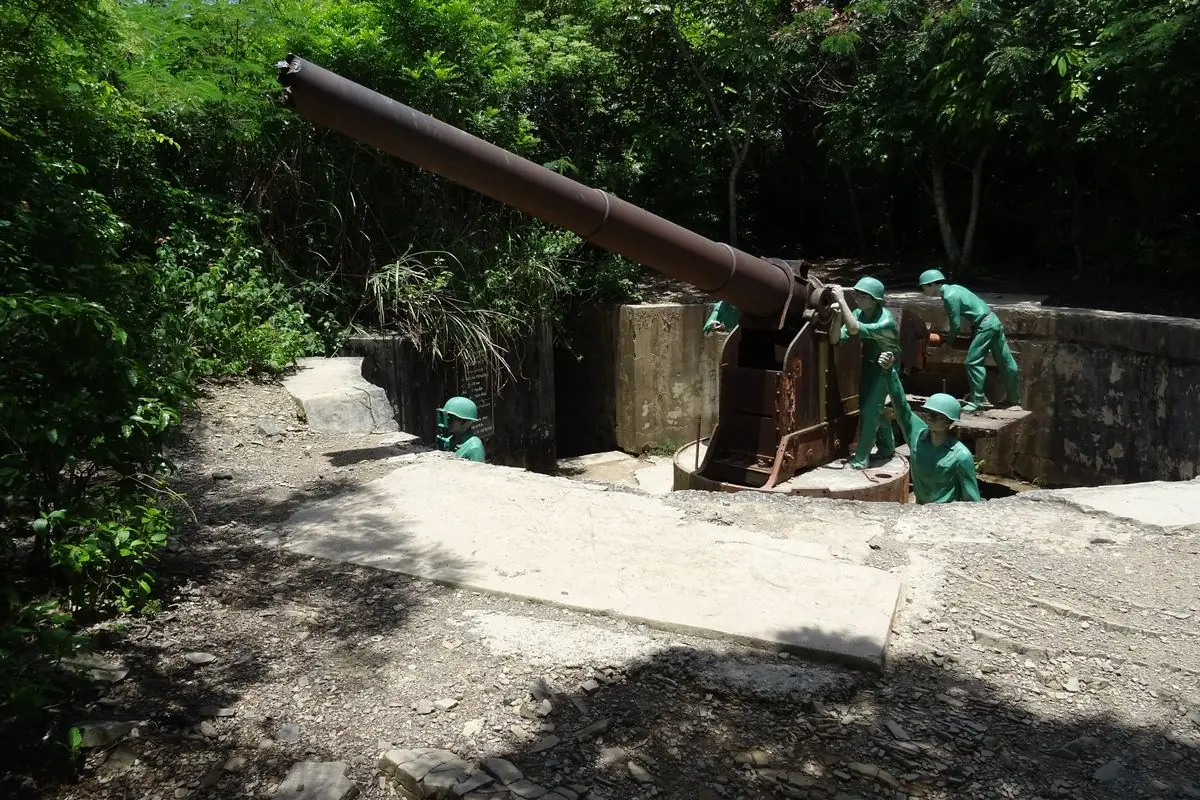
The setting is particularly striking.
Behind the guns are trees and vegetation covering the hillside. Beyond the firing positions lies the open coastal landscape.
This was one of the clearest places to understand why the fort was built where it was.
A coastal defense position needed clear lines of sight over approaching ships, as well as a secure and stable platform for its weapons.
Visitors interested in military history often had more to explore here than someone simply looking for a quick photograph.
Underground tunnels, trenches, and bunkers
Cannon Fort also contained concrete tunnels, covered passages, trenches, and defensive structures built into the hillside.
Some passages had curved ceilings, while other positions were partially concealed by vegetation or natural rock formations.

These spaces look relatively modest in photographs compared with the enormous artillery outside.
Their purpose, however, was essential.
They helped connect different parts of the defensive position, offered protection from hostile fire, and allowed soldiers to move between operational areas.
Command positions and shelters were arranged to support coordination across the site.
Because Cannon Fort is currently closed, there is no reliable basis for confirming the present preservation condition or safety of individual tunnels.
Visitors should not attempt to enter them or inspect the fortifications independently.
Historical exhibits and military equipment
The site once had a small exhibition area containing military-related objects, including rangefinding instruments, compasses, ammunition equipment, and other materials associated with the fort’s operation.

This part of the attraction could easily be overlooked by visitors coming primarily for the sunset.
Yet the smaller objects helped explain something important: a coastal artillery position depended on much more than powerful weapons.
Observation personnel needed to identify targets and estimate distances. Gun crews needed to receive information, adjust their equipment, and coordinate different tasks.
The fort functioned as a military system rather than a collection of isolated artillery pieces.
Observation decks and the former hilltop café
For many international tourists, the attraction that made Cannon Fort famous was not its military equipment but its panorama.
The observation areas overlooked Cat Ba Town, the harbor, the surrounding sea, and limestone islands beyond.
Older travel photographs show small boats scattered across blue water, with layers of forested limestone hills extending into the distance.
The hilltop café gave visitors somewhere to sit and enjoy the view without rushing.
Tables overlooking the bay, elevated walkways, and the changing late-afternoon light made Cannon Fort a favorite location for sunset photographs.
The café is now closed along with the wider tourist site.
Do not make the journey expecting the same hilltop drinks and panoramic seating shown in old guidebooks.
How do you get to Cannon Fort from Cat Ba Town?
When Cannon Fort was open to visitors, the usual route started in central Cat Ba Town, headed toward the Cai Beo Road area, and then followed a road climbing the hillside toward the fort.
The distance was relatively short, but the ascent included steep sections and bends.
Older travel guides therefore described several ways to reach the entrance.
Walking: Visitors staying near the town center previously walked uphill in approximately 20-40 minutes, depending on their accommodation and fitness. This is only a historical estimate for the old route, not a current recommendation for reaching an operating viewpoint.
Motorbike: Motorbikes were commonly used when the road was accessible. However, the steep gradient and tight bends could be uncomfortable for inexperienced riders.
Taxi or motorbike taxi: Visitors who wanted to avoid the climb could previously arrange a ride toward the fort’s entrance while tourist access was permitted.
Today, how many minutes it takes to reach the summit matters far less than whether visitors are allowed to enter at all.
The uphill road may now be blocked at certain points.
There is little reason to arrange a taxi just to arrive at a barrier and start searching for another route on foot.
Ask your accommodation about viewpoints that are currently open to the public for seeing Cat Ba from above.
Do not assume that roads leading toward communication equipment, technical installations, or neighboring hills are public tourist routes.
A road shown on a digital map does not guarantee public access to the place at its end.
How much is the Cannon Fort entrance fee, and what are the opening hours?
There is currently no confirmed official admission price or opening schedule for tourists visiting Cannon Fort.
Prices and opening hours still circulating online refer to earlier periods.
For example, the site once charged VND 50,000 for adults and VND 20,000 for children, with opening hours from 8:00 AM to 5:00 PM.
Those figures are historical and should not be used to plan a visit now.
Other travel guides published at different times have quoted admission prices of VND 40,000 or VND 80,000, along with opening hours such as 6:30 AM-6:00 PM or 7:00 AM-7:00 PM.
There is no reliable reason to choose one of those older figures as the current price.
Hai Phong’s sightseeing fee schedule, effective January 1, 2026, sets fees for a number of tourist attractions and routes across the city.
Cannon Fort does not appear as a separately priced attraction in that fee schedule.
Its absence from the schedule does not, by itself, prove that the site is closed. But alongside the current closure, it means there is no basis for claiming that ordinary admission tickets are currently being sold.
Until an official reopening is announced, the correct way to describe the 2026 admission price is no current ticket price available, not free admission.
Why was Cannon Fort so popular for sunset views?
Cannon Fort’s appeal came from more than its elevation.
The hill occupied a position with views in several directions, giving visitors different perspectives during the same visit.
On one side, there were the buildings and waterfront of Cat Ba Town.
Elsewhere, the landscape opened toward the harbor, boats, open water, and limestone islands.
From the higher observation positions, visitors could appreciate how the town fitted into the much larger landscape of the Cat Ba Archipelago and the surrounding bays.
In the late afternoon, lower sunlight could illuminate the slopes of the limestone islands, emphasizing their shapes and making the surrounding water appear softer.
From above, small boats looked like tiny objects scattered across a wide stretch of sea.

It was a very different experience from standing on a beach, where the view might be framed by the cliffs around a single sheltered cove.
Visitors could move between observation areas to include the town, harbor, or islands in their photographs.
That flexibility helped make Cannon Fort one of the best-known panoramic viewpoints near Cat Ba Town.
However, enjoying sunset scenery is not the same as watching the sun disappear directly into the sea.
The direction of sunset changes throughout the year, and many of Cat Ba’s beaches and bay-facing viewpoints look east or southeast.
At some locations, the evening light can be beautiful even though the sun disappears behind hills or buildings rather than the sea horizon.
When choosing an alternative to Cannon Fort, it helps to decide what you actually want to see: a panorama of the bay, the sky changing color, or the sun itself sinking toward the horizon.
They are not necessarily the same experience.
Where can you watch the sunset in Cat Ba instead?
Ben Beo Harbor
Boats and limestone islands at water level
Ben Beo Harbor is located in the Cai Beo area, a short distance from central Cat Ba Town.
It is one of the familiar departure points for boat trips into Lan Ha Bay.
Travelers with only a short afternoon who do not want to climb a hill can consider the publicly accessible waterfront around the harbor.
The main attraction here is the activity on the water.
Sightseeing boats, vessels serving local communities, and floating structures create a different scene from the beaches around the resort area.
Around 4:00-5:00 PM can be a pleasant time to enjoy the late-afternoon light, although the best timing varies by season.
Choose a permitted public viewpoint and avoid interfering with harbor operations.
Ben Beo is not an elevated observation deck. You will not get the broad perspective over Cat Ba Town that Cannon Fort once provided.
The harbor’s orientation also means that the sun may not be directly in front of you.
The area is at its best when the evening light falls across the boats, water, and limestone formations.
It is a practical option for travelers who want to stay close to town without booking a restaurant or organized excursion.
Do not enter controlled piers or boat boarding areas without the necessary permission or ticket.
Cat Co coastal area
Beaches and cliffside scenery
The Cat Co beaches are among the best-known coastal areas close to central Cat Ba Town.
The small sandy coves sit between steep limestone cliffs, creating a more enclosed landscape than the open water around the harbor.
The coastal area has included paths and stretches of road along the hillside, allowing visitors to look down toward the beaches from slightly above sea level.
Unlike Cannon Fort, the scenery here feels much closer.
You may have a cliff on one side, a curved beach below, and the sea extending between rocky headlands.
The softer light of late afternoon is often more suitable for photographing the coves than the strong midday sun.
You can combine a short walk around Cat Co with a nearby café rather than spending the entire afternoon chasing one particular viewpoint.
There is one practical complication.
Parts of the Cat Co waterfront are associated with resorts and private developments. Access arrangements can change, and a path visible in an older photograph is not necessarily open to everyone today.
Ask locally which coastal paths are currently accessible.
Stay on designated walkways and do not climb over railings or scramble onto exposed rocks for photographs.
Several Cat Co viewpoints also face eastward.
They can be beautiful in the evening without offering a direct view of the sun setting over the ocean.
LePont near Cat Co 3
A drink overlooking the sea
LePont Cat Ba Bungalow and its associated restaurant and bar are located near Cat Co 3, in an elevated coastal setting.
The property appears in 2026 Cat Ba travel recommendations for people looking for a place to sit with a drink and enjoy the sea.
Compared with standing near Ben Beo Harbor, LePont offers a more relaxed way to spend the end of the afternoon.
Rather than moving between viewpoints, you can settle into an outdoor seating area, order something, and watch the light change over the water.
Some seating areas have wider views than others. Trees, nearby structures, and the layout of the property can affect the scenery from individual tables.
LePont can also work for travelers planning to have dinner afterward without immediately returning to the town center.
Before going, ask whether the venue is currently serving visitors who are not staying there, whether outdoor tables are available, and what the latest menu prices are.
There is no reason to treat drink prices from an older blog post as confirmed 2026 prices.
For photography, arriving 30-45 minutes before sunset is a sensible plan.
If you wait until the sky is already darkening before arranging transport, much of the useful natural light may be gone by the time you sit down.
Lan Ha Sky Bar
A high viewpoint without climbing a hill
Lan Ha Sky Bar is located at the Flamingo Cat Ba resort complex near the Cat Co beaches.
It is one of the more suitable alternatives if what you miss most about Cannon Fort is its elevated perspective rather than the military exhibits.
The sky bar occupies a high-level space overlooking Lan Ha Bay.
Visitors can enjoy views of the sea and limestone islands while having drinks instead of climbing a steep hill.
Lan Ha Sky Bar is open 8:00 AM-11:00 PM, with capacity for approximately 300 guests.
These are the bar’s 2026 hours, not Cannon Fort’s visiting hours.
The opening schedule does not guarantee that every seating area will be accessible throughout the day.
Events, private functions, or operational changes can affect availability.
If you are not staying at Flamingo, contact the resort before visiting to confirm whether outside guests are accepted, whether reservations are required, and whether a minimum spend or other access conditions apply.
Lan Ha Sky Bar is better suited to couples, groups of friends, or families who prefer a serviced venue with comfortable seating.
The trade-off is the cost of food and drinks, together with any conditions imposed by the resort.
The view is also different from Cannon Fort.
You are looking out from a tall building rather than a historic hilltop with multiple observation directions.
A late-afternoon Lan Ha Bay cruise
Limestone islands from the water
If the part of Cannon Fort’s old photographs that interests you most is the collection of limestone islands spread across the sea, a boat trip on Lan Ha Bay may be even more rewarding.
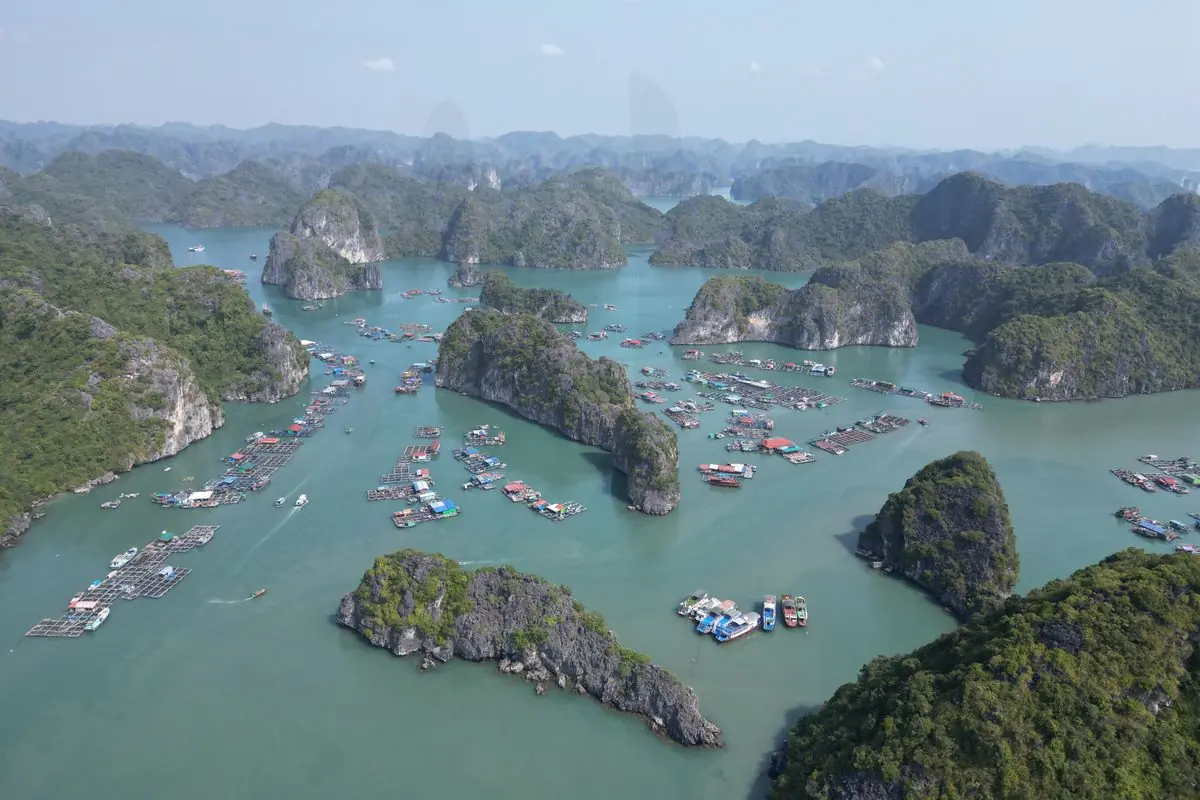
From the Ben Beo area, sightseeing routes travel through waters dotted with limestone formations, floating aquaculture areas, and sheltered coves.
Instead of looking down on the islands, you can see their cliffs rising directly from the water.
This gives you a much better sense of their scale.
When choosing a trip, note that not every Lan Ha Bay tour stays on the water until sunset.
Many standard daytime trips return during the afternoon.
A tour that includes swimming and kayaking does not necessarily include sunset viewing.
Before booking, ask for the exact departure time, expected return time, and the area where the boat is scheduled to be during the final part of the afternoon.
Make sure sunset viewing is genuinely included in the itinerary rather than merely mentioned in the promotional description.
Under Hai Phong’s sightseeing fee schedule effective January 1, 2026, the fee for bay routes in the Cat Ba Archipelago is VND 120,000 per adult and VND 60,000 for children aged six and above.
This is the official sightseeing fee, not the complete price of an organized boat tour.
The final tour price depends on the operator and what is included, which may involve the vessel, guide, sightseeing fees, and activities.
A cruise is a better option if you have more than a brief gap before dinner and want to spend time exploring the bay itself.
If you are prone to seasickness or prefer not to depend on a fixed boat schedule, a waterfront viewpoint or elevated café will be simpler.
Which alternative to Cannon Fort should you choose?
No single viewpoint near Cat Ba Town can recreate the entire Cannon Fort experience.
Each alternative offers a different part of what once made the fort appealing.
| What you want | Best option to consider | What to expect |
|---|---|---|
| Boats and bay scenery near town | Public waterfront near Ben Beo Harbor | Water-level scenery rather than a hilltop panorama |
| A coastal walk and late-afternoon photographs | Cat Co area | Check which paths are open; direct sunset views are not guaranteed |
| A drink overlooking the sea | LePont near Cat Co 3 | Confirm seating availability and current menu |
| An elevated view without a long walk | Lan Ha Sky Bar | Check access conditions and table reservations |
| Limestone islands throughout the bay | Late-afternoon Lan Ha Bay cruise | Choose a trip that explicitly includes sunset viewing |
If you only have an hour before dinner, staying on land is generally easier than arranging a boat trip.
On the other hand, if you have already spent the day cruising around Lan Ha Bay, you do not need to squeeze another viewpoint into the evening just to photograph the same limestone formations from a different angle.
A well-timed boat journey may be enough.
What time is sunset in Cat Ba?
Sunset time in Cat Ba changes noticeably between winter and summer.
During June and July, the sun can set after 6:30 PM.
By November and December, daylight ends considerably earlier, with sunset typically occurring around 5:10-5:30 PM.
The following table gives approximate sunset times around the middle of each month.
| Month | Approximate sunset time |
|---|---|
| January | 5:32 PM |
| February | 5:50 PM |
| March | 6:01 PM |
| April | 6:11 PM |
| May | 6:22 PM |
| June | 6:34 PM |
| July | 6:36 PM |
| August | 6:22 PM |
| September | 5:55 PM |
| October | 5:28 PM |
| November | 5:11 PM |
| December | 5:13 PM |
These are reference times, not fixed sunset times for the entire month.
The exact time changes from day to day.
In early November, for example, the sun sets over the Cat Ba Town area at approximately 5:14 PM.
By 5:30 PM, natural light will already be noticeably weaker.
For a November itinerary, arriving at your chosen viewpoint at 5:00 PM may leave very little time to park, find a table, or walk to the best available viewing area.
A more comfortable plan is to arrive around 4:15-4:30 PM.
That gives you time to appreciate the scenery in the final daylight and watch the sky change color.
How to plan an afternoon around Cat Ba Town
Option 1: Cat Co beaches and a seaside café
This plan is suitable for travelers staying in central Cat Ba who want an easy afternoon after a busy morning or full day of sightseeing.
- 3:30 PM
Start at around 3:30 PM and head toward the Cat Co area.
Spend some time photographing the bays from public viewpoints and walking along accessible coastal sections.
- 4:15 PM
Around 4:15 PM, make your way to a sea-facing venue such as LePont, provided you have confirmed that it is operating and welcoming visitors.
Order a drink and enjoy the final part of the afternoon without needing to move between several locations.
On a clear day, the limestone formations beyond the coastline provide enough scenery for photographs without adding another stop.
- After 5:30 PM
During winter, you can return to central Cat Ba for dinner after around 5:30 PM.
In summer, move the schedule later according to the day’s sunset time.
The main advantage is simplicity.
You do not need to arrange a boat departure or plan a route up a hill.
Option 2: A panoramic view from above
If you would rather enjoy a broad view of the bay, consider Lan Ha Sky Bar at Flamingo Cat Ba.
Before heading over, contact the property to check whether non-resident guests can use the bar, whether there are sea-facing seats available, and whether advance reservations are necessary.
Once access is confirmed, plan to arrive about 30-45 minutes before sunset.
The attraction here is the elevated view of the water and islands.
There is no need to follow a hiking route or climb a steep road.
This makes the option especially convenient for families with older relatives or travelers who prefer comfortable seating.
The 8:00 AM-11:00 PM opening hours do not mean that you can arrive at any time and automatically get the best table.
Option 3: A sunset cruise on Lan Ha Bay
This option gives the whole afternoon to a Lan Ha Bay boat trip that specifically includes sunset viewing.
Start by checking the departure and return times.
Only after that should you compare the activities included in each tour.
A trip with numerous swimming, kayaking, and dining stops may be less suitable than a simpler itinerary that leaves enough time on the water during the final daylight.
Confirm the departure harbor, meeting point, pickup arrangements, and total price.
Ben Beo is a familiar departure area, but not every tour uses the same pickup location.
Once you book, save the operator’s written confirmation.
Do not assume that a photograph featuring the word "sunset" means your boat will actually be sailing through the bay when the sun goes down.
Where else can you explore Cat Ba’s military history?
Cannon Fort was unusual because it combined military heritage with coastal scenery.
While it remains closed, you can separate those interests and visit places that offer different experiences.
For military history, Hospital Cave, known in Vietnamese as Hang Quân Y, is worth considering.
Unlike Cannon Fort’s open-air artillery positions, this cave complex is associated with wartime medical facilities and shelter inside a limestone mountain.
Check its current visitor arrangements and opening hours before traveling there.
For mountain scenery, the Kim Giao forest and Ngu Lam Peak route in Cat Ba National Park offers elevated views over wooded limestone hills.
However, most of the scenery is forest and mountains rather than the harbor and open sea.
It is not a direct replacement for Cannon Fort’s coastal panorama, nor is it a place to remain after dark without appropriate authorization and arrangements.
Travelers more interested in the island’s natural environment may prefer a Lan Ha Bay cruise or a guided kayaking activity.
Each attraction has its own access requirements, opening arrangements, and safety considerations.
There is little benefit in squeezing several distant places into a single afternoon just because Cannon Fort is unavailable.
Is it worth going to the entrance of Cannon Fort just for photos?
Given its current closure, there is little reason to make a special trip to the road leading up to Cannon Fort simply to take photographs.
The site’s most impressive views were from inside the visitor area, where the artillery emplacements, historic structures, and observation points were located.
If you cannot enter, the access road does not necessarily provide anything comparable.
Old photographs taken from a bend in the uphill road also do not establish that stopping or photographing from the same place is currently permitted.
Avoid parking on steep bends, blocking access roads, or stopping near barriers in search of a photograph.
Do not use side trails or unofficial paths to reach restricted technical or military areas.
For keen photographers, it is understandable to be disappointed about missing Cannon Fort, especially after seeing older pictures of boats scattered among the limestone islands.
But on a two-day, one-night trip to Cat Ba, spending an entire afternoon searching for a way into a closed attraction may mean missing the best light of the day.
A confirmed, accessible viewpoint is a better use of that time.
To catch the sunset, confirm your boat booking or sea-view table the day before, then aim to arrive 30-45 minutes before the sun goes down; in November that is around 5:10 PM. Cannon Fort is still not an attraction you can reliably include in your itinerary.
Frequently asked questions
Is Cannon Fort in Cat Ba open?
Cannon Fort remains closed to tourists, with no officially confirmed reopening date. Check with your accommodation or the relevant local authorities before visiting, and do not attempt to cross closed gates or barriers.
How much is the Cannon Fort entrance fee, and what are its opening hours?
There is no confirmed current admission price or reopening schedule. Older references to VND 40,000-80,000 tickets and various opening hours should not be treated as valid for 2026. Cannon Fort is also not listed as a separately priced attraction in Hai Phong's sightseeing fee schedule effective January 1, 2026.
How do you get to Cannon Fort from Cat Ba Town?
Visitors previously traveled from central Cat Ba Town toward the Cai Beo Road area before following a steep road up Hill 177, either on foot, by motorbike, or by vehicle. Parts of the route may now be blocked, and there is currently no confirmed official tourist access route into the closed site.
What is special about Cannon Fort in Cat Ba?
Cannon Fort is a former coastal defense position built on a hill approximately 177 meters above sea level in the early 1940s. It once contained large coastal artillery guns, concrete gun emplacements, command shelters, trenches, military exhibits, and observation points overlooking Cat Ba Town and the surrounding sea.
Where can you watch the sunset in Cat Ba if Cannon Fort is closed?
Consider the public waterfront near Ben Beo Harbor for boats and coastal scenery, the Cat Co area or LePont for a relaxed seaside afternoon, Lan Ha Sky Bar for an elevated bay view, or a Lan Ha Bay cruise with a confirmed sunset itinerary. None provides exactly the same perspective as Cannon Fort, but each offers an alternative near Cat Ba Town or on the surrounding bay.