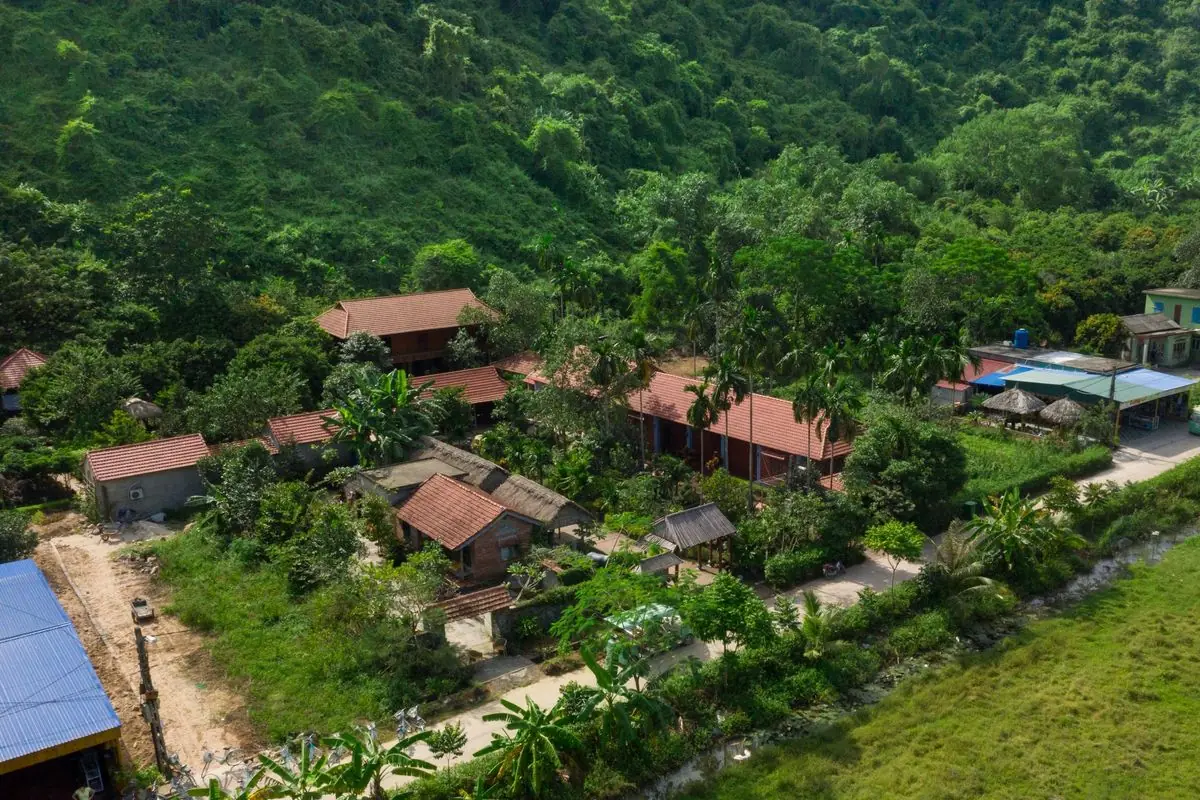
Where to see Cat Ba langurs in the wild, and how likely you are to spot one
Seeing a Cat Ba langur in the wild is extremely rare, even when your boat passes through the bay where these animals live. Understanding their habitat and behavior, however, gives you a better chance of recognizing one without disturbing the troop.
 14 min read
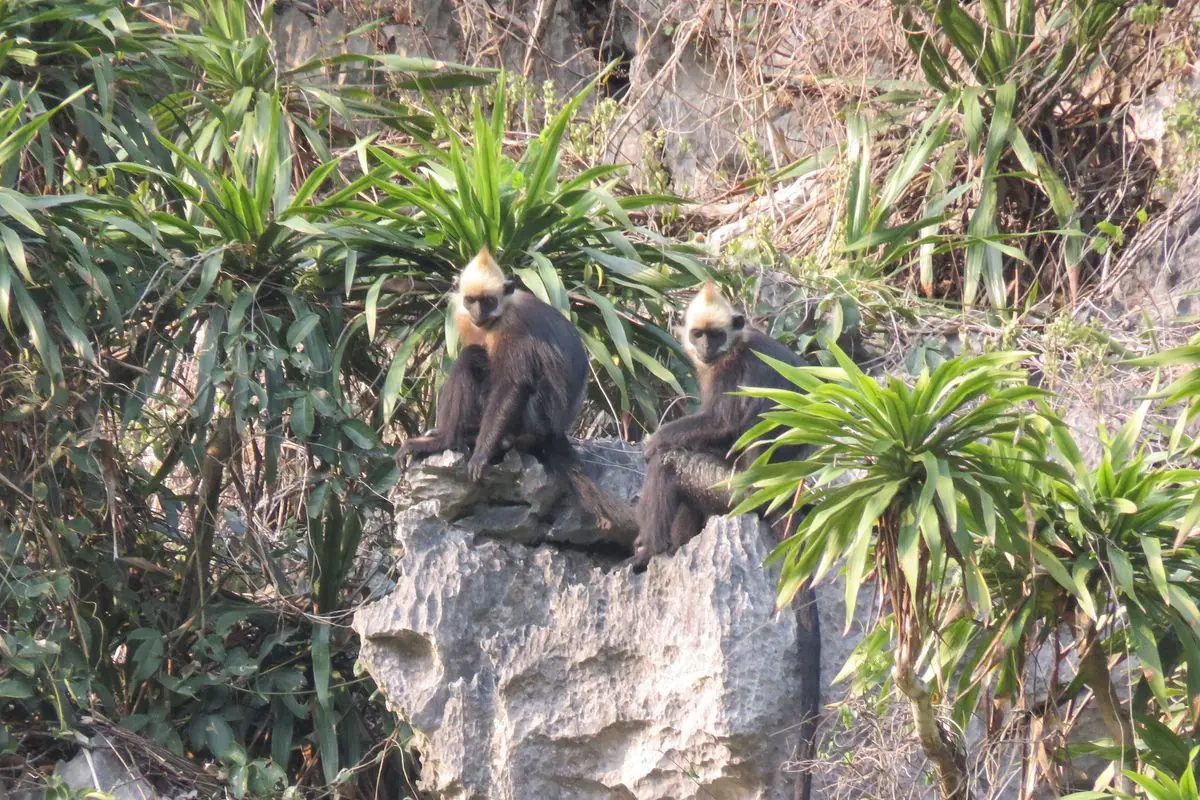
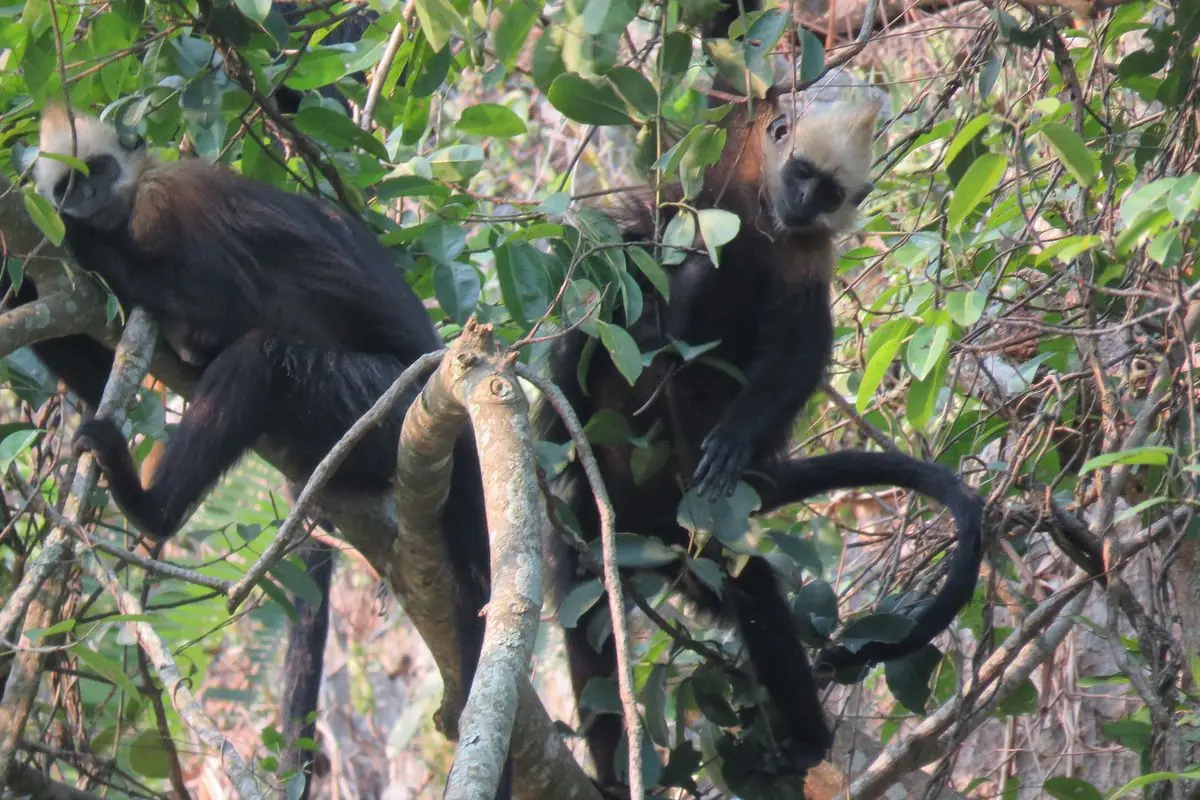
Two adult Cat Ba langurs sit side by side on a limestone boulder among shrubs, their dark coats setting off the pale golden fur on their heads.
While cruising through Lan Ha Bay, you might notice a dark shape moving across a limestone cliff and wonder whether you’ve just spotted a Cat Ba langur. Even boats passing through their natural habitat rarely encounter these elusive primates. With luck you might see a troop in the distance, but don’t plan your Cat Ba trip around the expectation of finding one.
The Cat Ba langur is one of the world’s rarest primates
The Cat Ba langur (Trachypithecus poliocephalus), also known as the golden-headed langur, is one of the world’s rarest primates. Its Vietnamese names include voọc Cát Bà, voọc đầu vàng, and voọc đen đầu vàng.
Besides the black coat and golden head, the species is endemic to Vietnam’s Cat Ba Archipelago, meaning no naturally occurring wild population exists anywhere else on Earth.
Unlike many monkeys that spend most of their time in forests, Cat Ba langurs have adapted to the archipelago’s rugged limestone terrain. They move across near-vertical cliffs, feed on vegetation growing along rocky slopes, and shelter in natural caves.
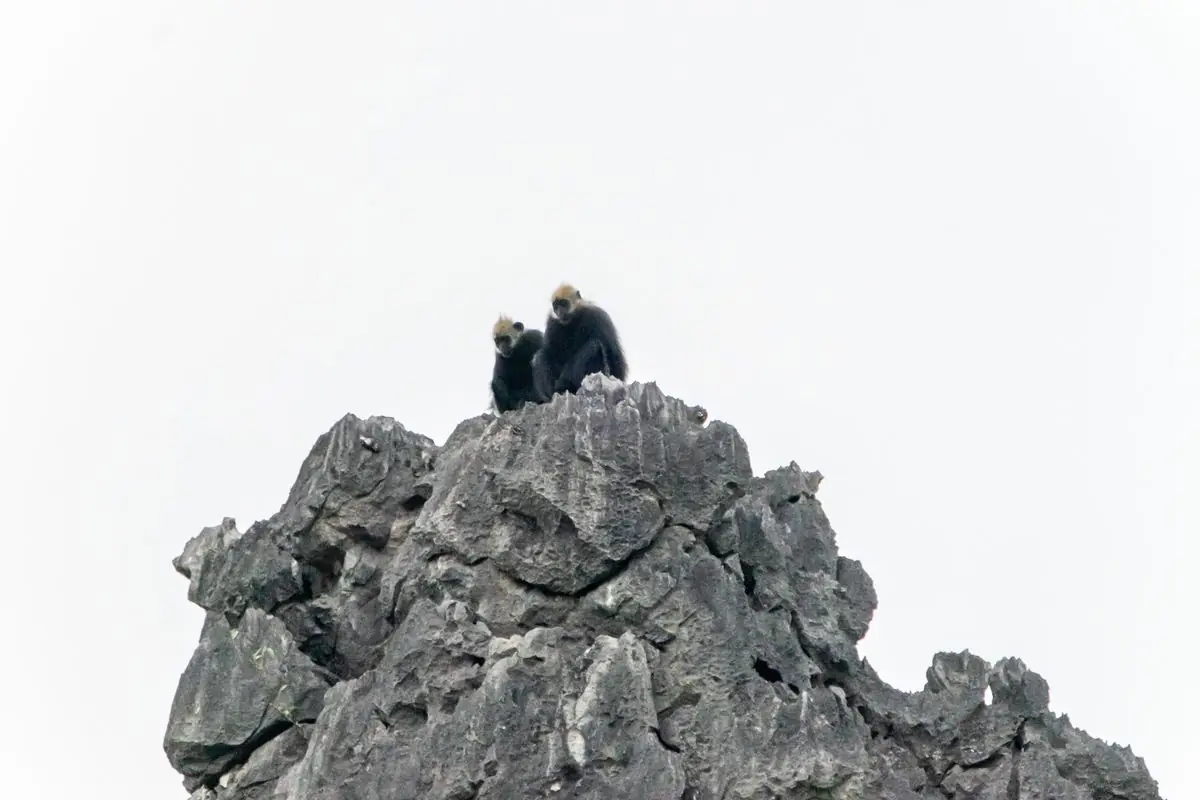
Their diet consists mainly of leaves, along with young shoots, flowers, and fruit. A typical troop includes an adult male, several females, and their offspring, although group structures can vary.
Unfortunately, a species that was once relatively widespread across the archipelago has suffered a dramatic population decline due to hunting and habitat loss.
Today, the Cat Ba langur remains classified as Critically Endangered (CR), the highest threatened category on the IUCN Red List before extinction in the wild.
Can you actually see Cat Ba langurs in the wild?
Yes, but your chances are very low, and sightings are never guaranteed.
The people most likely to encounter Cat Ba langurs are conservation workers and national park rangers who monitor the remaining population.
They know the areas where troops have previously been recorded, understand their behavior, and sometimes spend several days surveying the coastline by boat. Even with that experience, there are occasions when an entire week of fieldwork passes without a single sighting.

For an ordinary visitor, the chances are considerably smaller.
First, there are very few langurs spread across a large and complicated landscape of forests, islands, and limestone cliffs. They live in several small groups rather than gathering in one predictable location.
Second, they are highly sensitive to human activity. When a langur detects a potential threat, it may make an alarm call, prompting the rest of the troop to become alert and move somewhere safer.
Finally, much of their most important habitat lies within strictly protected areas. Tourists cannot simply enter these locations to search for wildlife.
A boat trip around Lan Ha Bay or a walk through Cat Ba National Park is still worth doing. Treat a langur sighting as a bonus, not the point of the trip.
No official Cat Ba langur watching tours
There is currently no widely available, officially confirmed tourist program that guarantees guided encounters with wild Cat Ba langurs.
Organizing dedicated wildlife-viewing trips inside protected langur habitat involves strict conservation and access restrictions.
A responsible operator should explain the limitations of the experience, avoid promising wildlife encounters, and never offer to take visitors into restricted habitat for an additional fee.
Pick an excursion that is worth the money for the bay, caves and fishing villages alone, with or without a langur.
Where do Cat Ba langurs live?
Cat Ba langurs inhabit limestone forests and rocky landscapes across protected parts of the Cat Ba Archipelago, including areas bordering Lan Ha Bay.
Locations documented through conservation monitoring include Cua Dong, Hang Cai, Gio Cung, Ham Lon, and Nam Cat.
These are known habitat areas, not designated tourist viewing spots.
Some are near waterways used by sightseeing boats, but visitors still aren’t allowed to approach the cliffs or caves where langurs live.
The animals also move between feeding grounds, resting areas, and sleeping sites. A cliff where rangers observed a troop yesterday may be completely empty today.
Sea cliffs give them routes and hard-to-reach caves
Cat Ba’s limestone formations contain numerous cracks, rocky ledges, and natural caves. These features provide the langurs with routes through the landscape as well as relatively inaccessible sleeping places.
Some troops use caves high on cliffs facing the sea, occasionally at elevations exceeding 100 meters above the water.
From a boat, it can be surprisingly difficult to distinguish a motionless langur from the dark rocks, shadows, and vegetation surrounding it.
Their black fur also provides natural camouflage in shaded areas.
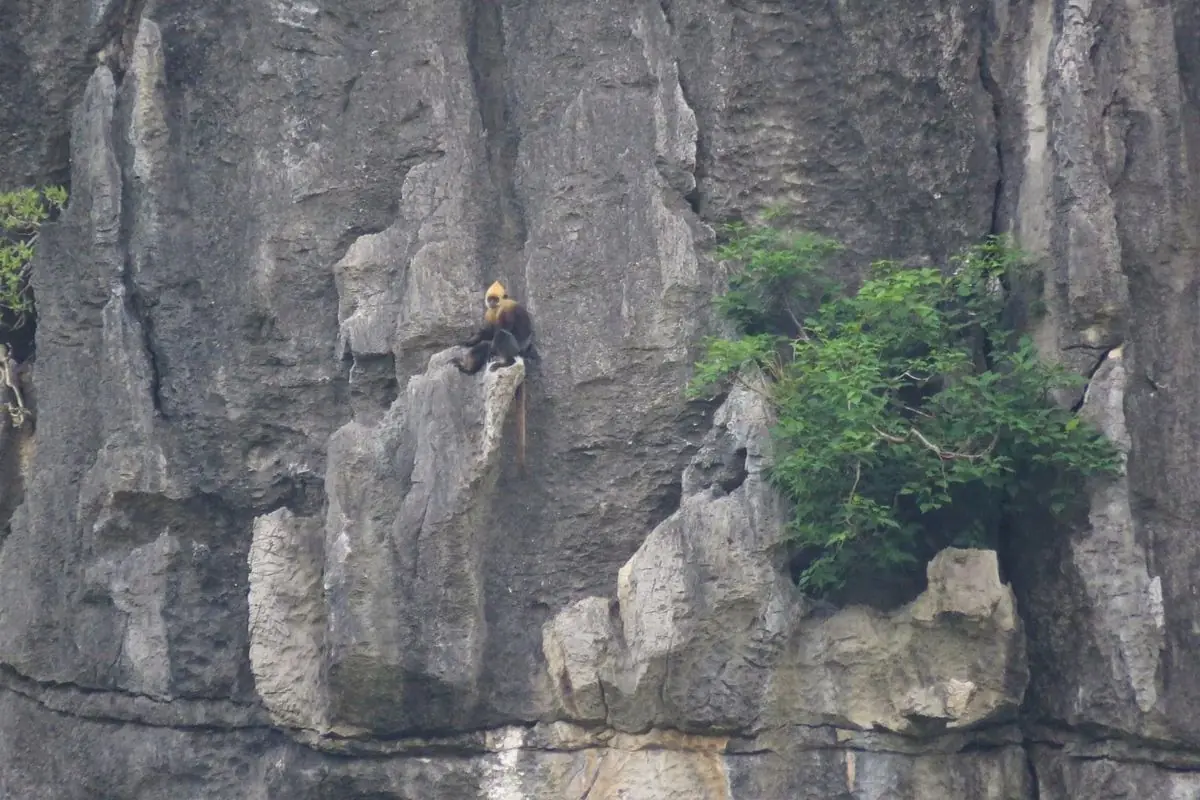
This rugged environment helps protect the animals from some threats on the ground. Unfortunately, being high above the water doesn’t protect them from boat engines, loud music, or repeated disturbances caused by vessels approaching their habitat.
What is the best time to see Cat Ba langurs?
Early morning may offer better conditions
Cat Ba langurs tend to forage more actively during cooler parts of the day.
In the morning, before the sun becomes too strong, a troop may appear on a limestone slope or a cliffside covered with vegetation, feeding on leaves, shoots, and fruit.
Some field observations suggest that around 9 a.m., langurs may begin moving farther into the forest or toward more sheltered areas.
The timing shifts from day to day.
Their activity depends on temperature, sunlight, food availability, and the behavior of individual troops.
Late afternoon can also be an active period as the animals feed and move before returning to their sleeping sites.
Early morning may improve the conditions for a chance encounter, but it does not guarantee a sighting.
Visitors must also follow authorized tour routes and operating hours. Hiring a boat to search protected cliffs at sunrise is not an appropriate alternative.
No season clearly improves your chances
There is no reliable evidence that visiting during a particular month significantly increases an ordinary tourist’s chances of seeing a Cat Ba langur.
The species lives on the archipelago year-round and does not migrate seasonally.
Breeding also occurs at different times rather than during a clearly defined season that visitors can plan around.
For your overall trip, choosing a period with comfortable temperatures, calm seas, and good visibility makes more sense.
Those conditions make the bay trip more pleasant; the langurs stay just as hard to find.
During stormy periods, always check marine weather forecasts and official notices before heading out.
No wildlife sighting is worth taking unnecessary risks at sea.
Can you spot Cat Ba langurs on a Lan Ha Bay boat tour?
A sightseeing boat in Lan Ha Bay may pass limestone formations and coastal forests similar to those where langurs live.
Occasionally, visitors notice animals moving along cliffs or among the trees.
However, a standard Lan Ha Bay cruise is not a langur-watching excursion.
Most itineraries focus on scenery, caves, floating fishing communities, and permitted water-based activities.
Your boat may not pass anywhere near an active langur troop, and the timing of your excursion is unlikely to match the animals’ movements.
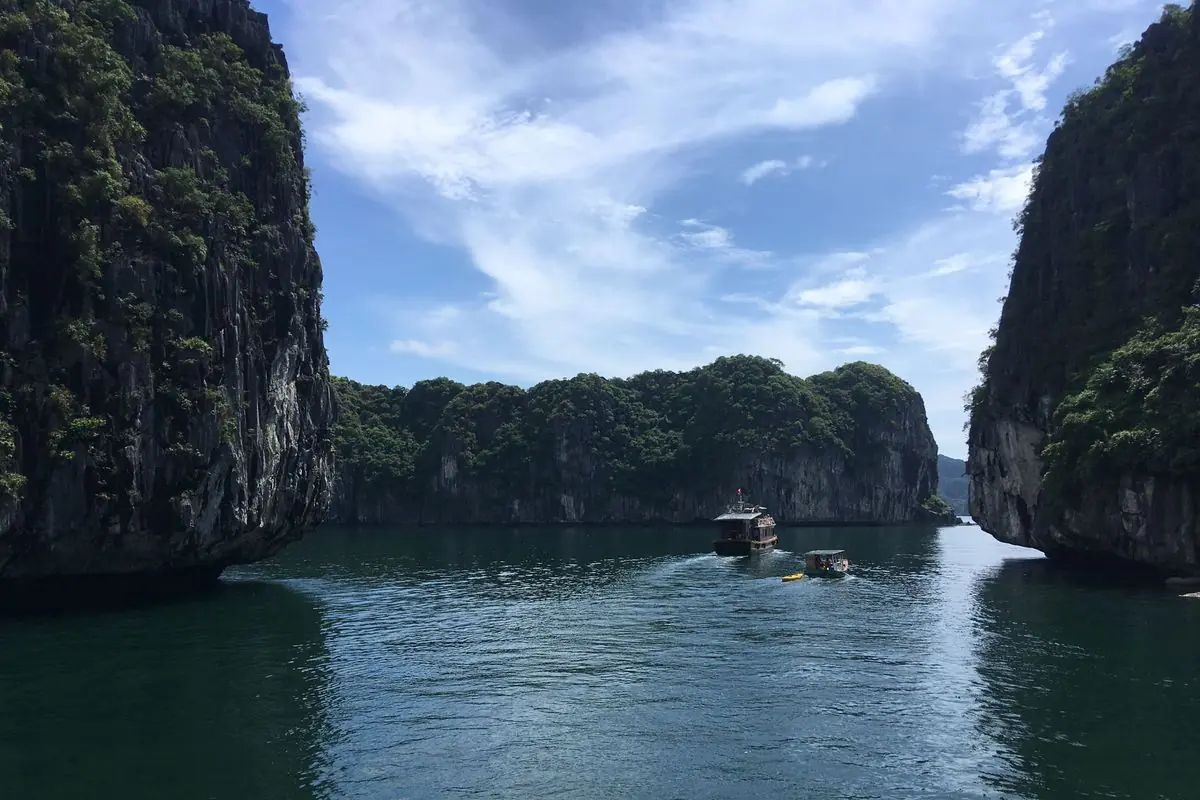
Most boats pass through the wider area without anyone on board spotting a langur.
Don’t ask the captain to get closer to a cliff
Engine noise, loudspeakers, and repeated boat traffic can place considerable stress on these sensitive animals.
Conservation monitoring has documented troops abandoning previously safe sleeping caves and familiar areas following disturbances from human activity.
When you happen to notice a langur on a cliff, observe it from a distance while remaining on an authorized boating route.
Avoid asking the captain to change course, accelerate toward the animal, or approach the rocks for a closer photograph.
A langur still feeding when your boat moves on is a better sighting than a troop scattering up the cliff.
Kayaking won’t get you closer either
Kayaking is not a way to get closer to them either.
Kayaking activities across the bays around Cat Ba were temporarily suspended in November 2024 while authorities reviewed management and safety requirements.
The suspension still applies in Lan Ha Bay, and any operator still offering kayaking may only run it in a separately licensed area.
Actual permissions may vary by location and date.
A tour that still advertises kayaking may not be allowed to run it on the day you visit.
How to tell a Cat Ba langur from a rhesus macaque
The monkey on a Cat Ba cliff may well be a different species.
The archipelago is also home to rhesus macaques (Macaca mulatta), known locally as khỉ vàng.
These monkeys inhabit forests and coastal areas, and some populations are much more accustomed to people than the extremely elusive langurs.
The monkeys commonly seen on Monkey Island are not Cat Ba langurs.
The easiest way to distinguish the two species is by looking at their coat, head, and tail.
| Feature | Adult Cat Ba langur | Rhesus macaque |
|---|---|---|
| Body fur | Black or very dark brown | Grayish brown or yellowish brown |
| Head | Distinctive golden or pale-yellow crown | No characteristic golden crown |
| Face | Dark-colored face | Often pinkish or reddish face |
| Tail | Long, slender, and conspicuous | Relatively shorter |
| Diet | Primarily leaves | Omnivorous, eating a wide variety of foods |
| Behavior around people | Generally elusive and sensitive to disturbance | Some troops are accustomed to visitors |
An adult Cat Ba langur typically has a body length of approximately 47-53 cm, with a remarkably long tail that creates a distinctive silhouette as it moves across limestone cliffs.
The golden coloring on its head may become paler with age, so not every adult looks as brightly colored as the animals shown in promotional photographs.
Baby Cat Ba langurs are bright orange
Newborn Cat Ba langurs have striking golden-orange fur, dramatically different from the dark coats of adults.
During their earliest weeks, infants spend most of their time clinging to or being carried by their mothers.
As they grow, darker patches develop and gradually spread until their coat takes on the coloration typical of older langurs.
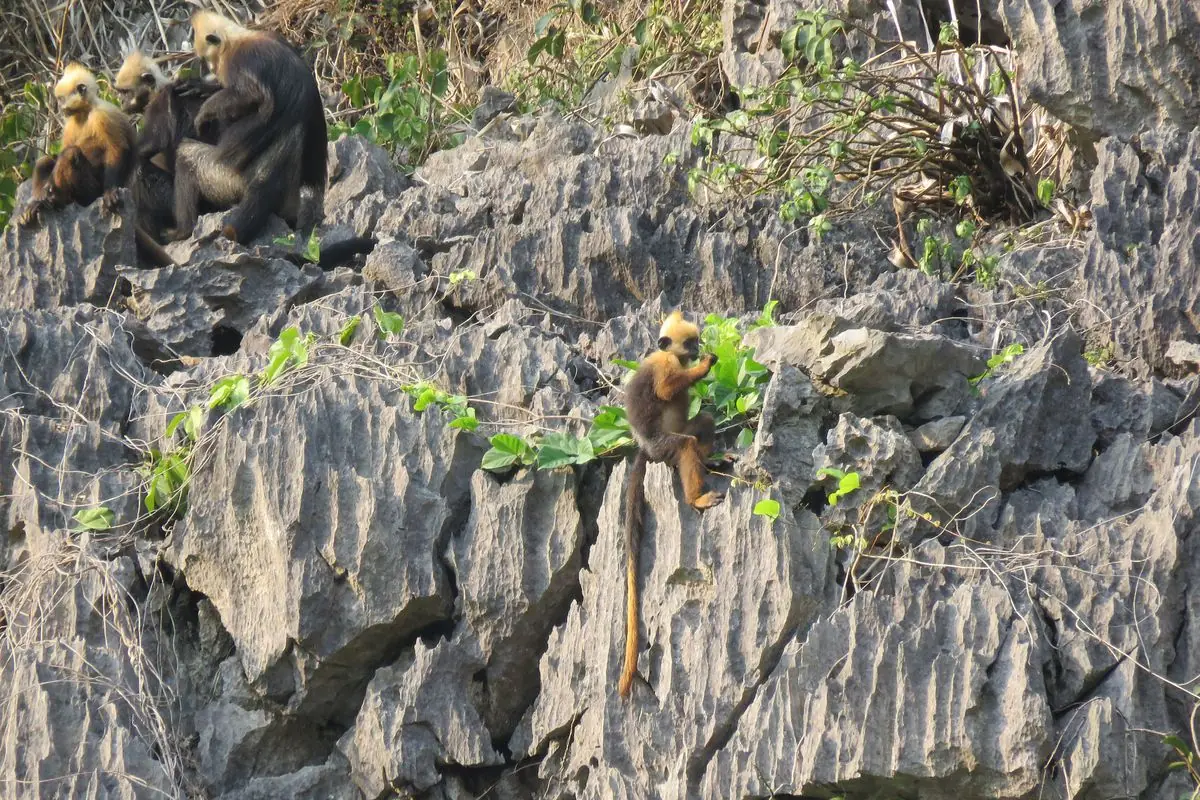
Females generally give birth to one infant at a time, making each successful birth important to the recovery of such a small population.
No particular month reliably brings baby langurs into view.
Keep well away from troops with infants, as mothers and newborns need to remain free from unnecessary disturbance.
An unusual behavior: Cat Ba langurs sometimes drink saltwater
Most primates are not well adapted to drinking water with high salt concentrations.
Cat Ba langurs, living on limestone islands by the sea, are an exception.
Field observations have recorded langurs occasionally approaching low rocky ledges to sip salty water.
They may drink directly, use their hands to bring water to their mouths, or dip their tails into the water before pulling them back up and licking the moisture.
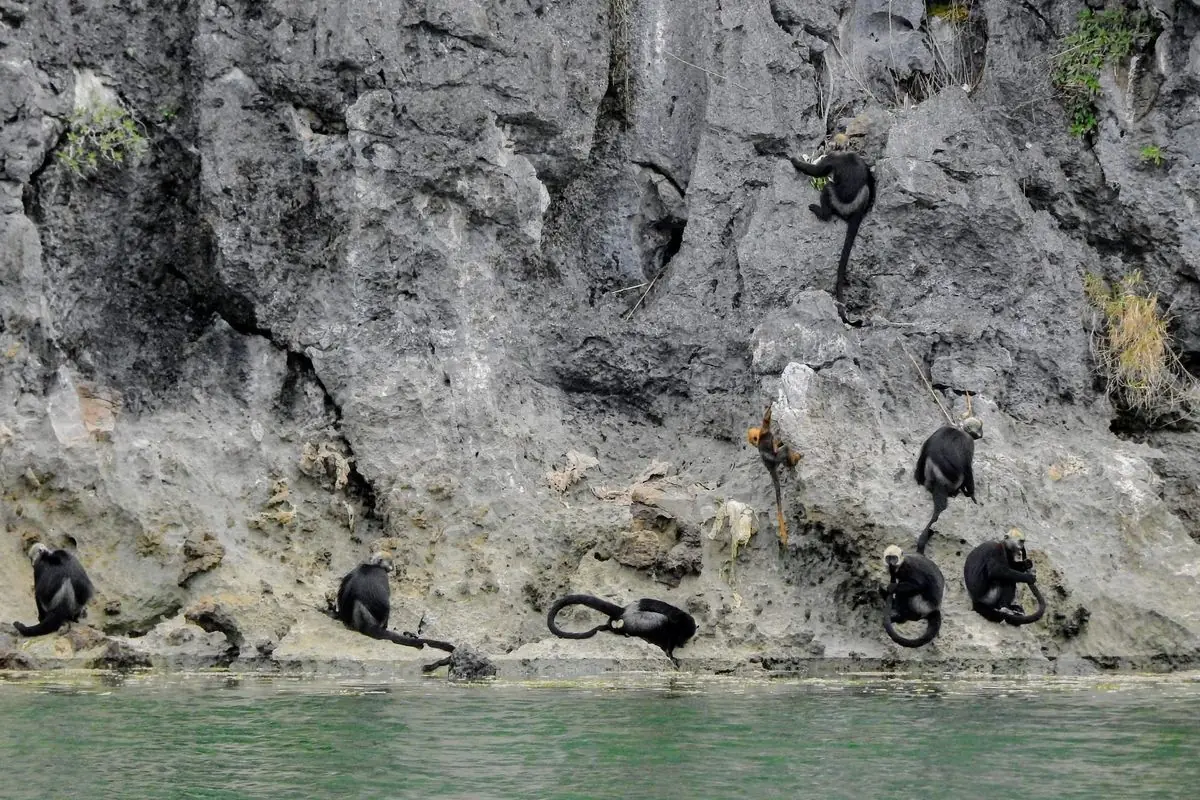
A genetic study published in 2024 identified variations in genes linked to sodium and calcium metabolism that may help explain the species’ adaptation to limestone habitats and salty water.
Scientists are still working out the mechanisms involved.
Still, the observation stops short of showing that seawater is the animals’ only source of water, or that every visit to the shoreline is intended to replenish minerals.
Don’t go looking for low rocky ledges in the hope of catching langurs drinking.
These behaviors should only be observed by chance, from a respectful distance.
What should you do if you encounter a Cat Ba langur?
Imagine you’re enjoying a boat ride when you notice a black langur with a golden crown sitting on a distant cliff.
What you do in the next few minutes decides whether the troop is disturbed.
Stay quiet and keep your distance
Watch from permitted spots
Lower your voice, avoid shouting to other passengers, and don’t play music, blow horns, or imitate animal calls to attract attention.
Continue watching from an authorized location.
Use binoculars or a camera with a telephoto lens instead of trying to get physically closer.
There is no single viewing distance that works for every location and situation.
Follow the instructions of rangers, protected-area managers, and your tour operator.
If the animals appear to change their behavior because of your presence, increase your distance or end the observation.
Never feed, chase, or provoke the animals
Leave the troop alone
Do not throw fruit, snacks, or any other objects toward the animals.
Avoid calling out to make them look at your camera, and don’t wait for the troop’s dominant male to make an alarm call before moving away.
Alarm calls are part of the langurs’ natural response to potential threats.
Once alerted, an entire troop may become anxious and relocate to another part of the forest.
No photograph is worth frightening a species already at such high risk of extinction.
Avoid drones and protect sensitive locations
When shooting and posting
Drones can generate noise and cause disturbance, particularly when flown near sleeping caves or cliffs used by wildlife.
In addition to complying with aviation regulations, visitors must respect the conservation rules of Cat Ba National Park.
If you’re fortunate enough to photograph a langur, sharing the experience can help raise awareness of the species.
However, avoid publishing the exact coordinates of sleeping caves or places where a troop is caring for newborns.
Too much attention can unintentionally turn a quiet, protected habitat into a gathering point for curious visitors and tour boats.
How many Cat Ba langurs are left in 2026?
The population was estimated at nearly 90 wild individuals in early 2026.
This figure comes from published population monitoring information rather than a live, continuously updated count.
In September 2023, the conservation project recorded 82 individuals.
Over the following years, the population continued to recover through habitat protection, anti-poaching measures, and conservation monitoring.
In 2025, Cat Ba National Park rangers recorded 14 langur births.
By early 2026, reports put the total population at nearly 90 individuals, with important groups found in areas including Cua Dong and Gio Cung.
You may still encounter older articles stating that only 60-80 individuals remain, while other descriptions refer more generally to around 100.
These differences largely reflect when the estimates were published and how population information has been updated.
Read any population figure together with the year it was published; none of them is an exact count for today.
Hunting and habitat loss nearly wiped them out
Historically, the Cat Ba Archipelago was estimated to support approximately 2,500-2,700 langurs.
That population collapsed due to hunting, habitat degradation, and human pressure on the forests.
Some animals were killed for meat or for use in traditional medicinal practices unsupported by reliable scientific evidence.
By the early 2000s, only around 40-50 wild individuals remained.
This dramatic decline left small groups isolated from one another, reducing opportunities for breeding between populations and increasing the risk of inbreeding.
Even when numbers begin to rise again, such genetic challenges cannot be resolved within just a few years.
The recovery to nearly 90 individuals is therefore an important conservation achievement, but the species is far from secure.
The Cat Ba Langur Conservation Project
The Cat Ba Langur Conservation Project began in 2000, initially supported by Germany’s Münster Zoo and the Zoological Society for the Conservation of Species and Populations (ZGAP).
Since 2019, Leipzig Zoo has continued supporting and managing the project in cooperation with Cat Ba National Park and local conservation authorities.
Important activities include anti-poaching patrols, monitoring langur troops by motorboat, protecting sleeping caves, restoring habitats, and working with communities living near protected forests.
In 2025, the organizations involved also continued efforts to maintain conservation activities into the following project period.
Although hunting has become better controlled, the remaining langurs still face serious threats.
These include fragmented habitats, uncontrolled tourism, noise from boats, and low genetic diversity.
Under Vietnamese law, the Cat Ba langur is a specially protected endangered species and is included in Group IB.
The current list has applied since January 1, 2026.
Illegal hunting, killing, trading, keeping, or transporting these animals is strictly regulated and subject to serious legal penalties.
A rising population means newborn langurs can grow up in the same forests and limestone landscapes their species has occupied for generations.
Planning a Cat Ba trip around langurs
A nature-focused trip to Cat Ba works fine without a wildlife sighting as its goal.
One accessible option is visiting Cat Ba National Park, walking through Kim Giao Forest, hiking toward Ngu Lam Peak, or exploring designated sections of its limestone ecosystem.
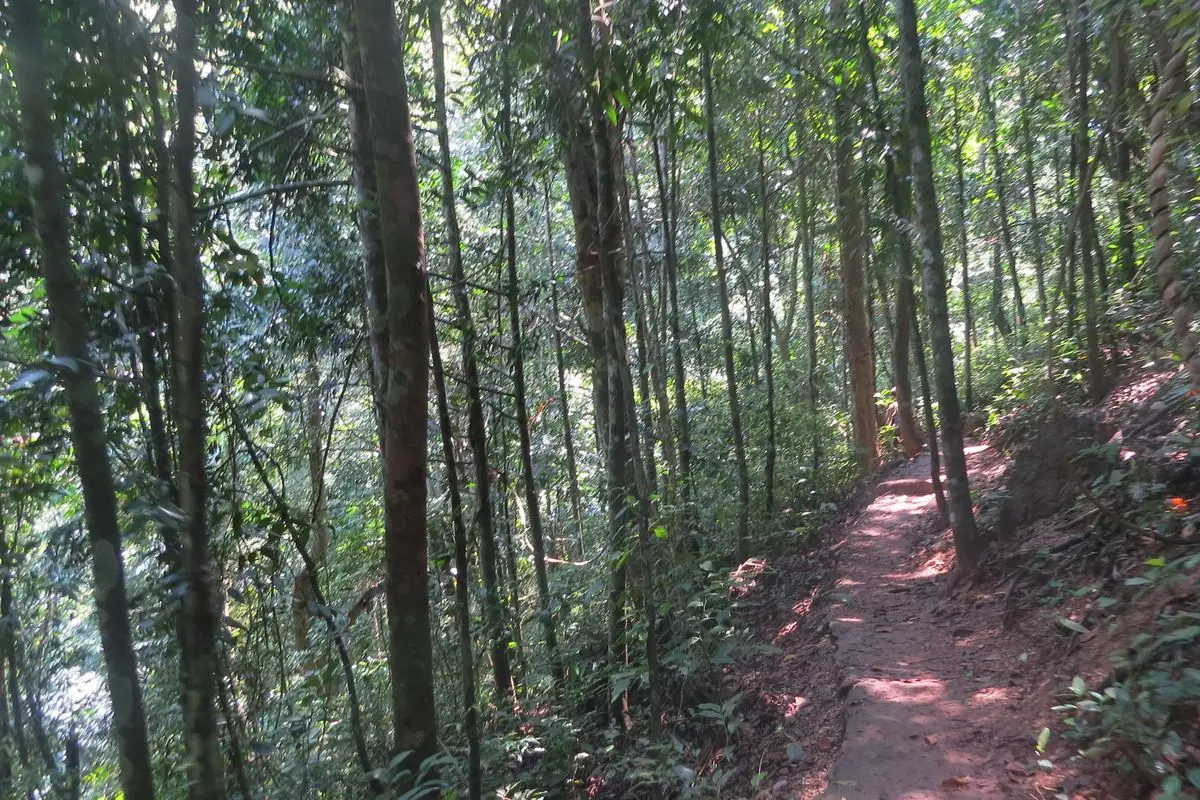
These routes are not specifically designed for langur watching, but they provide a valuable introduction to the natural environment where the species has evolved.
For visits from January 1, 2026, the published adult entrance fee for Cat Ba National Park is VND 160,000 per visit.
The central route through Kim Giao Forest, Ngu Lam Peak, and Trung Trang Cave is listed at VND 120,000 per adult.
Reference visitor hours are 7:00 a.m. to 5:00 p.m., subject to the park’s operating notices.
For Lan Ha Bay excursions, look for operators with clear itineraries, authorized routes, and responsible environmental practices.
Avoid tours promoting visits to langur sleeping caves or promising to find the animals at any cost.
The published daytime sightseeing fee for Lan Ha Bay from 2026 is VND 120,000 per adult, excluding boat rental and other tour services.
Fees, access arrangements, and available activities can change, so confirm the details before your departure.
Contact Cat Ba National Park directly
For the latest information about open walking routes, protected areas, and approved nature education activities, contact:
Explain that you’re interested in learning about Cat Ba langurs and would like to know which educational or nature-based activities are currently available.
Ask about conservation activities, not the precise locations of active langur troops.
Without a sighting, Cat Ba still has its limestone islands, coastal forests and quiet bays, and the langurs keep the undisturbed cliffs they need.
Keen hikers can walk through Kim Giao Forest toward Ngu Lam Peak. Interested in learning about Cat Ba langurs themselves? Contact the park and ask which educational activities are currently available.
Frequently asked questions
Can you see Cat Ba langurs in the wild? Are there langur-watching tours?
It is possible to encounter Cat Ba langurs in the wild, but sightings are extremely rare. There is currently no widely available, officially confirmed tourist program dedicated to guaranteed langur encounters. Avoid operators promising sightings or access to strictly protected habitats.
Where do Cat Ba langurs live? Can you see them on a Lan Ha Bay cruise?
Cat Ba langurs inhabit limestone forests and cliffs across protected parts of the Cat Ba Archipelago, including habitats near Lan Ha Bay such as Cua Dong and Gio Cung. Visitors on boat tours might occasionally see one from a distance, but regular sightseeing routes don't guarantee passing through areas where langurs are present.
What is the best time of day or season to see Cat Ba langurs?
Early mornings and other cooler periods can be favorable for langur feeding activity. However, no particular hour or season guarantees a sighting. Choose your travel dates based on weather, authorized visiting hours, and overall safety rather than the expectation of encountering langurs.
How many Cat Ba langurs are left?
Reports published in early 2026 estimated nearly 90 Cat Ba langurs living in the wild. The exact number may change as births, deaths, and population monitoring results are recorded. Although the population has recovered since the early 2000s, the species remains Critically Endangered.
Are the monkeys on Cat Ba's cliffs or Monkey Island actually Cat Ba langurs?
Not necessarily. Cat Ba is also home to rhesus macaques, which have brownish-gray coats and often pink faces rather than the distinctive golden crown of Cat Ba langurs. The monkeys commonly encountered on Monkey Island are not golden-headed langurs. When identifying an animal from a distance, look at its overall coat color, head markings, and tail shape.