Visiting the Bach Dang historic site is easier than you might think
The site opens at 7:00 am. Arrive in the morning, spend around two hours following the temples and historical displays, and save the riverside Victory Square for the end.
 20 min read
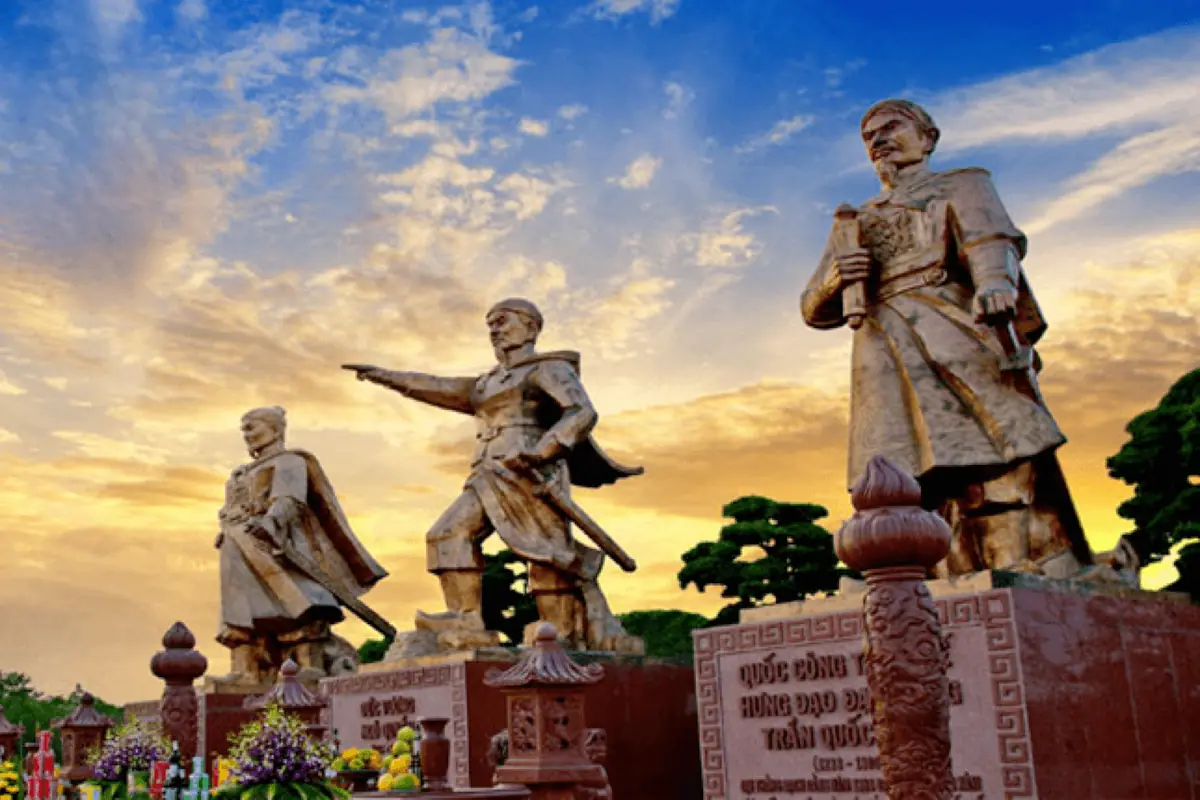
Victory Square looks out over the Bach Dang River.
Bach Dang historic site: where it is and what to expect
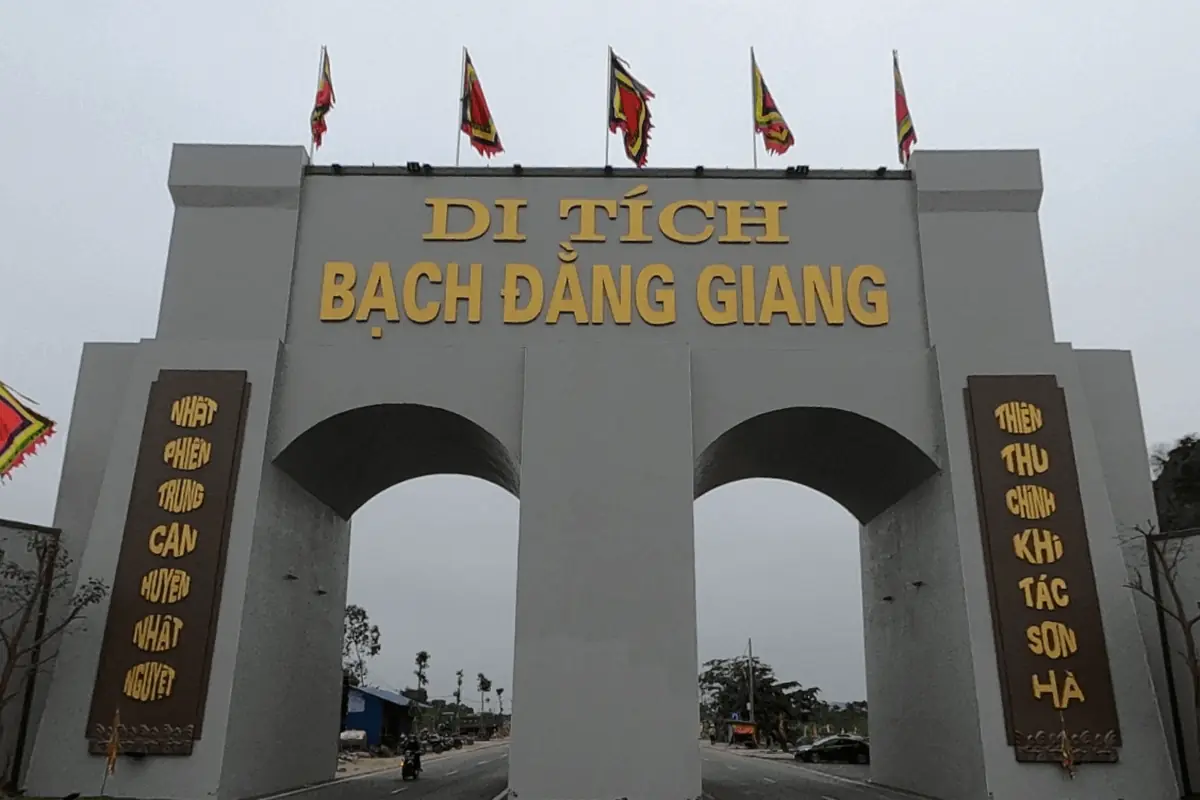
The entrance sign reads Khu di tích Bạch Đằng Giang, and beyond it a series of temples, landscaped paths and historical displays leads towards three large statues overlooking the Bach Dang River. The memorial complex is roughly 18-20 km from central Hai Phong, and there is no admission charge. No history background is needed: the visit is built around three battles, three commanders and the river landscape that helped shape the outcomes.
First, make sure you are going to the right place
The place most visitors mean by Bach Dang historic site is the Bach Dang Giang National Historical Relic Site, a memorial complex in the Trang Kenh area of northern Hai Phong. It lies in Bach Dang Ward, Hai Phong, Vietnam, in what used to be called Thuy Nguyen. The address in older travel guides may say Minh Duc Town, Thuy Nguyen District; other guides say Minh Duc Ward, Thuy Nguyen City. These different administrative descriptions reflect changes to local government boundaries rather than several separate memorial sites.
For navigation, search the full Vietnamese name Khu di tích Quốc gia Bạch Đằng Giang. This matters because Bach Dang is also the name of a river, a present-day ward and several historical places spread across the Hai Phong-Quang Ninh region. Map pins for a wooden-stake excavation, a different temple or a river viewpoint lead elsewhere.
The complex stands in the broader Trang Kenh, Hai Phong landscape, where limestone formations rise beside river channels. The Bach Dang River is in front of the memorial, while the Thai River and nearby hills form part of the setting described in accounts of the old battlefield. Looking across the water helps explain why this place is more than a collection of statues. Boats traveling between inland waterways and the sea had to navigate narrow approaches, changing tides and channels that could become dangerous if an opposing army controlled the banks.
Trang Kenh refers to a wider scenic and archaeological area of rivers and mountains. Bach Dang Giang refers to the principal memorial and worship complex that travelers explore today. Its main buildings were developed between 2008 and 2018, and the site received national historical relic status in 2020. The modern buildings commemorate much older events; they are not intact 10th- or 13th-century architecture.
Don’t expect a ruined fortress with original defensive walls to trace. What you find is a large, orderly memorial with places of worship, a small historical exhibition, sculptures, a reconstructed defensive-stake scene and a striking riverfront square. The natural setting connects those modern elements to the centuries-old story.
Opening hours, tickets and practical costs
Gates are open 7:00 am to 7:00 pm, every day. Historical films are screened from 7:00 am to 5:00 pm, but check on arrival whether screenings are running and when the next one starts.
Transport is likely to be your main expense. There is no reliable single taxi price from “Hai Phong”, because the city is large and the fare depends on your departure point, vehicle, company and booking time. Check a live quote in the taxi or ride-hailing app you plan to use; old blog estimates are not fixed tariffs. If you arrange a driver for the return journey, confirm whether waiting time is included. That small conversation matters more here than at a busy central-city attraction with vehicles constantly passing.
Getting to Bach Dang Giang from central Hai Phong
From the Hai Phong Opera House area, the easiest option is a car, taxi or motorbike. A common approach crosses Binh Bridge into the former Thuy Nguyen area, then follows the roads towards Trang Kenh and Bach Dang. The usual route follows Road 359 and National Highway 10, though the exact turns depend on where you start and on road conditions. Use your navigation app for the final approach, and check that it leads to the memorial entrance on the Tran Hung Dao road side, not to another riverside pin.
From the central city it is around 18-20 km. Allow 35-50 minutes each way by car or motorbike for an ordinary trip. A hotel near Cat Bi International Airport, for example, will have a different journey from one near the Opera House. Rush-hour traffic, construction or a busy festival can add time.
A taxi is a comfortable choice for families, older travelers and international visitors unfamiliar with the roads north of the city. Save the full Vietnamese name and show it to the driver. You can ask the driver to wait or arrange a pickup after roughly two hours. Decide the pickup point before you enter the grounds, since private vehicles do not drive through the memorial paths.
A motorbike gives you flexibility if you already ride confidently in Vietnam. Choose a dry day, wear a proper helmet and leave time for the drive back. There is no advantage in rushing through the temples just to reach another attraction by a tightly fixed time. The walking portion is substantial enough that comfortable footwear matters even if you arrive on two wheels.
Public transport is less straightforward. Bus route 16B runs in the broader Thuy Nguyen area, but stops and onward connections should be checked on the day. By bus, plan on a short taxi or motorbike-taxi ride for the last stretch to the gate. Visitors without much spare time will generally find a direct car journey simpler.
The best way to walk around the memorial
You can spend a long time here if you visit every worship hall, but it is possible to understand the essential story in around 90 minutes to two hours. The most useful order for a first visit is to begin with the interpretation of the battles, move through the temples dedicated to the commanders, and finish beside the river. In that sequence, the statues at the end are no longer just three impressive figures: you already know whom they represent.
Start at the exhibition hall
The historical exhibition hall introduces the battles through documents, images and displays relating to the river campaigns. Look for a map here before getting absorbed in individual dates. Find the water channels, the entrances towards the sea and the three key years: 938, 981 and 1288. Once you know which enemy force was involved in each campaign, the rest becomes much easier to follow.
With children, ask here how a river can work as part of a defense system. A high tide can cover obstacles, while a falling tide may expose them and change where a boat can safely travel. A stake field by itself does not explain a victory. The defenders also needed advance knowledge of the channels, coordination on the banks and a plan to engage the opposing fleet at the right moment.
The complex offers QR-code audio or interpretive information, which helps independent visitors. Bring a charged phone if you want to use it. Not every panel or recording has a full English translation, so international visitors may find it helpful to read a short overview of the three battles before arriving. A guide is optional, though a knowledgeable one booked in advance can add context.
Stop at the Victory Pillar and stone garden
The Victory Pillar, or Trụ Chiến thắng, stands among large decorative stones and landscaped grounds. The four-sided stone pillar is about 5.5 meters tall, with inscriptions honoring Ngo Quyen, Emperor Le Dai Hanh and Tran Hung Dao. It acts as a bridge between the historical exhibition and the individual temples.
Skip the full inscriptions if you like and use the names as a reference point. Think of them as three chapters in the story of Vietnamese independence, separated by centuries. The garden is also an easy place for a group to pause, take photographs and regroup before the next stretch of walking. A class discussion works better here than in a narrow temple doorway.
Visit the three main temples in the context of their battles
The Temple of Ngo Quyen honors the commander who defeated the Southern Han fleet in 938. His victory is remembered as a decisive break from a long era of domination by Chinese dynasties and the beginning of a new period of independent rule. The temple at Bach Dang Giang is a modern place of commemoration; it is not the only historical site in northern Vietnam connected with him.
The Temple of Emperor Le Dai Hanh, also called Trang Kenh Vong De Temple, marks the victory over the Song invasion in 981. Le Dai Hanh’s personal name was Le Hoan. Unlike 938, his campaign defended a state that had already regained independence, during a very different political crisis and military invasion.
Linh Tu Trang Kenh is dedicated to Tran Quoc Tuan, better known as Tran Hung Dao. In Vietnamese religious tradition he is also called Duc Thanh Tran, or Saint Tran. He commanded the Tran forces in the famous 1288 campaign against the Yuan army. Most visitors have this battle in mind when they picture wooden stakes hidden beneath a tidal river.
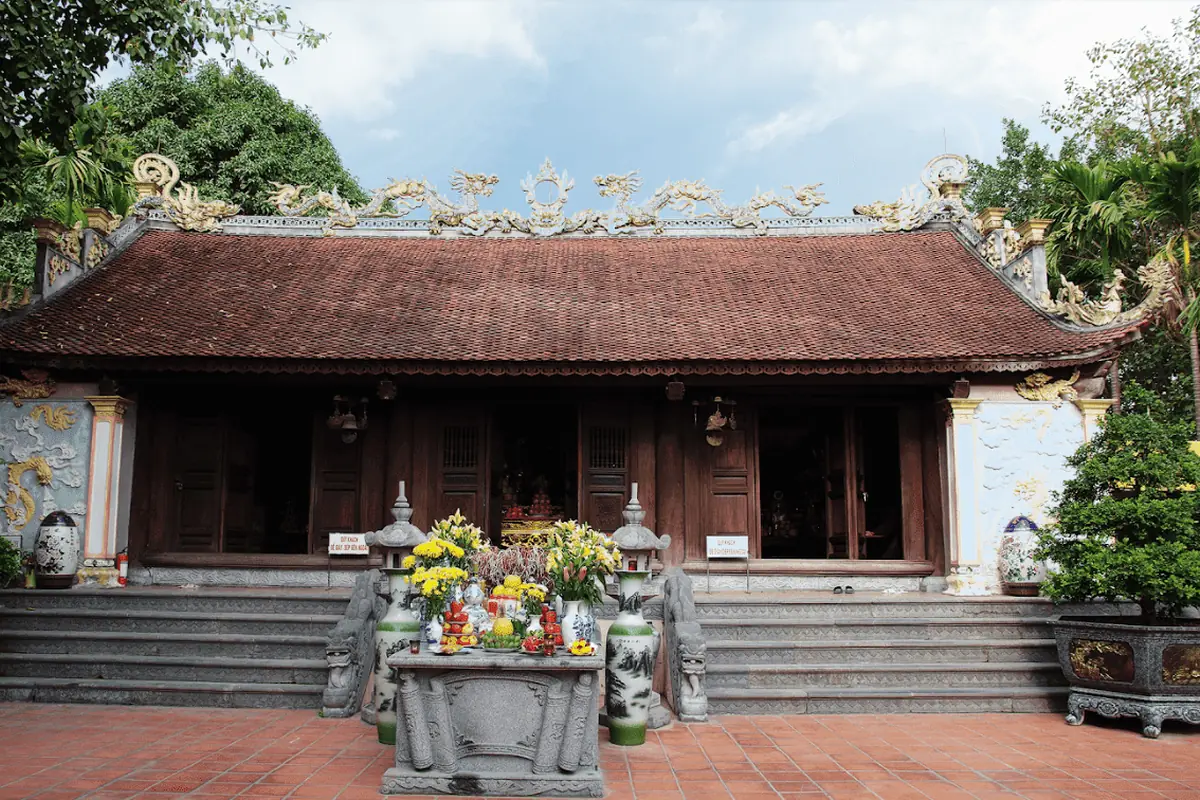
For an elderly family member or a child who is tiring, visiting the three commander temples is a sensible priority. It is better to enjoy those stops and the river square than to race through every building with no time to absorb anything.
Make time for the pagoda and other places of worship
The grounds also contain Truc Lam Tu Trang Kenh Pagoda, the Trang Kenh Mother Goddess Temple and a temple dedicated to President Ho Chi Minh. They show another side of the site: alongside its role as a history destination, Bach Dang Giang is a place for Buddhist observance, local spiritual traditions and acts of remembrance.
The pagoda sits on a slope, and reaching parts of it involves steps. Let visitors with limited mobility decide whether that section is comfortable before committing to it. The Mother Goddess temple and the Ho Chi Minh memorial can be added when your group has the time and energy, but they need not replace the historical exhibition if understanding the battles is your main reason for coming.
Approach these buildings on their own terms. A shrine is not a photography set, and the atmosphere can be especially solemn when people are making offerings. Watching the rituals quietly is often a more appropriate choice than trying to enter every area during a service.
Walk past the stake-making sculptures to Victory Square
One part of the landscape features sculptures representing the work of preparing wooden stakes. The sculptures make a good transition between the history you have read and the large river view ahead. A wooden barrier had to be prepared and installed in advance; the defenders needed material, labor and an understanding of where ships were likely to pass. What looks like a simple trick on a classroom diagram depended on a large coordinated operation.
The highlight for many visitors is Victory Square, a platform projecting towards the Bach Dang River. Three monumental bronze statues represent Ngo Quyen, Le Dai Hanh and Tran Hung Dao. Each statue is approximately eight meters high. Behind and around them, the open sky, water and surrounding limestone hills are part of the experience.
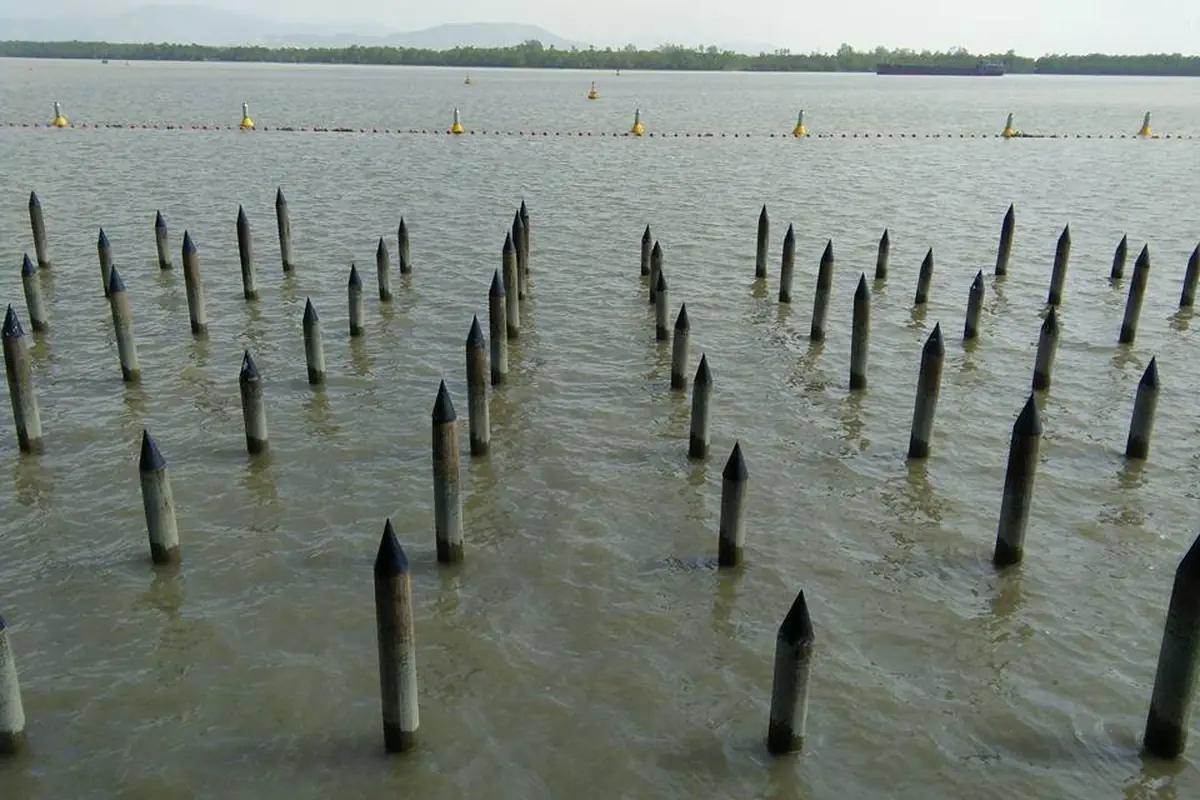
Below the square are rows of wooden stakes arranged to evoke the historic defensive fields. From here the tactical explanation becomes much more concrete: river width, water level, the opposite bank and the position of obstacles can all be discussed while looking at an actual waterscape. The modern shipping and landscape around the river are not exactly what a medieval commander would have seen, but the geography still helps you picture the problem both armies faced.
Stay on the designated walkways and keep children away from railings and the water’s edge. On a busy day, allow a little time to stand aside and look properly rather than stopping in the middle of the main approach for photographs. Treat Victory Square as the high point of the visit and give it time.
The three battles of Bach Dang, without the confusing detail
Why does a single river have such a prominent place in Vietnamese history? Because the wider Bach Dang river system was associated with three major victories against northern invasions. The campaigns took place in different centuries and involved different dynasties. The link between them is not that each battle unfolded in precisely the same spot or followed an identical script. It is the repeated importance of river geography, timing, local knowledge and coordinated resistance.
The battle of 938: Ngo Quyen and the Southern Han
In 938, Ngo Quyen faced a naval expedition from the Southern Han. The well-known account of the campaign describes a prepared stake barrier and the use of tidal conditions to draw the enemy fleet into a vulnerable position. As the water receded, the attackers lost the freedom of movement they needed and were defeated. The defeated fleet was commanded by Hoang Thao.
The larger significance is political. Ngo Quyen’s victory ended the prospect of renewed Southern Han control and helped establish a new period of Vietnamese self-rule. He became king in 939. If you remember only one sentence from this part of the exhibition, make it this: the victory of 938 is a landmark in the restoration of independent rule.
A visitor should not assume that the precise original stake field from 938 can be seen intact beside the modern statues. The reconstructed stakes there are an educational feature. The geographic setting relates to a much wider river and estuary system, so archaeological evidence and historical interpretation must be handled with more care than simply pointing at one row of posts.
The battle of 981: Le Dai Hanh and the Song
In 981, the threat came from the Song dynasty. Vietnam, then known as Dai Co Viet, was invaded by the Song while the Dinh dynasty was in turmoil. Le Hoan, who became Emperor Le Dai Hanh, led the defense. His forces fought across several approaches, including major engagements along the river network around Bach Dang.
The area around the Thai River and U Bo hill saw important fighting in this campaign. The Song general Hau Nhan Bao was killed, and the invasion failed. The point for visitors is that the second victory was not simply a recreation of Ngo Quyen’s story with the names changed. It took place in an established Vietnamese kingdom defending itself against a new invasion.
Look for Le Dai Hanh’s temple with that distinction in mind. For a child, the difference is easy to express: the first victory helped secure a new era of independence; the second defended that independence after another power tried to conquer the country.
The battle of 1288: Tran Hung Dao and the Yuan
In 1288, the Vietnamese Tran dynasty was fighting the third major invasion by the Yuan dynasty. As the invaders withdrew, part of the enemy fleet under O Ma Nhi attempted to move through the Bach Dang waterway towards the sea. Tran forces under Tran Hung Dao, also known as Tran Quoc Tuan, prepared a coordinated attack using boats, positions along the banks, knowledge of tides and defensive stake fields.
The decisive engagement on 9 April 1288 resulted in a major Vietnamese victory. O Ma Nhi and Phan Tiep were captured. The defeat of the fleet was a key part of the collapse of the invasion. This battle is often the clearest example of how a seemingly ordinary estuary became a military trap through planning and local knowledge.
The most useful way to explain it is to imagine the water changing beneath the ships. At a high tide, submerged obstacles could be difficult to spot. As the tide fell, safe passages narrowed while defenders attacked. The stakes mattered, but so did the timing, placement of forces and the choice of where to confront the retreating fleet. The barrier only worked as part of a wider military operation.
The modern memorial is associated especially with the river landscape of the 981 and 1288 campaigns. The historical battlefield extended across waterways and positions much larger than today’s visitor complex. The temples, sculptures and reconstructed stakes present those events in a concentrated form for visitors rather than marking every exact original fighting position.
Are the wooden stakes at Bach Dang Giang original?
Settle this question before the visit, especially if you are traveling with students. The stakes visible in the water by Victory Square are a reconstruction. The site’s management describes them as symbolic of the old defensive position. They help people visualize a stake field, but they should not be labeled as individual surviving posts installed during the medieval battles.
For archaeological material, there is a separate place called the Cao Quy stake-field conservation site, or Khu bảo tồn bãi cọc Cao Quỳ. It is in Luu Kiem Ward, formerly part of Lien Khe Commune in the Thuy Nguyen area, about 15 km from Bach Dang Giang by road. Wooden posts were discovered there in 2019, followed by archaeological investigation. A conservation area has since been developed with facilities for viewing and protecting the material, including stakes preserved in place.
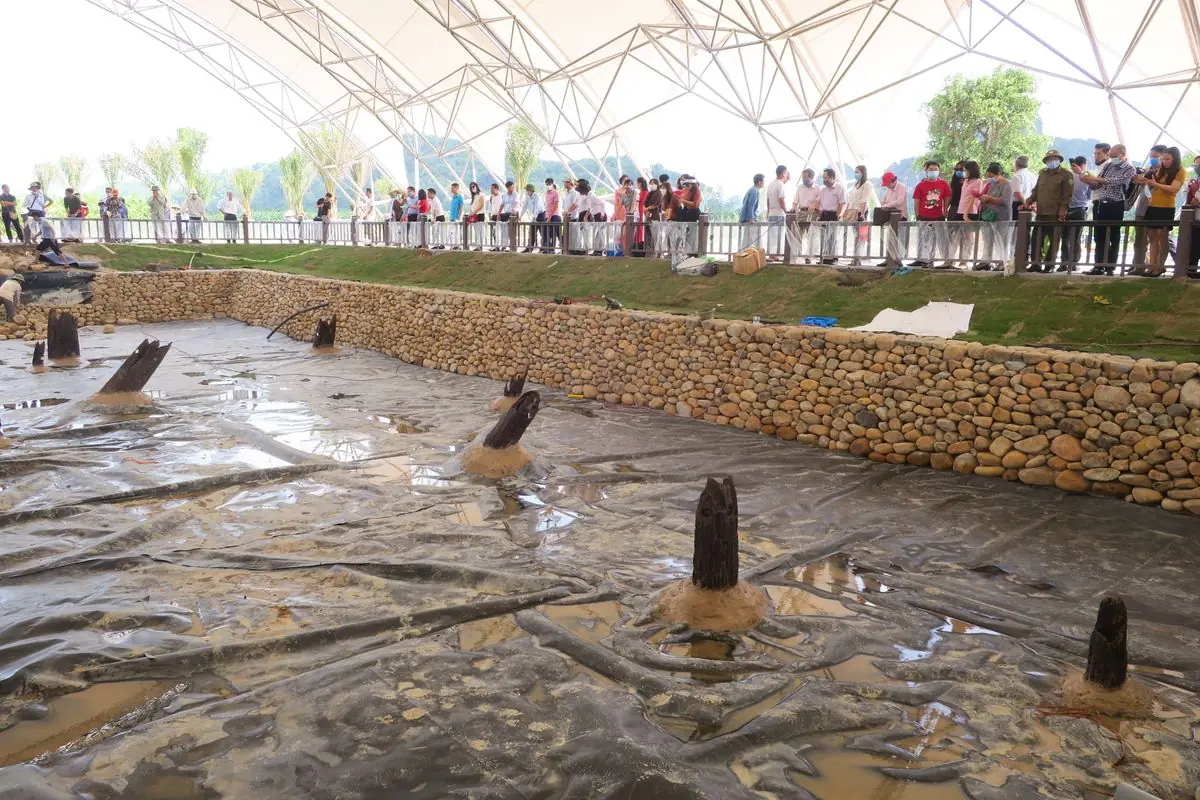
Researchers have linked the discoveries to the defensive system of the Tran dynasty. Archaeologists are still working out how individual groups of stakes functioned. A field of ancient timber posts, an interpretation in a museum and a modern visual reconstruction are three different kinds of evidence; it is worth keeping them separate when telling the story.
When are the festivals and commemorations?
The main ceremonies at Bach Dang Giang follow the Vietnamese lunar calendar. Each ceremony therefore falls on a different Gregorian date every year.
The major observances include the Tran seal-opening ceremony on the 14th and 15th days of the first lunar month, the commemoration of Ngo Quyen on the 18th day of that month, the remembrance of Le Dai Hanh on the eighth day of the third lunar month, and the death anniversary of Tran Hung Dao on the 20th day of the eighth lunar month. Buddhist celebrations such as Vesak and the Vu Lan observance are also associated with Truc Lam Pagoda.
In 2026, the Tran seal-opening ceremony took place during the night of the 14th and into the early hours of the 15th day of the first lunar month. Ceremonies can bring large numbers of worshippers to the site. Ritual schedules, access arrangements, performances and side events change from year to year, so check that year’s announcement.
Photographers and visitors who prefer to read the exhibits quietly will usually do better on an ordinary weekday than on a main festival date. For someone interested in living traditions, the busy atmosphere of a ceremony may be the very reason to visit. Just leave more time, dress respectfully and expect to share the space with people who have come to worship rather than sightsee.
The best time of day for a comfortable visit
On hot days, the pleasant window to get going is around 7:30-10:30 am. You can explore the exhibition and temples before the larger paved areas heat up, then reach the riverfront square while the morning is still manageable. A hat is useful outdoors, but remove it when entering worship areas.
Cooler winter days allow a slower start. Later in the afternoon, remember that films stop screening before the site closes, and you may not want to rush through the indoor material. Late-afternoon light suits photos, but starting too close to closing leaves little time for the battle history.
Much of the route is outdoors. Check the weather forecast during periods of heavy rain or storms, especially because the memorial includes an exposed riverfront area. Do not plan to remain on open waterside platforms in strong wind or hazardous weather. On normal days, walking shoes, water and sun protection are enough; the memorial has some steps but no real hiking.
A realistic two-hour itinerary from Hai Phong
A half-day trip works well if you keep the order simple. The timings below already include some slack.
Leave the central city at around 7:15 am and aim to reach the site close to 8:00 am, allowing for a normal journey across the river and towards Trang Kenh. Spend 8:00-8:25 finding your bearings and visiting the exhibition hall. Use 8:25-8:45 for the stone garden and Victory Pillar. Between 8:45 and 9:40, visit the main temples to Ngo Quyen, Le Dai Hanh and Tran Hung Dao, pausing wherever you want to read or observe quietly.
From 9:40 until roughly 10:15, follow the route towards the stake-making sculptures and Victory Square. Use the time left before 10:30 am to rest, take photographs or return to a detail you missed. You can then head back towards central Hai Phong for lunch. You get a proper history-focused morning without spending a whole day traveling.
If you are visiting with an older relative, take longer breaks and skip some of the steps towards the pagoda. If you are leading a school group, add at least 30 minutes for questions and reading. People who want to photograph every architectural feature or visit all worship spaces may prefer a visit lasting two to three hours.
What to combine with Bach Dang Giang nearby
The strongest pairing for a full history day is Bach Dang Giang and the Cao Quy stake field. Visit the memorial first to learn the broad narrative, then travel to the archaeological conservation area to see how physical evidence is investigated and protected. The sites are approximately 15 km apart, and you should budget both travel time and a separate visit at Cao Quy. Plan a full day for it, particularly when traveling with children or relying on taxis.
Another option in the former Thuy Nguyen area is My Cu Pagoda, known in Vietnamese as Chùa Mỹ Cụ or Linh Sơn Tự. The pagoda is an older Buddhist site in the My Cu area, now associated with Le Ich Moc Ward. It makes sense for travelers who are more interested in temples and local religious heritage than in a second archaeological stop. My Cu is outside the Bach Dang Giang compound, so check the driving route instead of assuming two places in the same former district are close together.
There is also value in not adding another attraction. After two hours of walking through memorial buildings, a relaxed return to central Hai Phong for lunch may be the best choice for a family. If you are visiting northern Vietnam for the first time, that gives you time to explore the city’s food and streets later in the day without turning one historical excursion into an exhausting sequence of car rides.
A useful way to choose is to ask what you want more of. More evidence of the old battlefield? Add Cao Quy. More traditional religious architecture? Consider My Cu Pagoda. More free time in the city? Go back after the riverside square. There is no need to treat all three as compulsory stops.
Tips for families, school groups and international visitors
Children can remember this place through a simple timeline: Ngo Quyen in 938, Le Dai Hanh in 981 and Tran Hung Dao in 1288. Before you leave, explain that the defending forces used a combination of wooden stakes, tides, boats and ambushes. At the exhibition, ask children to identify one thing on a map that would make navigation difficult for an invading fleet. At the square, let them point out the reconstructed stake field and explain why those posts are not the same as excavated artifacts.
Carry a little water, and agree on a meeting point for larger groups. People move at different speeds across the open areas and religious spaces of this extensive site. Small children should stay close to adults around the waterfront. A school trip works better with a few well-explained stops than with every student rushing through every building.
Overseas travelers often find the names confusing at first. Bach Dang River, Hai Phong is the river and estuary landscape. Trang Kenh is the surrounding historic and scenic area. Bach Dang Giang is the memorial complex you visit, while Cao Quy is a separate archaeological conservation site. The three invading powers, in chronological order, were the Southern Han, the Song and the Yuan. The three Vietnamese commanders represented by the great statues correspond to those same dates.
You do not have to take part in worship to visit. Quiet observation is appropriate, and respectful dress is expected in the temples. A private guide who can explain the military geography in your language helps, but English-speaking guides need to be arranged in advance. QR-code interpretation on site helps too, though not every recording is in English.
And leave yourself a moment at the river after the history lesson. The striking part of Bach Dang Giang is the relationship between the written story and the physical landscape: temples honor commanders, models explain tactics, and the river shows why the setting mattered. That combination makes it one of the most rewarding historic sites in Hai Phong for a traveler looking beyond the usual city-center itinerary.
The simplest plan: pick a clear weekday morning, save the full Vietnamese place name in your map and begin with the exhibition hall. After reaching Victory Square, decide whether the archaeological stakes at Cao Quy deserve a second outing.
Frequently asked questions
Where is the Bach Dang historic site?
Bach Dang Giang is in Bach Dang Ward, Hai Phong, Vietnam, in the Trang Kenh area of the former Thuy Nguyen. Use Khu di tích Quốc gia Bạch Đằng Giang as the full search name when navigating.
Is there an entrance fee, and what are the opening hours?
Admission is free. Opening hours are 7:00 am-7:00 pm daily, with film screenings until 5:00 pm depending on the day's activities. The vegetarian meal service is currently suspended.
How far is it from central Hai Phong?
The drive from the central city is roughly 18-20 km, depending on your hotel and route. Allow around 35-50 minutes each way by car or motorbike, plus about two hours for a main-route visit.
Can I see original Bach Dang battle stakes here?
The stakes below Victory Square are reconstructions. For excavated wooden stakes, visit the separate Cao Quy conservation site in Luu Kiem Ward, roughly 15 km away. Check that site's visiting arrangements independently.
Which battles does Bach Dang Giang commemorate?
The site commemorates Ngo Quyen's victory over the Southern Han in 938, Le Dai Hanh's victory over the Song in 981, and the Tran forces' victory over the Yuan in 1288 under Tran Hung Dao. All three are associated with the wider Bach Dang river system, though their circumstances differed.