Should you attend the Do Son buffalo fighting festival?
Organizers sell no tickets for the Do Son buffalo fights: the stands are invitation-only, and everyone else watches on screens outside. The lunar dates, how invitations work, the trip from Hai Phong and what happens to the buffaloes all matter before you decide to go.
 13 min read
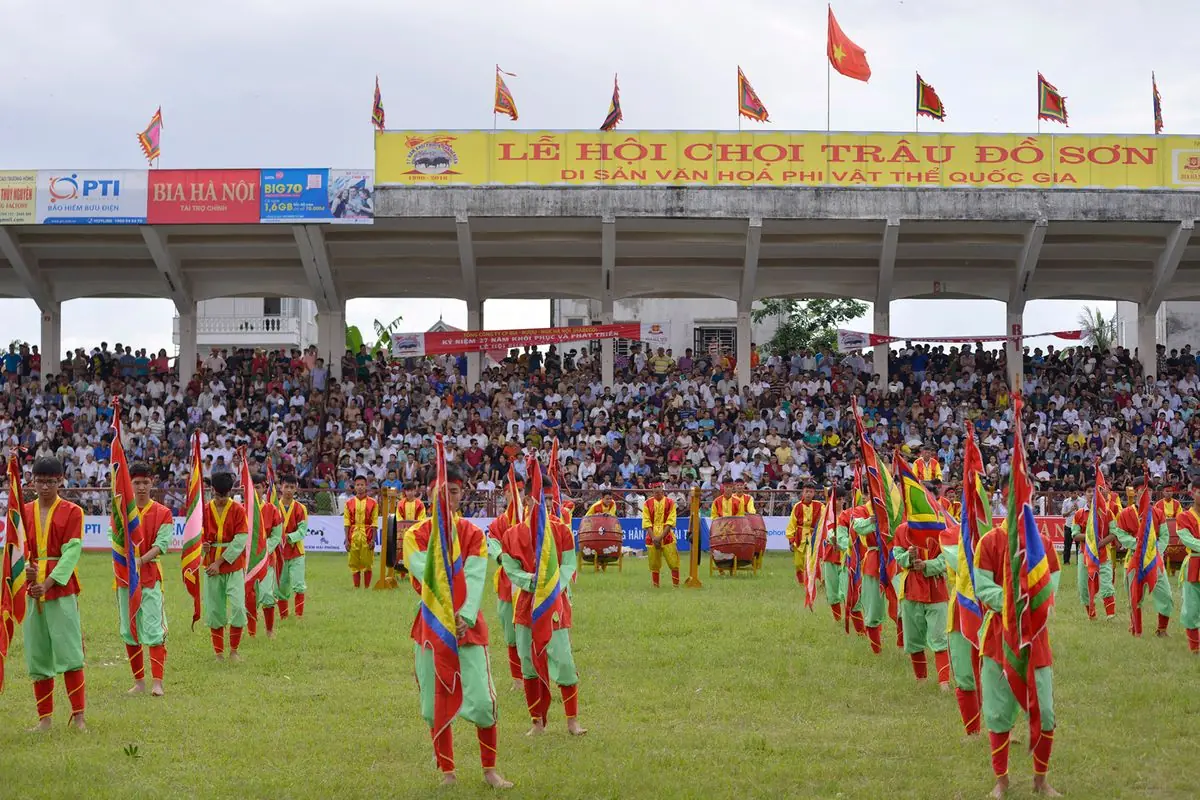
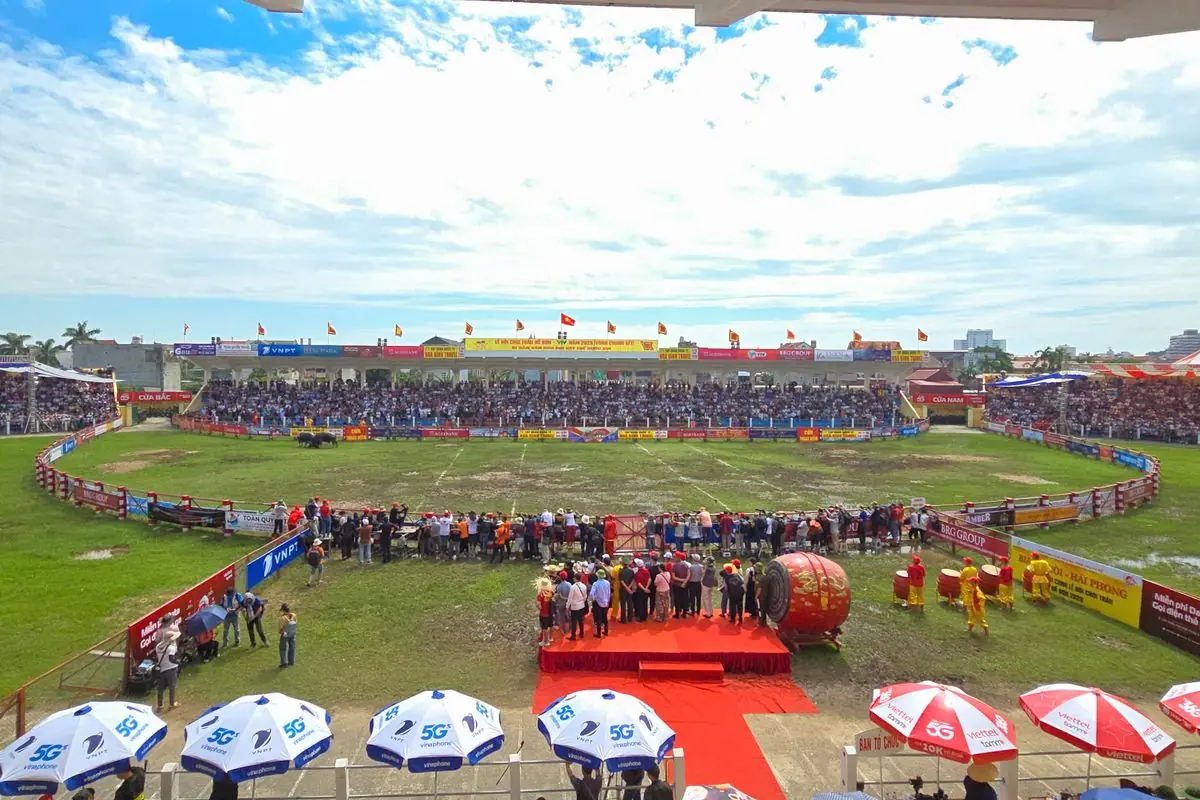
Festival time at Do Son stadium: flag dancers and drummers perform in front of a packed stand.
Drums echo across the stadium, colorful flags flutter above the stands, and two massive buffaloes enter the arena as the crowd erupts in cheers. This is the atmosphere of the Do Son Buffalo Fighting Festival, whose final round traditionally takes place on the ninth day of the eighth lunar month. It is a religious ceremony with animal sacrifice at its centre: losing buffaloes are slaughtered after their matches and the champion is sacrificed the next day.
When does the Do Son buffalo fighting festival take place?
The Do Son Buffalo Fighting Festival is held in Do Son Ward, Hai Phong, Vietnam. Its two main competition days follow the Vietnamese lunar calendar: the qualifying round takes place on the eighth day of the sixth lunar month, while the final round takes place on the ninth day of the eighth lunar month.
Religious ceremonies begin before the competitions and continue afterward at local temples and communal houses. The fights take two days at the stadium, while the festival around them runs for weeks.
Do Son buffalo fighting festival 2026 schedule
The 2026 festival marked the return of the qualifying round after eight years during which only the final round had been held.
The two rounds followed this schedule:
| Event | Lunar Date | Gregorian Date |
|---|---|---|
| Qualifying-round ceremonies | 1st-9th days of the 6th lunar month | July 14-22, 2026 |
| Qualifying competition | 8th day of the 6th lunar month | July 21, 2026, from 7:30 AM |
| Final-round ceremonies | 1st-16th days of the 8th lunar month | September 11-26, 2026 |
| Final competition | 9th day of the 8th lunar month | September 19, 2026, from 7:30 AM |
| Champion buffalo sacrifice ceremony | 10th day of the 8th lunar month | September 20, 2026 |
| Closing religious ceremonies | 16th day of the 8th lunar month | September 26, 2026 |
Both competitions took place at Do Son Central Stadium, 274 Ly Thanh Tong Street, Do Son Ward, Hai Phong.
The qualifying round on July 21 featured 32 buffaloes competing in 16 head-to-head matches. Of these, 28 entries came from four local religious institutions: Nghe Temple, Ngoc Xuyen Communal House, Nam Communal House, and Ngoc Hai Communal House. The remaining four places went to owners whose buffaloes had achieved notable results in 2025.
Following the qualifying round, 15 buffaloes advanced to the final competition on September 19. Winning buffaloes continued through successive matches until the champion was determined.
When is the Do Son buffalo fighting festival in 2027?
The festival keeps the same lunar dates every year, and the Do Son organizers publish the detailed schedule closer to the time.
Based on the traditional lunar dates and their corresponding Gregorian dates in 2027, the expected schedule is:
| Event | Lunar Date | Expected Gregorian Date |
|---|---|---|
| Qualifying round | 8th day of the 6th lunar month | Sunday, July 11, 2027 |
| Final round | 9th day of the 8th lunar month | Thursday, September 9, 2027 |
These dates are calculated from the lunar calendar and should not be treated as an officially confirmed competition schedule.
Opening times, the number of participating buffaloes, ceremonial activities, and visitor arrangements will need to be confirmed by the organizers.
In 2026, the festival schedule came out in mid-June, about five weeks before the qualifying round. Booking refundable rooms and transport for 2027 leaves room to move once the official dates appear.
Do you need a ticket to watch the Do Son buffalo fighting festival?
Organizers do not sell admission tickets. Instead, stadium access is controlled through invitation passes distributed according to the venue’s safe seating capacity.
For the 2026 festival, the planned allocation included approximately 12,000 invitations for the qualifying round and 18,000 for the final round.
Invitations were distributed among officials, participating organizations, relevant agencies, and local residents. Passes intended for residents were allocated through local neighborhood groups.
How can independent travelers get an invitation?
In 2026, organizers did not announce a public online registration system or a dedicated invitation collection point for independent tourists.
Without an invitation, arriving early does not get you into the stands, whether you are from another Vietnamese province or from abroad.
Before traveling, you can contact the Do Son Ward authorities or local tourism information services to ask about the admission arrangements for that year’s festival.
On an organized group trip, ask the tour operator whether they actually hold valid invitations.
Can you watch without an invitation?
Yes, there are alternatives.
Organizers installed large LED screens outside the stadium in 2026 so visitors who could not enter the stands could still follow the matches.
The final round on September 19 was also broadcast live on VTV6, VTVgo, and Hai Phong television channels. Coverage began around 7:30 AM and continued through the morning.
For first-time visitors, the outdoor screen still comes with the drums, festive decorations, and crowds, without the squeeze inside the packed stadium.
The screens, television coverage, and invitation arrangements above are from 2026; organizers set them again for each festival.
How to get to Do Son from Hai Phong city center
Do Son is approximately 20 kilometers from central Hai Phong.
The most common route follows Pham Van Dong Road, also known as Provincial Road 353, toward the coastal district.
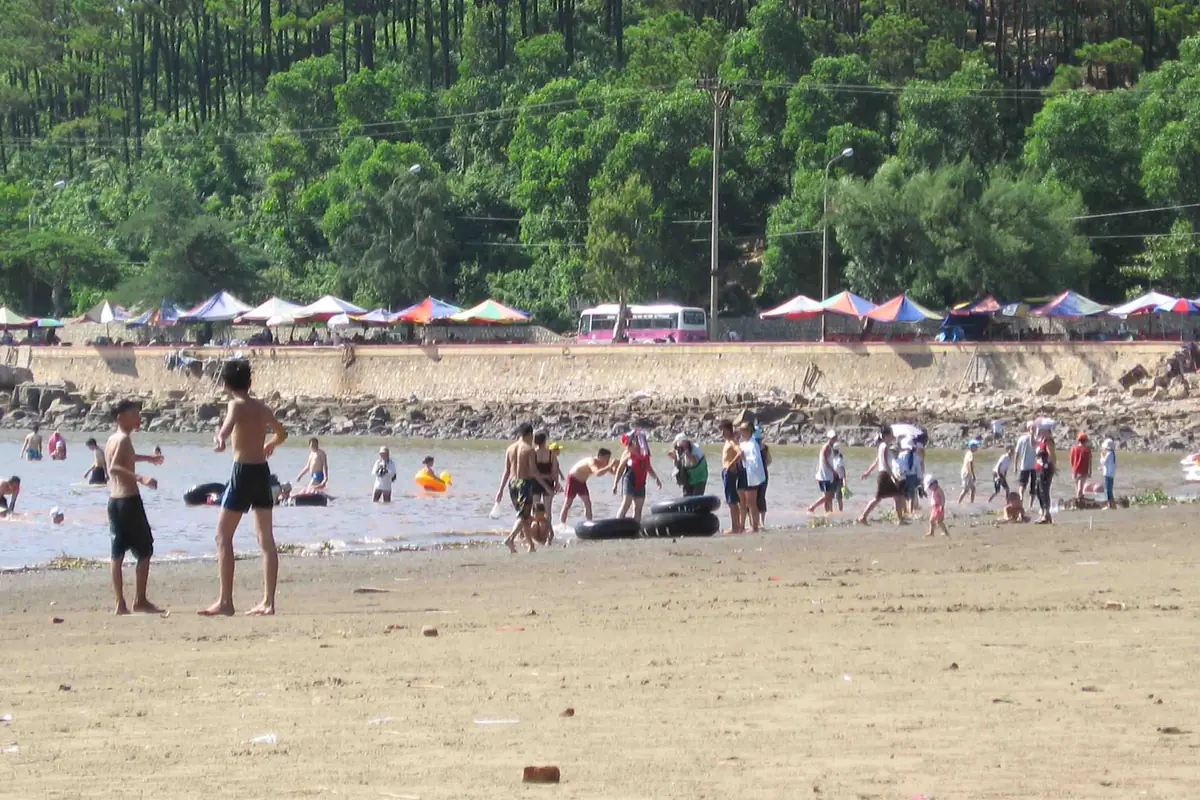
Under normal traffic conditions, the journey by car takes around 20-30 minutes, depending on where you start.
On the day of the final competition, however, thousands of visitors travel toward the stadium. Traffic restrictions and congestion can make the journey considerably longer.
By taxi or ride-hailing service
This is usually the easiest option for families, groups of friends, and international visitors unfamiliar with Hai Phong’s transport system.
Enter Do Son Central Stadium, 274 Ly Thanh Tong Street as your destination.
During the festival, traffic controls may prevent vehicles from reaching the stadium entrance directly. Agree on a pickup spot with your driver beforehand, somewhere vehicles are allowed to stop.
Check the estimated fare before confirming your ride, as ride-hailing prices may rise during busy festival hours.
By bus number 03
Bus route 03 connects the VSIP industrial area, Hai Phong’s Political-Administrative Center, central neighborhoods, and Do Son.
The route passes through major roads including Lach Tray, Pham Van Dong, and Ly Thanh Tong before continuing toward Do Son’s Zone 2 beach area and Ben Nghieng.
Published fares are:
| Ticket Type | Reference Fare |
|---|---|
| Single section | VND 25,000 per person |
| Full route | VND 30,000 per person |
A route adjustment announced in 2025 listed departures every 15 minutes during peak hours and every 30 minutes during off-peak periods.
However, the operator’s current timetable runs a bus roughly every 40 minutes, with outbound services operating from 5:00 AM to 6:00 PM and return services from 6:00 AM to 7:10 PM.
Look up the operator’s timetable the night before if you want to be at the stadium for the 7:30 AM start.
The bus is a budget-friendly choice for travelers with a flexible schedule, though taxis are generally more convenient when festival traffic restrictions are in effect.
By motorbike or private car
Pham Van Dong Road provides a relatively straightforward drive to Do Son, making it convenient to combine the festival with a visit to the seaside.
The streets around the stadium can become crowded early in the morning, though.
Use designated parking areas with attendants, keep your parking ticket, and follow traffic instructions.
Avoid leaving your vehicle on sidewalks, near emergency exits, or along roads reserved for festival security and emergency services.
Who is worshipped at the Do Son buffalo fighting festival?
The reason buffalo fighting matters so much in Do Son sits in the local temples and communal houses, where the ceremonies run before and after the fights.
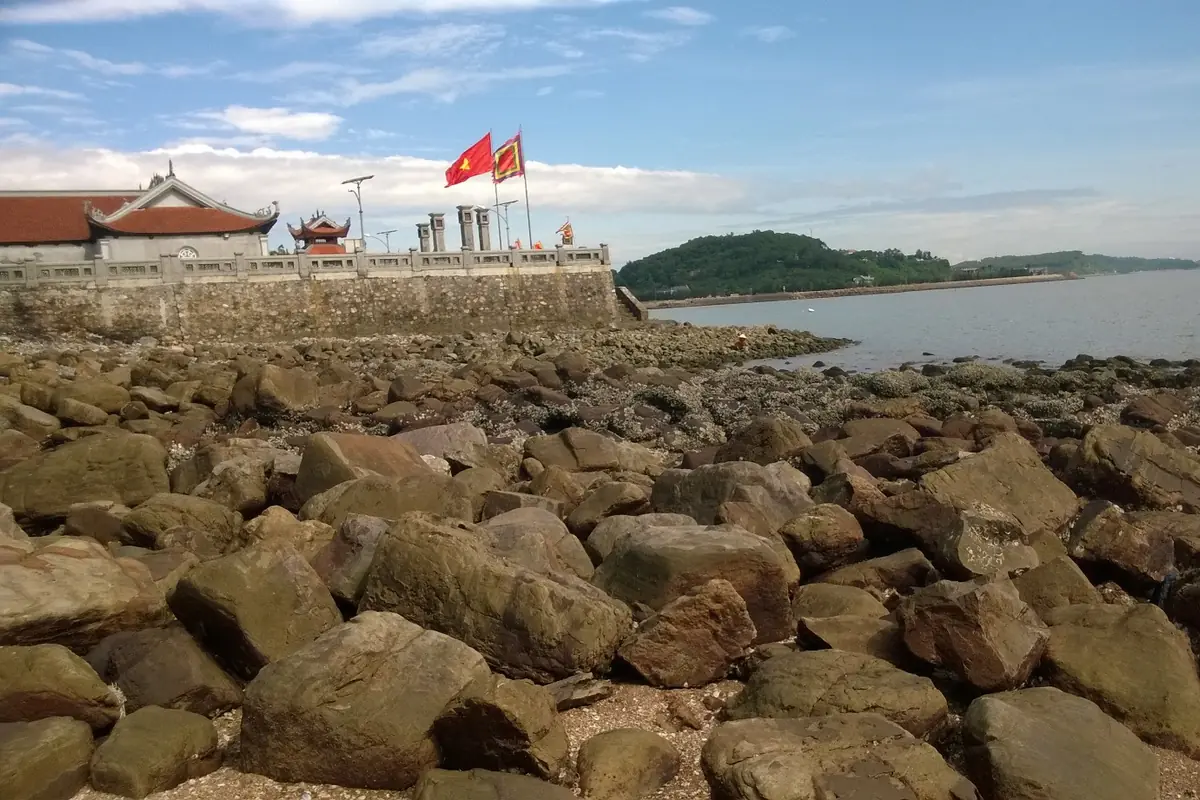
The festival is rooted in the worship of Diem Tuoc Dai Vuong, a guardian deity revered as the tutelary spirit of the Do Son region.
For generations, local fishing communities have honored this deity as a protector of their lives and livelihoods at sea.
The festival also includes water-deity worship, with prayers for favorable weather, calm seas, safe fishing journeys, and prosperity.
Local communities use it to thank the gods, bring the neighborhoods together, and keep rituals passed down over generations.
After a period of interruption, the festival was revived in 1990 and has continued since then.
On December 27, 2012, it was added to Vietnam’s National List of Intangible Cultural Heritage.
Heritage status has not ended the controversy, most of which centres on the buffalo sacrifice rituals.
What happens during the religious ceremonies?
Traditional ceremonies take place at Nghe Temple, Nam Hai Than Vuong Temple, several local communal houses, and the stadium.
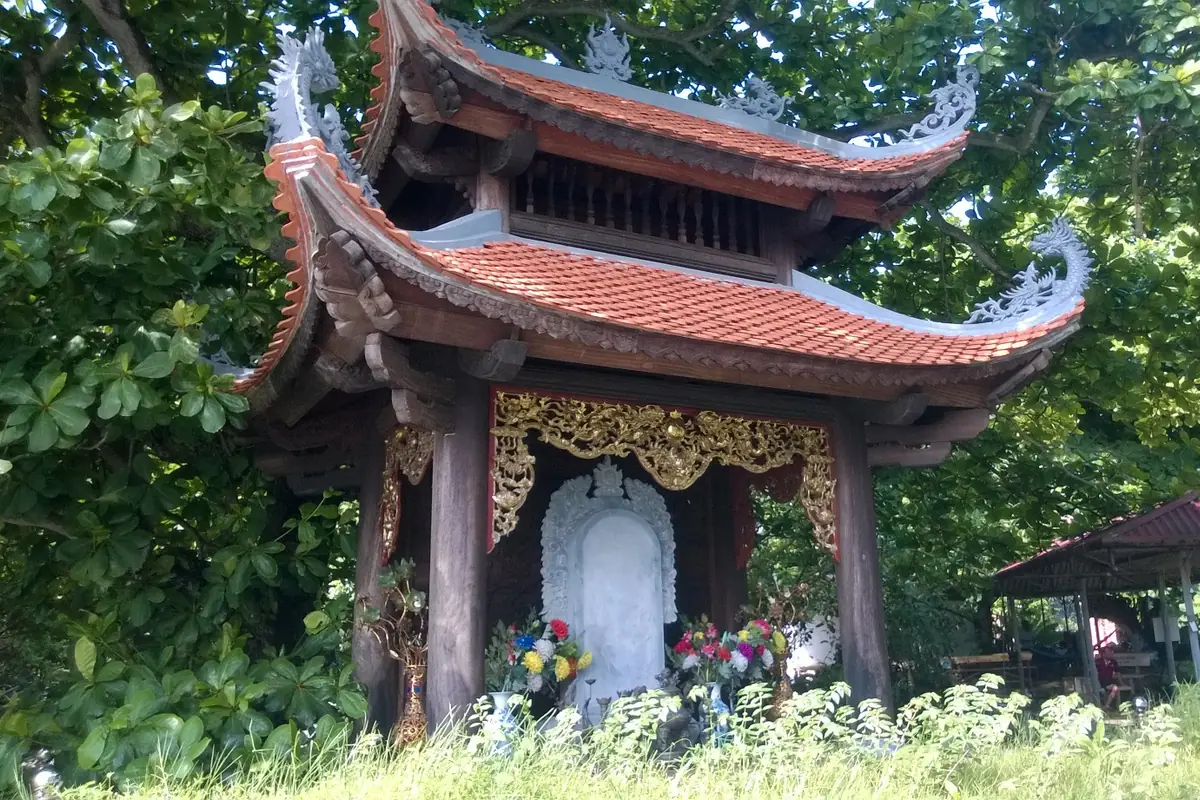
The religious program includes incense offerings, ceremonial flag raising, water processions, prayers to the deities, processions honoring the village guardian spirit, the sacrifice of the champion buffalo, thanksgiving rituals, and concluding ceremonies.
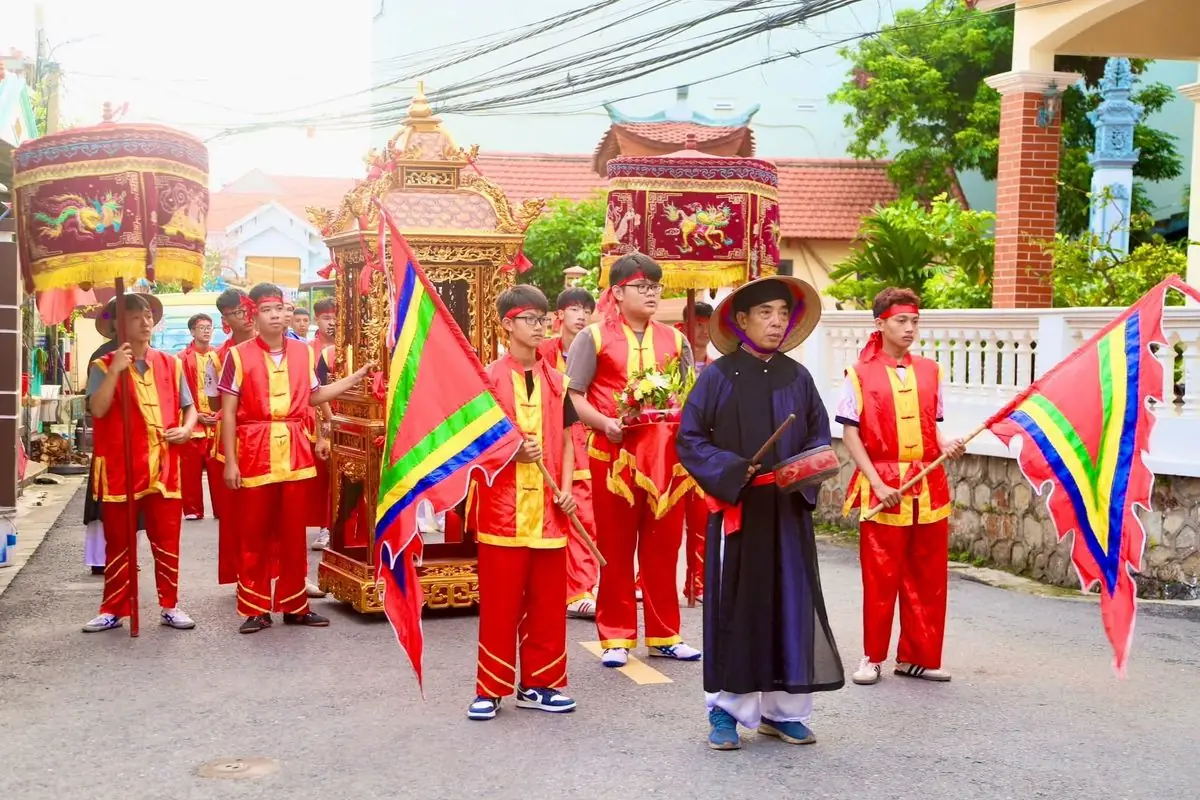
One ritual is the presentation of the buffalo at its communal house.
After this ceremony, the participating animal is respectfully referred to as "ong trau," meaning "Mr. Buffalo."
This title reflects the buffalo’s special position within local religious beliefs.
The same animal that enters the ring is also a sacred offering in the community’s ceremonies.
Many ceremonies take place before or after the main fighting day, so travelers interested in Vietnamese folk culture can follow them at the temples and communal houses and leave the matches out.
How are the fighting buffaloes selected and raised?
Not every buffalo is considered suitable for the Do Son festival.
Owners often spend considerable time searching for, selecting, and caring for their animals before the competition.
Some owners have described traveling to Vietnam’s northern mountainous provinces, the Mekong Delta, and even China or other Southeast Asian countries to find suitable buffaloes.
They typically look for strong bodies, thick skin, large horns, closely positioned horn bases, and good physical endurance.
Some competing buffaloes are around 10-15 years old and have participated in previous fights before arriving in Do Son.
Training can be intensive.
Owners may exercise their buffaloes through running on sand, swimming in ponds, and mud bathing to maintain physical fitness.
Several months before the festival, the animals may receive additional food and conditioning. They are also gradually introduced to flags, drums, and crowded environments to become accustomed to the festival atmosphere.
Even a buffalo used to drums and crowds is a powerful animal that can react unpredictably when frightened or provoked.
What safety rules applied to buffalo owners in 2026?
Organizers introduced stricter safety requirements for buffalo care and training.
Owners were required to arrange regular supervision, cover horn tips when handling or moving the animals, and train them away from residential areas.
Elderly people and children were prohibited from entering training areas.
Buffaloes underwent inspections before being accepted into the competition, and animals displaying dangerous aggression toward people could be disqualified and replaced.
These measures were intended to reduce the risk of accidents involving handlers, residents, and spectators.
Are losing buffaloes killed? What happens to the champion?
If scenes of injured animals or slaughter upset you, read this part before you decide to go.
Losing buffaloes are slaughtered, and the champion buffalo is also sacrificed as part of a religious ceremony.
Winning the competition won’t spare the animal or let it live out its remaining years.
During the 2026 final round, losing buffaloes were taken away for slaughter, and their meat was sold to residents and visitors.
Prices ran from approximately VND 4 million to VND 5 million per kilogram, far higher than ordinary buffalo meat.
These prices reflect traditional beliefs that festival buffalo meat brings luck. There is no established evidence that the meat has superior nutritional value because the animal participated in the festival.
Prices can also vary depending on the individual buffalo and the timing of the sale.
During the 2025 festival, slaughtering and meat sales took place while other matches were still underway.
As a result, visitors moving around the festival area may encounter scenes of butchering or meat displays that they find disturbing.
The champion buffalo receives its own ceremonial sacrifice.
In 2026, this ritual was scheduled for the morning of September 20, the day after the final competition, as part of the traditional offerings and thanksgiving ceremonies.
Why is the champion buffalo sacrificed?
In the religious traditions of Do Son, the buffaloes selected for the festival are understood as offerings to the deities.
The champion is the animal that stood out in the competition, so its sacrifice is the high point of the thanksgiving ceremony.
This explains why the ritual has lasted across generations, and it is also where the animal welfare questions start.
Some people see the festival as an important part of local cultural identity that deserves preservation.
Others object to making animals fight and subsequently slaughtering them, regardless of the religious or cultural context.
What happened at the 2026 Do Son buffalo fighting final?
The final round on September 19, 2026, attracted more than 20,000 residents and visitors to the area around Do Son Central Stadium.
After a series of elimination matches, buffalo number 15, owned by Le Ba Ngoc and representing Ngoc Xuyen Communal House, became the champion.
It defeated buffalo number 21, owned by Hoang Gia Dung and representing Nam Communal House, in the final match.
The winning buffalo weighed approximately 900 kilograms and had been purchased in Hanoi.
The victory also marked the third time Le Ba Ngoc had owned a champion buffalo, following previous wins in 1993 and 2005.
The 2026 prize structure was:
| Prize | Winning Buffalo | Prize Money |
|---|---|---|
| First place | Buffalo No. 15 | VND 100 million |
| Second place | Buffalo No. 21 | VND 70 million |
| Joint third place | Buffaloes No. 05 and 23 | VND 30 million each |
What other activities took place during the festival?
The buffalo fighting competition was only one part of the wider celebrations.
On the afternoon of September 18, a traditional wrestling exchange featuring approximately 30 wrestlers took place at May 15 Square.
That evening, a street carnival traveled from Dam Vuong Park to May 15 Square.
The parade featured decorated vehicles with models representing the participating buffaloes, along with lion and dragon dances and other performances.
Earlier in September, Do Son also hosted a week of cultural, tourism, and commercial activities.
The wrestling, carnival, and culture week give the festival atmosphere and local traditions without watching animals fight.
Is it safe to attend the Do Son buffalo fighting festival?
Organizers put many safety measures in place, and some risk remains.
Fighting buffaloes can weigh hundreds of kilograms, have large horns, and move very quickly when agitated, with tens of thousands of people around the stadium.
In 2026, the fighting arena was separated from spectator stands by reinforced concrete barriers and B40 wire fencing.
Buffalo exit gates, emergency escape routes, and other protective structures were reinforced.
Police officers and festival personnel were also deployed to manage security, traffic, and fire prevention.
Safety tips for first-time visitors
For international tourists, the safety and invitation rules generally apply in the same way as they do to Vietnamese visitors.
Save the stadium address in Vietnamese, keep a translation app available, and ask staff for directions before entering controlled areas.
Organizers have not announced English-language commentary, translation services, or a section for international visitors.
Move away from danger in an emergency and follow instructions from authorized personnel.
Vietnam’s medical emergency number is 115.
Should you attend the Do Son buffalo fighting festival?
The Do Son Buffalo Fighting Festival has deep cultural roots in the spiritual life of Vietnam’s coastal fishing communities.
Incense offerings, water processions, temple ceremonies, drums, flags, and local gatherings all reflect traditions that have been preserved over many generations.
At the same time, the buffaloes may be injured during the matches, and both losing animals and the champion are slaughtered as part of the festival’s practices.
Skipping the arena still leaves Do Son’s temples and communal houses, the festival’s history, and conversations with local residents during the festival days.
Frequently asked questions
When is the Do Son buffalo fighting festival in 2027?
According to the traditional lunar schedule, the qualifying round is expected on July 11, 2027, corresponding to the eighth day of the sixth lunar month. The final round is expected on September 9, 2027, corresponding to the ninth day of the eighth lunar month. These dates have been calculated from the lunar calendar and have not yet been officially confirmed by organizers.
What time does the Do Son buffalo fighting final start, and where is it held?
In 2026, the final round began at 7:30 AM on September 19 at Do Son Central Stadium, 274 Ly Thanh Tong Street, Do Son Ward, Hai Phong. The starting time for the 2027 final will need to be confirmed through an official announcement.
Do you need to buy tickets for the Do Son buffalo fighting festival?
In 2026, organizers did not sell tickets. Instead, visitors entered the stadium using invitation passes distributed in limited numbers. Those without invitations could watch on large outdoor LED screens or through live television coverage. Avoid purchasing unofficial invitations, as counterfeit passes have been reported.
Are losing buffaloes and the champion buffalo killed?
Yes. Losing buffaloes are slaughtered after their matches, and their meat is sold to residents and visitors. The champion is sacrificed in a traditional religious ceremony, which in 2026 took place the day after the final.
What's the best way to travel from central Hai Phong to Do Son?
A taxi or ride-hailing service is generally the most convenient option for first-time visitors. The journey covers approximately 20 kilometers and usually takes 20-30 minutes in light traffic. Bus number 03 is another option, with published fares of VND 25,000-30,000 per person depending on the journey.