Hanoi to Hai Phong by train: which station, what time, and how much?
Four regular pairs of trains operate between Hanoi and Hai Phong daily, with journeys taking approximately 2 hours 25 minutes to 2 hours 45 minutes. Not every train departs from or terminates at Hanoi Railway Station.
 24 min read
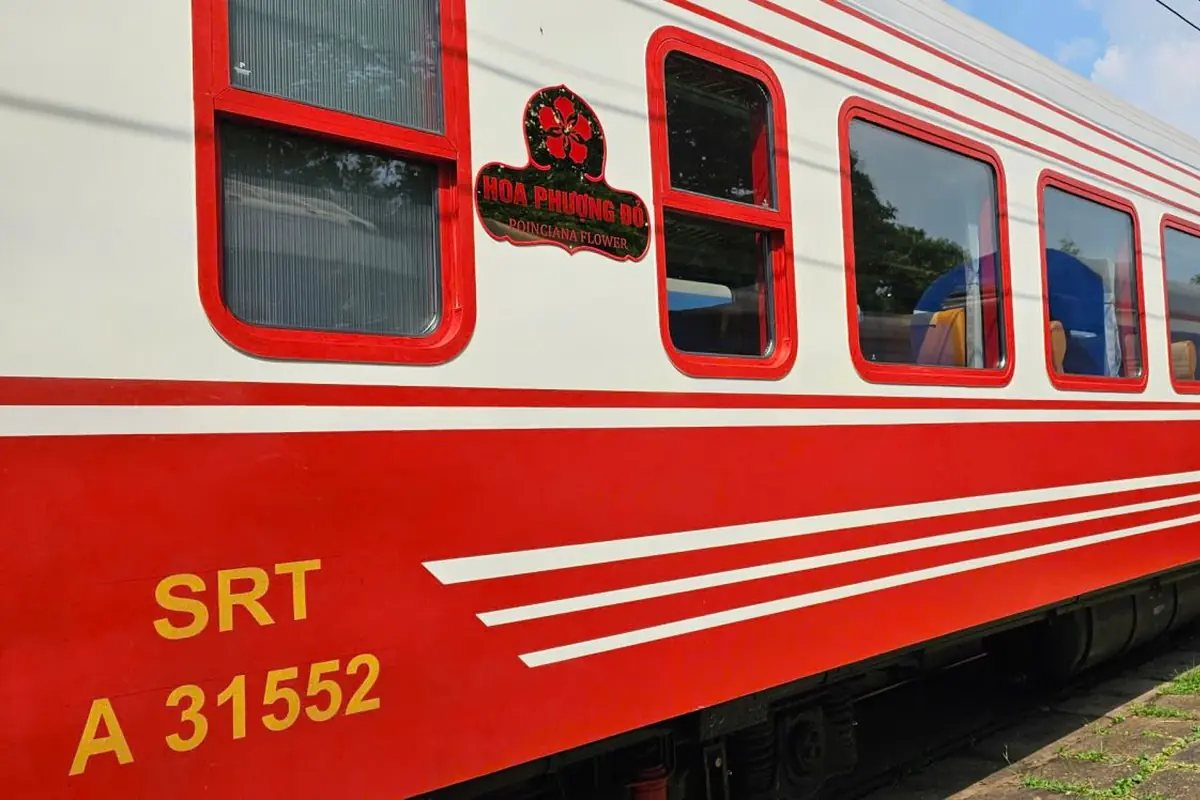
Hoa Phuong Do is the service on all four regular pairs.
Taking the train from Hanoi to Hai Phong is straightforward once you know which station to use. Your first step is to choose your travel date, check the train number, and confirm the departure station printed on your ticket. Several services run daily, but arriving at Hanoi Railway Station when your train actually departs from Long Bien can ruin an otherwise simple journey.
1. Which station does the Hanoi to Hai Phong train leave from?
There are three stations to understand at the Hanoi end of the route: Hanoi Railway Station, Long Bien Station, and Gia Lam Station. They are separate stations on the same railway line. Although several trains stop at more than one of them, their departure and arrival arrangements differ.
Hanoi Railway Station: the most convenient choice for central Hanoi
HP1, LP3, LP5; LP7 on weekends, holidays
Hanoi Railway Station is located at 120 Le Duan Street, close to the Old Quarter, Hoan Kiem Lake, and the Temple of Literature. On maps and booking platforms, it is usually listed as Hanoi Railway Station or simply Hanoi Station.
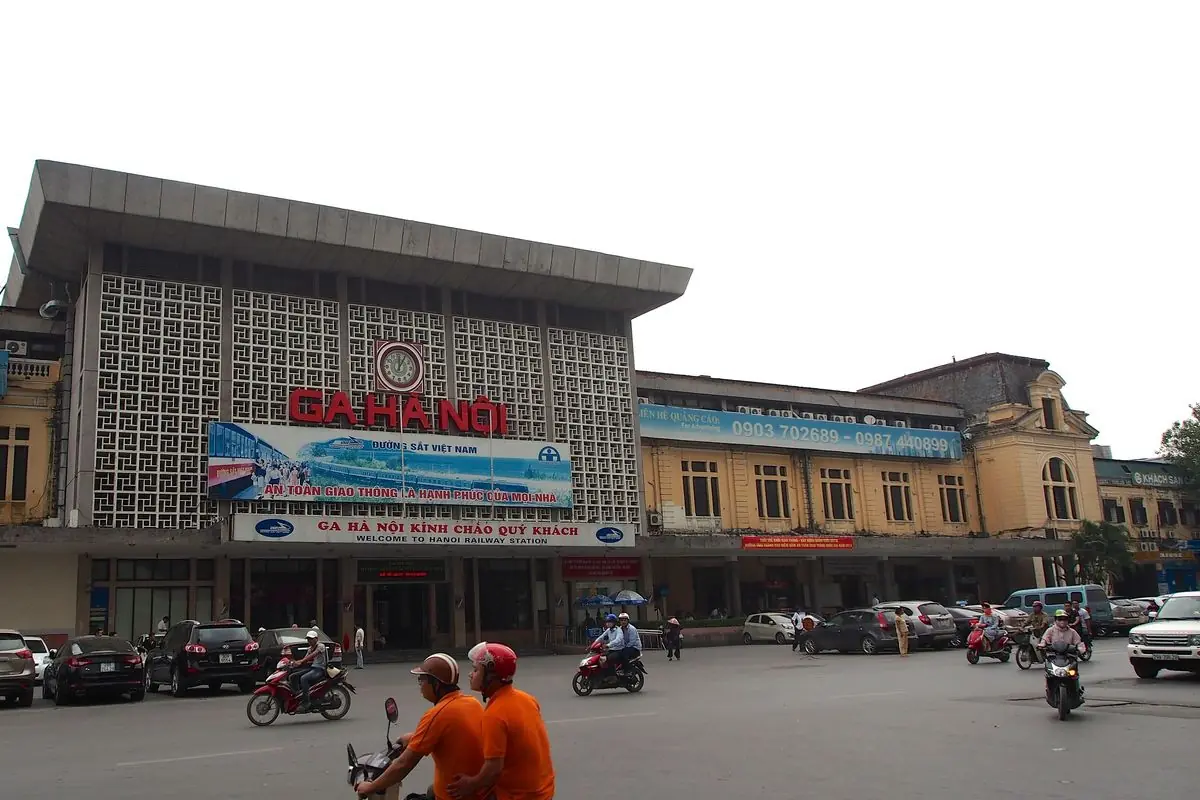
Three regular services depart from here:
- HP1
- LP3
- LP5
LP7 also starts at Hanoi Railway Station on Saturdays, Sundays, public holidays, and Tet holidays.
Hanoi Railway Station is often the easiest option when you are staying around Hoan Kiem, the Old Quarter, or central Ba Dinh. You can arrange a taxi directly from your hotel, enter the station, and find your platform without traveling across the Red River.
Long Bien Station: close to the Old Quarter, but not for every train
LP3, LP5, LP7; not HP1
Long Bien Station sits near the western end of Long Bien Bridge, close to Dong Xuan Market and the northern part of Hanoi’s Old Quarter. It is smaller than Hanoi Railway Station, with more limited waiting space. However, its location can be convenient for travelers staying in the northern Old Quarter.
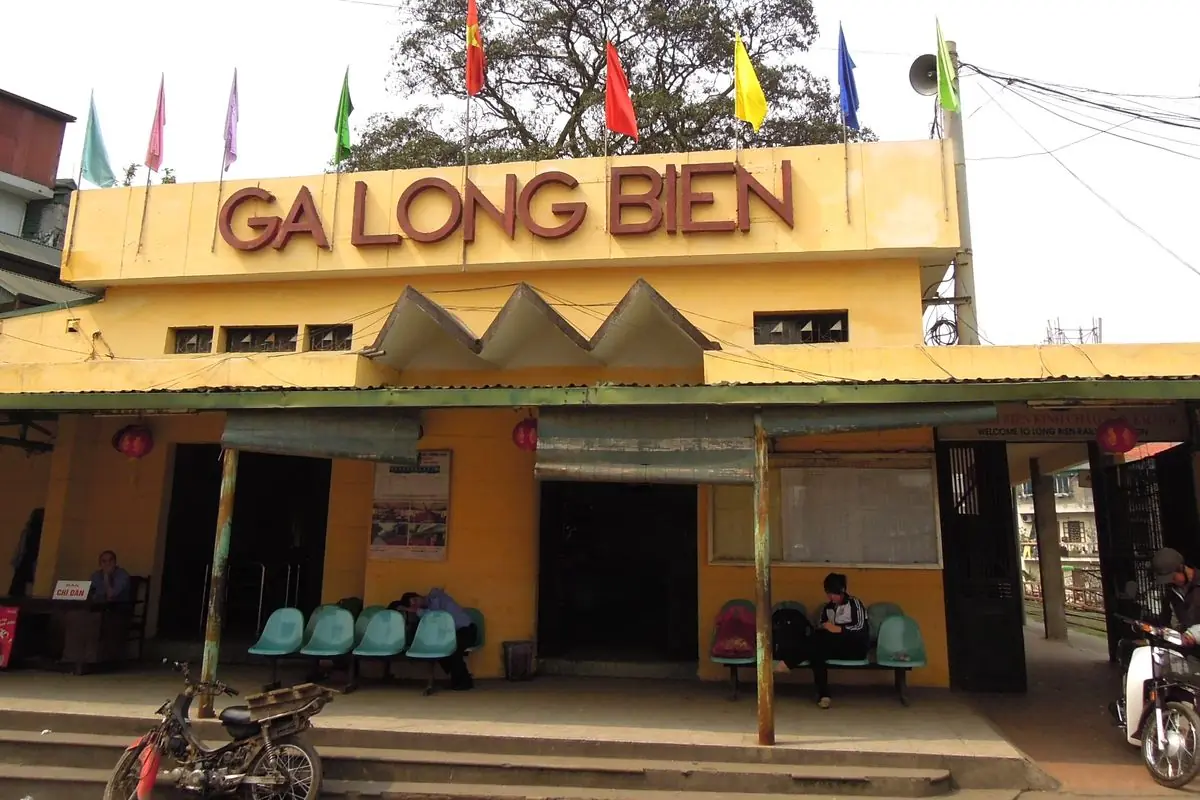
Under the regular timetable:
- LP3, LP5, and LP7 stop at Long Bien Station on their operating days.
- HP1 does not pick up passengers at Long Bien Station.
One important detail concerns LP7. On weekdays, LP7 normally starts at Long Bien. On Saturdays, Sundays, and public holidays, it starts at Hanoi Railway Station before stopping at Long Bien.
That means two tickets for LP7 can show different departure stations depending on the date. Always read the station name on the ticket rather than relying on the train number alone.
Gia Lam Station: a useful alternative across the Red River
All four services stop here
Gia Lam Station is in the Ngoc Lam area, east of the Red River. It is not another name for Long Bien Station.
Travelers staying in Ngoc Lam, Bo De, Long Bien, or other eastern parts of Hanoi may find Gia Lam more convenient than traveling into the city center.
All four regular Hanoi-Hai Phong services stop at Gia Lam:
- HP1
- LP3
- LP5
- LP7
The same applies in the opposite direction.
You can select Gia Lam as your departure station when booking instead of buying a ticket from central Hanoi. If you intend to board at Gia Lam, book your ticket from Gia Lam. Do not automatically assume that a ticket issued from Hanoi Railway Station allows you to board at a later station without checking the conditions.
Hai Phong Station vs. Thuong Ly Station
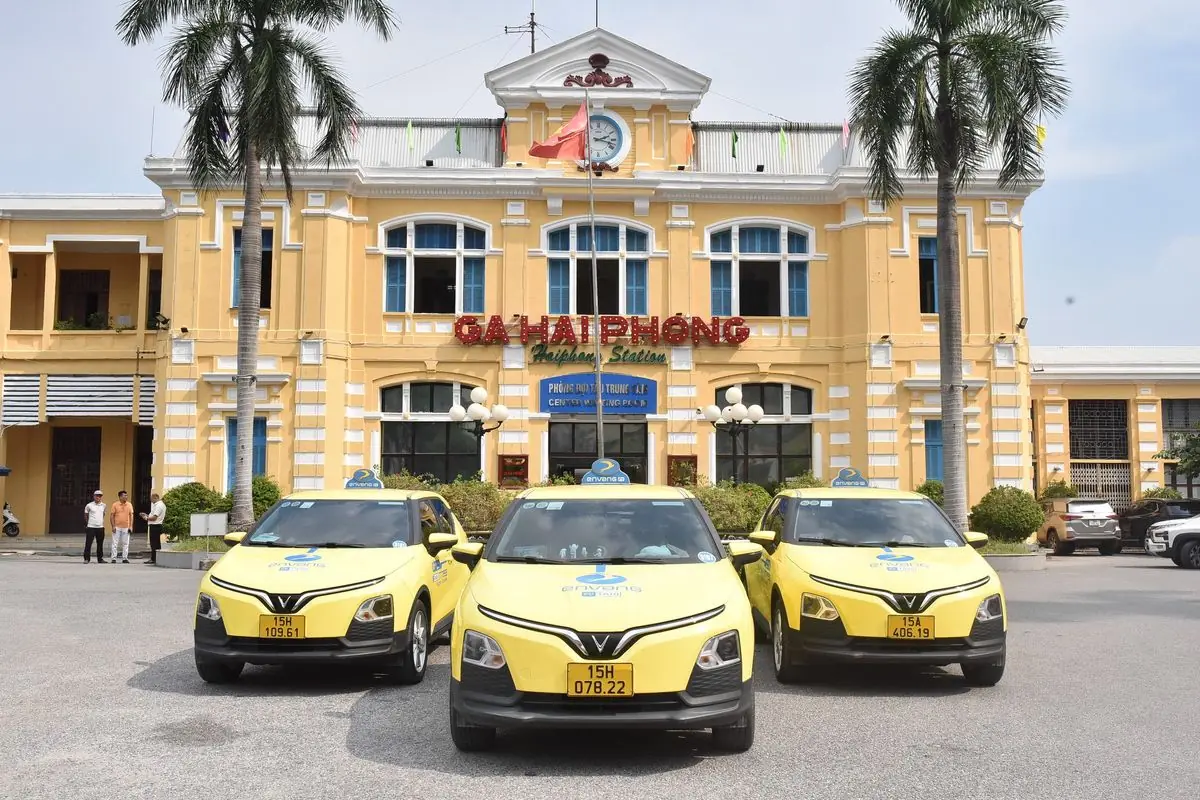
At the Hai Phong end, most visitors will want to get off at Hai Phong Railway Station, located at 75 Luong Khanh Thien Street. The station is close to the city center, making it convenient for hotels around Dien Bien Phu, Tran Phu, Cau Dat, and Tam Bac.
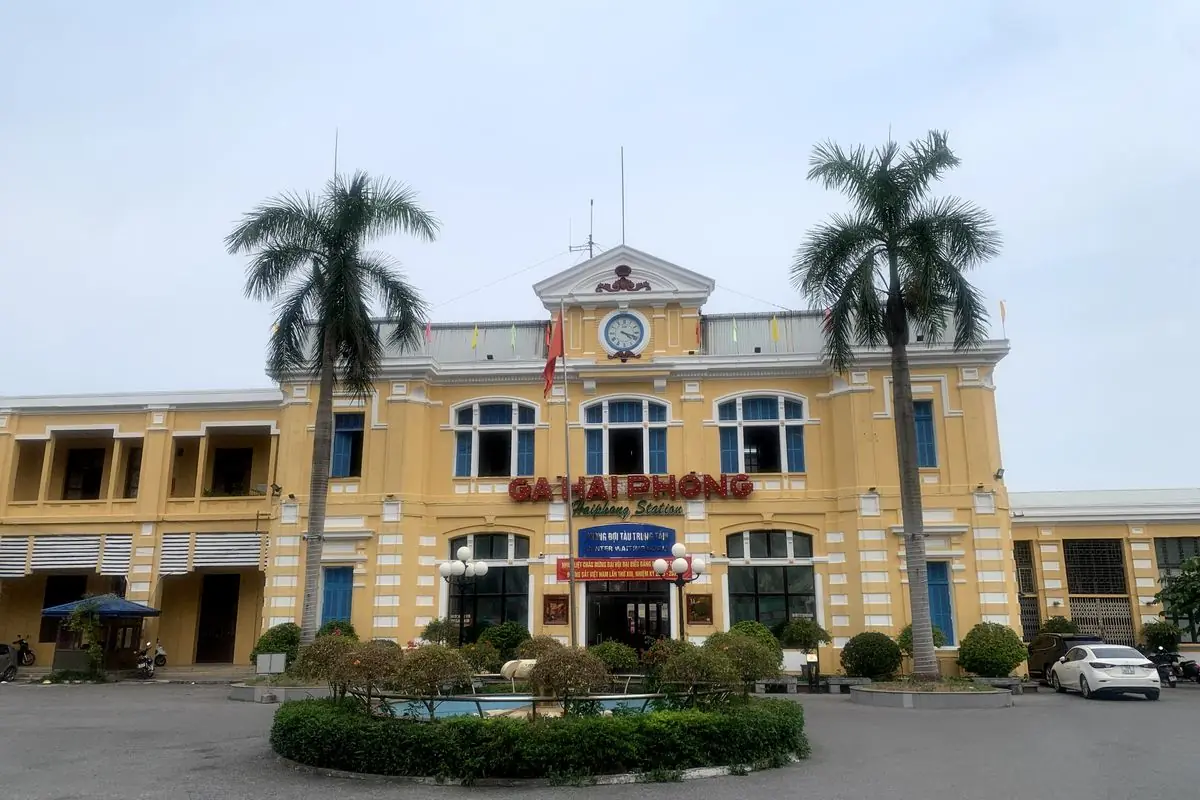
Before reaching the final station, trains also stop at Thuong Ly Station, west of central Hai Phong. Thuong Ly may be useful if your accommodation or next destination is closer to the western part of the city. All four regular pairs of trains stop at Thuong Ly.
For a first visit, Hai Phong Railway Station is usually the more practical choice. It places you close to many central hotels, restaurants, and local transport options.
2. Hanoi to Hai Phong train timetable for 2026
The railway line between Hanoi and Hai Phong is approximately 102 kilometers long. Four regular pairs of trains operate daily, with journeys generally taking between 2 hours 25 minutes and 2 hours 45 minutes.
The tables below follow the timetable introduced on February 10, 2026. Times at intermediate stations may vary slightly following timetable adjustments. Check your confirmed ticket before traveling.
Hanoi to Hai Phong train schedule
| Train | Departure station | Departure | Arrival in Hai Phong |
|---|---|---|---|
| HP1 | Hanoi | 06:00 | 08:25 |
| LP3 | Hanoi | 09:25 | 12:00 |
| LP5 | Hanoi | 15:15 | 18:00 |
| LP7 | Long Bien (weekdays) | Around 18:20-18:21 | 20:55 |
Important for LP7: On Saturdays, Sundays, public holidays, and Tet holidays, the train departs from Hanoi Railway Station at 18:10 before stopping at Long Bien.
The best departure depends on how you want to spend your time in Hai Phong.
- 06:00
HP1
This is the best choice if you want an early start. Arriving at 08:25 gives you nearly a full day in Hai Phong. Have breakfast, drop your luggage at your hotel, and begin exploring without losing the morning.
- 09:25
LP3
A more relaxed option for travelers who do not want to wake up before dawn. The train reaches Hai Phong at 12:00, which works well for lunch followed by hotel check-in or sightseeing.
- 15:15
LP5
Useful if you have plans in Hanoi during the morning and want to spend the night in Hai Phong. The train arrives at 18:00, leaving time to reach your hotel and go out for dinner.
- Evening
LP7
Suitable for travelers moving between the two cities after work or after spending a full day in Hanoi. The train reaches Hai Phong at 20:55. Choose accommodation with evening reception and inform the property of your arrival time, especially if you are staying in an apartment or small homestay.
HP1 is generally the better option for a day trip from Hanoi. LP3 is still possible, but you will have considerably less time in Hai Phong.
Hai Phong to Hanoi train schedule
| Train | Departure from Hai Phong | Arrival station | Arrival time |
|---|---|---|---|
| LP2 | 06:05 | Hanoi | Around 08:49-08:50 |
| LP6 | 09:10 | Hanoi | 11:52 |
| LP8 | 15:00 | Long Bien (weekdays) | Around 17:30-17:40 |
| HP2 | 18:40 | Hanoi | 21:15 |
LP8 follows a special arrangement. On weekdays, it normally terminates at Long Bien Station. On Saturdays, Sundays, public holidays, and Tet holidays, it continues to Hanoi Railway Station, arriving at approximately 17:40.
LP2 and LP6 also stop at Long Bien before continuing to Hanoi Railway Station. HP2 does not stop at Long Bien.
HP2 at 18:40 is the latest departure among the four regular services for a day trip to Hai Phong. It leaves enough time for sightseeing and an early dinner, but you still need to allow time to return to the station.
Starting dinner at 17:30 does not guarantee you will be standing on the platform by 18:30. A busy restaurant, delayed food, or a late taxi can make the last part of your day unnecessarily stressful.
Are there extra trains on weekends?
Yes. Vietnam Railways may operate additional services during weekends, public holidays, and other busy periods.
Extra train numbers include:
- LP9: An additional Hanoi-to-Hai Phong service, generally arranged for Saturdays or periods of higher tourist demand.
- LP10: An additional Hai Phong-to-Hanoi service. It operates on Sundays, leaving Hai Phong at 16:20 and reaching Hanoi at 19:03.
- HD2: An additional service associated with the Hai Duong-Hanoi section, rather than a standard full-route Hai Phong-to-Hanoi option.
These are not necessarily daily services, and their operation may change according to demand. Only include an additional train in your plans when it appears as available for your exact travel date on the official booking system.
3. Which stations does the train stop at?
The Hanoi-Hai Phong railway runs through several towns and urban areas in northern Vietnam.
The principal stations along the route, in order from Hanoi, are:
Hanoi → Long Bien → Gia Lam → Cam Giang → Hai Duong → Phu Thai → Thuong Ly → Hai Phong
Not every train stops at every station. HP1 and HP2 have fewer intermediate stops than some of the LP services. In particular, HP1 does not stop at Long Bien or Cam Giang. HP2 also skips Long Bien. The LP services generally make more intermediate stops.
These differences are not especially important when you are going all the way from Hanoi to Hai Phong. You board at your selected station and remain on the train until your destination. However, anyone traveling from Cam Giang, Hai Duong, or Phu Thai must choose a service that actually stops there.
Does the train cross Long Bien Bridge?
Under normal operating conditions, trains traveling between Long Bien and Gia Lam cross the Red River on Long Bien Bridge. For international visitors who have never taken a Vietnamese train, this is one of the more interesting sections of the journey.
You may be able to see the river, sandbanks, and neighborhoods along its banks. The view depends on your seat, the direction you face, and the weather. Do not expect the entire route to resemble a scenic mountain railway.
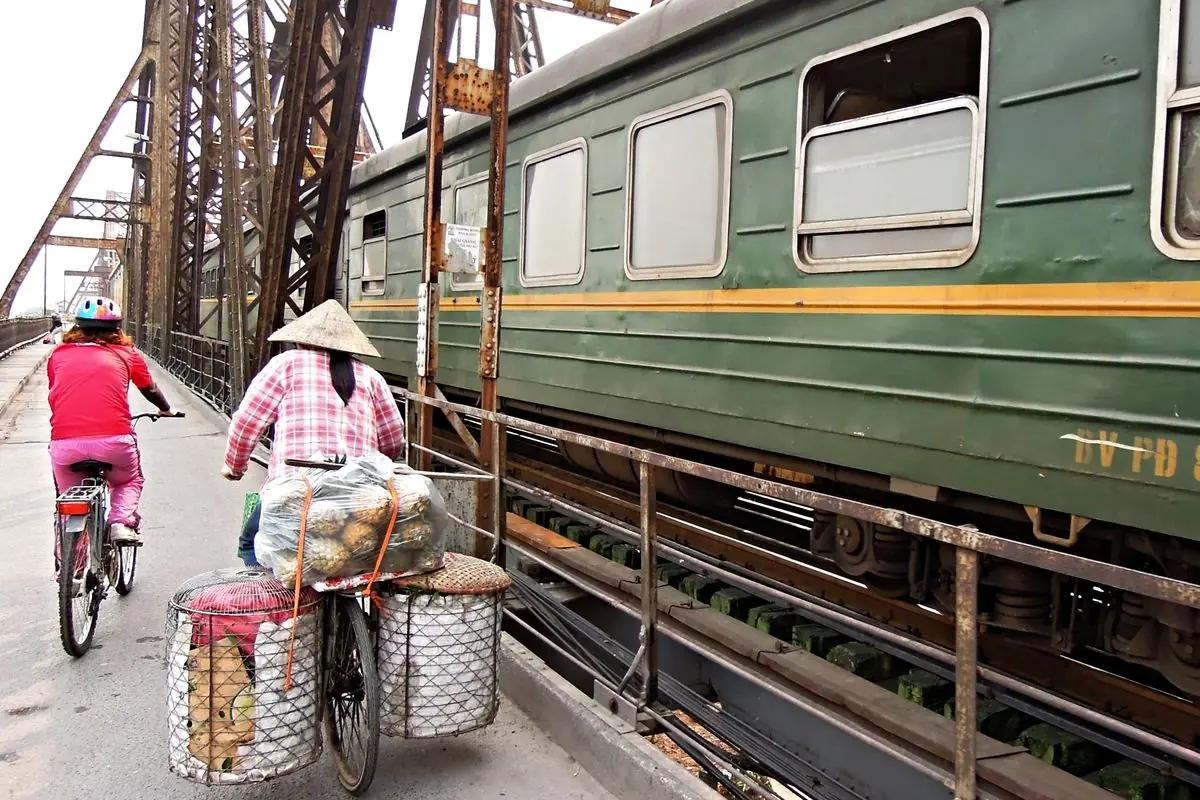
Beyond Hanoi, the train passes residential neighborhoods, level crossings, towns, farmland, and industrial areas. The approach to Hai Phong also includes substantial urban scenery.
Hanoi’s famous Train Street, where visitors gather to photograph trains passing close to buildings, is a separate attraction rather than a boarding point for this service.
4. How much is the Hanoi to Hai Phong train ticket in 2026?
Ticket prices depend on the travel date, train, departure station, destination, carriage type, and any discounts available at the time of booking.
Vietnam Railways introduced flexible ticket pricing across all train services from May 1, 2026. As a result, there is no single fare that accurately represents every Hanoi-Hai Phong departure throughout 2026.
The official booking system displays the applicable fare after you select your date, train, stations, and seat.
Published ticket prices for different carriage types
The prices below are useful for understanding the difference between seating classes. They were published by Vietnam Railways during specific periods in 2025. They are historical reference prices, not live quotations.
| Carriage type | Published May 5, 2025: weekday / weekend | Published June 16, 2025: weekday / weekend |
|---|---|---|
| Standard 64-seat carriage | 105,000 / 130,000 VND | Not restated in the announcement |
| 56-seat rotating-chair carriage | 150,000 / 180,000 VND | 150,000 / 180,000 VND |
| 34-seat VIP carriage | 250,000 / 300,000 VND | 300,000 / 350,000 VND |
Prices are per passenger, one way, for 2025.
The June 16, 2025 announcement also stated that seats with a table in the middle of the 56-seat carriage cost an additional 5,000 VND compared with regular seats.
The two announcements show that prices can change even within the same year. For a journey in 2026, use the fare displayed by the official booking system for your chosen departure.
Is a return ticket cheaper than two one-way tickets?
Vietnam Railways has previously offered a 10% discount on the return portion of a round-trip booking, along with other promotional fares for certain passenger groups. However, the applicable discounts and booking conditions may change.
Before paying, compare the total cost of a round-trip booking with two separate one-way tickets.
Booking both directions in advance can be useful on a two-day, one-night trip to Hai Phong. The Sunday evening HP2 service and VIP seats may be particularly popular during busy travel periods.
5. What is the Hoa Phuong Do train? Is it a separate luxury train?
The Hoa Phuong Do service was introduced on the Hanoi-Hai Phong route on May 10, 2025. Its name refers to the red flamboyant flower, a familiar symbol of Hai Phong.
Hoa Phuong Do is not one separately scheduled luxury train.
Instead, the name applies to the upgraded service operated across the four regular pairs of trains:
- HP1 / HP2
- LP2 / LP3
- LP5 / LP6
- LP7 / LP8
These trains include different carriage types, each offering a different level of comfort.
You still book an ordinary train number such as HP1, LP3, LP5, or LP7 when traveling from Hanoi. For the return journey, you choose LP2, LP6, LP8, or HP2. Once you have selected the train, you choose the carriage and seat type.
Some travel websites describe the service as the Hoa Phuong Do luxury train or Hanoi to Hai Phong luxury train. These names generally refer to the upgraded carriages, particularly the VIP carriage, rather than a separate luxury service with its own timetable.
What is inside the 34-seat VIP carriage?
The VIP carriage is the main attraction for travelers who want the Hoa Phuong Do experience.
Its interior takes inspiration from Indochinese design, with wooden flooring, leather-upholstered seats, warm lighting, and decorative details that make the space feel closer to a lounge or small café than a conventional train carriage. The VIP carriage is equipped with Wi-Fi and beverage-service facilities. Complimentary drinks were included in the VIP offering during past operating periods. Summer 2025 also added cakes.
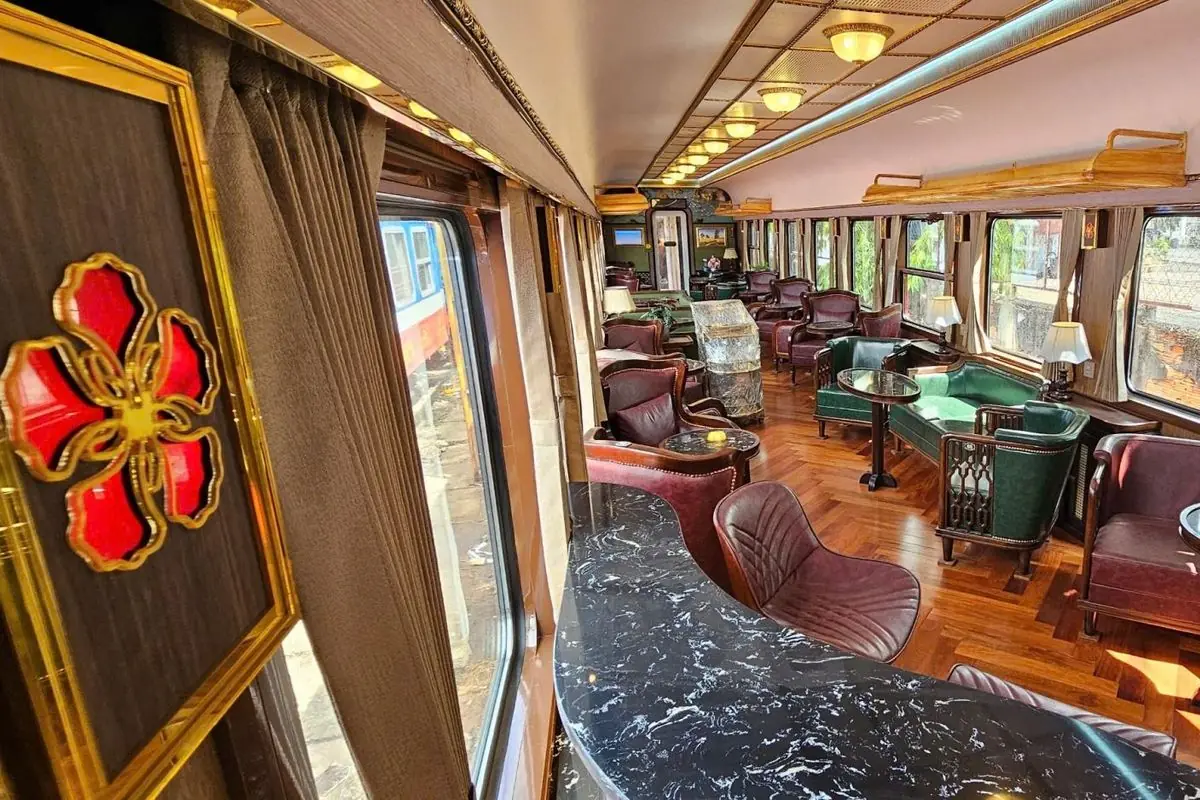
This carriage is worth considering if you want the train journey itself to be part of your trip rather than simply transportation between two cities. It is particularly appealing to couples, groups of friends, and travelers who enjoy photographing interesting interiors.
However, the word luxury needs some context. The VIP carriage is attached to a regular train operating on the existing railway line. Its journey time is similar to that of the other carriages.
You are not paying for a faster train, a private sleeping compartment, or an overnight luxury-rail experience. The additional cost mainly covers the seating, interior design, atmosphere, and included services.
Live music was also mentioned in publicity surrounding the service’s launch, but you should not assume performances take place on every departure.
Is the 56-seat rotating-chair carriage worth choosing?
For a journey lasting less than three hours, the 56-seat carriage offers a sensible balance between comfort and price.
One of its main features is the ability to rotate the seats 180 degrees. This allows passengers to adjust their seats to face the train’s direction of travel. That can be helpful if you dislike sitting backward on a moving train.
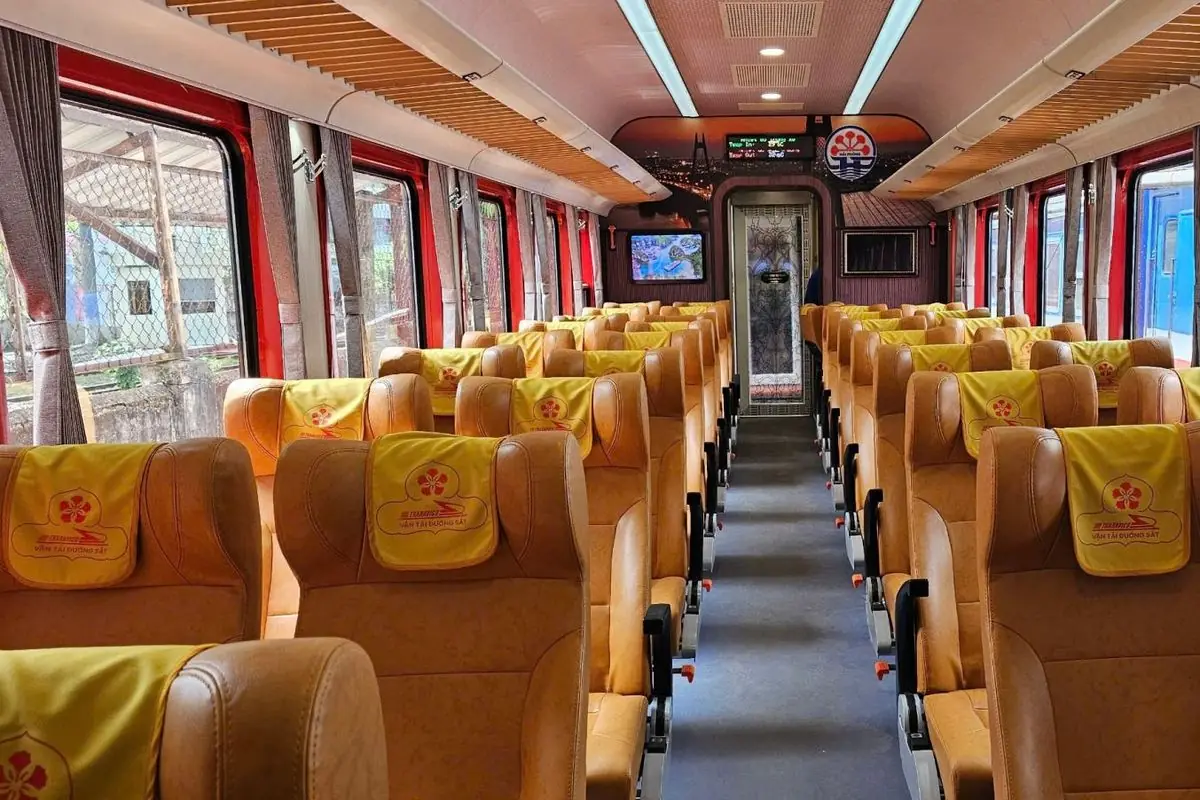
The carriage has air conditioning, windows for sightseeing, and a more conventional seating arrangement than the VIP section. The upgraded carriages also feature electronic information displays and improved toilet facilities.
You do not get the same lounge-style interior as the VIP carriage, but the experience is comfortable enough for a short intercity journey. For a couple or family spending one or two nights in Hai Phong, this is a good category to check first if comfort matters more than having a particularly photogenic carriage.
Is the standard 64-seat carriage comfortable enough?
Yes, for ordinary travel. The standard carriage on the upgraded Hoa Phuong Do service offers seating and air conditioning. You travel along the same railway line and arrive at the same station as passengers in the more expensive carriages. Choosing a cheaper seat does not mean losing sightseeing time or taking a slower route.
If your main reason for visiting Hai Phong is to enjoy the food, explore the streets, and spend time in the city, the money saved on a standard ticket can be used at your destination instead.
Is the VIP carriage worth the extra money?
Yes, if you are buying a train ticket mainly for the experience and not just transportation.
For a first ride on Hoa Phuong Do, the VIP carriage is worth considering if you enjoy attractive interiors, comfortable seating, and taking photos. It also makes more sense when your preferred departure still has VIP seats available.
Frequent travelers, or anyone simply trying to move between Hanoi and Hai Phong efficiently, may find the rotating-chair or standard carriage better value.
Even the VIP carriage is still part of a functioning public train. You may hear children, conversations between passengers, and the normal sounds of railway travel. Wi-Fi availability also does not guarantee a reliable connection throughout the journey. It is better not to schedule an important video meeting while the train is moving.
6. How to book Hanoi to Hai Phong train tickets
You can purchase tickets at railway stations, through authorized ticket offices, or online.
Online booking is often more convenient for international travelers because you can check availability, choose your seat, and keep your ticket on your phone. However, several third-party websites use names resembling those of official railway services. Check the website address carefully before entering payment details.
Step 1: choose the correct departure and arrival stations
For a journey toward Hai Phong, your departure station may be:
- Hanoi
- Long Bien
- Gia Lam
Most visitors should select Hai Phong as the destination. Getting off at Thuong Ly is worth checking when your accommodation is closer to that station.
For the return journey, select Hai Phong as your departure station and choose Hanoi, Long Bien, or Gia Lam as your destination according to the available timetable. Do not simply select a city name without checking which station the ticket actually refers to.
Step 2: select your travel date and train
Once you enter your travel date, the booking system shows the departures available for sale.
Check three details together:
- Train number
- Departure time
- Departure station
For example, an LP7 ticket on a Tuesday may show Long Bien as the starting station. An LP7 ticket on a Sunday may offer departure from Hanoi Railway Station. Both are LP7 services, but their starting stations can differ.
Step 3: choose your carriage and seat
The booking system displays the available seating categories and carriage layout. You may see seat descriptions, carriage numbers, and seat codes.
If you specifically want the Hoa Phuong Do VIP experience, check the carriage description and seating capacity instead of relying on the word VIP alone.
The 34-seat VIP carriage has been carriage number 3, but train formations can change. The actual carriage layout displayed during booking is the best reference for your departure.
When traveling as a couple or group, select adjacent seats during booking. Do not rely on being able to rearrange seats after boarding, especially during busy weekends.
Step 4: enter passenger information
Vietnamese travelers should enter the required details from an accepted identity document. International passengers can use their passports. The name and document number entered during booking should match the identification carried for the journey.
Tickets booked for other people need the details of the passengers who will actually travel. Do not use your own name for every ticket.
Families with children should also select the appropriate passenger categories before calculating the final fare.
Step 5: pay and save your electronic ticket
After payment is confirmed, save the ticket information provided by the booking system. This may include a ticket code or QR code.
Before closing the booking page, double-check:
- Travel date and departure time
- Departure and arrival stations
- Train number, carriage, and seat number
- Passenger name and identification details
- Successful payment confirmation
Keep an image or file of your electronic ticket on your phone so you can access it without an internet connection. You should still carry the identification document used for booking in case staff need to verify your details.
Can you change or cancel a train ticket online?
From May 15, 2026, Vietnam Railways introduced online ticket exchange and refund functions through its official booking system. Passengers can use the Exchange/Refund Ticket section, enter their ticket information, and review the applicable conditions. The system will display any fees or fare differences when the ticket qualifies for the requested transaction.
Verification may involve a one-time password sent to the phone number or email address provided during booking. For tickets purchased directly at a station, you may need assistance from railway staff.
Do not assume every ticket can be changed free of charge. The conditions depend on the ticket type, timing, and rules applicable to the booking.
7. How early should you arrive at the station?
For the Hanoi-Hai Phong route, arriving approximately 30 minutes before departure is a reasonable target. Allow more time if you have never used the station, are carrying large luggage, or are unfamiliar with the boarding process.
Long Bien Station is smaller than Hanoi Railway Station and has more limited space. Pay attention to the entrance, platform signs, and instructions from railway staff.
When your train arrives, staff can help direct passengers toward the correct carriages. Your electronic ticket shows the carriage and seat numbers.
Try to identify the correct carriage before boarding rather than entering a random door and dragging your luggage through several carriages. Ask a railway employee on the platform when you cannot find your carriage.
Do you need to print your ticket?
Vietnam Railways uses electronic ticketing. Passengers can present electronic ticket information according to the railway’s ticket-control procedures.
Keep your ticket code and identification document readily accessible. A phone with a dead battery or an email that will not load at the platform can create an unnecessary problem. Saving a screenshot of your QR code is a simple precaution.
8. Luggage rules: can you bring a suitcase on the train?
Passengers with valid tickets may carry up to 20 kg of hand luggage free of charge.
The size limits include:
- Maximum length: 0.8 meters
- Maximum width: 0.5 meters
- Maximum volume: 0.16 cubic meters
Luggage exceeding these limits may need to be transported under separate baggage arrangements or incur additional charges, depending on the train and applicable regulations.
For a short trip, one cabin-sized suitcase and a backpack are much easier to handle than two large suitcases. Carriages provide places for luggage, but bags should not block aisles or be placed where they could fall. Keep your passport, wallet, phone, laptop, and other valuable items in a smaller bag close to you.
Can you bring food and drinks?
You can prepare water and some convenient food for the journey. Bread, cakes, and packaged snacks are easier to manage than messy meals or strongly scented foods. The journey is only around two and a half hours, so there is no need to pack a large amount of food.
Passengers booking VIP or rotating-chair seats should check whether any drinks or refreshments are included with their particular ticket. Toilets are available on board, so there is no reason to avoid drinking water throughout the trip.
Can you bring a bicycle or motorbike?
Vietnam Railways provides luggage and vehicle-transport services at stations and on services that can accommodate them. However, a motorbike is not treated as ordinary hand luggage that you can simply wheel into a passenger carriage.
Contact the relevant station before traveling to ask about accepted trains, documentation, transport charges, and delivery arrangements. These procedures may differ from purchasing a passenger ticket.
During the disruption involving Long Bien Bridge in February 2026, passengers transporting motorbikes were instructed to use Gia Lam Station.
9. What is the journey like on board?
Unlike long-distance Vietnamese trains with sleeping compartments, the Hanoi-Hai Phong service is designed mainly for shorter journeys with seated accommodation. Once on board, you find your seat, store your luggage, and watch the scenery through the windows.
The interior experience depends on the carriage. Standard carriages focus on essential seating and transportation. Rotating-chair carriages offer greater flexibility in seating direction. The VIP section has the most distinctive interior design and additional services.
Leaving Hanoi, the train passes city neighborhoods and level crossings before moving through towns and agricultural areas. Around Hai Duong, the landscape becomes more urban near the station. Toward Hai Phong, residential neighborhoods, farmland, and industrial areas alternate along the route.
It is a relatively unhurried journey. You can read a book, listen to music with headphones, talk with your travel companions, or simply look outside. However, do not expect complete silence. Ticket inspections, passengers getting on and off at intermediate stations, and conversations are all normal parts of the experience. For travelers who want to sleep or work without interruptions, a train carriage may not be as predictable as a quiet hotel room.
10. How to get from Hai Phong Railway Station to your hotel
Hai Phong Railway Station is located at 75 Luong Khanh Thien Street, close to the city center. You can arrange a taxi or app-based ride from the area outside the station to hotels around Tran Phu, Dien Bien Phu, Cau Dat, or Tam Bac.
Some central hotels may be within walking distance, but check the actual route before deciding to walk. A short distance on the map can feel considerably longer when you are pulling a suitcase through busy streets in the summer heat.
Travelers arriving on HP1 at 08:25 should ask their accommodation whether luggage storage is available before check-in. Many hotels only allow guests to enter their rooms in the afternoon. Do not assume you can check in immediately after arriving in the morning.
Inform your accommodation of your expected arrival time when you are coming on LP7 at 20:55. This is particularly important for small homestays or apartments without 24-hour reception.
Can you walk from the station to central Hai Phong?
Yes, depending on where you are staying. From the station, you can walk toward streets such as Cau Dat and Tran Phu or continue toward the Tam Bac area. These are familiar parts of central Hai Phong and good areas for exploring the city.
Check the walking route rather than relying only on the straight-line distance. A short journey may still involve large intersections or sections that are uncomfortable with luggage.
Should you get off at Thuong Ly instead?
Choose Thuong Ly only when your next destination is more conveniently reached from that station. Hai Phong Railway Station remains the easier option for most central accommodation. You arrive close to hotels, restaurants, and commonly used transport services.
If you have booked accommodation west of the city center, compare travel times from both stations before buying your ticket. Getting off one stop earlier does not necessarily mean reaching your hotel sooner.
Can you continue to Cat Ba Island after arriving by train?
Yes, but you will need another means of transport between Hai Phong and Cat Ba. The Hanoi-Hai Phong train does not continue to Cat Ba Island.
HP1 arriving at 08:25 gives you more flexibility than the afternoon or evening trains for an onward journey on the same day. You have more time to transfer to the next transport service.
LP3 arriving at 12:00 may also work depending on the onward schedule, but you should confirm the connection before booking the train.
Do not treat the train’s arrival time as the time you will reach the next terminal. You still need to leave the train, collect your luggage, exit the station, and travel to the next departure point.
11. Returning from Hai Phong to Hanoi: which station should you choose?
For the return journey, you have the same three Hanoi-area stations to consider: Gia Lam, Long Bien, and Hanoi Railway Station. The most convenient choice depends on where you need to go after arriving.
Hanoi Railway Station
This is a popular choice for travelers staying in central Hanoi or continuing their trip around the city. LP2, LP6, and HP2 terminate at Hanoi Railway Station under the regular timetable. LP8 also continues here on Saturdays, Sundays, public holidays, and Tet holidays.
From the station, you can arrange transport to the Old Quarter, Hoan Kiem Lake, or central accommodation.
Long Bien Station
Long Bien can be convenient if your accommodation is in the northern Old Quarter or near Dong Xuan Market. LP2, LP6, and LP8 stop at Long Bien. The additional LP10 service also stops there under its applicable operating schedule.
HP2 does not stop at Long Bien.
This train gives you the afternoon and early evening in Hai Phong, but you will arrive at Hanoi Railway Station rather than Long Bien.
Gia Lam Station
Gia Lam can be useful when your destination is east of the Red River. All four regular return services stop here. Book directly to Gia Lam and continue to your accommodation.
However, Gia Lam is not automatically the best choice if your hotel is in the Old Quarter. You would still need to cross the river to reach central Hanoi.
12. Which train should you choose for your trip?
For a day trip from Hanoi to Hai Phong
The most straightforward combination is:
Outbound: HP1 at 06:00
Return: HP2 at 18:40
You reach Hai Phong at 08:25 and have most of the day to explore before returning to the station.
Allow enough time to travel back in the late afternoon. An attraction far outside the city center may not fit comfortably into the last few hours of your itinerary when you need to board HP2 at 18:40.
For two days and one night in Hai Phong
LP3 at 09:25 is a good choice if you prefer a relaxed morning. You arrive at 12:00, have lunch, and either leave your luggage at the hotel or check in according to its policy. That leaves the afternoon for sightseeing.
The following day, you can return on LP8 at 15:00 or HP2 at 18:40. LP8 is useful if you want to be back in Hanoi before the evening. HP2 gives you more time in Hai Phong, although you will not reach Hanoi until 21:15.
For the Hoa Phuong Do experience
You do not need to search for a train number named Hoa Phuong Do. All four regular train pairs are part of the upgraded service.
Start by selecting the travel date and departure time that suit your itinerary. Then check whether the chosen train has seats available in the 34-seat VIP carriage.
A daytime departure is preferable for photographing the interior and enjoying the scenery. LP7 offers the same general carriage experience in the evening, but the views outside become much more limited after dark.
For families with children or older travelers
Choose a departure that allows everyone to reach the station without rushing. Avoid unnecessarily early starts if traveling with small children or family members who need additional rest.
LP3 from Hanoi or LP6 from Hai Phong may be worth considering.
Carriage selection also matters. Comfortable seating and sufficient space can make the journey easier, while the VIP carriage may appeal to families who want a more distinctive travel experience.
Do not overlook the distance between your accommodation and the station. A departure at an attractive time may still be inconvenient if getting to the correct station requires a long journey across the city.
13. Common mistakes to avoid
- Confusing Hanoi Railway Station with Long Bien Station: These are two different stations. LP7 may have a different starting point depending on the day.
- Assuming Hoa Phuong Do is one separate luxury departure: Hoa Phuong Do is the name of the upgraded train service used by the regular HP and LP trains, not an independent train number.
- Buying a standard ticket after seeing photos of the VIP carriage: Different carriages on the same train have different interiors and seating arrangements. Check the carriage type before paying.
- Using an old ticket-price table as a current quotation: Fares have changed during different operating periods, and flexible pricing has applied since May 2026. The official booking fare is the amount to rely on.
- Assuming every train stops at Long Bien: HP1 and HP2 do not stop there under the regular timetable.
- Planning another activity too close to the train’s arrival time: Even on a short train journey, you still need time to leave the carriage, collect your luggage, and arrange onward transport.
- Assuming additional weekend trains operate every day: LP9, LP10, and HD2 are additional services rather than part of the four regular daily train pairs. Check availability for your travel date.
Aim to book your ticket for HP1 at 06:00 and confirm the departure station by 20:00 the evening before, especially if you want a Hoa Phuong Do VIP seat. The next morning, arriving at the station around 05:30 gives you a sensible margin before departure.
Frequently asked questions
Which station does the Hanoi to Hai Phong train depart from?
HP1, LP3, and LP5 normally depart from Hanoi Railway Station at 120 Le Duan Street. LP7 starts at Long Bien Station on weekdays and Hanoi Railway Station on Saturdays, Sundays, public holidays, and Tet holidays. All regular services stop at Gia Lam.
How long does the train from Hanoi to Hai Phong take?
The journey takes approximately 2 hours 25 minutes to 2 hours 45 minutes. HP1 leaves Hanoi Railway Station at 06:00 and reaches Hai Phong at 08:25, making it one of the quickest regular services.
Is Hoa Phuong Do a separate luxury train?
No. Hoa Phuong Do is the upgraded train service operating across four regular pairs of trains between Hanoi and Hai Phong. Its premium offering is mainly the 34-seat VIP carriage, featuring Indochinese-inspired interiors and additional amenities.
Can foreigners book Hanoi to Hai Phong train tickets with a passport?
Yes. Foreign passengers can use a valid passport when providing passenger information. The name and document number on the ticket should match the passport carried during the journey.
What is the last train from Hai Phong to Hanoi?
HP2 is the latest of the four daily services. It leaves Hai Phong at 18:40 and arrives at Hanoi Railway Station at 21:15. It does not stop at Long Bien. Check the timetable for your exact travel date in case of special adjustments.