Getting around Cat Ba Island: how to choose the right transport
On Cat Ba Island, each leg of the trip suits a different ride. Walking and electric carts work well around Cat Ba Town, while taxis and private cars make longer journeys and travelling with luggage much easier than a rented scooter.
 13 min read
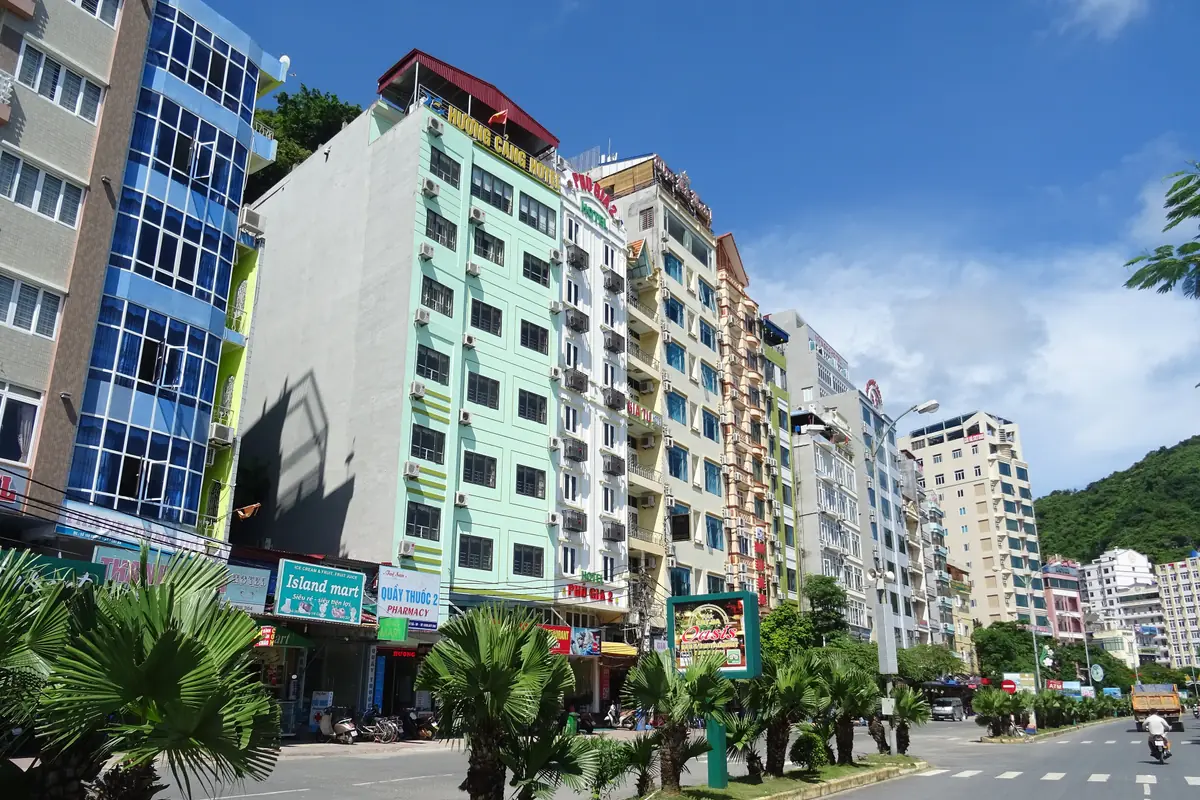
This is the central area, where restaurants, a pharmacy and convenience shops sit a few minutes' walk from the hotels.
You’ve just arrived at Cai Vieng Ferry Terminal, opened Google Maps and realised your hotel in Cat Ba Town is still quite a distance away. It happens to plenty of first-time visitors. Arrange your transfer into town first, then pick transport for each outing by area.
1. Get to know Cat Ba Island before choosing your transport
Cat Ba’s roads follow the coast in places, but they also climb steep hills and wind around mountain bends. Two places that look close together on a map can still be a tiring walk, especially in the midday heat or after a long day at the beach.

First time on the island? These are the main areas worth knowing.
Cat Ba Town is the island’s main tourist centre, with plenty of hotels, restaurants, cafés and scooter rental services. Stay near 1/4 Street or the central waterfront and many places to eat and drink are within walking distance.
Cat Co Beaches are close to town, roughly 1-2 km away depending on which beach you’re visiting and where you’re starting. Electric carts are convenient, although walking is possible if you don’t mind some slopes.
Tung Thu Beach is another relatively accessible beach near town. It’s a good option for a relaxed swim without travelling too far, but check the actual route from your accommodation before setting off.
Cai Beo and Ben Beo Pier are around 2 km from the town centre. You’ll probably come here if you’ve booked a boat trip or need transport to destinations around Lan Ha Bay.
Farther inland are Hospital Cave, Trung Trang Cave, Cat Ba National Park and the northern parts of the island. These trips are better suited to a scooter or car than walking.
Viet Hai Village is the exception. There’s no direct road for cars from Cat Ba Town to the village. You can reach the area by boat from Ben Beo Pier, or via hiking and cycling routes through the national park.
Don’t assume that because a village appears on Google Maps, a taxi can take you all the way there.
2. How to get from Cai Vieng Ferry Terminal to Cat Ba Town
Plan this leg before you arrive, particularly if you’re travelling by ferry or cable car without your own vehicle.
Cai Vieng Ferry Terminal, Gia Luan Ferry Terminal and Phu Long Cable Car Station are all outside Cat Ba Town. You’ll need another ride to reach most hotels.
From Cai Vieng Ferry Terminal
After arriving at Cai Vieng from Dong Bai, you’ll still have approximately 20-25 km to travel to central Cat Ba Town, depending on the route.
Travelling with family, carrying large suitcases or arriving with older relatives? Book a taxi, private transfer or connecting shuttle in advance.
Drivers who’ve brought their own scooter or car across on the ferry can simply continue towards town.
Check where the shuttle actually stops. Some services drop passengers at a central meeting point rather than directly outside their accommodation.
If your hotel is down a smaller lane or part of a secluded resort, confirm the drop-off location before booking.
From Phu Long Cable Car Station
Phu Long Station is approximately 20 km from Cat Ba Town. Reaching the end of the cable car journey still leaves you short of the island’s main accommodation area.
When your ticket or travel package includes a connecting shuttle, check the pickup location, departure time and final stop.
Otherwise, you’ll need to arrange your own transfer.
Travelling with several suitcases? Don’t assume that the small electric passenger carts operating around town will take you directly from the cable car station to your hotel.
From Gia Luan Ferry Terminal
Gia Luan is often used by travellers arriving from the Tuan Chau side of Ha Long Bay.
The ferry terminal is in northern Cat Ba, while Cat Ba Town lies farther south. Expect another road journey of roughly 20 km or more, depending on your destination.
If you’ve arranged a pickup, send the driver your exact arrival terminal and estimated ferry arrival time.
Ferry schedules, unloading time and mobile reception can all affect when you’ll actually meet your driver.
3. Walking around Cat Ba Town: easy if you stay central
In Cat Ba Town, plenty of outings start and end on foot.
Staying centrally makes it easy to walk out for dinner, pick up snacks, visit a café or wander around the waterfront in the evening.
Walking also saves you from finding parking whenever you want to stop somewhere.
That said, some hotels sit uphill from the main streets, and routes towards the beaches can include steep sections, steps and uneven pavements.
To reach Cat Co Beach on foot, check the route to the specific beach you want to visit. Getting there is downhill; coming back is uphill, after a swim, with wet towels and beach bags.
Walking makes the most sense when you’re exploring close to your accommodation, aren’t rushing and only have a light bag.
If you’ve booked an early boat trip, it’s raining or you’re travelling with young children, taking a short ride is often more comfortable.
4. Electric carts in Cat Ba: great for short trips
You’ll see electric passenger carts around Cat Ba Town, particularly on routes serving beaches and other popular tourist areas.
These are small vehicles with drivers, designed to carry passengers on shorter journeys. They’re different from electric scooters that you rent and drive yourself.
A group can ride together without splitting up across several scooters, and carts are particularly handy after a swim when you’re carrying beach bags, sandals and damp towels.
How much do electric carts cost in Cat Ba?
Prices depend on whether you’re taking a shared service or hiring a vehicle for your group.
Some local electric transport services charge around 10,000 VND per person per ride.
Meanwhile, private electric cart services on shorter routes cost approximately 100,000-200,000 VND per trip. Longer bookings and customised journeys may cost more.
These prices refer to different types of services, so don’t assume they are interchangeable.
Before boarding, ask the driver:
"Is the fare per person or for the whole vehicle? Can you drop us at this hotel?"
Also check whether the driver can wait, whether return rides are available and whether there’s enough room for bulky luggage.
Electric carts don’t cover every part of the island. For Cat Ba National Park, Hospital Cave or other distant attractions, a taxi, private car or suitable scooter is usually the better choice.
5. Taxis in Cat Ba: best for luggage and families
Taxis are particularly useful on your arrival and departure days.
Riding a scooter along mountain roads with a suitcase or young children is hard work, and a car drops you right outside the hotel.
Alongside local taxi and private car operators, Green SM provides electric taxi services in Hai Phong. The company changed its name from Xanh SM in April 2026 and uses 1555 as its customer service hotline.
Check the Green SM app to see whether a ride is available at your exact pickup location.
On Cat Ba Island, pickup availability varies from spot to spot. Similarly, don’t assume that other ride-hailing apps, including Be, have reliable coverage across the island.
How to book a taxi without unexpected charges
Booking through an app? Check the estimated fare and make sure both your pickup and destination pins are correct.
For taxis arranged directly through your hotel or a local driver, agree on the total fare before departure.
Planning several stops? Ask about waiting fees, additional stops and how long the driver will remain available.
For example, to visit Cat Ba National Park, stop at Trung Trang Cave and return to town, you could arrange one car for the entire outing.
This saves you from searching for a new taxi at each attraction, but include the driver’s waiting time in your agreement.
Families with babies or young children should mention the number of passengers, suitcases, strollers and any child safety seat requirements in advance.
Child seats aren’t standard in every vehicle, so ask early.
Share a Google Maps pin, and confirm the location by name too.
Sometimes a map pin points towards a side entrance or a road behind your hotel. Where the property has multiple entrances, ask reception which one vehicles can access.
6. Renting a scooter in Cat Ba: freedom with a few responsibilities
Like stopping for a view, finding small cafés and reaching attractions outside town? A rented scooter lets you do all three on your own schedule.
Rental shops are available around the town centre, and many accommodation providers can help arrange a vehicle.
Some businesses will even deliver your scooter to your hotel.
Scooter rental prices in Cat Ba in 2026
Basic manual or semi-automatic motorbikes typically cost around 100,000-150,000 VND per day.
Automatic scooters generally cost approximately 130,000-180,000 VND per day, depending on the model and rental provider.
Some rental businesses advertise higher rates of around 200,000-300,000 VND per day.
Treat these as indicative figures rather than fixed island-wide prices.
Weekend demand, holidays, delivery arrangements and vehicle type can all affect what you’re quoted.
And don’t assume that a "one-day rental" automatically means 24 hours. Some businesses operate on calendar days, while others calculate rental periods from the pickup time.
Can you rent a scooter for half a day?
Some rental shops offer flexible half-day arrangements, while others have a one-day minimum or charge the full daily rate even when you return early.
An electric cart or taxi might be better value for a quick return trip to a nearby beach.
What driving licence do you need?
Check this before handing over a deposit.
Vietnam’s driving licence system changed on 1 January 2025.
Certain low-speed mopeds don’t require a driving licence, but the rider must be at least 16 years old.
To qualify, the vehicle must have a design speed of no more than 50 km/h and either a combustion engine of no more than 50 cc or an electric motor of no more than 4 kW.
Whether a "small scooter" or "electric bike" is licence-exempt depends on its actual specifications, not on what the rental shop calls it.
Driving in Cat Ba with a foreign licence
An International Driving Permit (IDP) issued under the 1968 Vienna Convention on Road Traffic must be carried alongside the corresponding valid national driving licence.
Both documents must be valid, and the licence category must cover the vehicle you’re riding.
An unofficial "international driver’s licence" purchased online without a recognised issuing authority isn’t sufficient.
Vietnam and South Korea also have a bilateral agreement on mutual recognition of international driving permits.
The agreement was signed on 23 June 2023 and took effect on 23 July 2023. It applies to citizens of the two countries, with qualifying Korean IDPs usable in Vietnam for up to one year from the date of entry, alongside a valid corresponding national licence.
What to check before accepting a rental scooter
Before taking the keys, spend a few minutes checking the vehicle and rental agreement.
Ask about the deposit, return time, fuel level and responsibility for damage.
Take photos or a short video of the scooter, including any existing scratches.
Test the front and rear brakes, lights, horn and mirrors. Check the tyres and take a slow test ride somewhere safe before heading onto a busy road.
Make sure the rental provider supplies valid vehicle registration documents and compulsory motor vehicle liability insurance documentation, in a legally acceptable form.
Wear a properly fitted helmet and fasten the strap.
Cat Ba’s mountain roads have plenty of bends and some long downhill sections. Wet conditions can make braking and cornering more difficult.
If you’ve never ridden on steep, winding roads before, Cat Ba probably isn’t the ideal place to learn.
And never ride after drinking alcohol, even if your hotel is only a short distance away.
7. Cycling in Cat Ba: beautiful, but choose your route
Some stretches of Cat Ba suit a relaxed bike ride; others are hard going for a casual rider.
Gentle morning rides work best on shorter routes around your accommodation, preferably on roads with manageable gradients.

Ask your hotel whether bicycles are available to rent or borrow.
Before heading out, check the brakes, tyres, saddle and lights if you’ll be riding later in the day.
Bring drinking water and look at the elevation of your route, not just the distance.
A 5 km route with steep climbs can feel much more demanding than a longer ride on flat ground.
For mountain roads and forest routes, consider your fitness and experience.
A pleasant downhill ride can also mean a challenging climb on the way back.
Viet Hai Village is a particularly appealing place to explore by bicycle once you’ve reached the area.
The village isn’t connected to Cat Ba Town by a regular road for cars, though. Anyone approaching it via national park trails should research the route and current conditions rather than simply following a map into the forest.
8. Is Cat Ba Island stroller-friendly?
You can certainly bring a stroller to Cat Ba, but how convenient it feels will depend on your accommodation and daily plans.
Some sections of the town centre are manageable with a stroller.
However, steps, steep hotel entrances, uneven pavements and routes down to the beaches can make moving around more tiring than expected.
For families with babies or toddlers, the easiest setup is staying close to restaurants and shops, walking only shorter distances and using taxis for longer journeys.
Electric carts can also be convenient around town, but check whether there’s room for a folded stroller and how safely you can board.
When booking accommodation, don’t just ask whether the hotel has a lift.
Also check whether there are steps between the road and reception, whether cars can stop outside the entrance and whether reaching the nearest beach involves a staircase.
A large stroller and several bags call for suitable vehicle transport from the ferry terminal or cable car station.
It’s much easier than trying to find a ride while carrying everything in the heat.
9. What to do if you leave something in a taxi or electric cart
Left your phone, handbag or jacket in a vehicle? Contact the driver or transport company as soon as possible.
Booked through an app? Open your trip history and look for the driver’s details or the lost-property support option.
For Green SM, the customer service number is 1555.
If you booked a local taxi or electric cart directly, call the number on your receipt or contact the operator.
Hotel-booked rides are often easiest to trace through reception, so start there.
When reporting a missing item, provide the approximate pickup time, pickup and drop-off locations, vehicle registration number if available, and a clear description of what you’ve lost.
A quick photo of the vehicle or a saved driver’s phone number can make tracking down your belongings much easier.
Valuable items are a different matter: if you can’t reach the transport provider or suspect the property is being deliberately withheld, you can ask local police for assistance.
Before getting out, check the seat and floor around you.
10. Which transport should you choose for your Cat Ba trip?
On a one- or two-day stay, it’s fine to mix and match rather than using the same type of transport for your entire visit.
For couples staying in Cat Ba Town: Walking and electric carts are usually enough for restaurants, cafés and nearby beaches. Consider a scooter if you want to explore farther and have the correct licence and experience.
For families with young children or older relatives: Taxis and private cars are the more comfortable option for ferry transfers and longer sightseeing trips. Walking and electric carts work well for shorter journeys around town.
Groups of friends visiting several attractions: Renting scooters or arranging a private car can both work. If you choose a car, agree on the waiting time and return pickup arrangements in advance.
For travellers carrying large suitcases: Go directly to your accommodation, leave your luggage and explore afterwards. Trying to combine your ferry transfer with multiple sightseeing stops usually creates more hassle than it’s worth.
Choose the right transport for each outing and confirm your pickup and drop-off points, and you’ll spend far less time worrying about how to get around.
Frequently asked questions
Do I need to rent a scooter in Cat Ba?
No. If you're staying in central Cat Ba Town and mostly visiting restaurants and nearby beaches, walking, electric carts and taxis can cover your needs. A scooter is more useful for independent trips farther around the island, provided you're legally licensed and comfortable riding on hilly roads.
Can I rent a scooter in Cat Ba for half a day?
Possibly, depending on the rental business. Some offer flexible half-day rentals, while others charge a full-day rate regardless of when you return. Confirm the total cost and return time before accepting the vehicle.
Can I walk from Cai Vieng Ferry Terminal to Cat Ba Town?
It's not recommended. Cai Vieng is approximately 20-25 km from central Cat Ba Town, depending on the route. Arrange a shuttle, taxi or private transfer, or continue with your own vehicle if you've brought one on the ferry.
Do electric carts go to Cat Ba National Park?
Electric passenger carts generally operate on shorter routes within their service areas, particularly around town. Don't assume that local electric carts serve the national park. For longer journeys, consider a taxi, private car or legally suitable scooter.
Should I send my driver a Google Maps location pin?
Yes, especially when travelling from Cai Vieng, Gia Luan or Phu Long Station to your accommodation. Share the pin and hotel name, then confirm which entrance the driver should use. This is particularly helpful for resorts and properties with multiple access points.